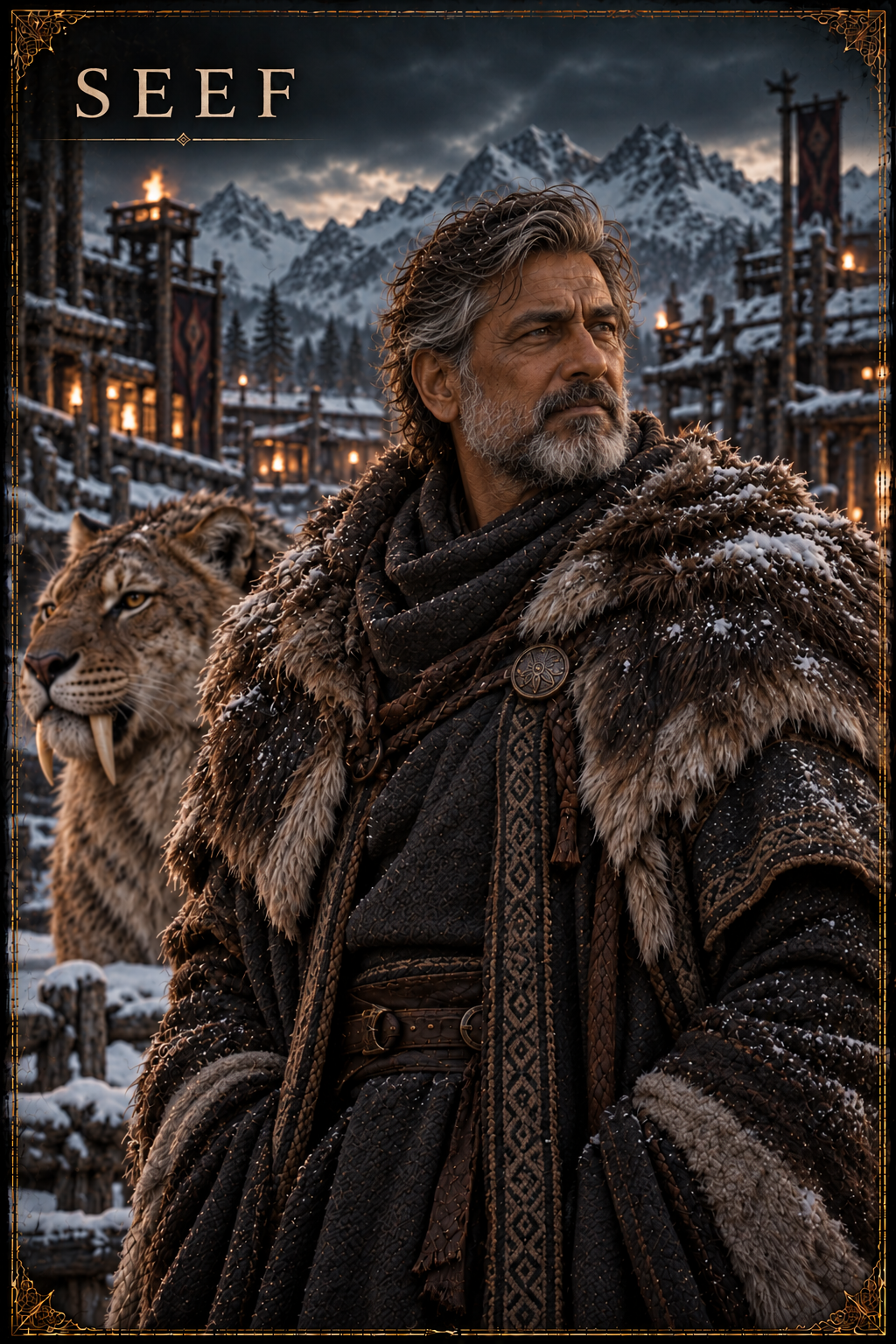
Seef
Chief · political and military leader
Leads the expedition into the White Wastes, then turns back to defend the settlement. Later, he raises Tooze, whom he found as a cub.
Glad you stopped by!
This story is a fan project created out of love for the WhiteOutSurvival universe.
All rights to the protected characters, locations, and original storyline belong to Century Games.
My contributions are limited to my original characters and the development of this specific story. This publication is not intended for any commercial purpose.
I’m really looking forward to your comments and feedback! Enjoy reading!

From survival to civilization. The Chronicle of the Winterland.
Explore Stories 01–48Halloween SpecialNFD internalThe story of the Kingdom of NFD. And its people.
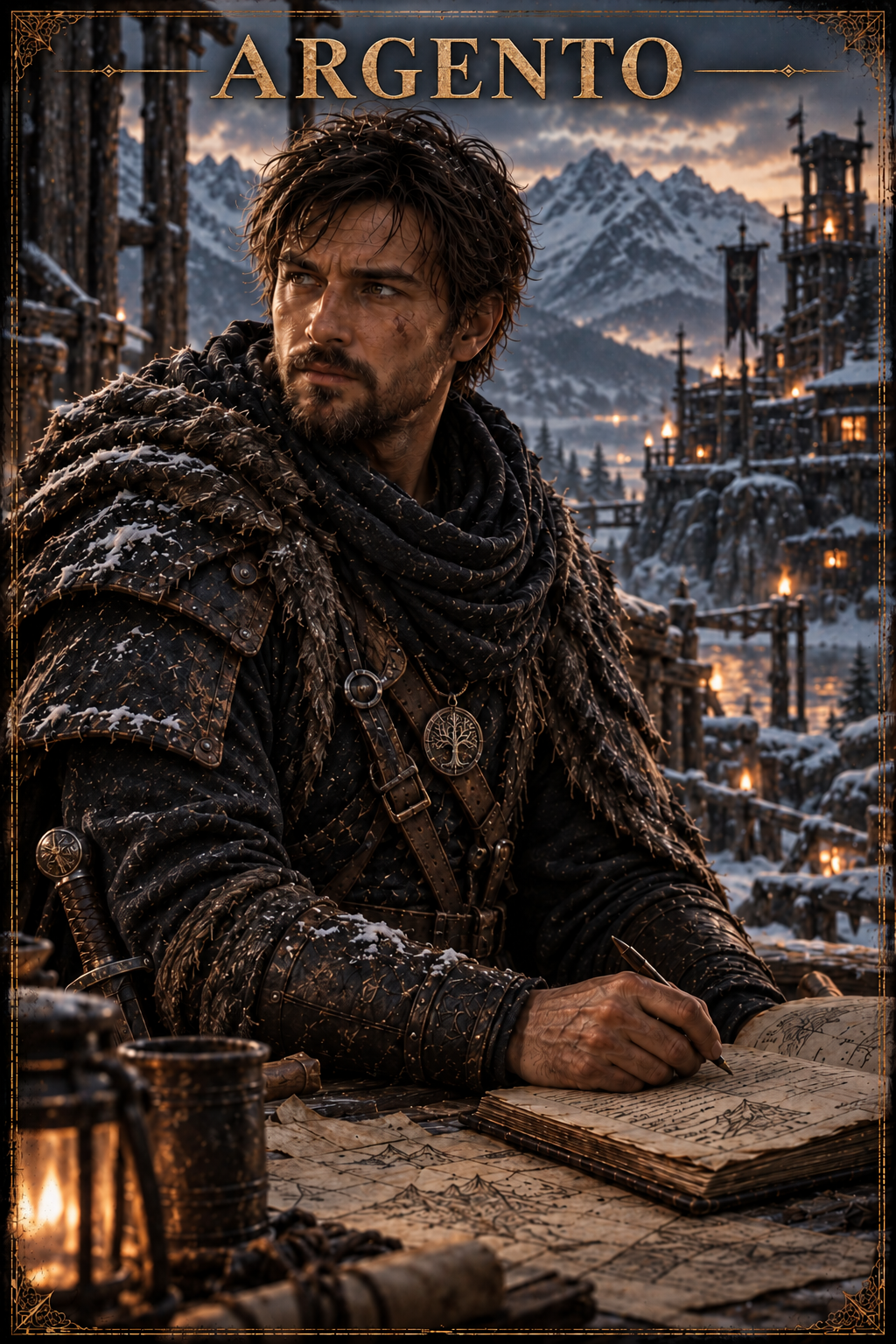
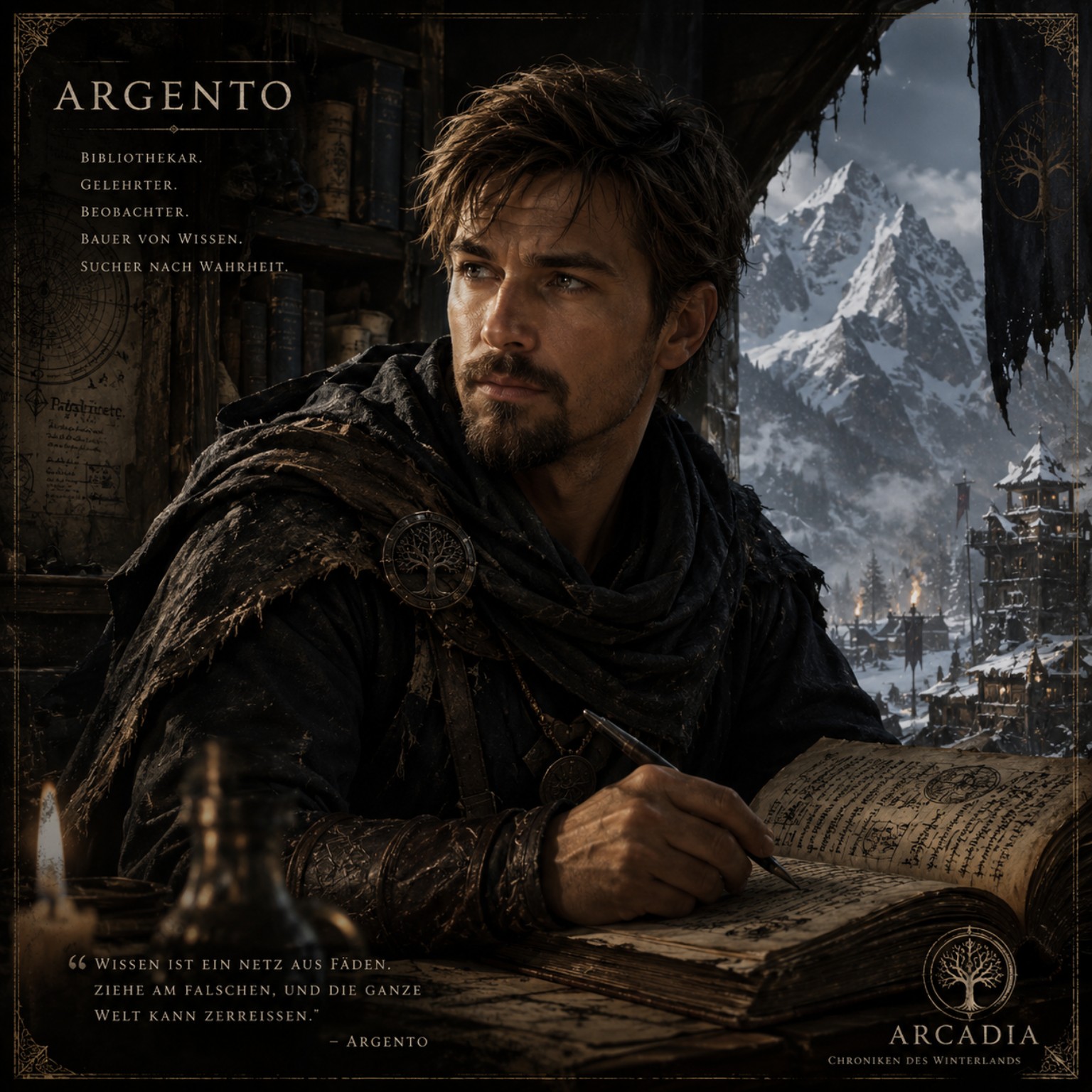
Chronicler · Librarian · Scholar · Strategist
Preserves knowledge, sees connections, and searches for the truth.
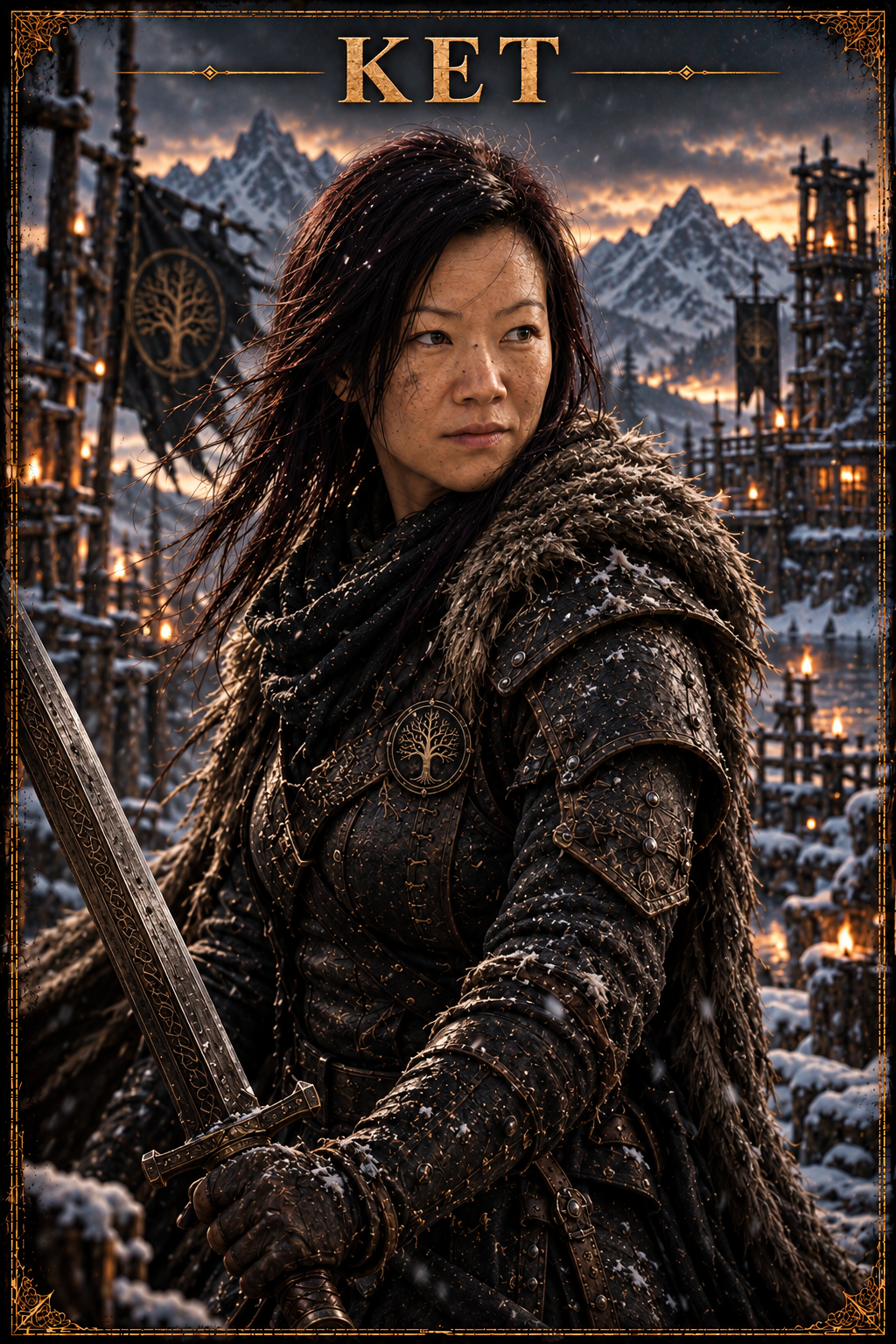
Infantry Leader · Strategist · Hunter
She leads to protect. She fights for NFD and the unity of its community.
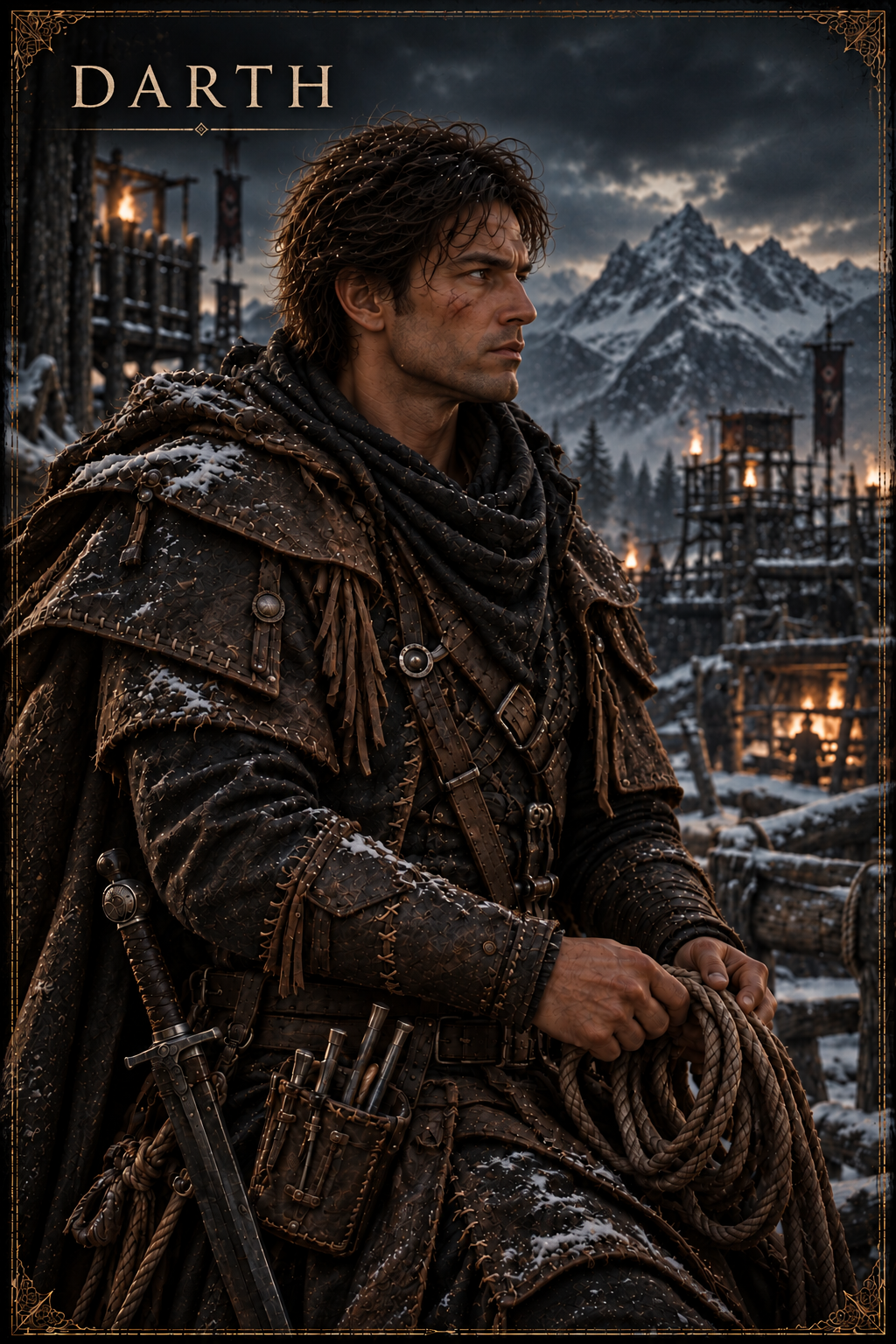
Fighter · Trap Planner · Improvisational Tactician
He thinks faster than any plan. When NFD must be defended, he uses the terrain, traps, and sheer resolve.
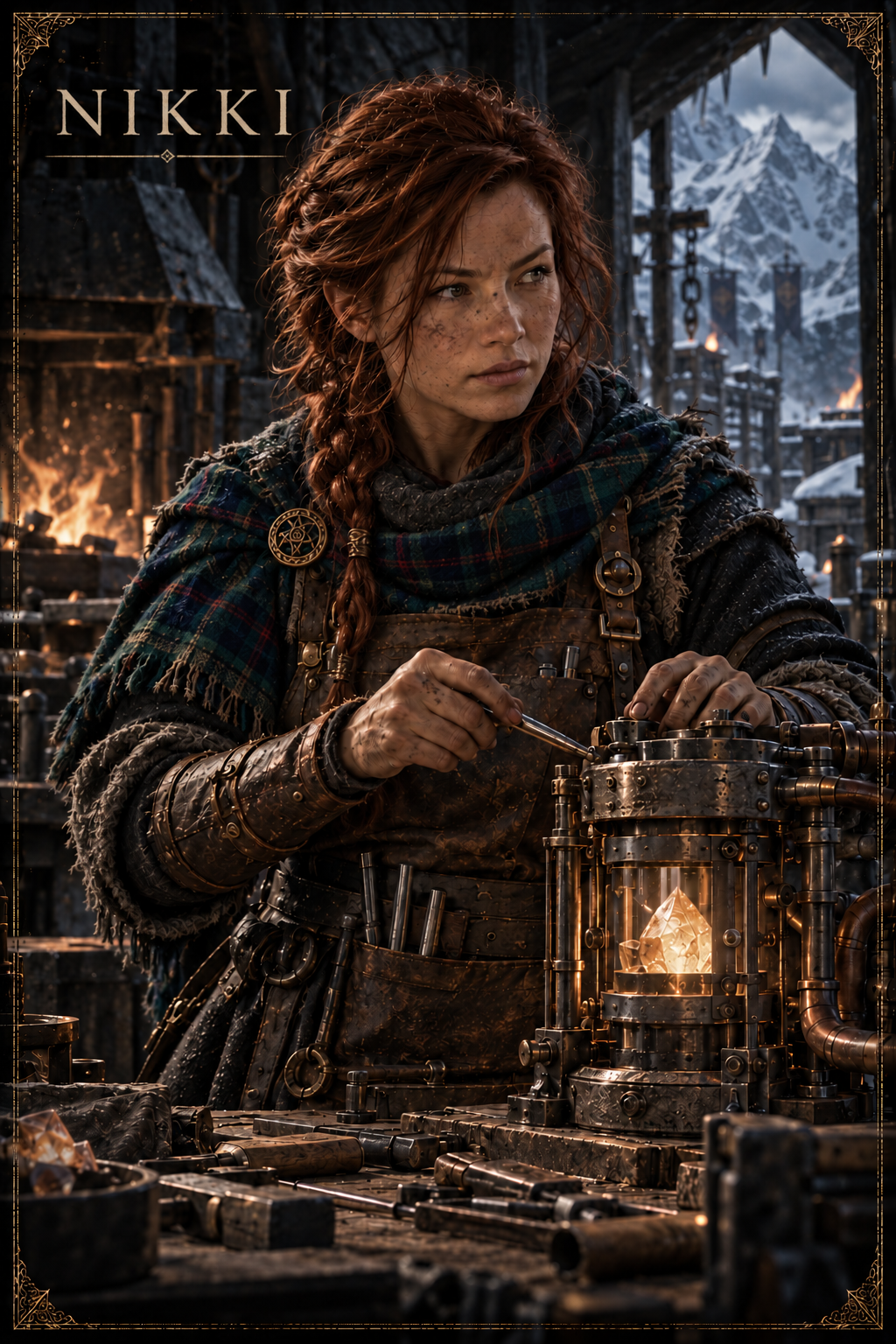
Technician · Engineer · Builder
Keeps the workshop and forge running. She turns fire crystals into reliable heat and ideas into useful technology.
The People from the Stories
Chief · political and military leader
Leads the expedition into the White Wastes, then turns back to defend the settlement. Later, he raises Tooze, whom he found as a cub.
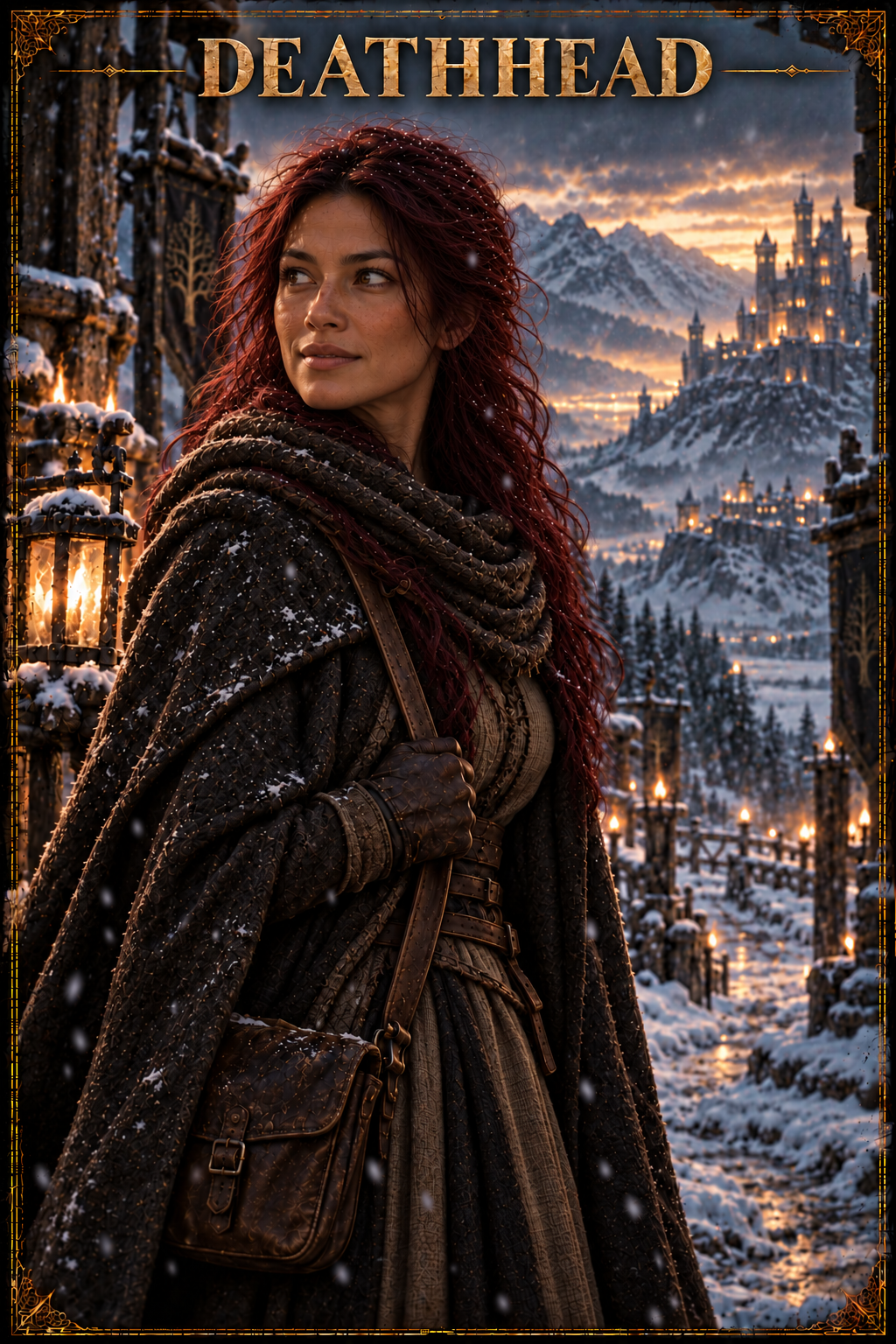
Fighter · Infiltration · Covert Operations
An independent fighter and operations specialist. She infiltrates Sunfire Castle as Mara for two winters and returns changed.
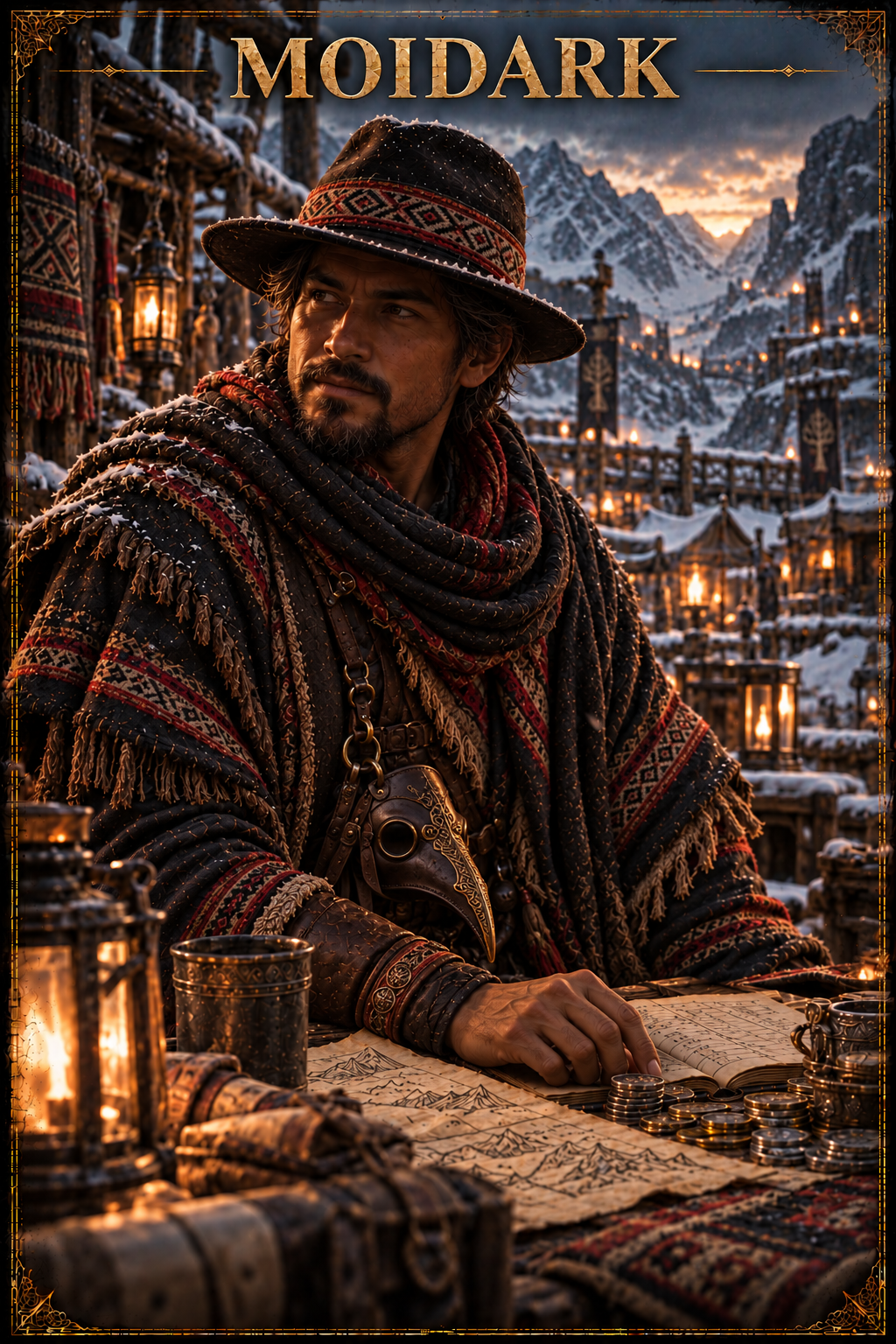
Merchant · Intelligence Gatherer · Strategist
He turns trade routes, logistics, and careful observation into a network for reliable intelligence.
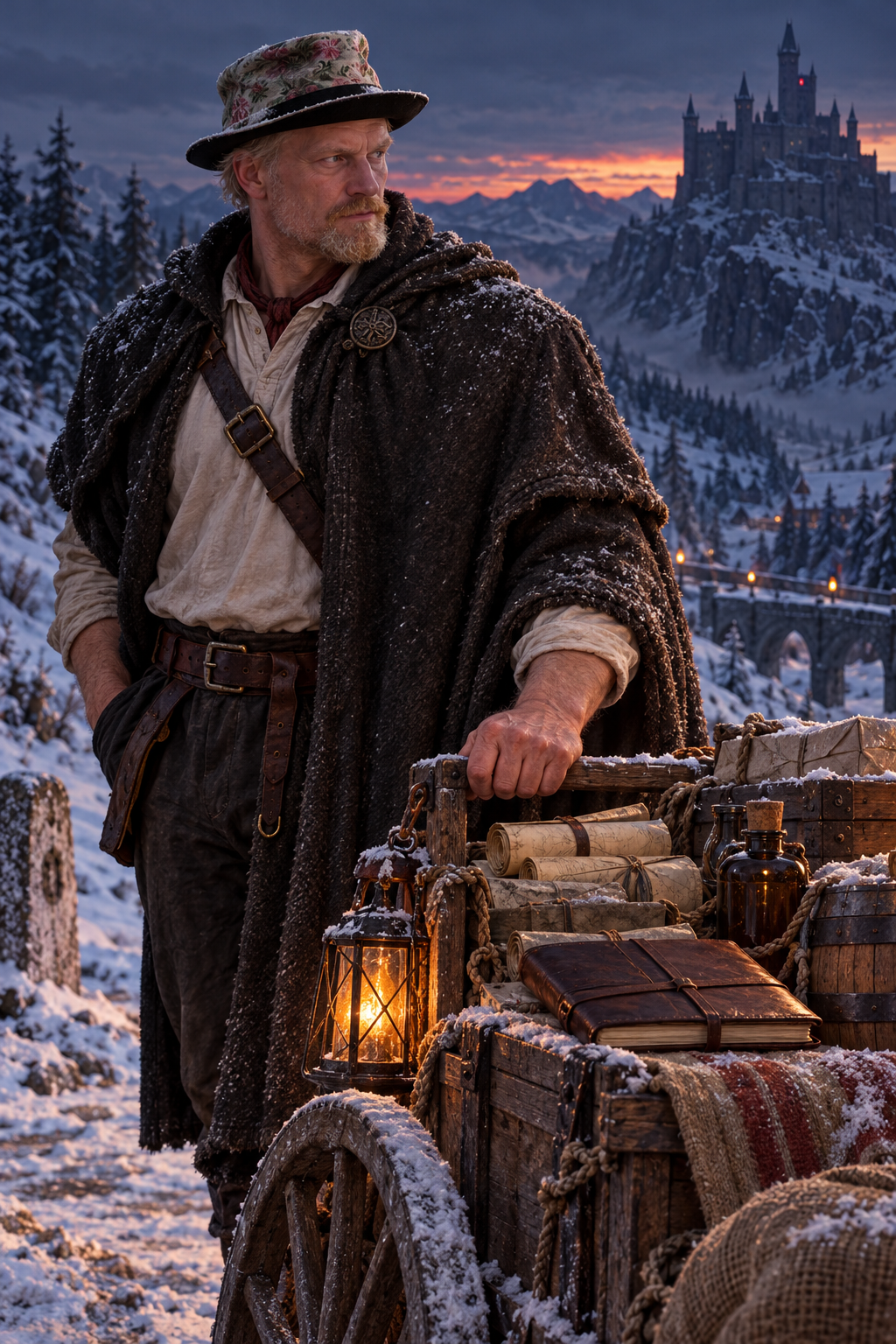
Merchant · Longtime Trade Contact
About two metres tall and powerfully built. His ledger helps Moidark identify purchases made under false identities. On his route near Sunfire Castle, he only checks the red candle signal from a distance; he carries no messages.
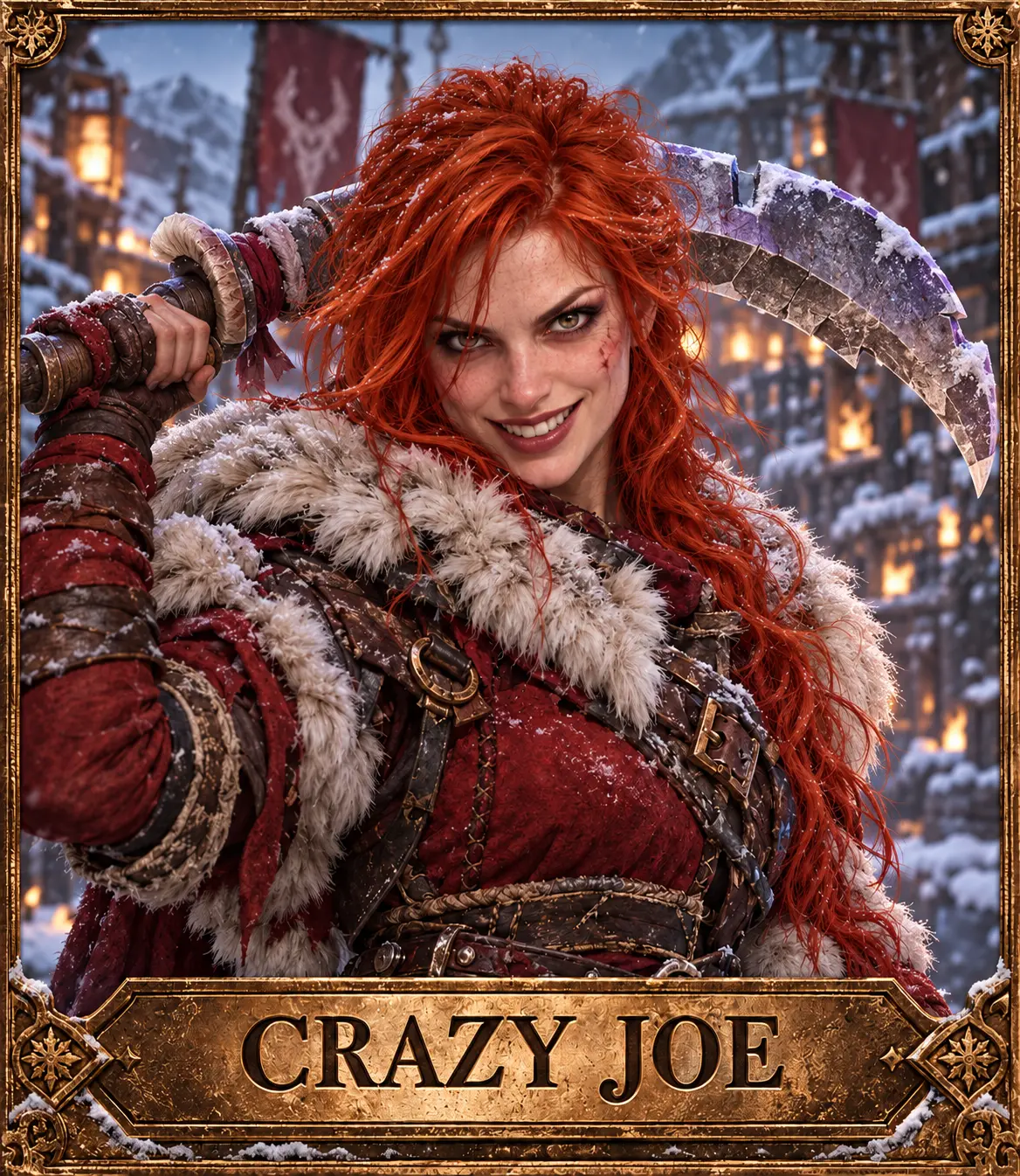
Pirate Queen · Leader of a Raider Army
Leads the attack on the Tundra Trading Post with a flaming chain flail. Badly wounded, she escapes; her campaign is not over.
Chronicle43
Archer · Former Blast-Furnace Worker
Recognizes Christal Meth as a crystal-related threat. His sabotage is later confirmed during the Furnace conflict.
Spearman · Hunter · Trainer
Leads the retreat to the settlement when it comes under attack. In the fight against the enormous bear, he finds a weak spot and kills it.
Fighter · Keen Bettor
He is documented as a fighter in the Loki conflict and in the defence of Winterland. Betting and gambling are his recurring running gag.
Trap Expert · Defender · Observer
He tests traps for how they work, not for their legends. In the White Wastes, he calls for more reliable defenses and considers the bears’ origin unresolved.
Naturalist · Forest Knowledge
Asha supports the community with her knowledge of nature and the forest. Further details of her life have not yet been established.
Chronicle29
Cook · Improvisational Defender
Kat defends the settlement with whatever is at hand—including a pot of hot broth against attacking bears.
Chronicle29
Recruit · Fighter · Tactician
After her home is destroyed, Seef recognizes her potential. Deathhead, Ket, and Argento train her in spear, bow, sword, and infantry tactics.
Fighter · Tactical Observer
During the hunt for Loki, Cabai spots exploitable weaknesses and helps shape the group’s tactics through careful observation.
Chronicle20
Archer · Field Fighter
Her accuracy proves crucial in the battle against Loki. Later, she is again documented as an experienced archer.
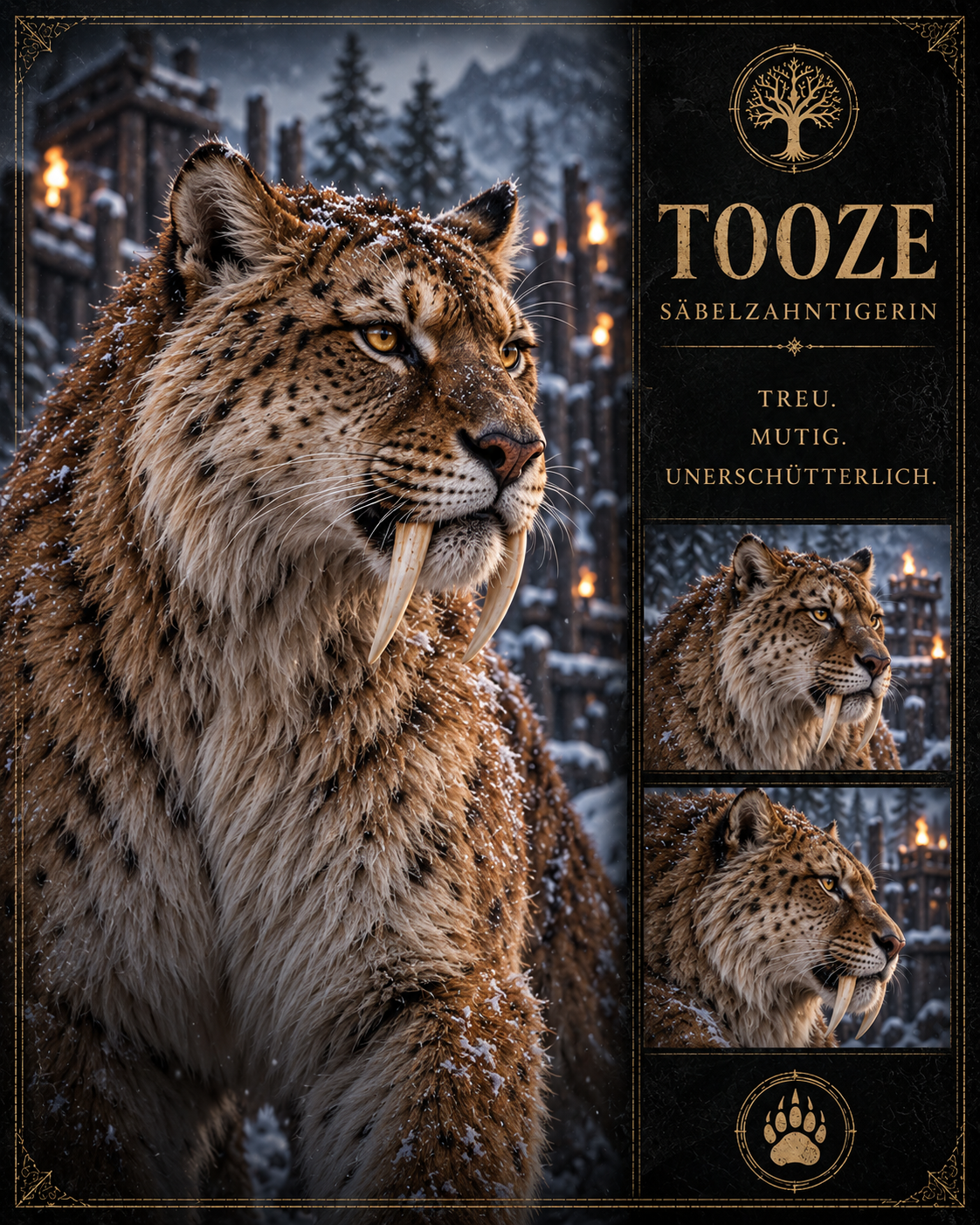
Sabertooth Tiger · Seef’s Companion
Seef finds Tooze as a cub and raises her. She fights at his side against the Great White Bears and kills their matriarch.
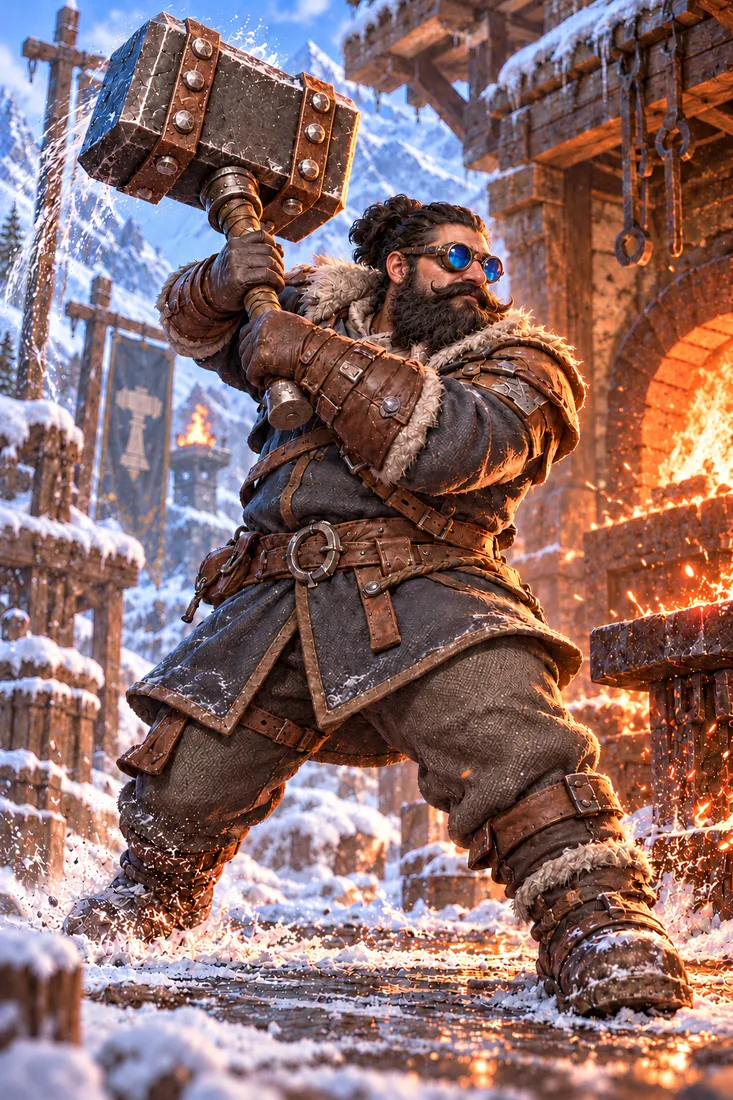
A blacksmith and master weaponsmith, Smith crafts custom blades and firearms. His feel for metal has earned him customers across the wilderness.
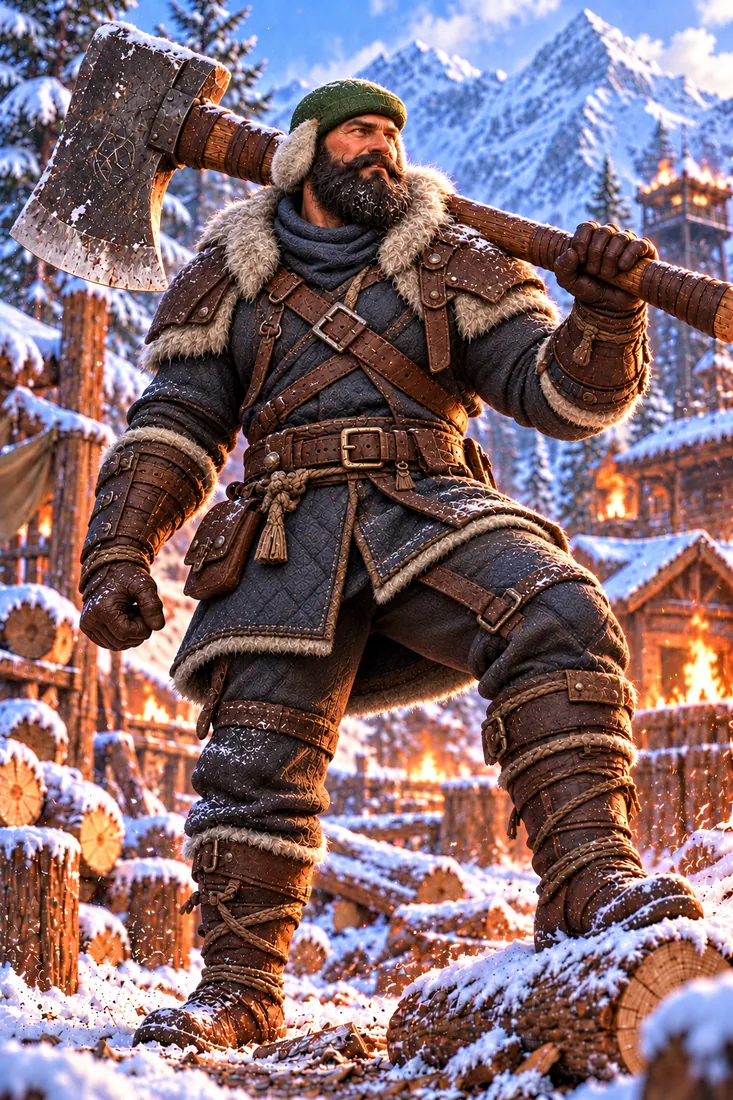
Eugene loves working as a lumberjack and takes his axe into battle. He dislikes standing still almost as much as he dislikes modern chainsaws.
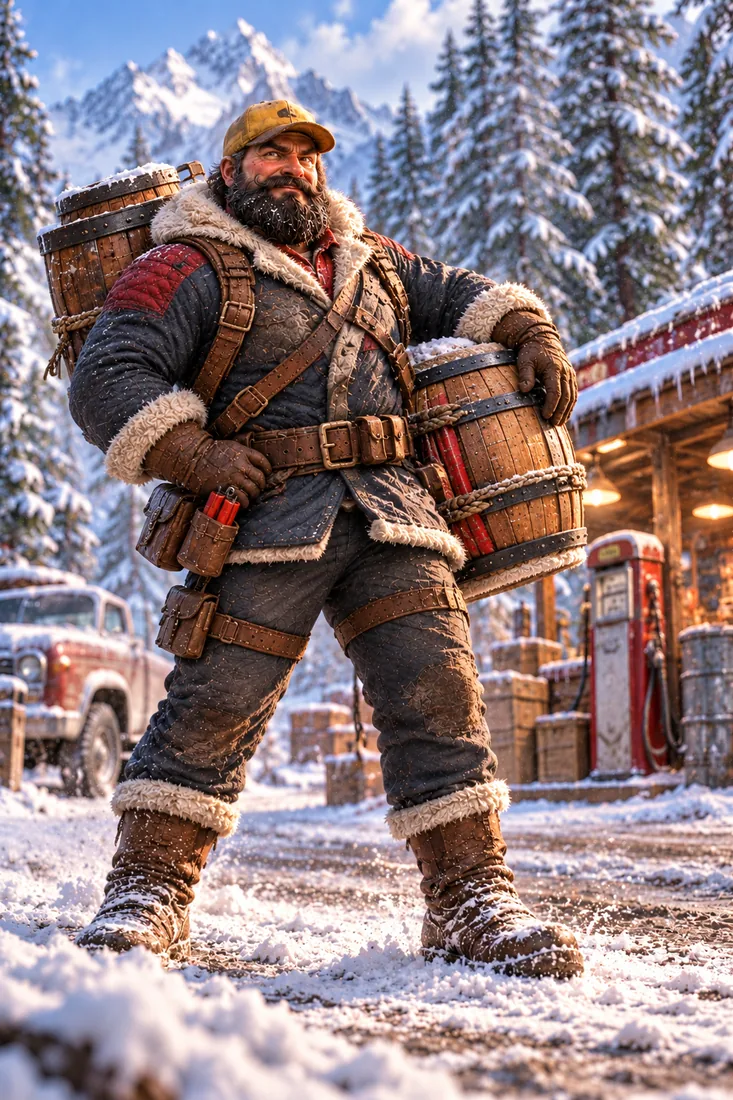
The loud explosives expert helps with coal mining and fights with grenades. Behind his rough voice is a generous, attentive man.
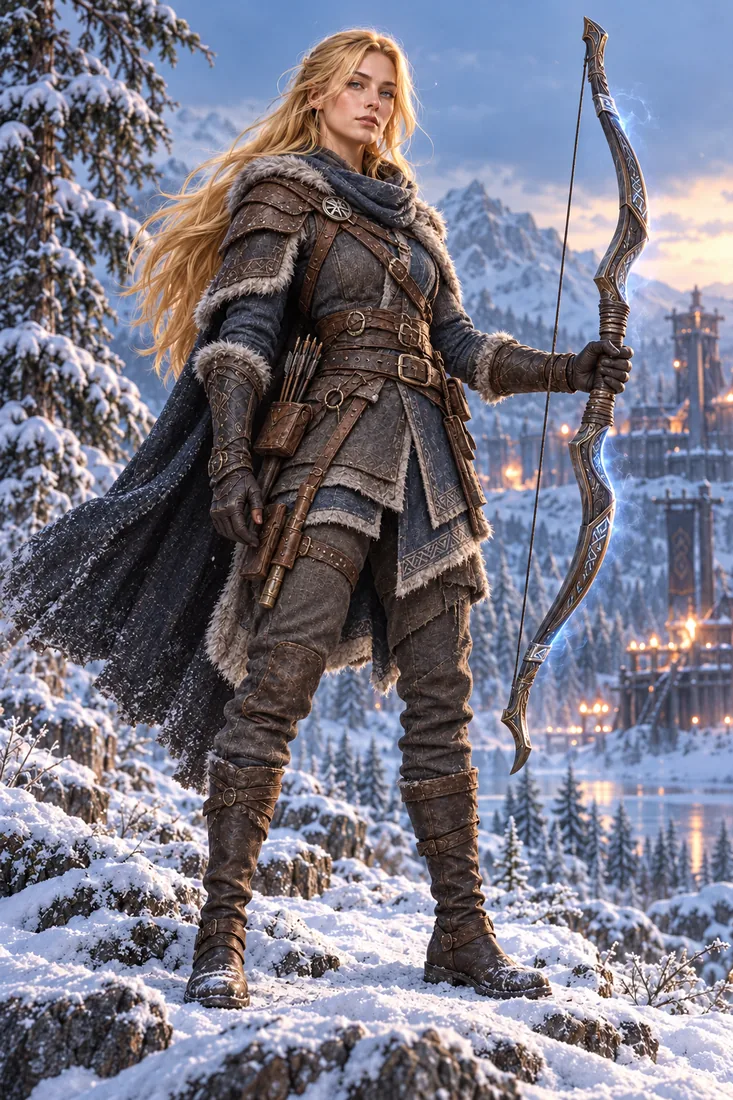
Cloris grew up in the forest, learning to hunt and live off the land. Her survival skills and keen sense for nature make her an accomplished scout.
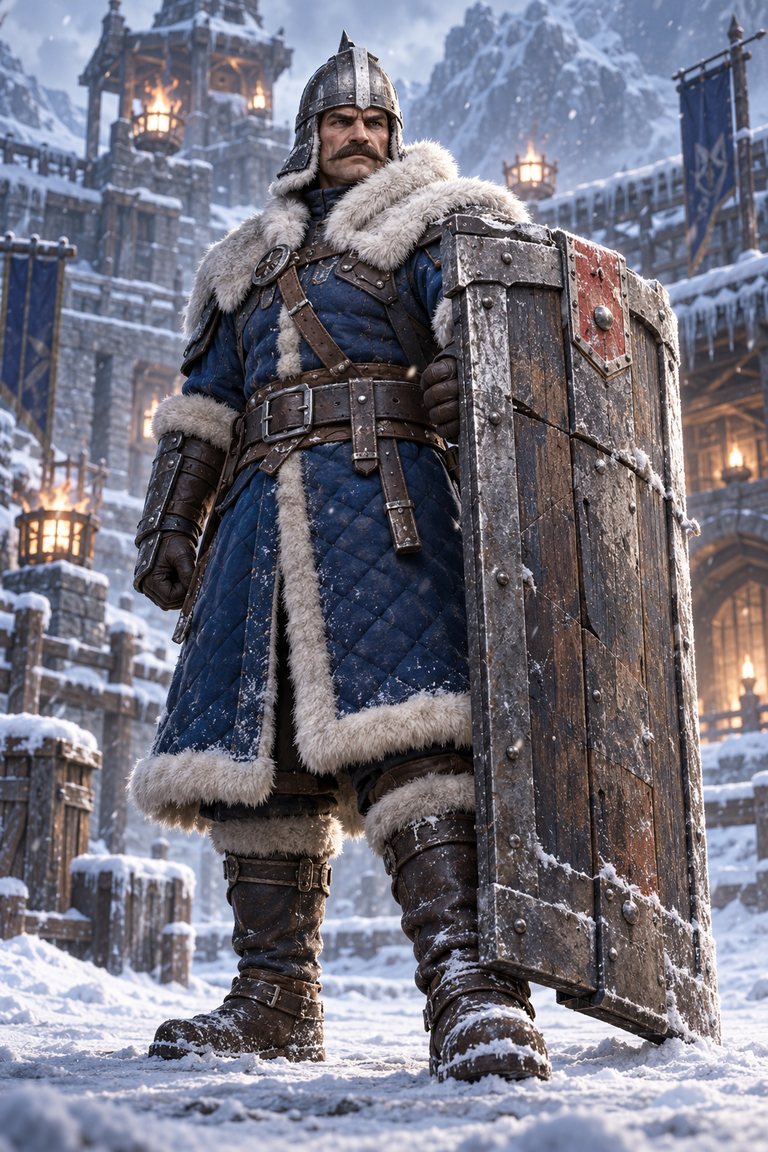
A disciplined veteran of the Royal Solaris Guard, Sergey protects cities from the Tundra’s dangers and brings his military experience to the Dawn Alliance.
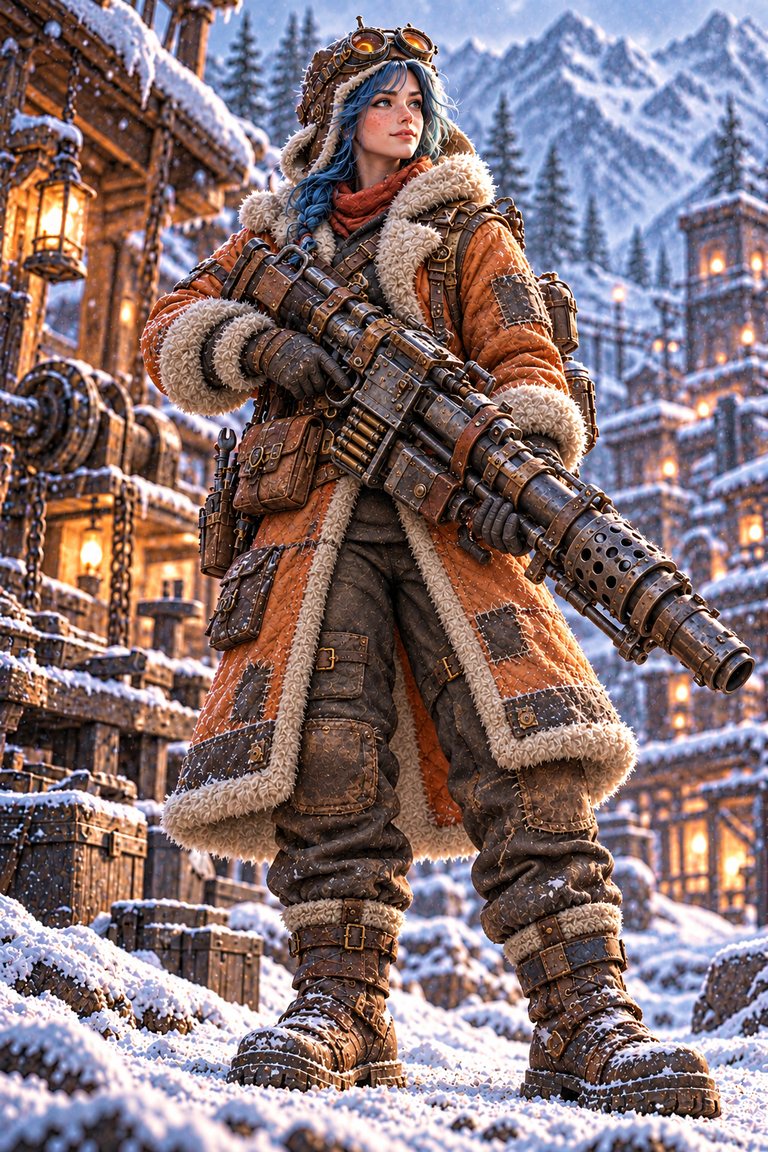
Inventor Jessie makes settlement life easier with her machines. When fellow survivors are threatened, she defends them herself with heavy weaponry.
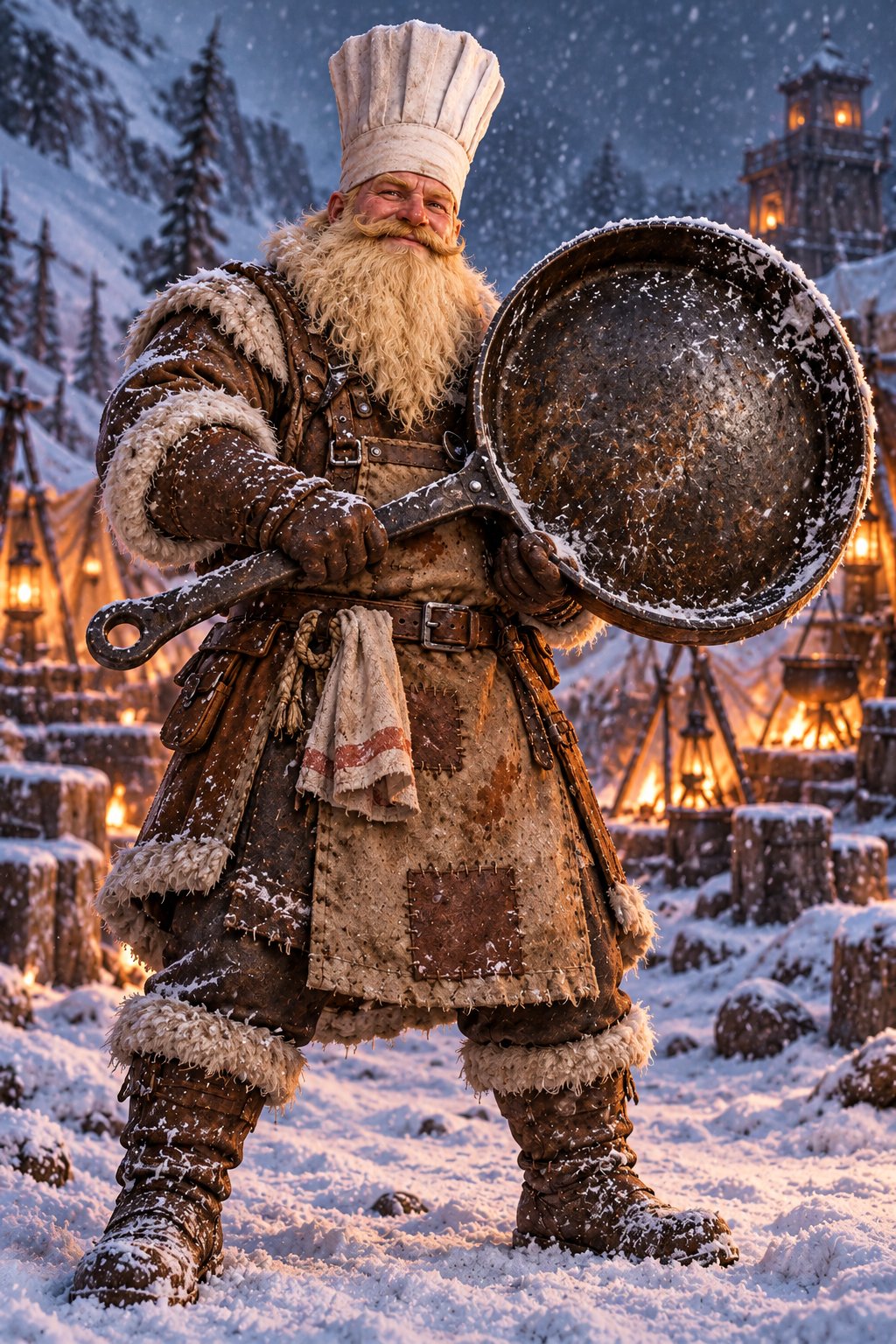
Former master chef of Sunfire Castle, Patrick lifts spirits with inventive meals. In the kitchen and in battle, he relies on a lifetime of skill with knives.
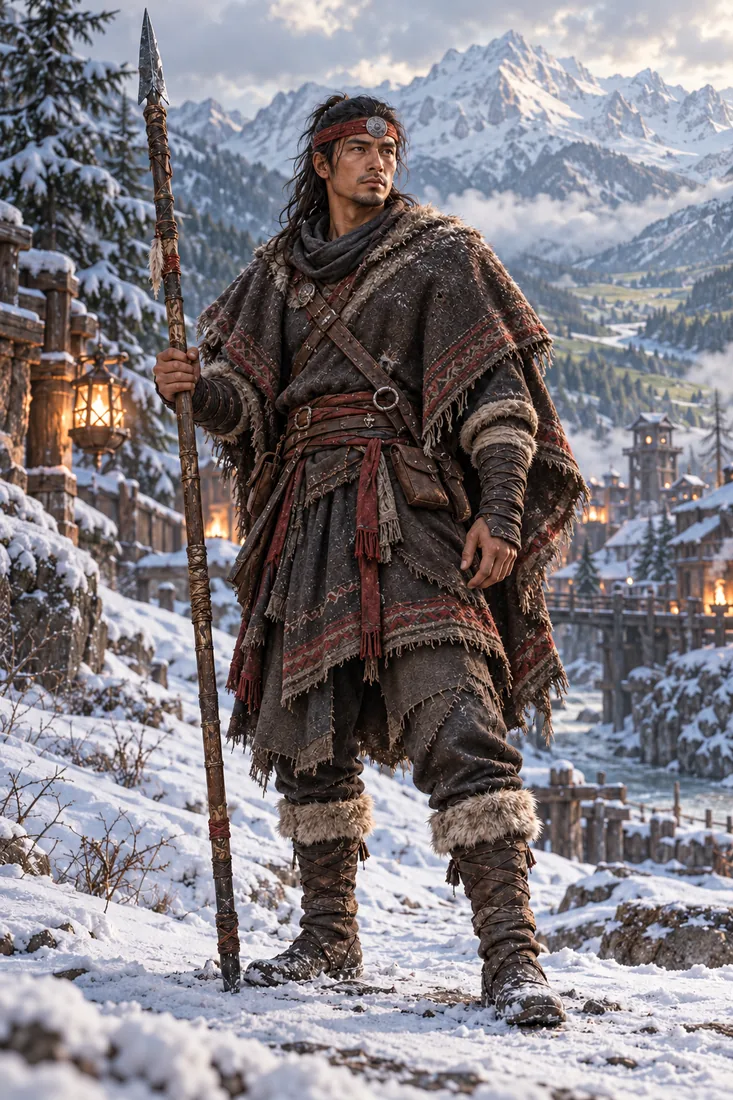
A warrior from the secluded Emerald Valley, Lumak fights the creeping frost threatening his homeland and the Phaethon forces invading it.
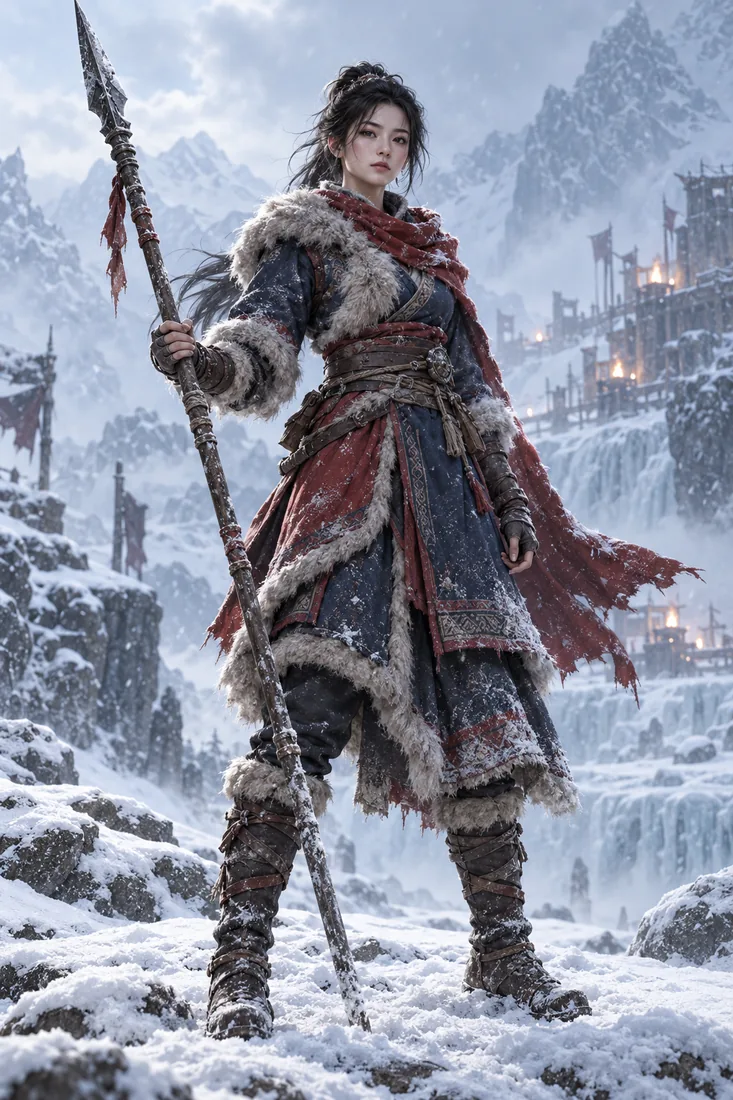
Ling Xue leads the Iron Eagles. Her elite legion favors direct engagements and precise strikes at the heart of the enemy.
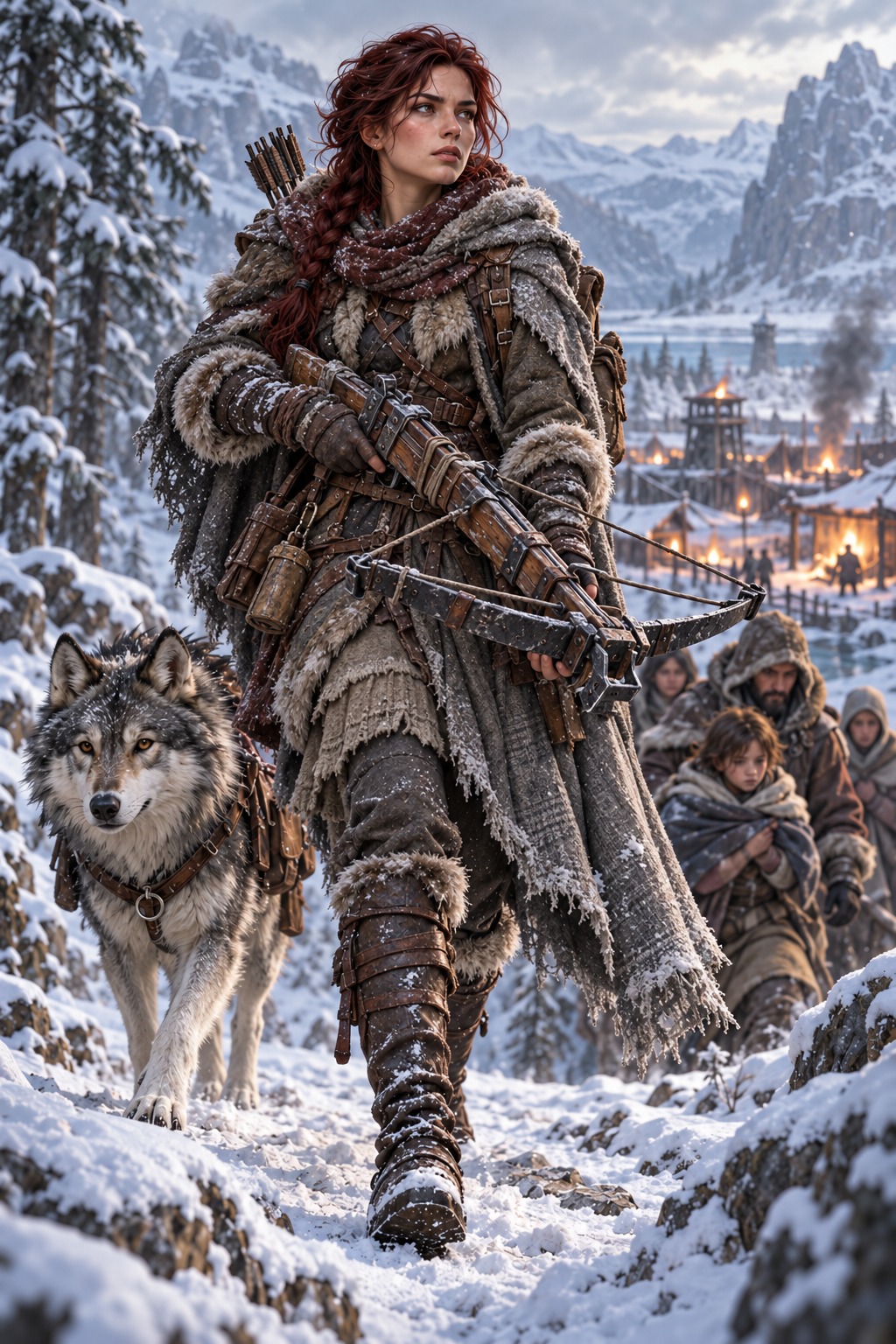
Feared mercenary leader Gina fights with explosive arrows and swift flanking attacks. Her Eagles live by one rule: discipline is strength.
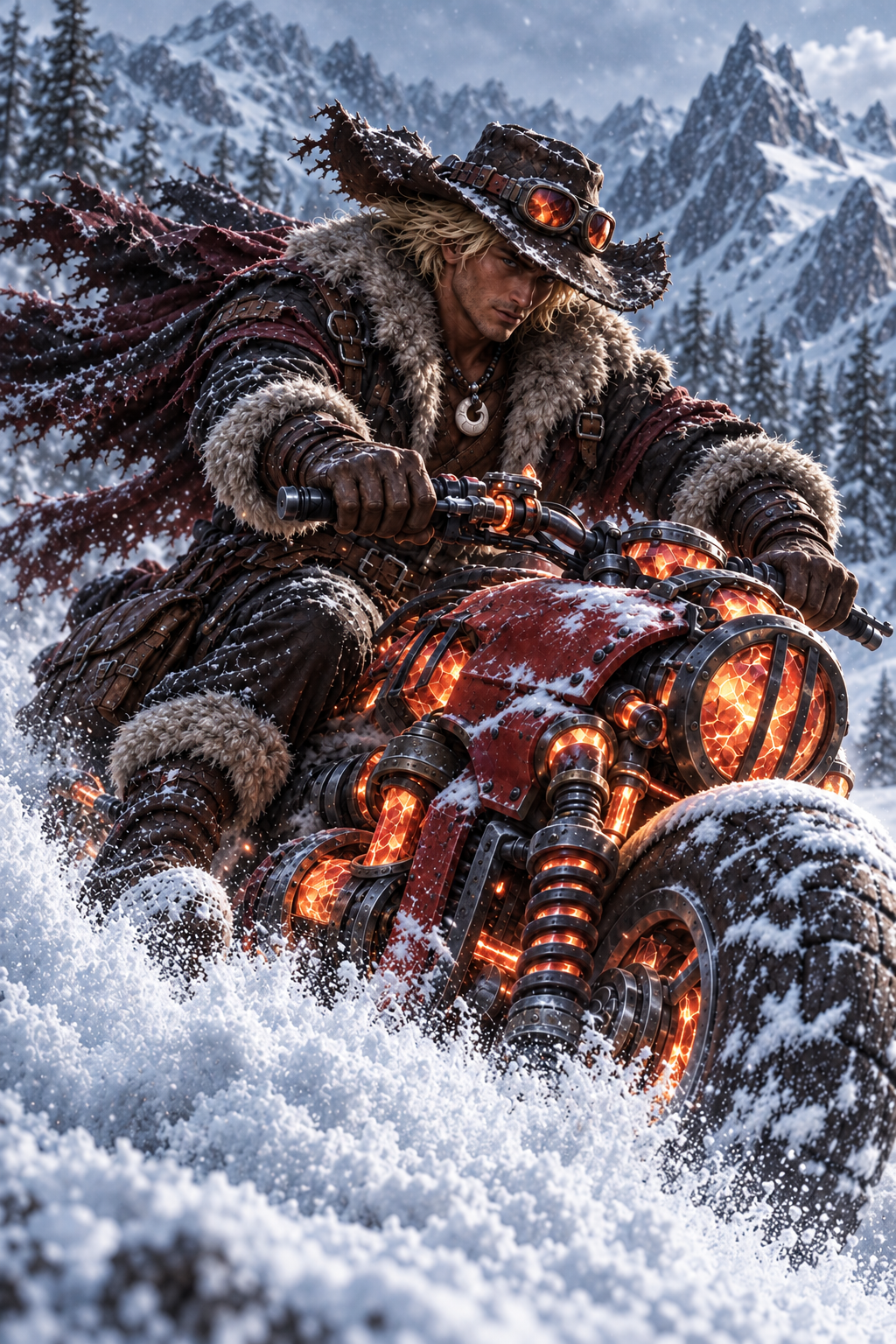
Bahiti’s mammoth-drawn carriage brings supplies and hope to remote settlements. A capable marksman, he represents the Dawn Alliance’s ideals.
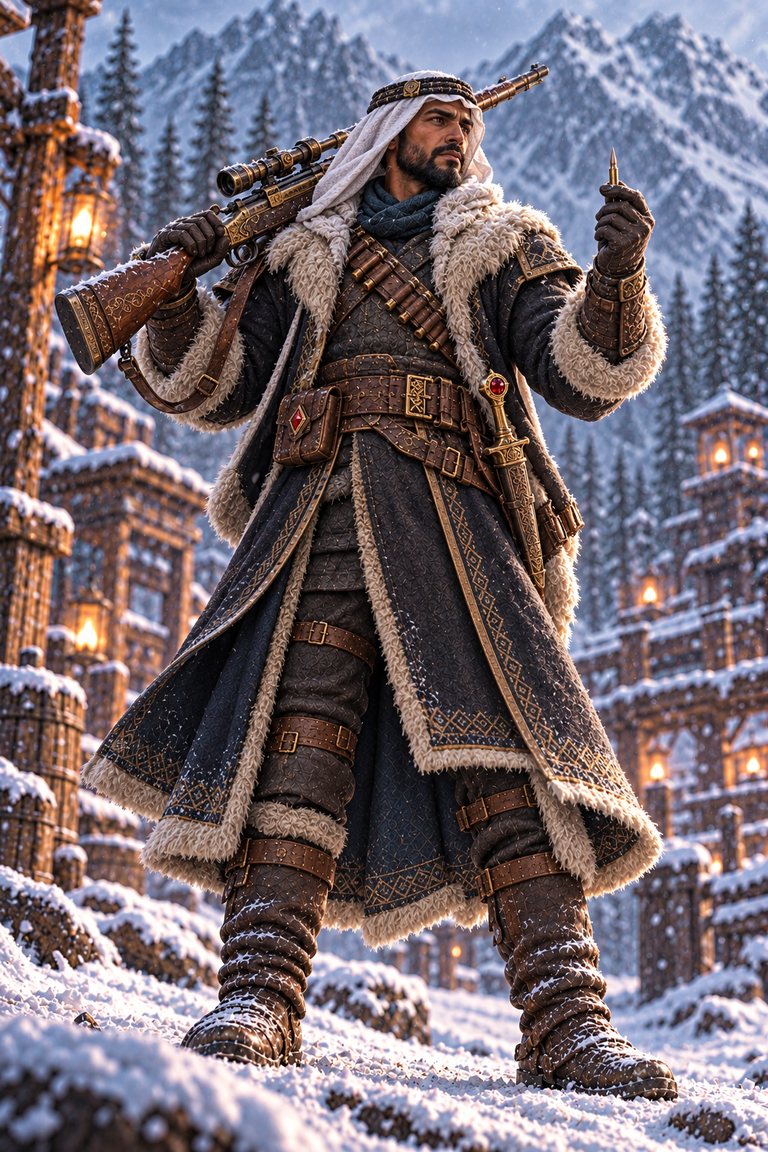
An independent scholar, tinkerer, and sharpshooter, Jasser travels the Tundra gathering knowledge and searching for a way to heal the world.
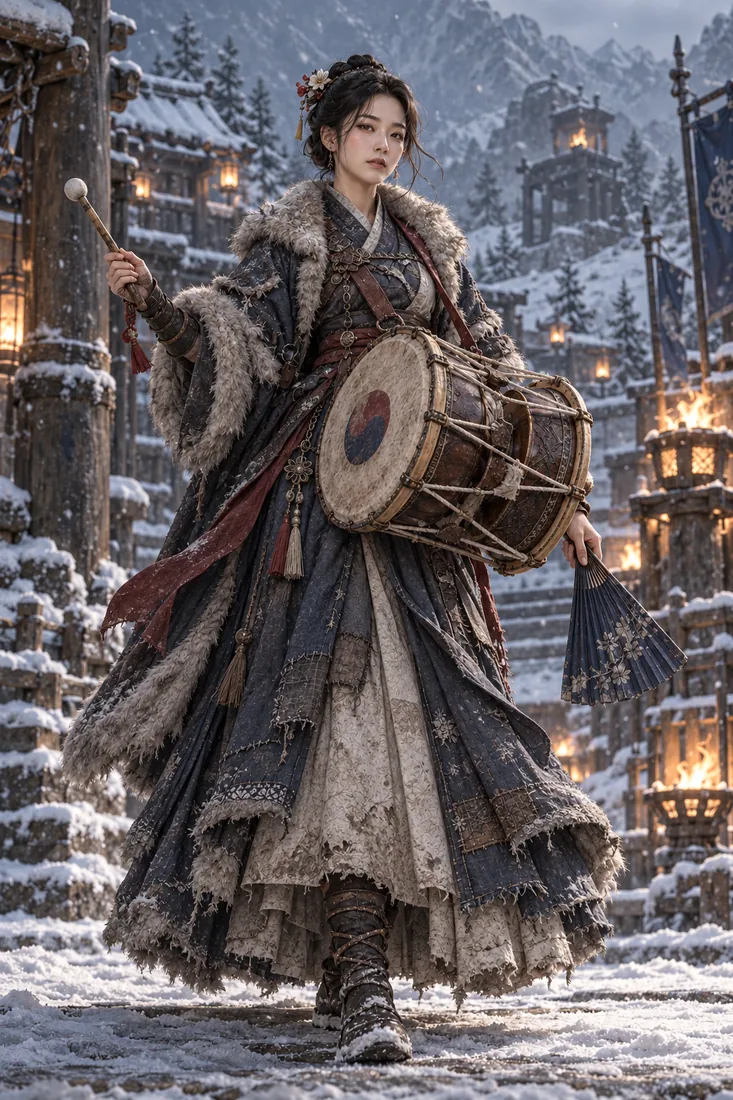
Seo-yoon travels from settlement to settlement with her troupe, bringing music and hope. When danger comes, she fights to protect her companions.
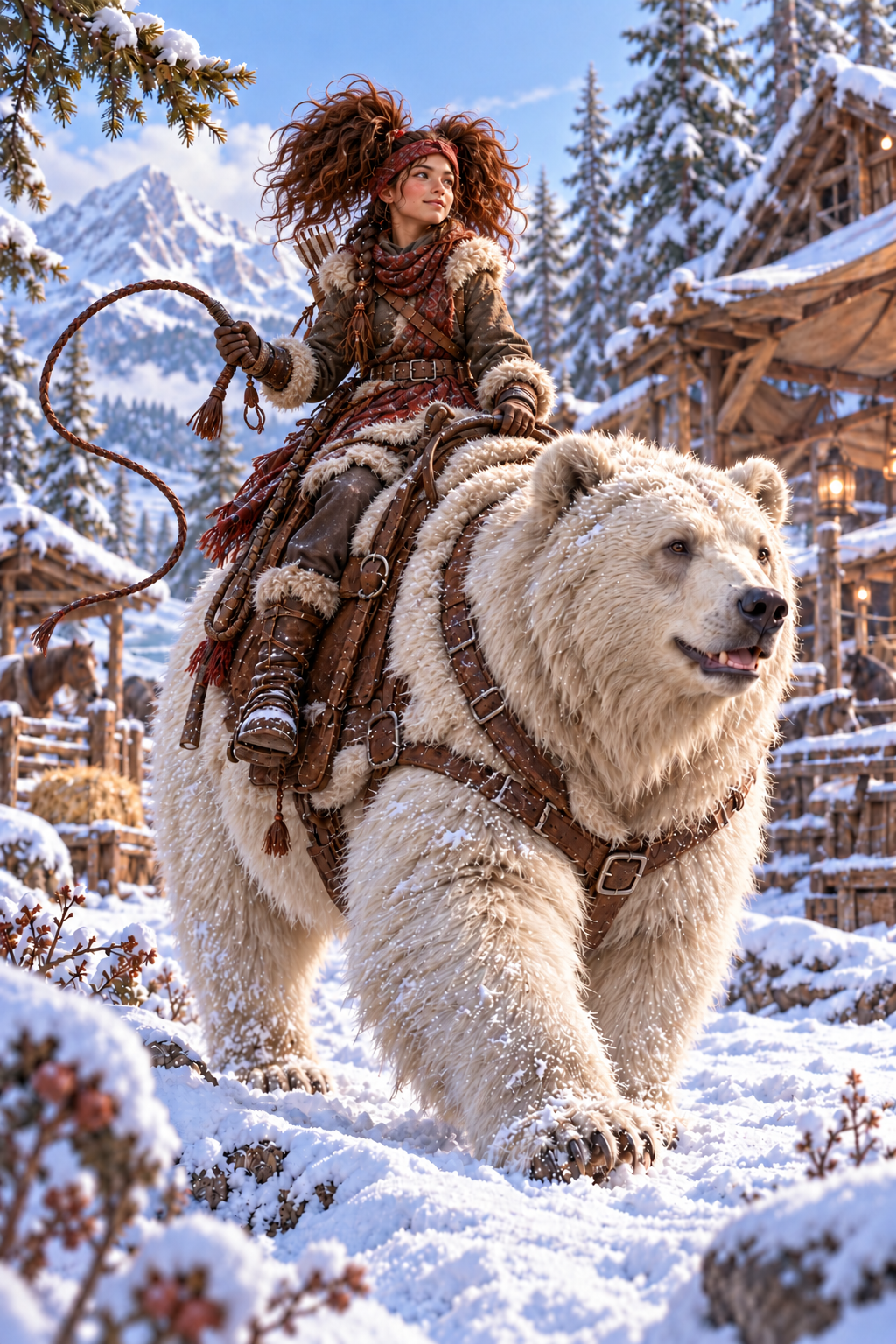
Young naturalist Natalia studies flora, fauna, geology, and astronomy. Her most remarkable gift is her ability to communicate with wild animals.
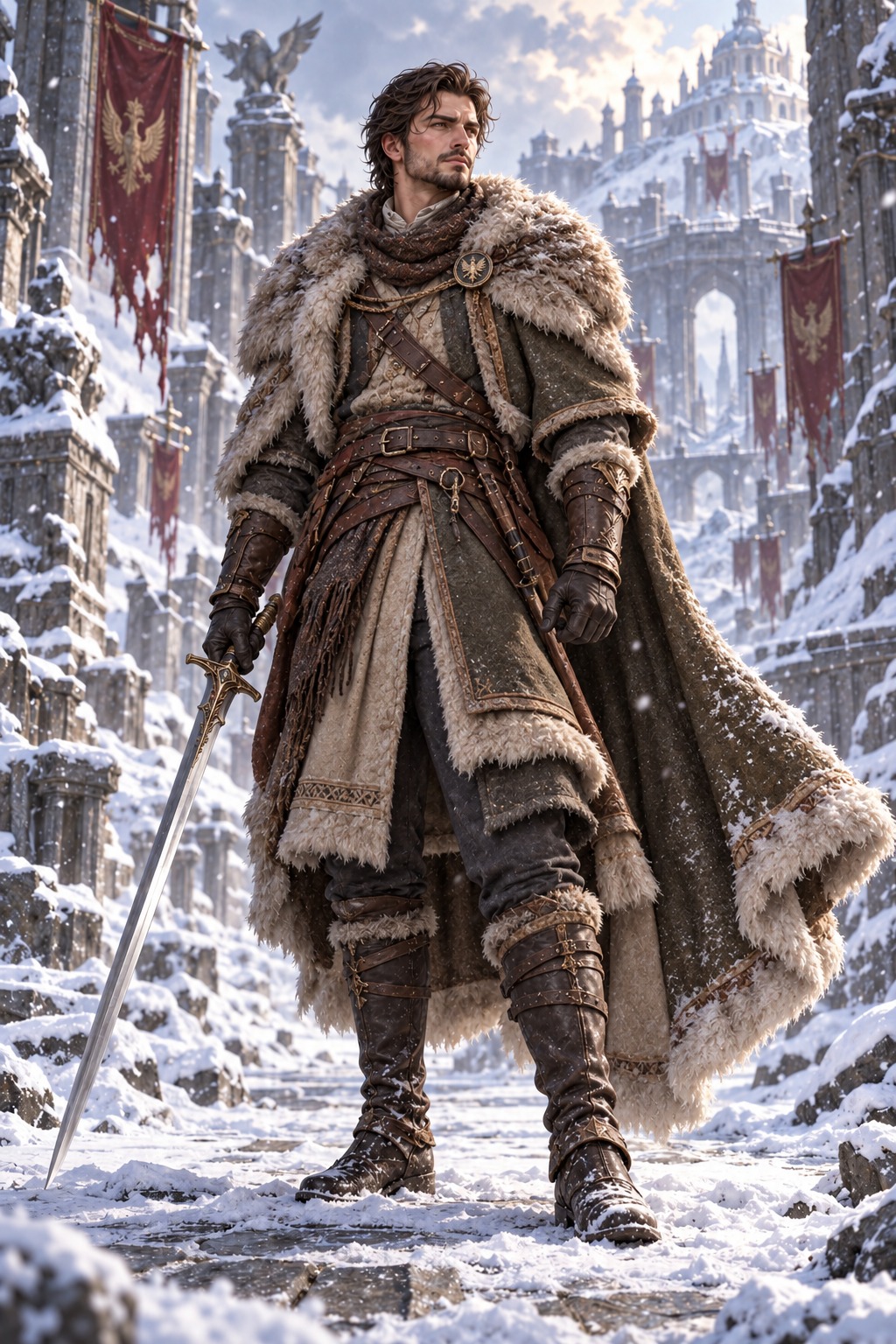
Heir to a duke, Jeronimo retains his courtly manner even after the old Empire’s fall. He has become a valuable fighter for the Dawn Alliance.
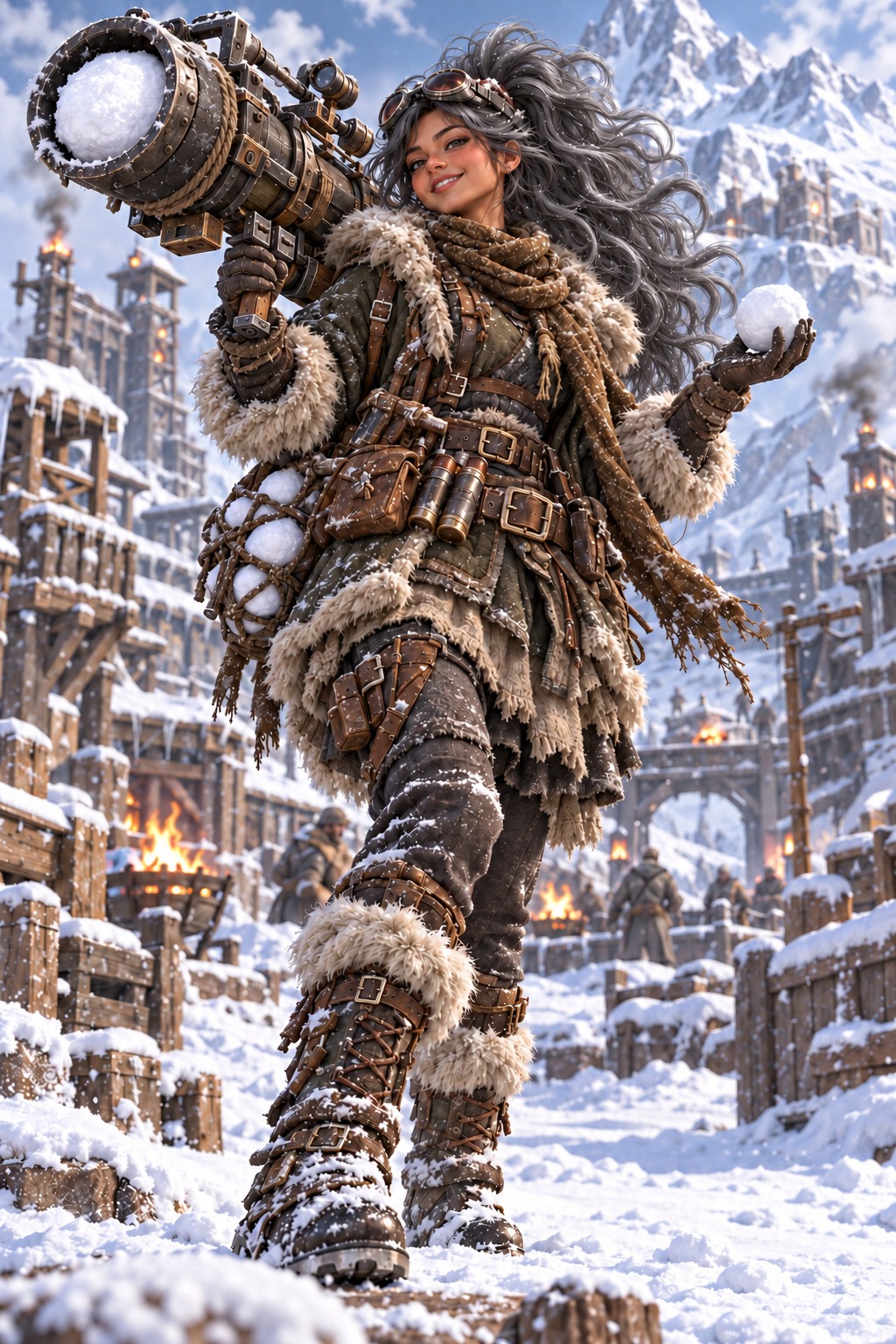
Molly has known only a world of endless winter and loves its snowy outdoors. Snowball fights, sled rides, and new discoveries are part of her everyday life.
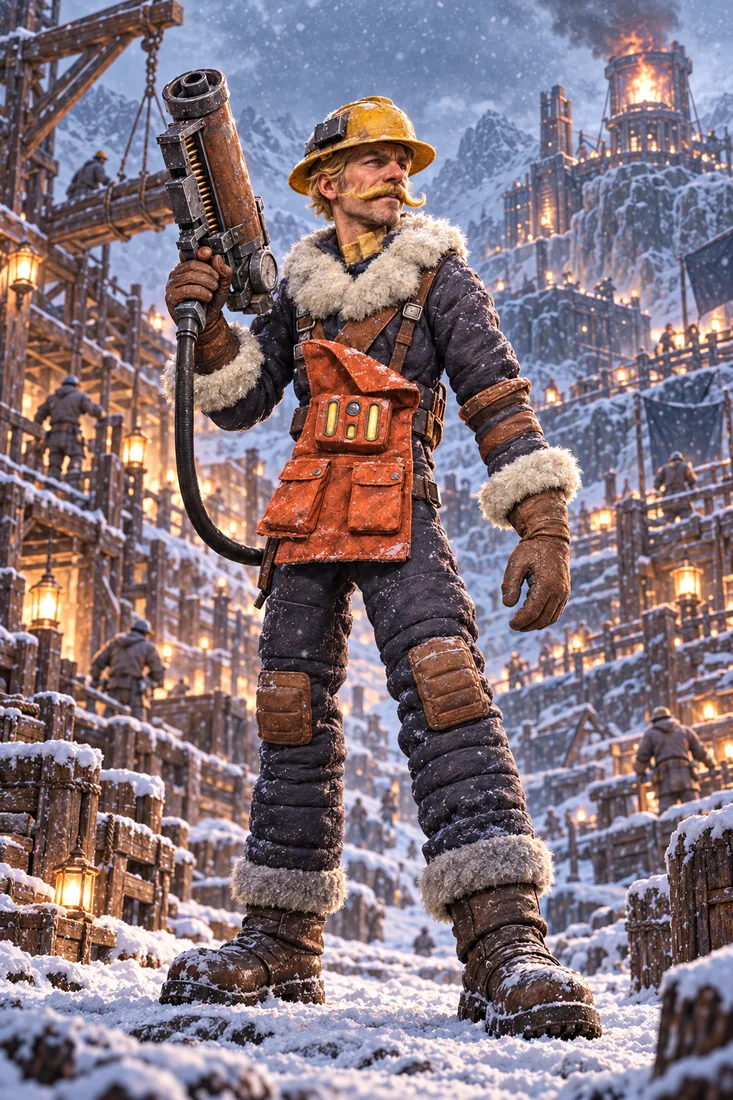
Once hailed as Sunfire Castle’s greatest architect, Zinman brings unmatched knowledge of design and construction to rebuilding.
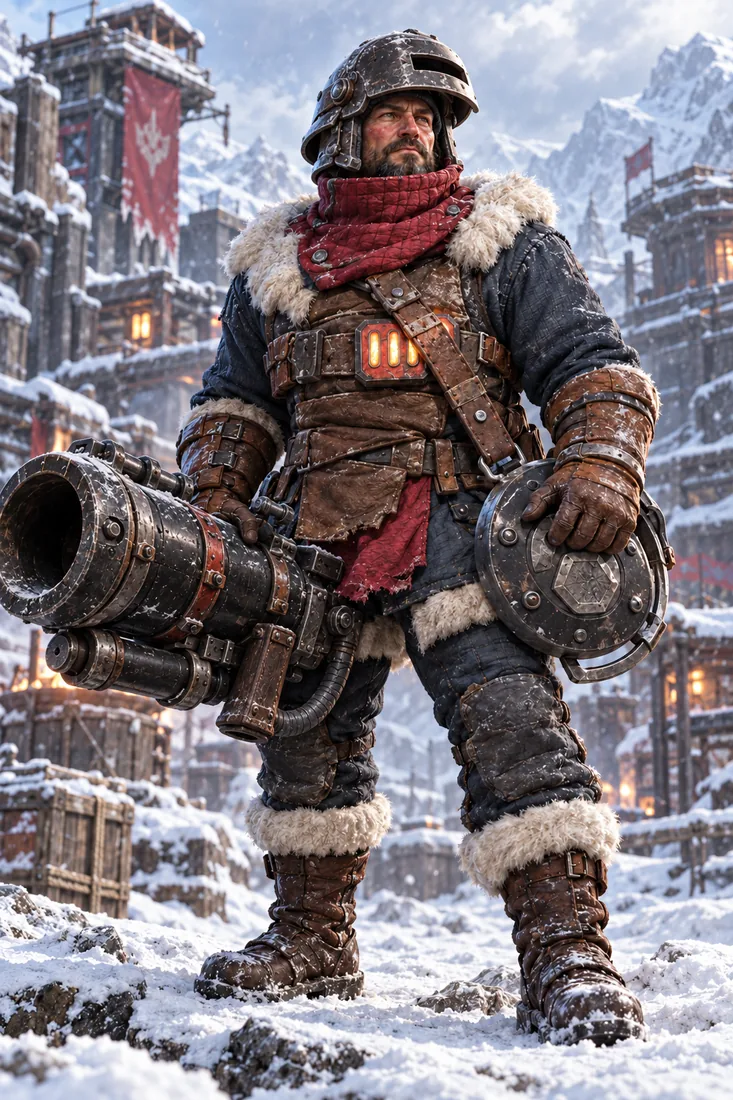
Flint is driven by vengeance against Phaethon. His personal campaign against the organization will end only when one side is defeated.
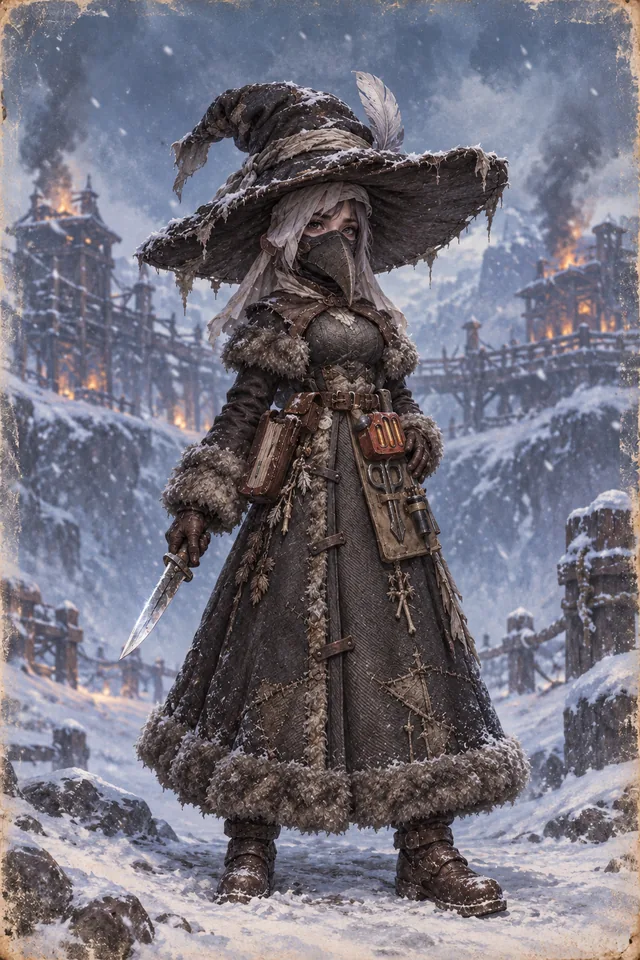
Doctor Philly was shunned for her beaked mask. When plague struck, she entered the quarantined village and worked to find a cure.
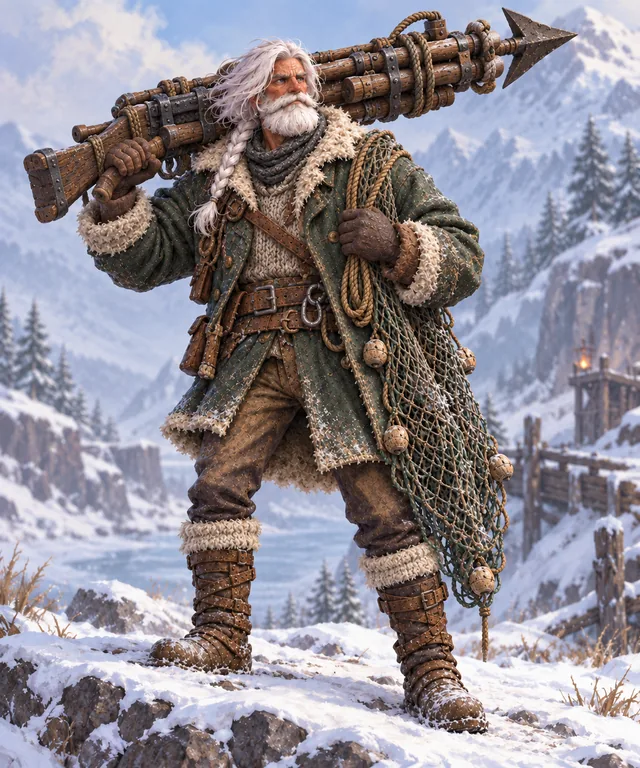
The taciturn whale hunter Alonso travels from port to port with his harpoon and net, following clues to a legendary sea monster.
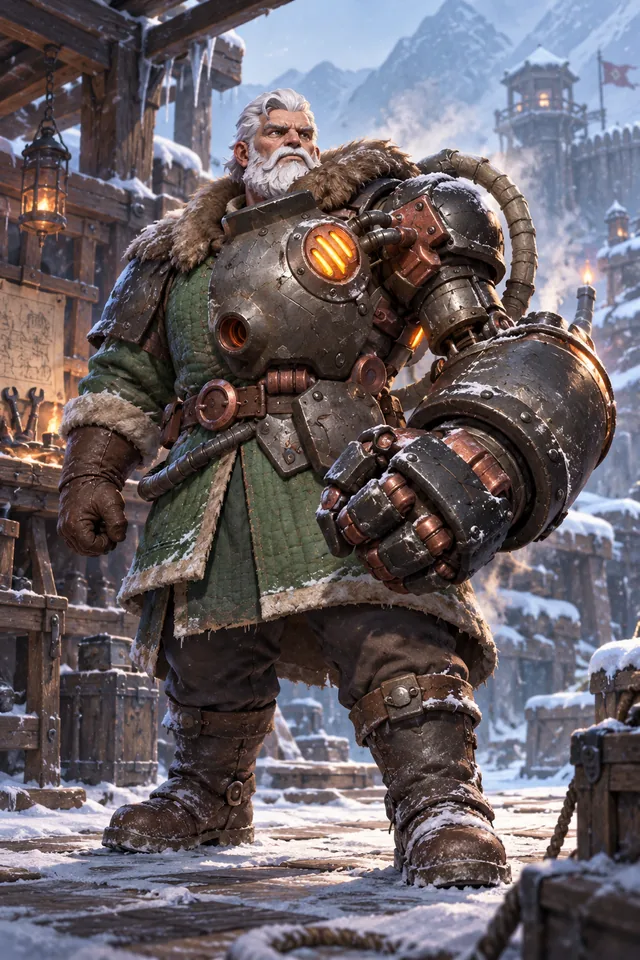
A Dawn Alliance founder, Logan protects survivors with decisive leadership and engineering skill. His steam-powered suit compensates for old injuries.
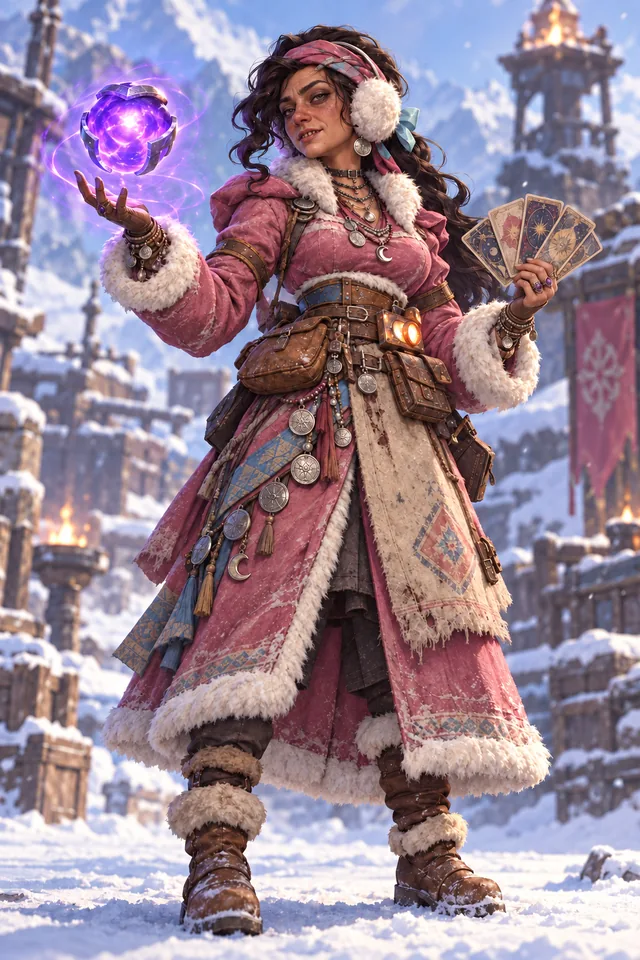
Mia’s famous merchant caravan brings goods and performances to the cities. Children and curious buyers alike look forward to its arrival.
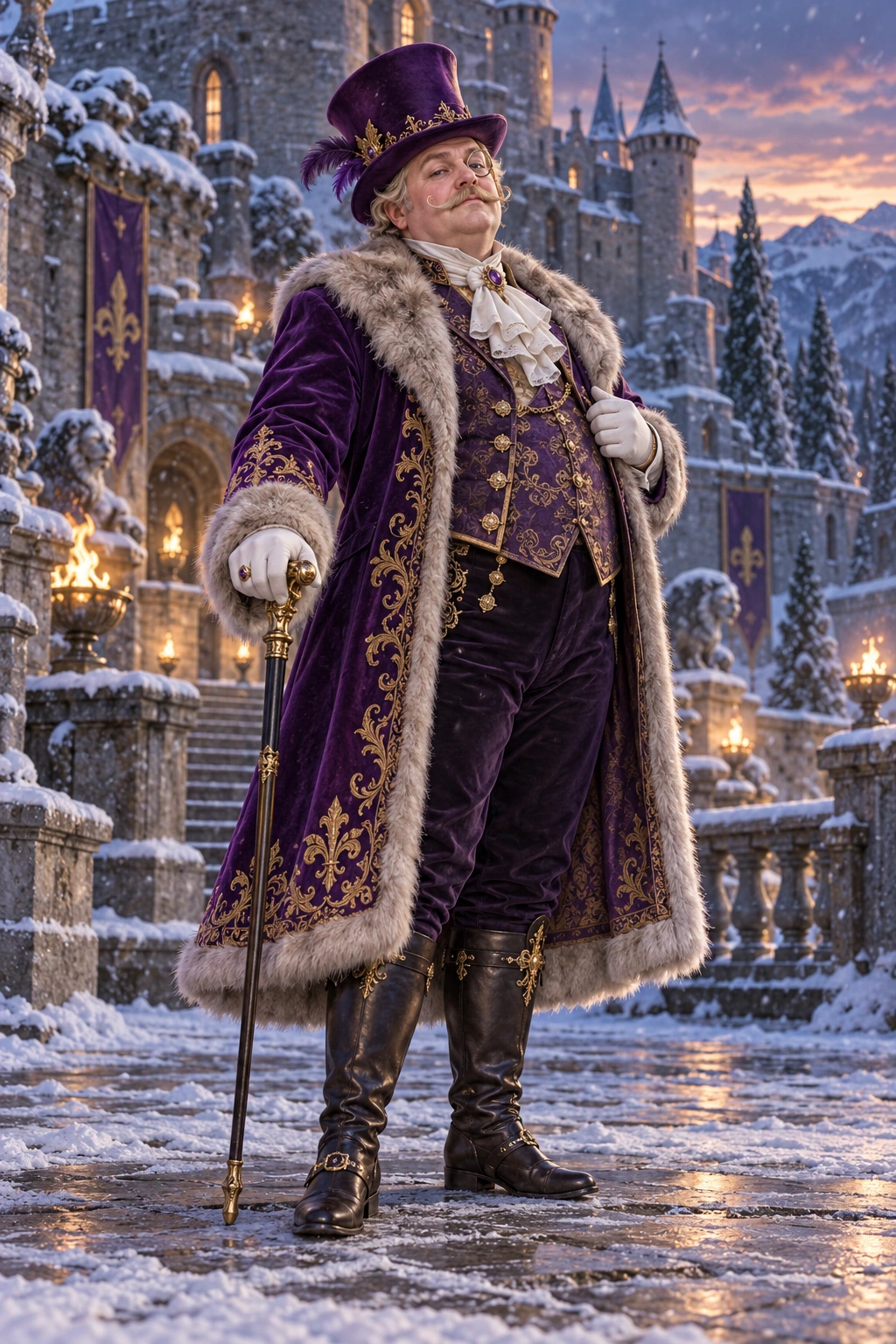
Greg believes only order can keep the frozen world from falling into chaos. As an impartial judge, he upholds the law—even when its old rules need reform.
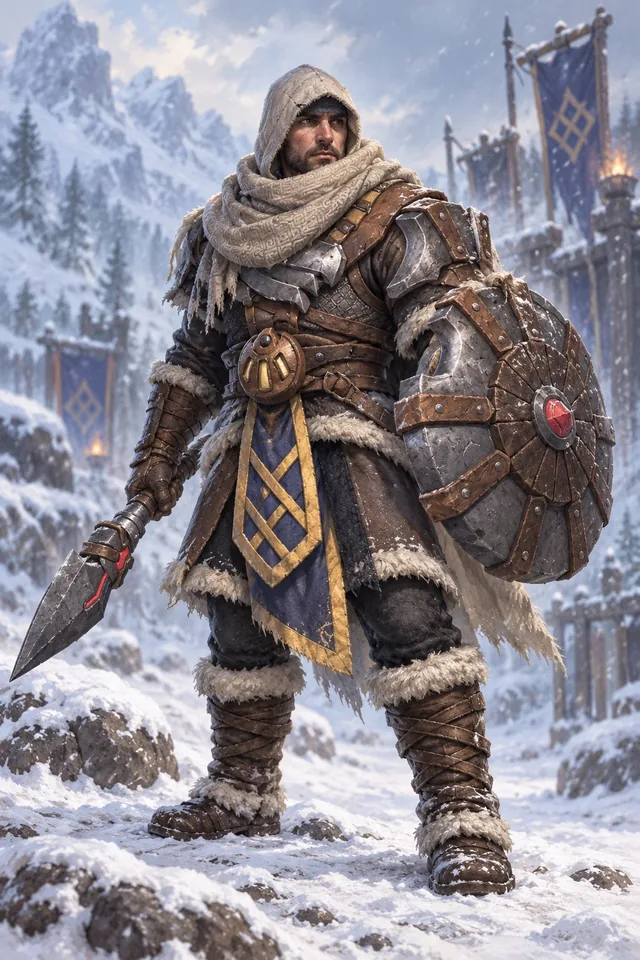
Ahmose belongs to a guardian clan sworn to protect the Fire Crystal known as Cthugha’s Heart. The king banished the clan after gaining control of its power.
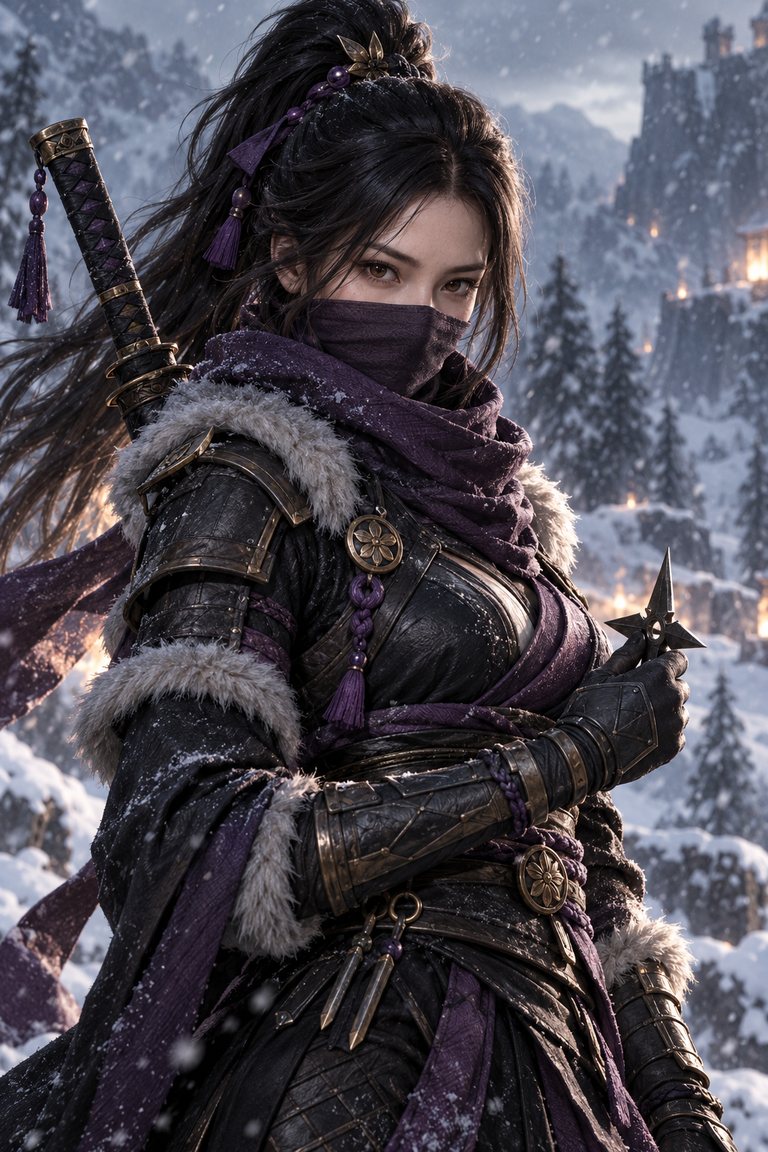
By day, Reina performs as a skilled juggler; by night, she reveals herself as a master of ninjutsu. She travels with Mia’s caravan.
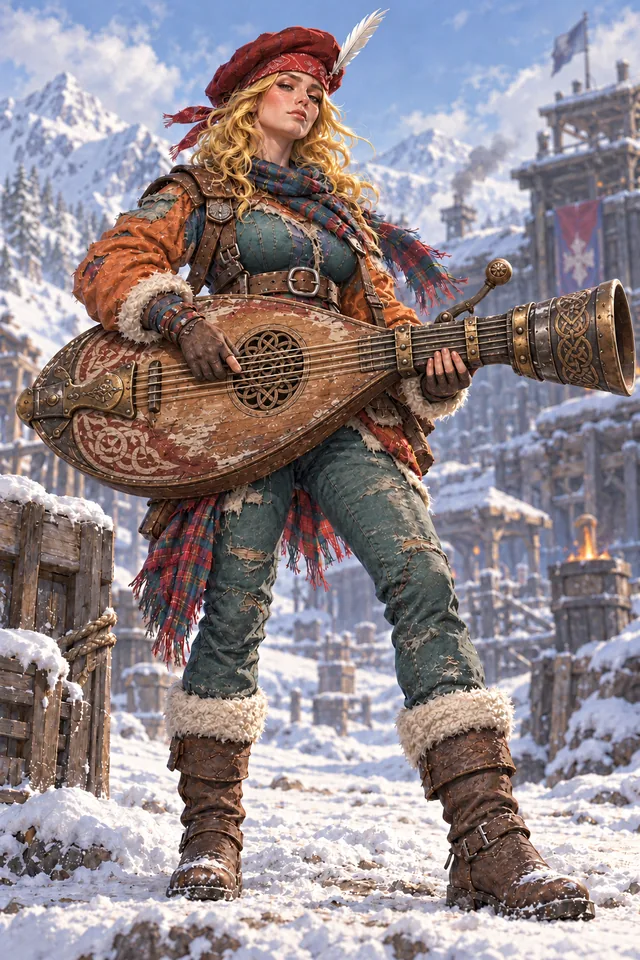
Bard Lynn travels from city to city, sharing her difficult past through music and poetry. Her performances aim to lift people’s spirits.
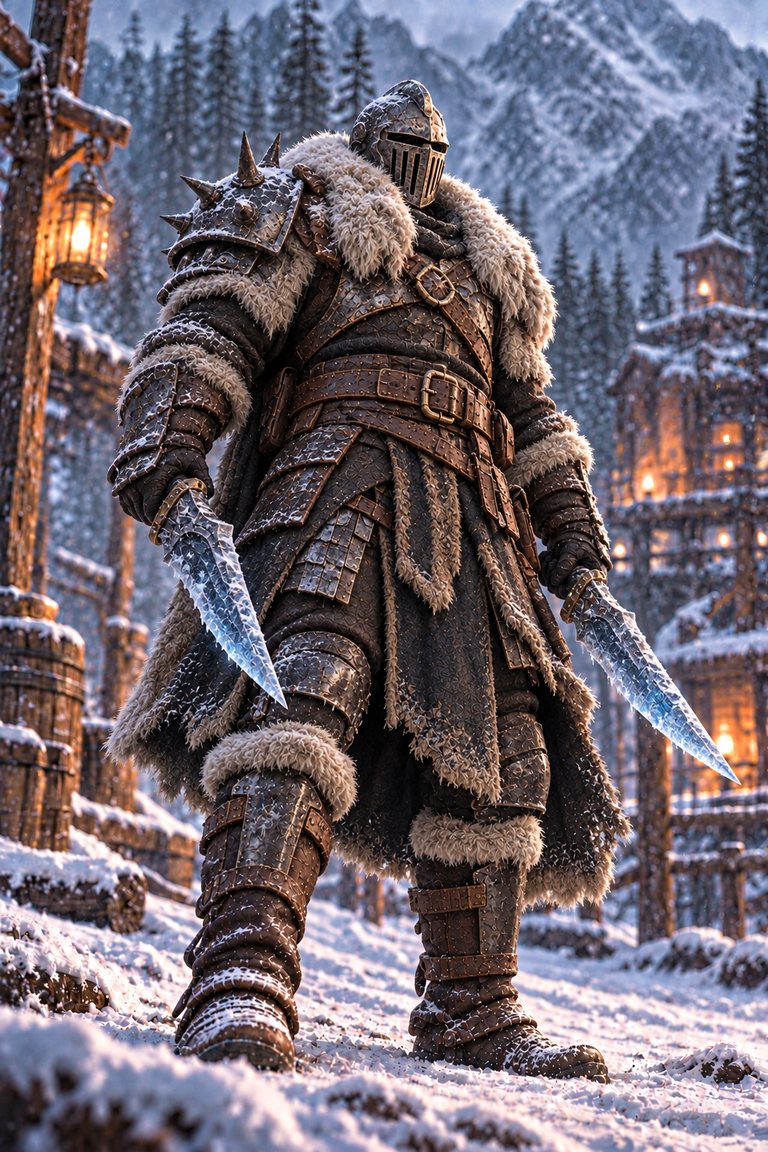
Hector is a celebrated arena fighter who seeks worthy opponents. To him, honor and self-respect matter as much as victory.
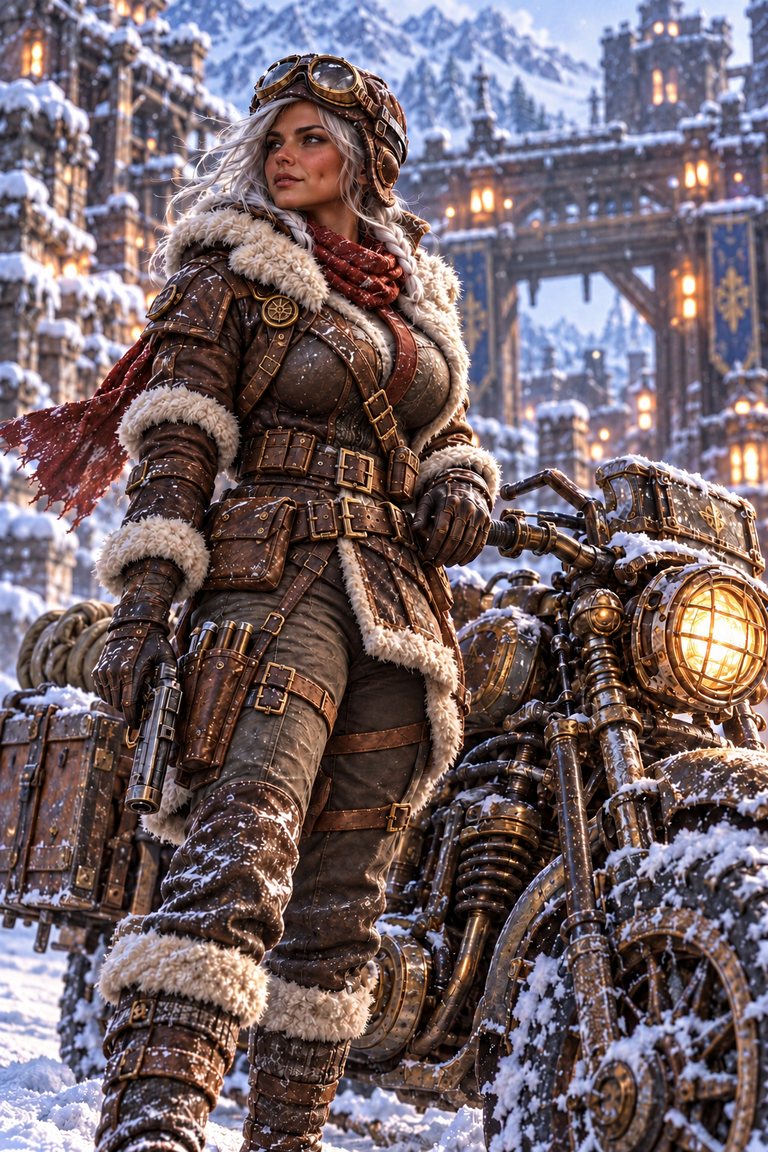
Norah leads a light mechanized brigade. Her rapid incursions deep into enemy territory support reconnaissance, strikes, and rescue missions.
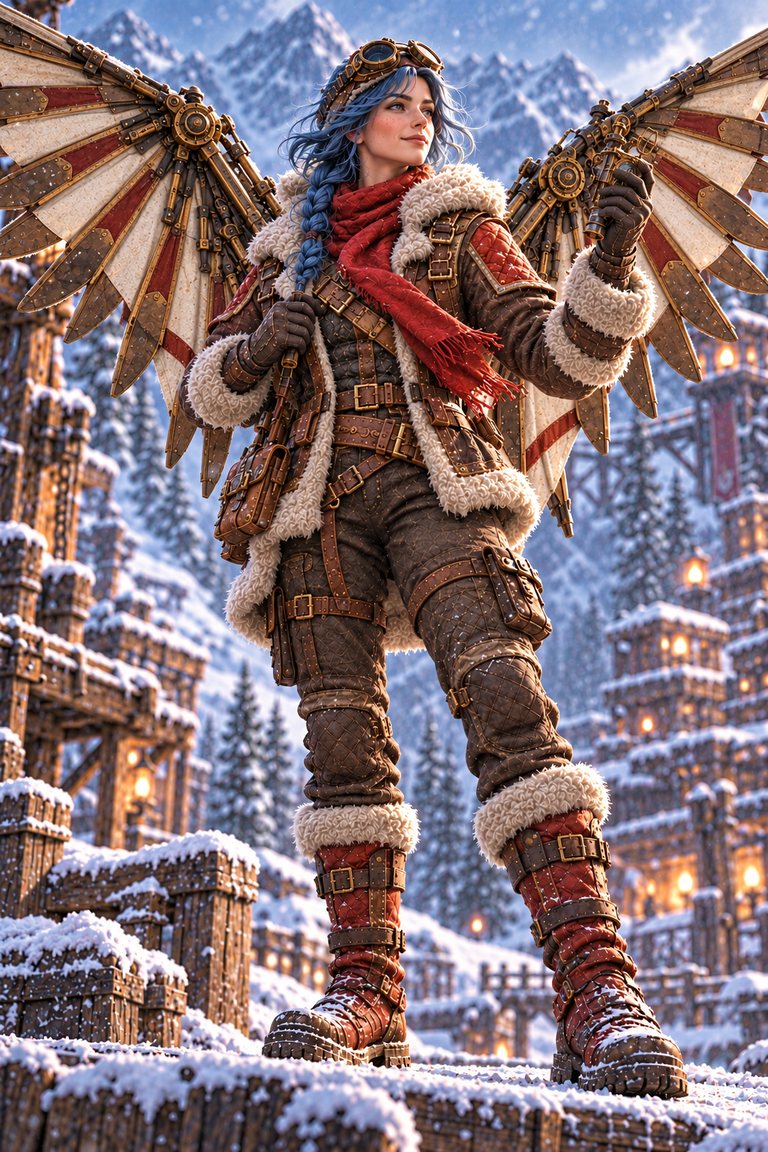
Scholarly commander Gwen designs flying machines for the Dawn Alliance. From above, they can spot enemy movements before battle.
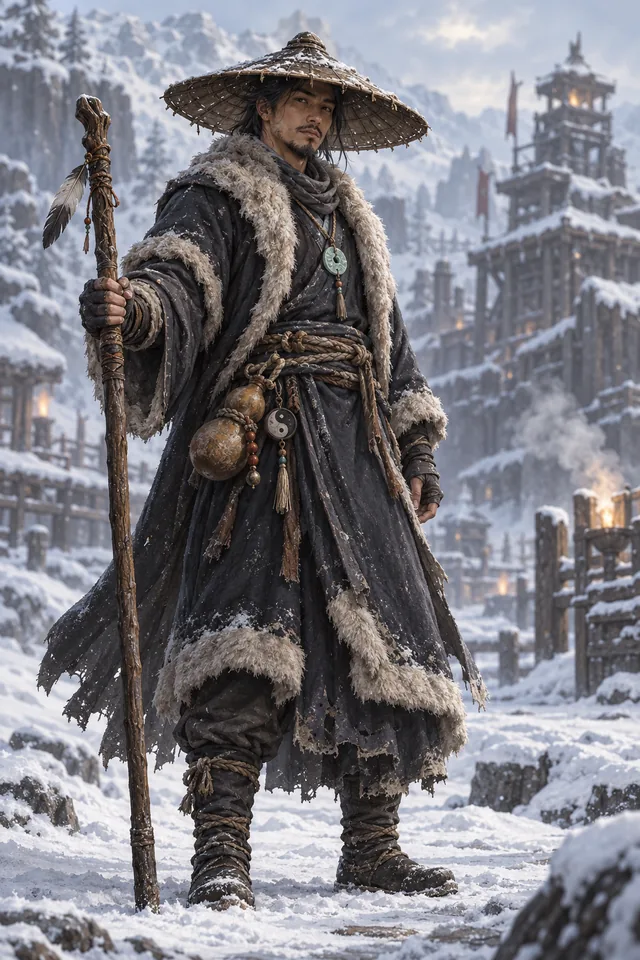
No one knows Wu Ming’s real name. The wandering martial artist uses his skills to protect the weak and drive off bandits.
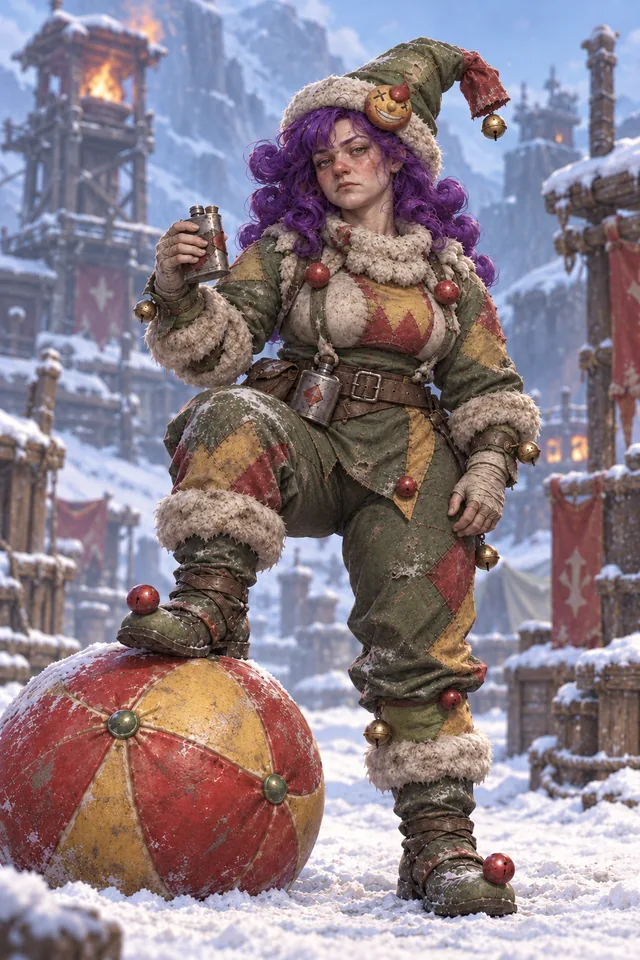
Part of Mia’s caravan, Renee delights children with clowning, juggling, and magic tricks. She especially enjoys spending time with her young audience.
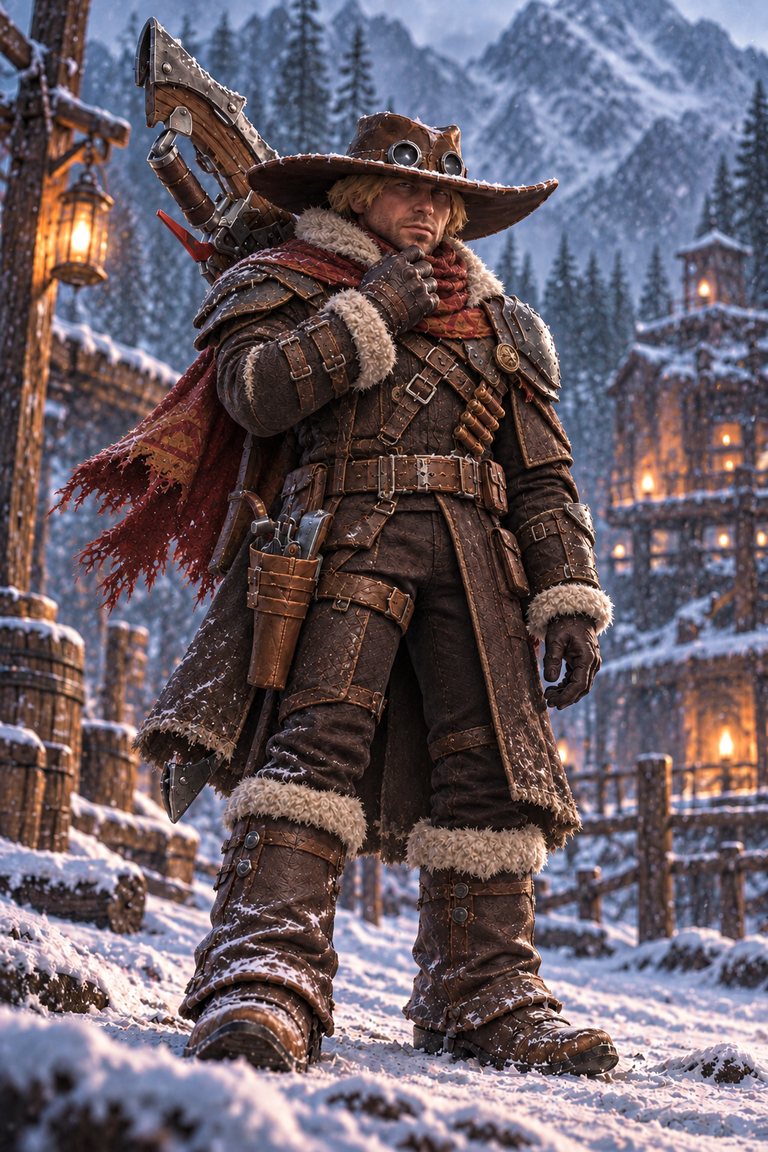
The taciturn bounty hunter Wayne completes jobs with cool precision. A skilled marksman and tinkerer, he built a boomerang that brings targets back alive.
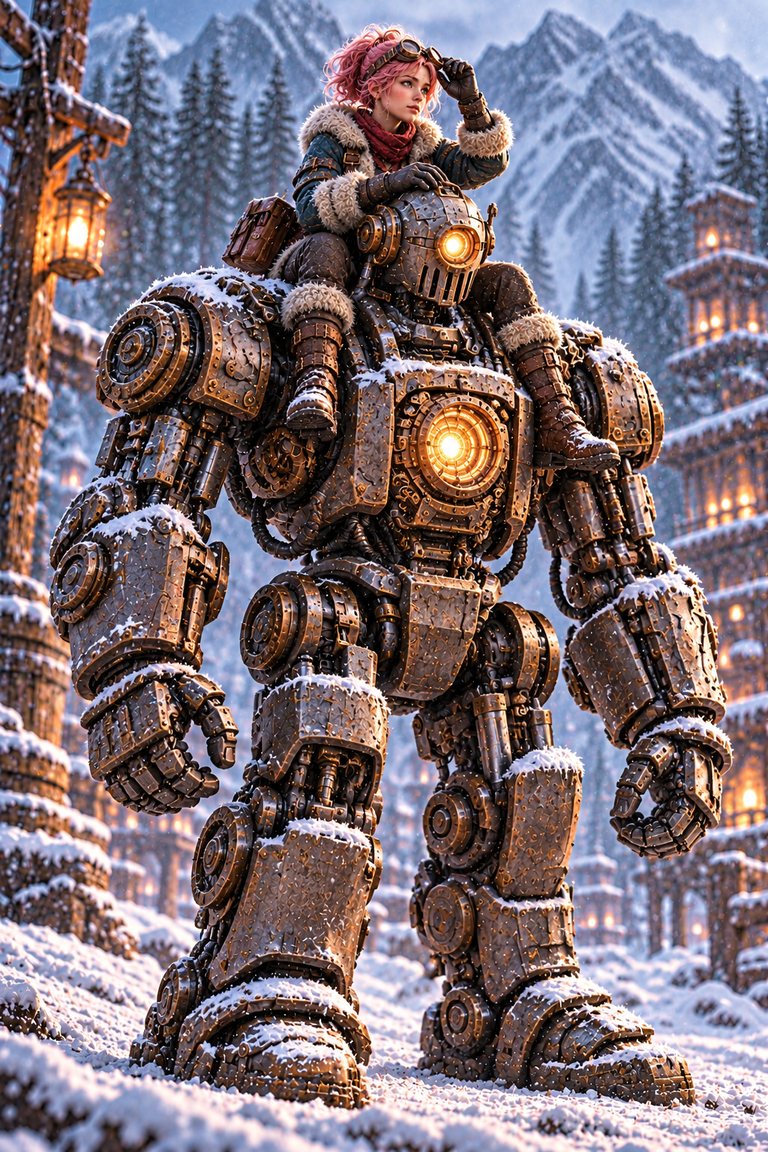
Edith and the metal giant Mr. Tin are inseparable. He rescued her as a baby, and she grew into the scientist best able to repair him.
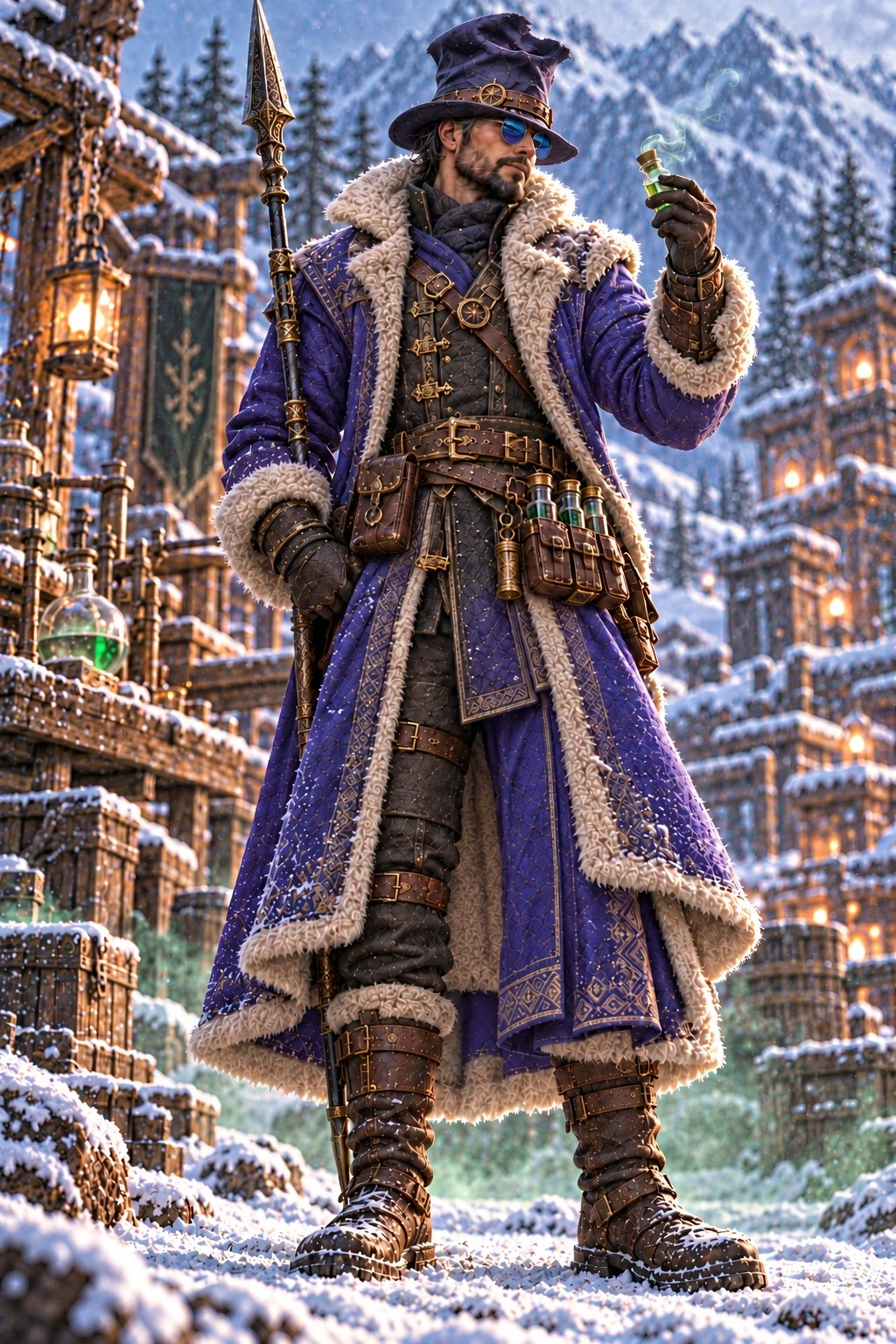
Scholarly Gordon is feared as one of the era’s greatest poisoners. Those who prey on the Tundra’s civilians face his dangerous expertise.
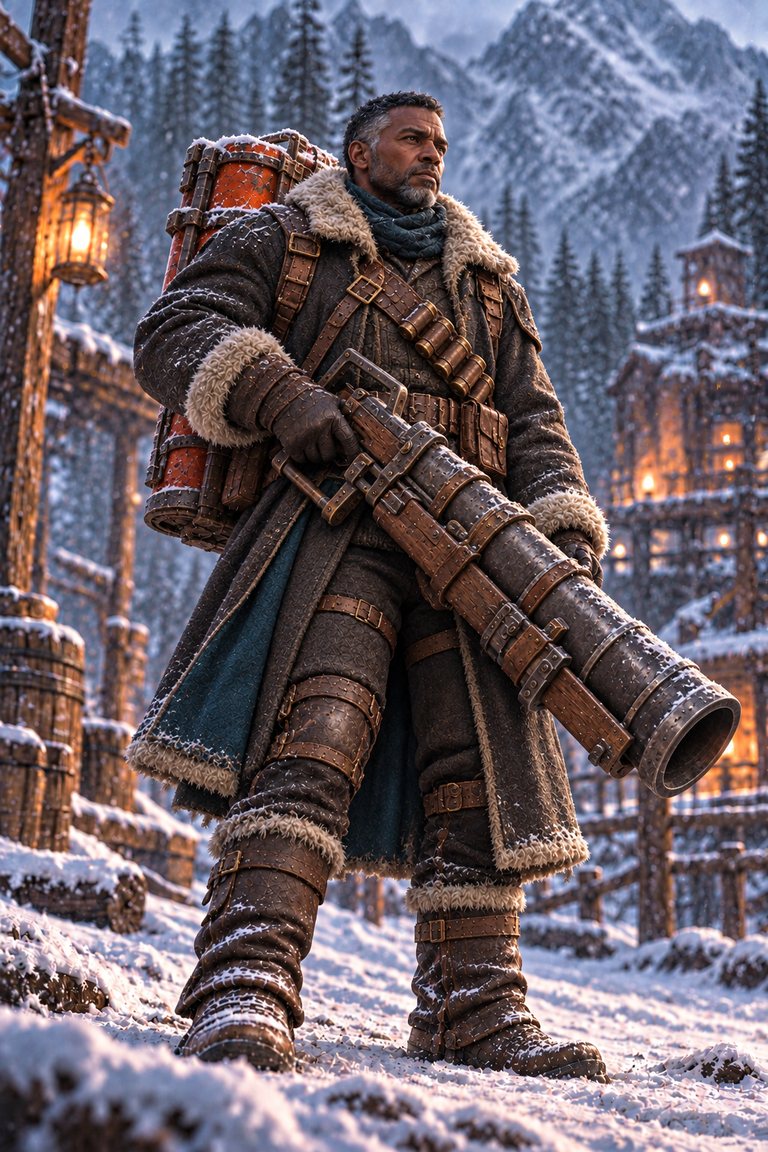
Bradley is a veteran warrior and strategist, trained at one of the old Empire’s finest military academies. He is one of Gina’s Eagles’ best fighters.
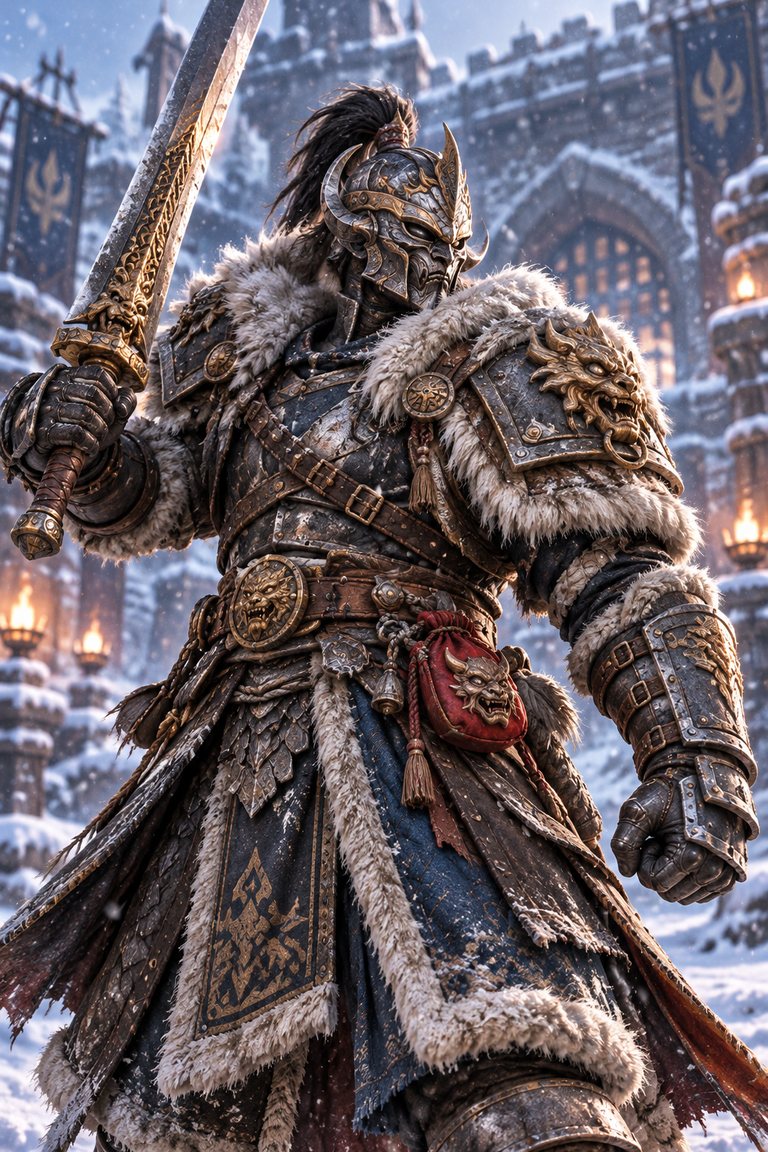
Valiant warrior and accomplished commander, Gatot arrived in the Tundra with an elite squad from a distant land. His true objective remains unclear.
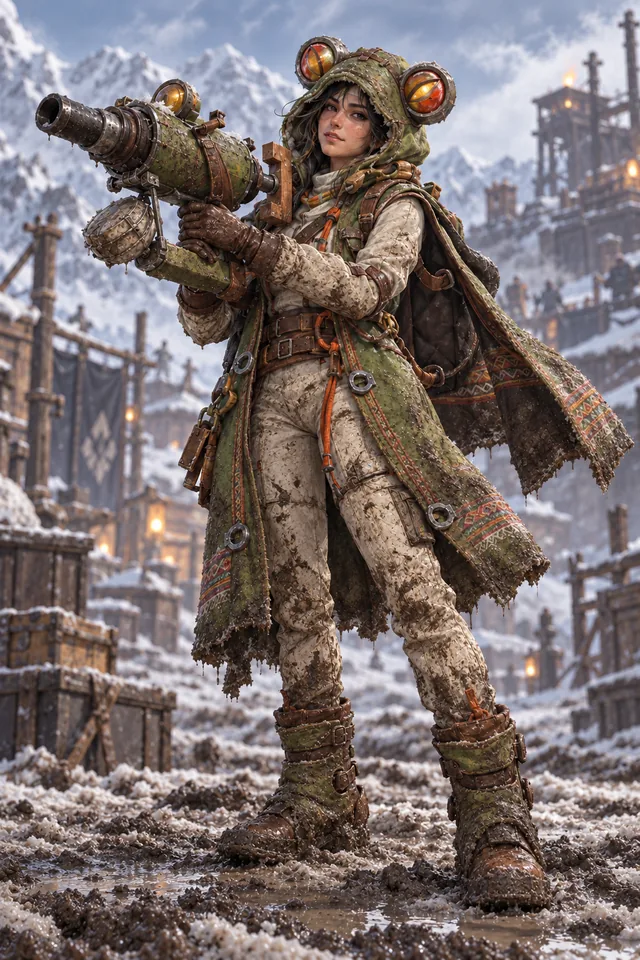
Sonya is chief engineer aboard the submarine Neptune. Her exceptional skill keeps the aging vessel running despite harsh conditions.
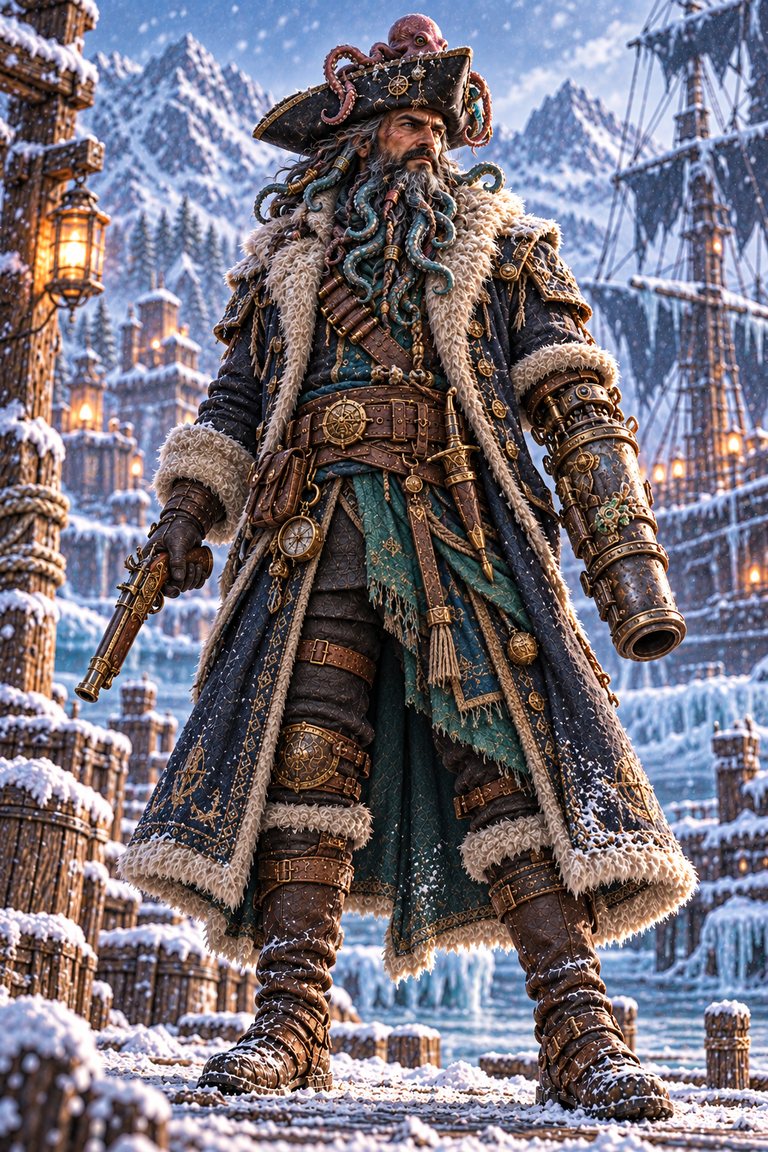
Captain Hendrik searches for the lost ruins of a legendary nation aboard his submarine, the Neptune. He occasionally trades ocean treasures for supplies.
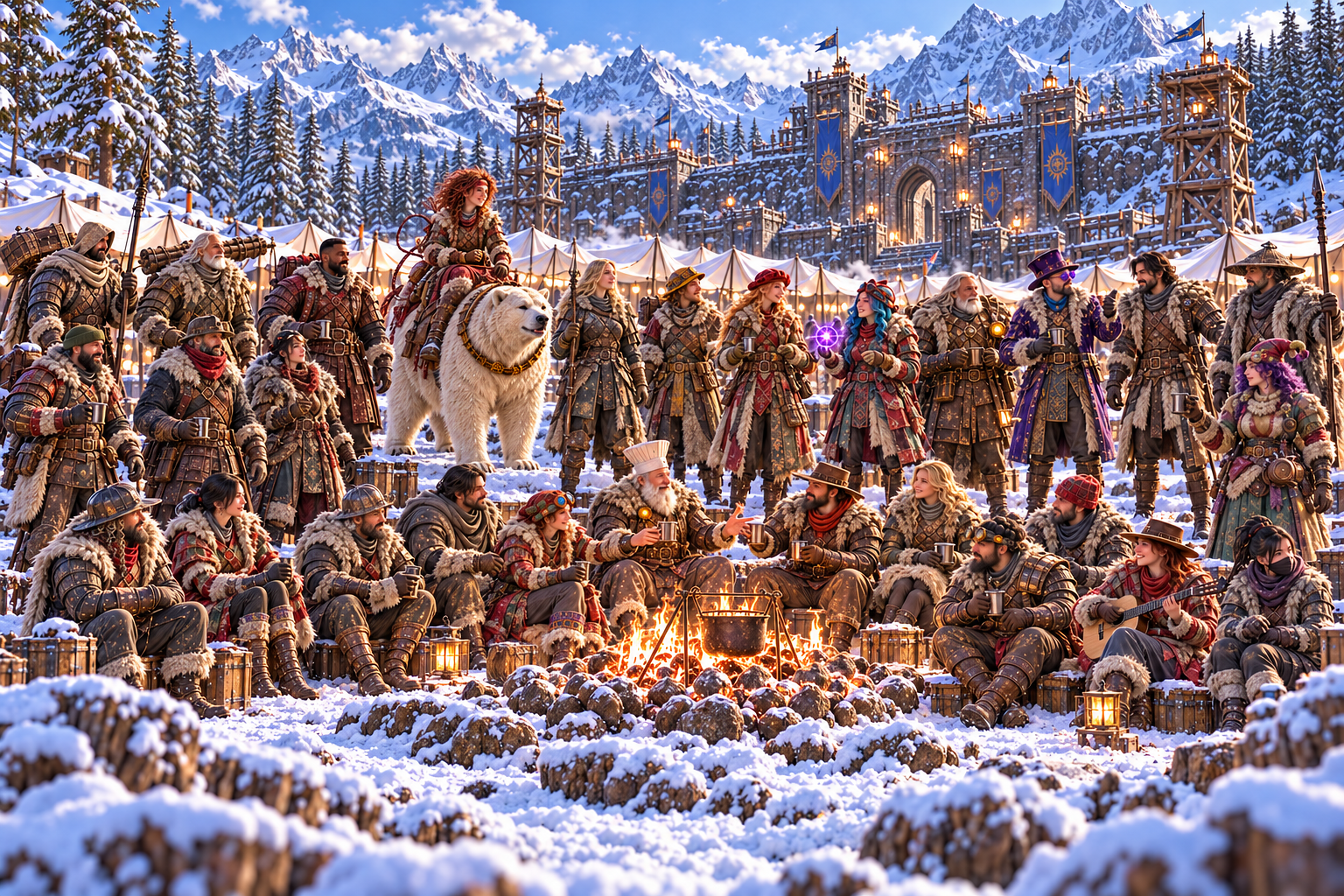
They strengthen NFD with specialist knowledge in the arena, hunting, diplomacy, military affairs, engineering, trade, and mining.
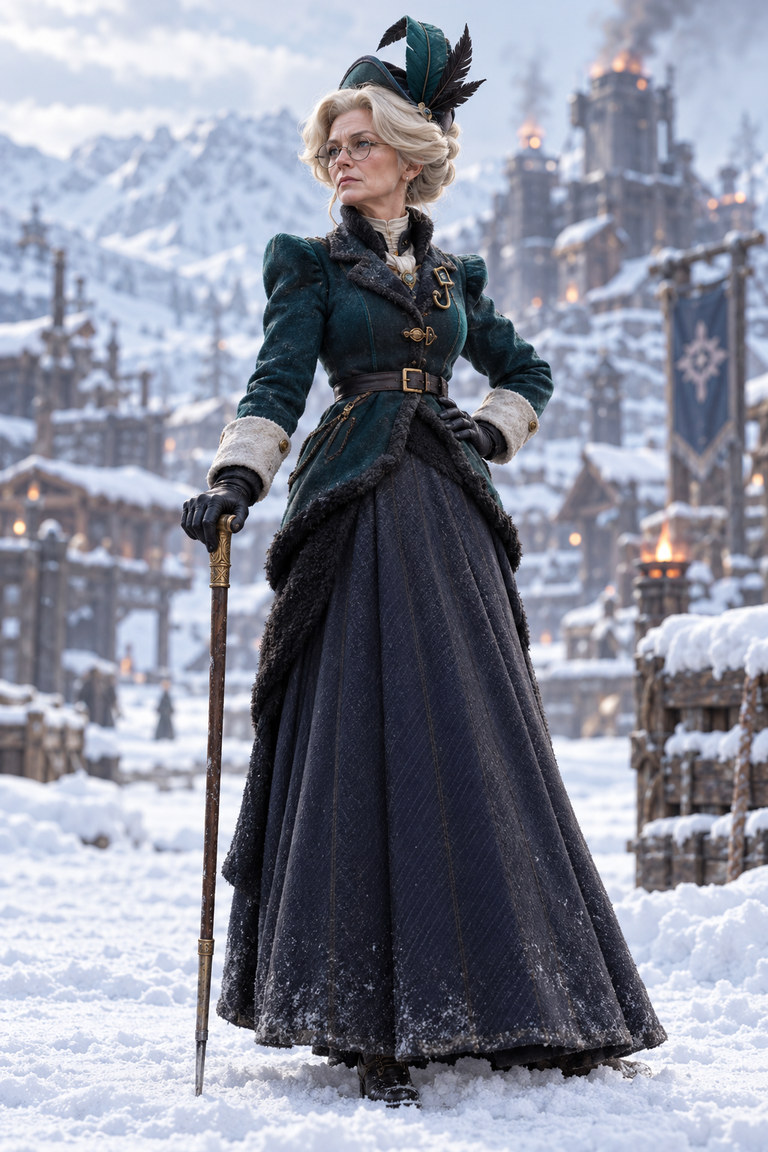
A survivor of Arcadia and a renowned scientist, Agnes works to rebuild New Arcadia. She envisions a city that brings knowledge, art, and security together.
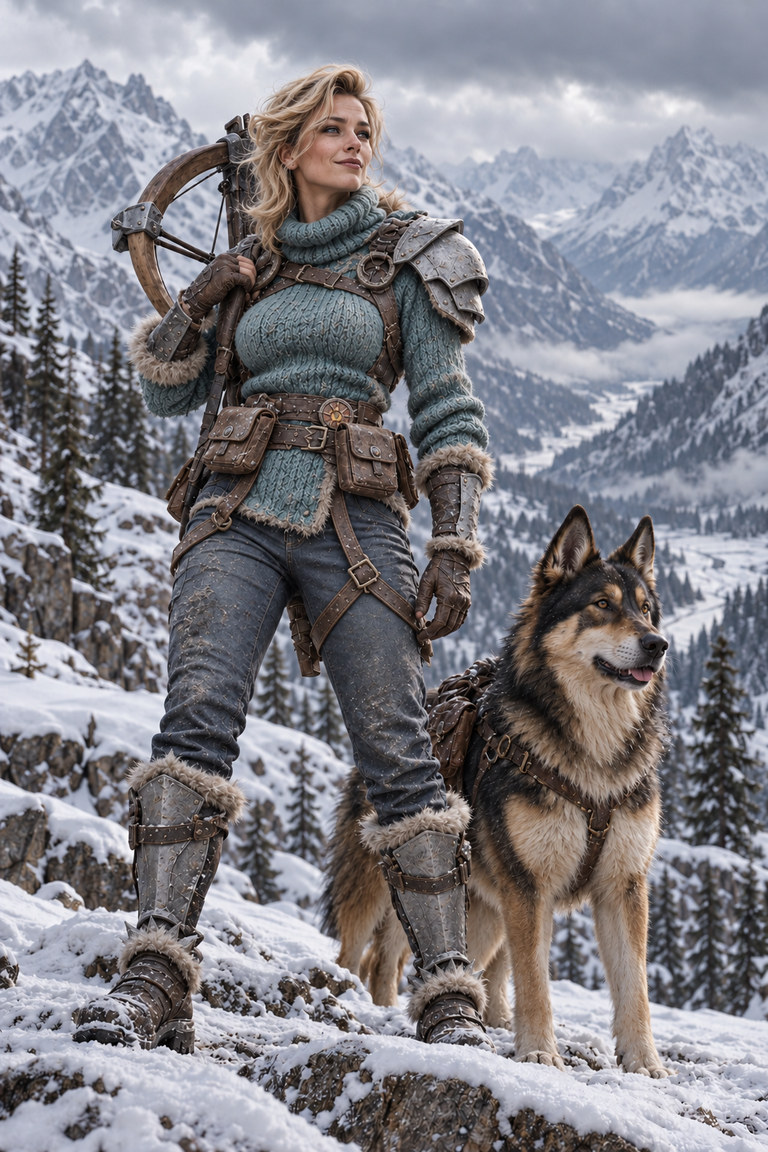
A veteran bear huntress, Cyrille knows the weaknesses of the tundra’s predators. She protects survivors and outposts with traps, explosive arrows, and smart tactics.
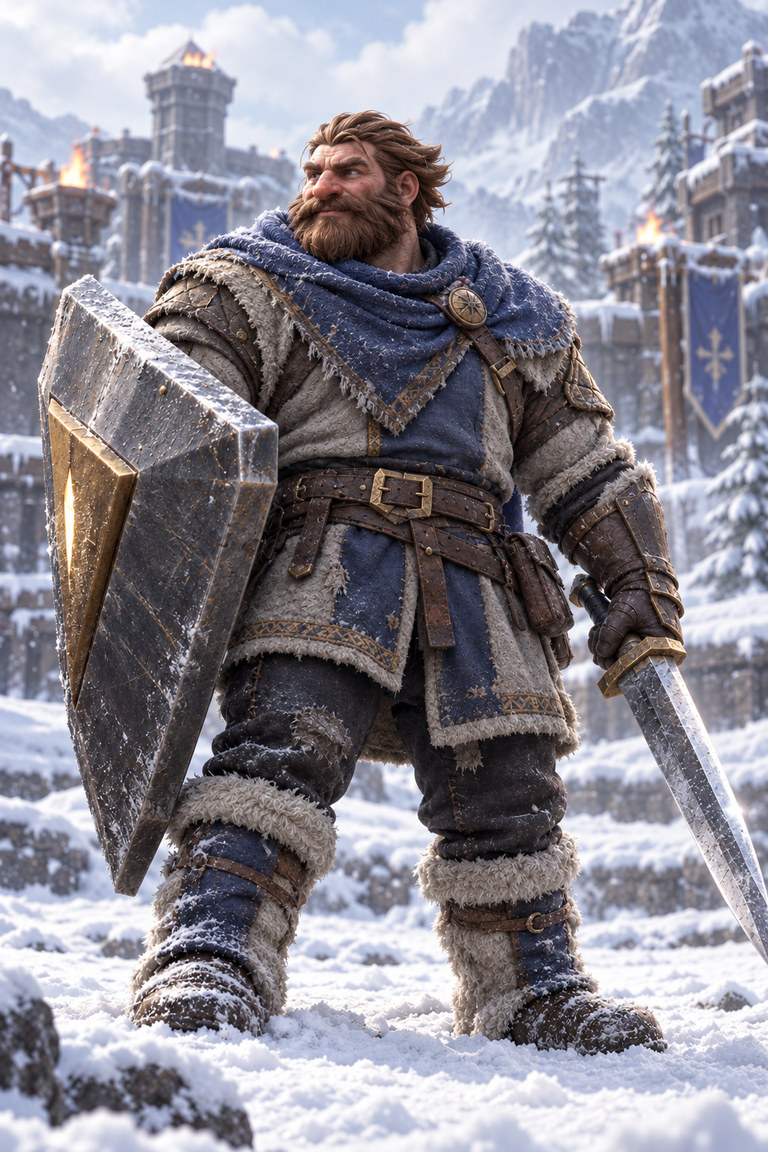
Once an undefeated Arena champion, Holger was gravely injured by a poisoned dagger. He now passes on his experience as an Arena coach and trains new fighters.
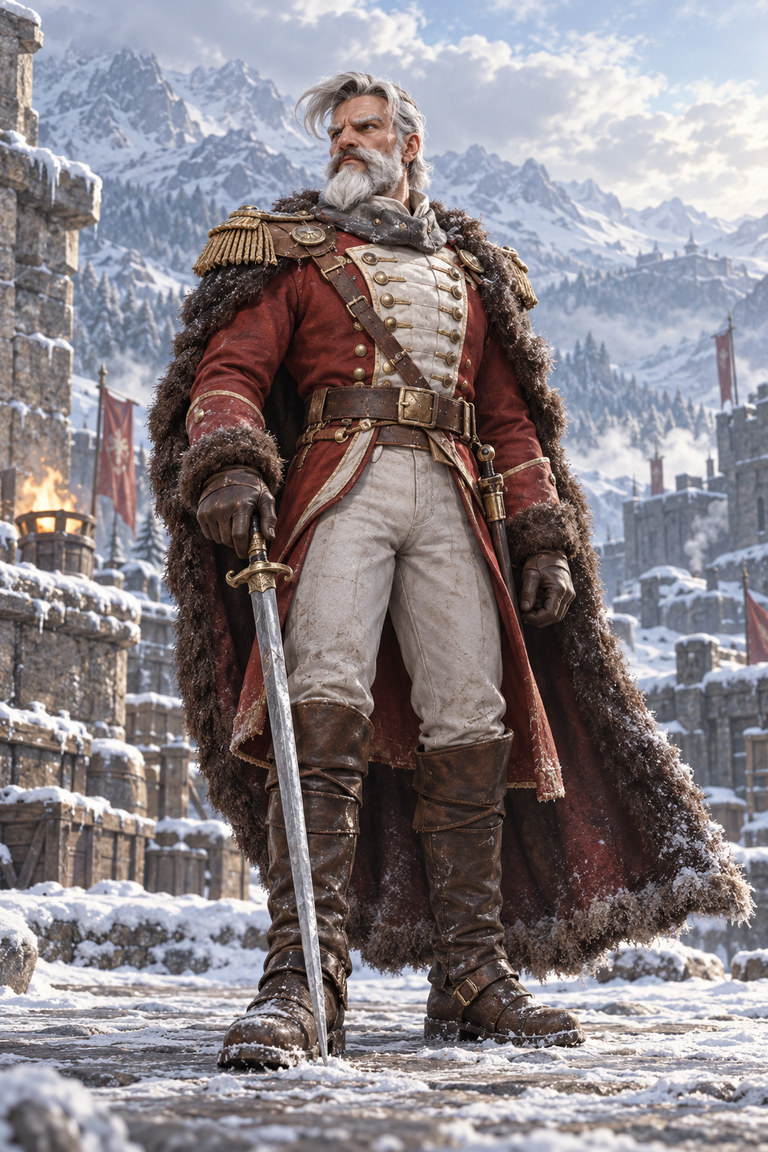
A highly decorated general twice forced from his position, Romulus now advises the Chief on military matters and puts his strategic experience in service of the new order.
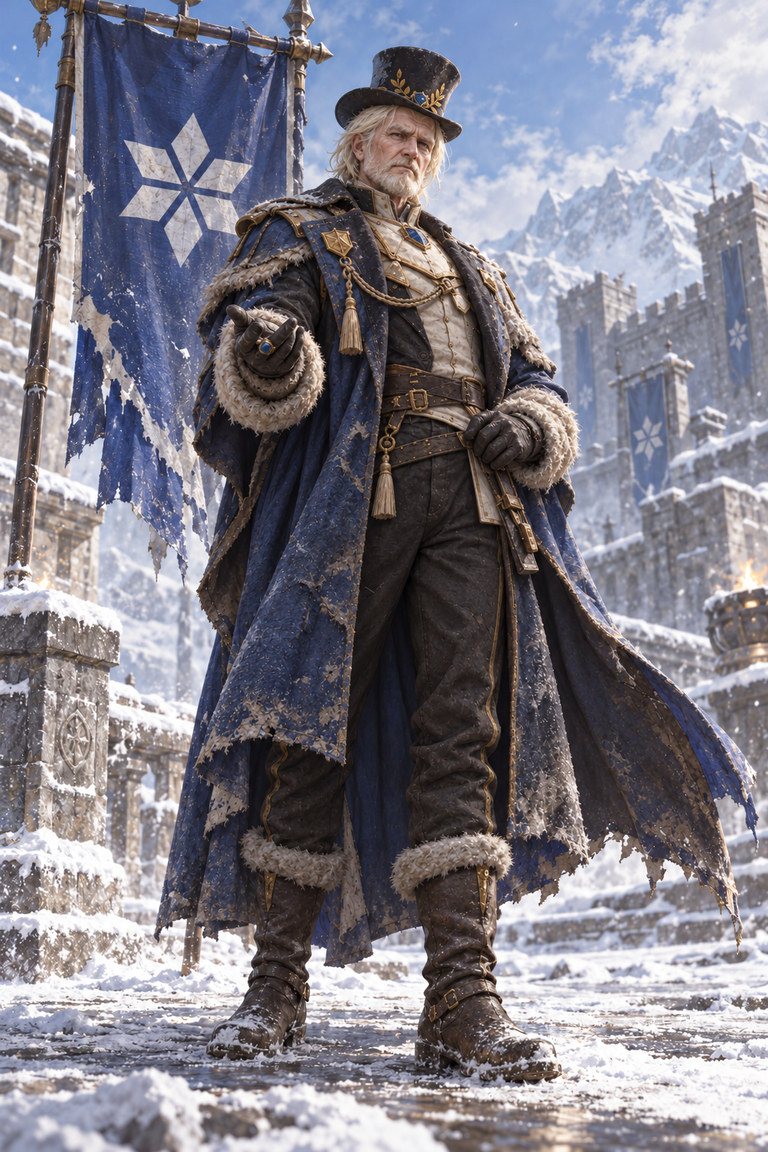
As a Dawn Alliance diplomat, Baldur uses insight and eloquence to resolve disputes. His negotiations can keep rivalries from turning into war.
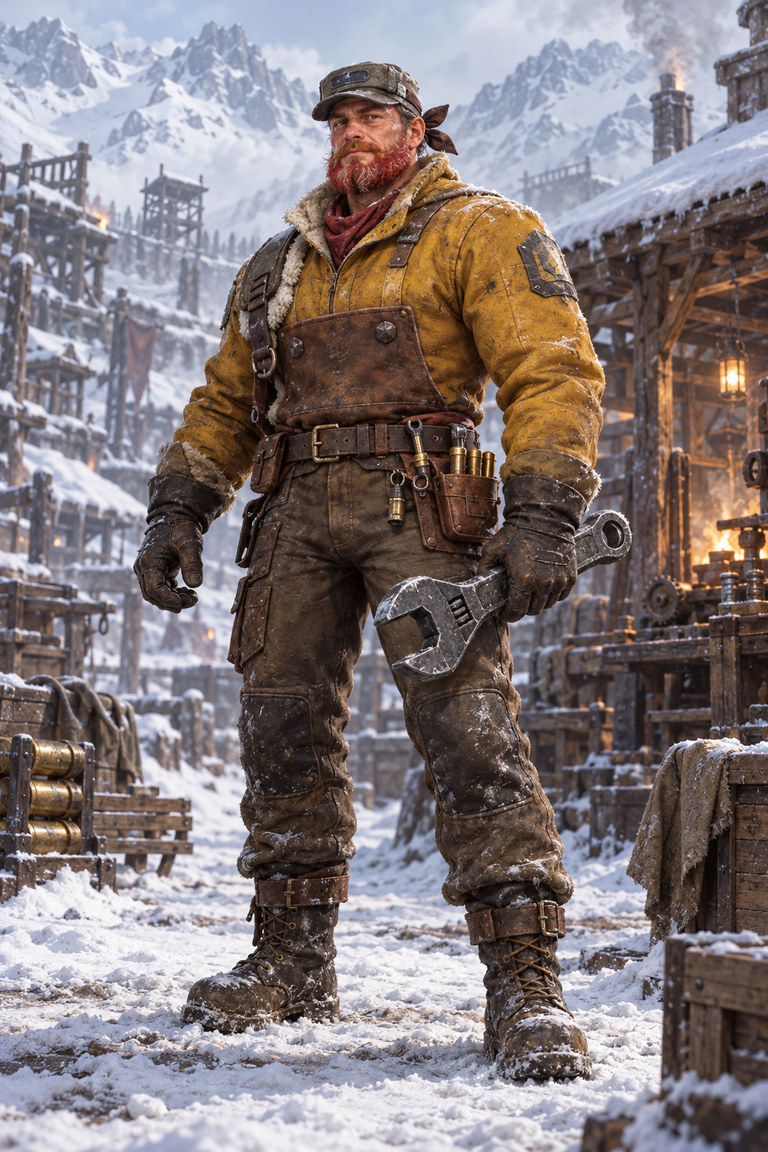
A gifted engineer and master of arms, Fabian creates technology to help survivors endure. His great projects include the mighty Typhon Tank.
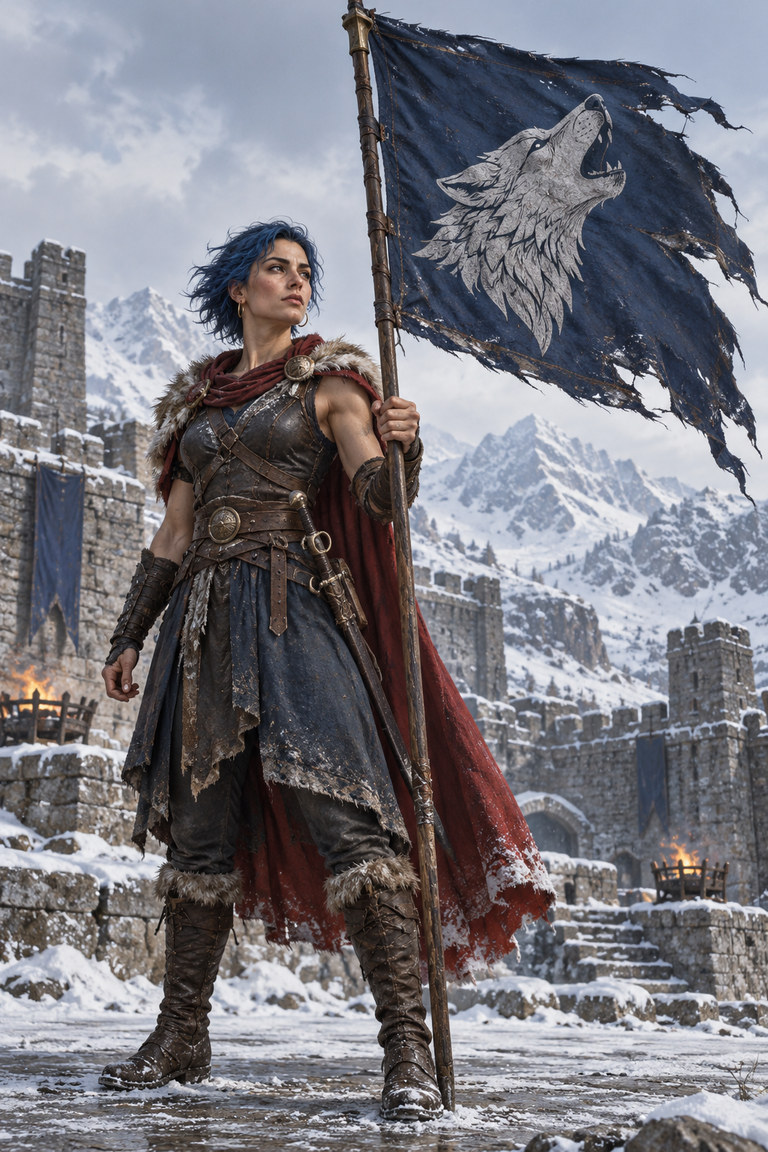
As High Marshal of the Dawnbreaker Brigade, Valeria leads one of the Tundra’s largest armies. She uses Imperial tactics and the terrain to hold off stronger enemies.
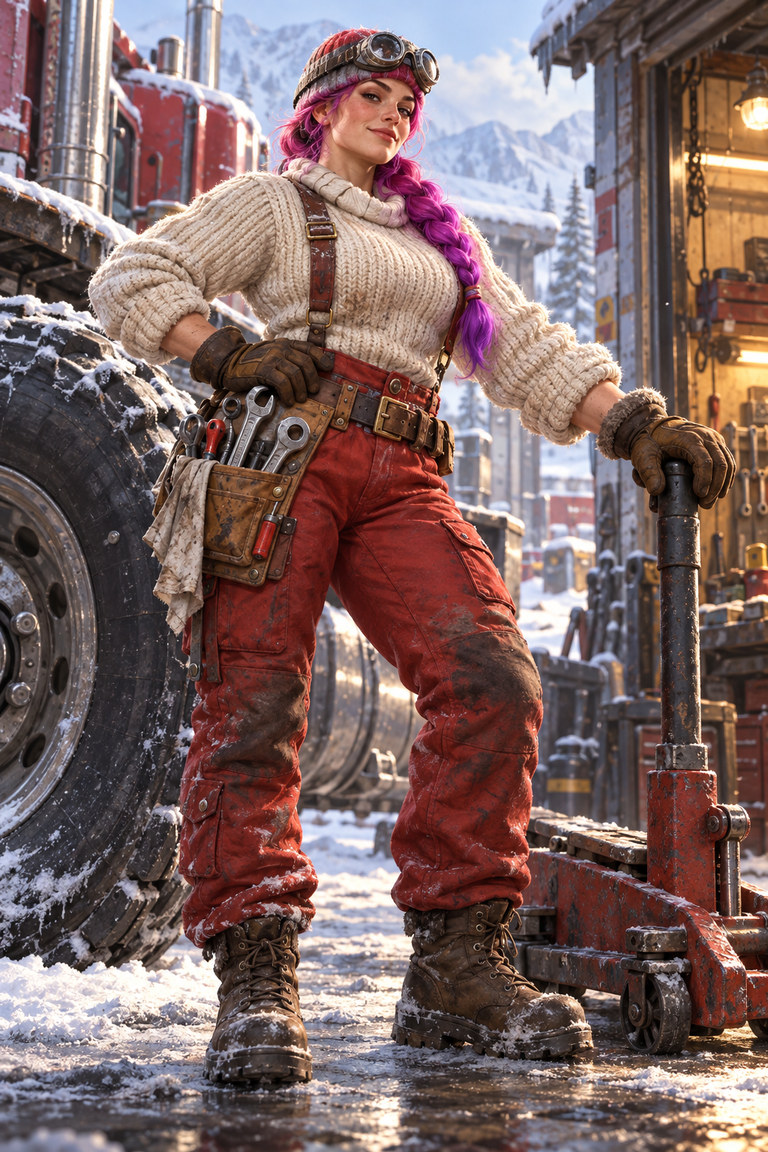
Once a mercenary commander, Ronne now protects trade convoys. She drives, repairs, and refits vehicles into heavily armed, armored transports.
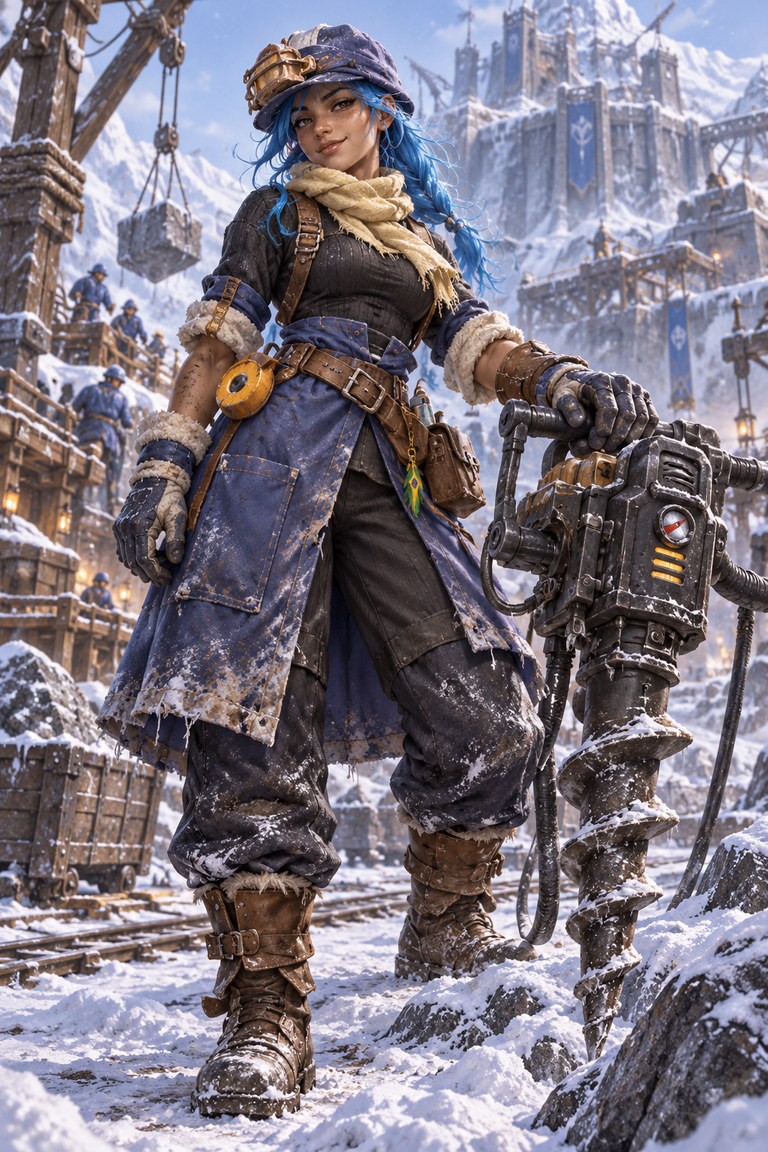
The daughter of Frostfire miners, Kathy leads her own crew. Courage, experience, and a keen sense of danger help her protect miners and put people before profit.
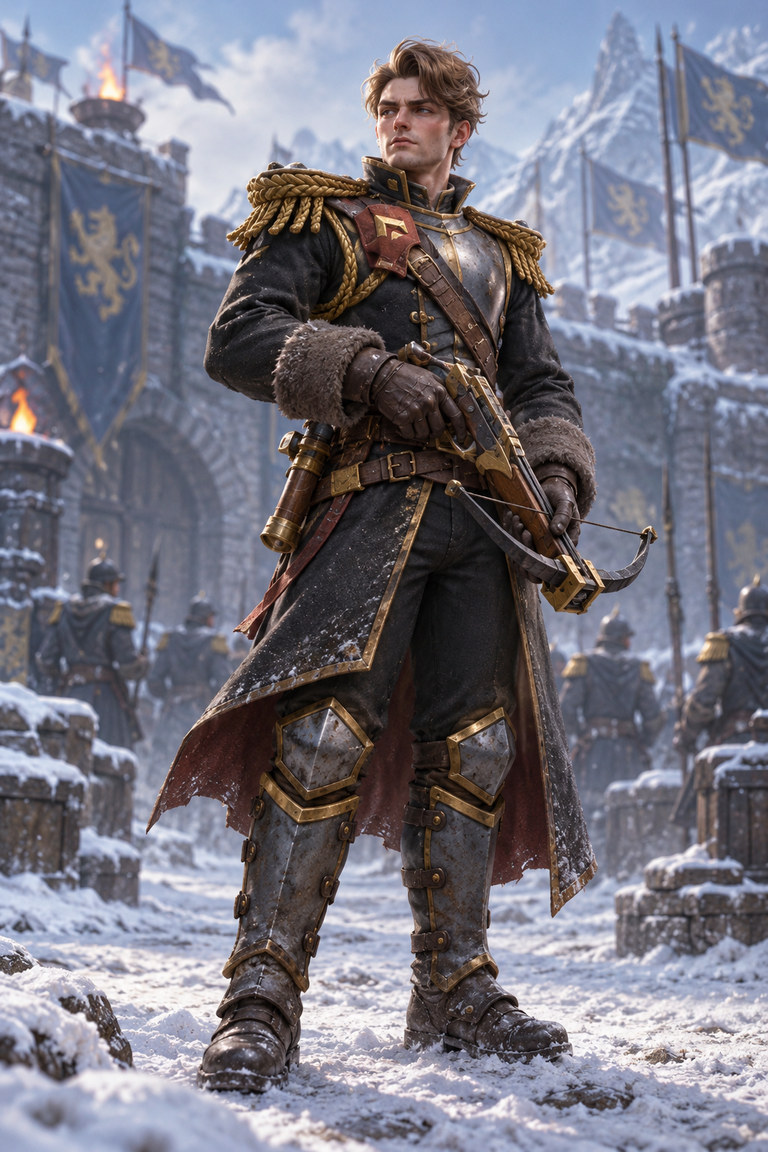
The Swedish commander and son of Jarnvid’s High Chief unites the mountain clans. His troops admire him; he can be cool and a little dismissive toward outsiders. Clever tactics let him stand against larger forces.
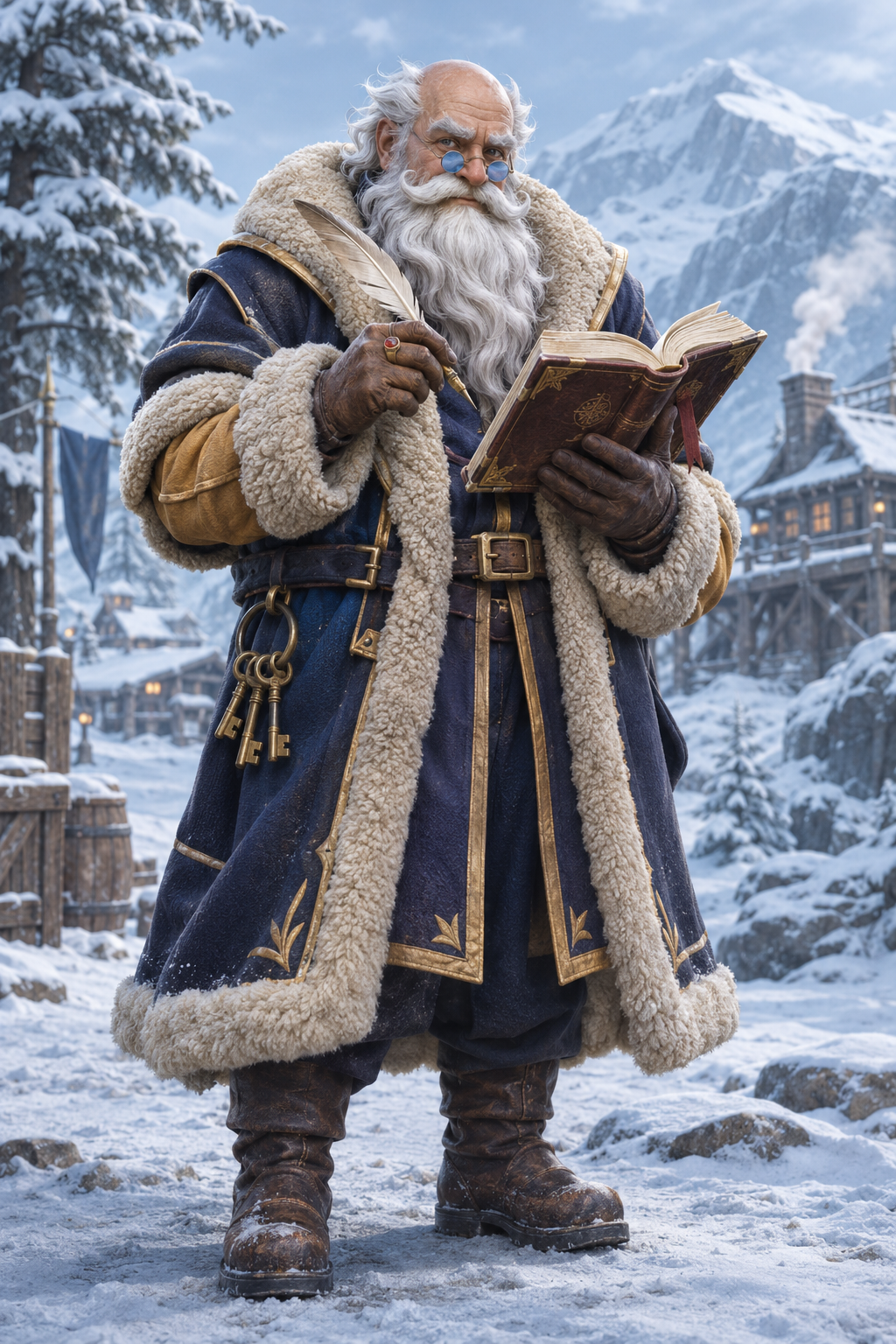
A former minister of the Solaris Dynasty, Justus is known for his fairness and wisdom. He once helped Her Highness the Princess establish a safe haven for survivors and protect them. With his knowledge of statecraft and governance, he now supports the city's development.
DEATHHEAD — THE NIGHT OF FALSE FRIENDS
Deathhead knew something was wrong when the man claimed for the third time that he was her friend.
Friends normally did not need to mention it quite so often.
She sat opposite him with her boots on the table and studied him through the smoke of her cigarette. The room was small, cold and smelled of stale sweat. Somewhere beyond the wall, water dripped at steady intervals.
The man's name was Rask.
At least, that was what he had claimed.
Deathhead did not believe a word of it.
“So,” she said. “You're my friend.”
“Yes.”
“Argento's friend.”
“Of course.”
“And presumably Darth's friend as well.”
Rask hesitated.
Only for a moment.
But Deathhead noticed.
“Naturally.”
She smiled.
“Then you're a remarkably friendly fellow.”
Rask did not return the smile.
A pity.
Deathhead liked men who could still laugh before they died.
Not that she intended to kill him.
Not yet.
“Where is Argento?” Rask asked.
“Why?”
“I have to speak to him.”
“Then find him.”
“I thought you could—”
“I can.”
She took her feet from the table.
“I simply don't want to.”
Rask slowly breathed out.
Now came the part Deathhead had been waiting for.
His right hand moved.
Not far.
Only a few inches.
Toward his coat.
Deathhead placed her cigarette in the ashtray.
“Move that hand another three inches and you'll have one fewer afterward.”
The hand stopped.
“You misunderstand me.”
“That happens all the time.”
Deathhead stood.
“Usually just before someone bleeds.”
His smile had vanished now.
Good.
At last they were being honest with one another.
“Who sent you?”
“No one.”
Deathhead sighed.
“Rask.”
“What?”
“I always give people one opportunity not to lie to me.”
She walked slowly around the table.
“You just had yours.”
Rask drew the weapon.
He was fast.
Deathhead was faster.
She seized his wrist, slammed it against the edge of the table and heard the dry crack of bone.
Rask screamed.
The pistol fell to the floor.
Deathhead trapped it with her foot and kicked it beneath a cabinet.
“See?”
She pushed him back into the chair.
“Now our conversation has already turned unpleasant.”
“You damned—”
Deathhead struck him in the face.
Not especially hard.
Just hard enough.
“No insults. My mother raised me properly.”
Rask spat blood onto the floor.
“You have no idea what's happening here.”
Deathhead paused.
There it was.
The sentence she had been waiting for.
Not You will regret this.
Not I will kill you.
But:
You have no idea.
That usually meant someone believed he knew more than she did.
And people like that were useful.
“Then explain it to me.”
Rask was silent.
Deathhead pulled up a second chair and sat directly in front of him.
“We have time.”
“No.”
His expression changed.
Deathhead noticed at once.
Not fear.
Expectation.
She looked toward the door.
Then the window.
Then back at Rask.
“You're waiting for someone.”
He grinned.
Shit.
Deathhead sprang up.
At that same instant, the window exploded.
Glass flew across the room.
Deathhead threw herself to the floor.
Shots hammered through the wall.
Rask was torn from the chair.
One hit.
Two.
Three.
Then silence.
Deathhead remained where she was.
Five seconds.
Ten.
No further shots.
She crawled to Rask.
His chest was a single bloody wound.
“Rask.”
His eyes moved.
Still alive.
Barely.
Deathhead seized his collar.
“Who?”
His lips moved.
She leaned closer.
“What?”
“Not…”
Blood ran from his mouth.
“Not Argento…”
Deathhead froze.
“What about Argento?”
Rask tried to speak.
A sound came from his throat.
Then nothing.
Deathhead let him go.
“Wonderful.”
She sat on the floor.
Shattered glass everywhere.
Blood.
Gun smoke.
Her cigarette was still glowing in the ashtray.
Deathhead reached for it.
She took a drag.
Thought.
Someone had sent Rask.
Rask had been looking for Argento.
And someone else had shot Rask before he could explain why.
It could mean many things.
None of them good.
Deathhead stood and searched his pockets.
Knife.
Ammunition.
A few coins.
A piece of paper.
She unfolded it.
No message.
Only a drawing.
A circle.
Three roughly drawn figures inside it.
One of them crossed out.
Beneath the second was a name.
Darth.
Beneath the third:
Argento.
Deathhead studied the paper.
Then looked at the dead man.
“You really should have started with the truth.”
She put the note away.
Outside, she heard an engine.
The shooters were leaving.
Deathhead went to the shattered window and looked out.
Too late.
Only tail-lights in the darkness.
She could have followed them.
Perhaps she would have caught one.
Perhaps not.
But that did not matter now.
She had to find Argento.
And Darth.
At once.
Deathhead picked up Rask's pistol.
She checked the magazine.
Full.
“At least you brought something useful.”
Then she left the room.
An hour later, Deathhead stood before a heavy door.
She knocked.
Nothing.
Again.
Nothing.
Deathhead rolled her eyes and kicked it.
“ARGENTO!”
Something moved inside.
Then a voice.
“Who's there?”
Deathhead briefly closed her eyes.
“The damned Father Christmas.”
Silence.
“Deathhead?”
“No. The other Father Christmas.”
The door opened a crack.
Argento peered out. In the room's light, the old burn scars on the left side of his face were clearly visible. His right hand, scarred as well, gripped the door firmly.
Deathhead held the bloodstained piece of paper out to him.
“Get dressed.”
Argento studied the note.
Then her.
“Why?”
Deathhead did not smile.
“Because someone has started putting our names on death lists.”
Argento opened the door fully.
“That sounds bad.”
“Yes.”
Deathhead walked past him.
“And yours is on it.”
Argento looked at the paper again.
“That sounds considerably worse.”
Deathhead sat down.
“Wait until you hear who else is on it.”
Outside, somewhere in the night, the sound of an engine faded away.
Neither of them noticed.
And across the street, someone slowly lowered a pair of field glasses.
The hunt had begun.
From the four farms to the false friends: the story of a community that became a civilisation.
Open the story index ↓Stories 01–48 translated · Complete English edition
Stories 01–34
Stories 35–48
THE WHITE ONE WHO WALKS
The Fable of Frost and the Fallen
THE STORY TOLD TO CHILDREN
In Winterland, almost every child knows of the White One Who Walks. Parents tell the fable on long winter evenings, when the wind rattles the shutters and the little ones need reminding once again not to venture alone into the snow. Some tell it gently. Others tell the old version.
No one remembers when the story was first told. But the names of the five hunters are still known today: Haldren, Veyr, Morwen, Old Garran, and Pell.
Even the elders argue over whether they ever truly lived.
The White One Who Walks
The Fable of Frost and the Fallen
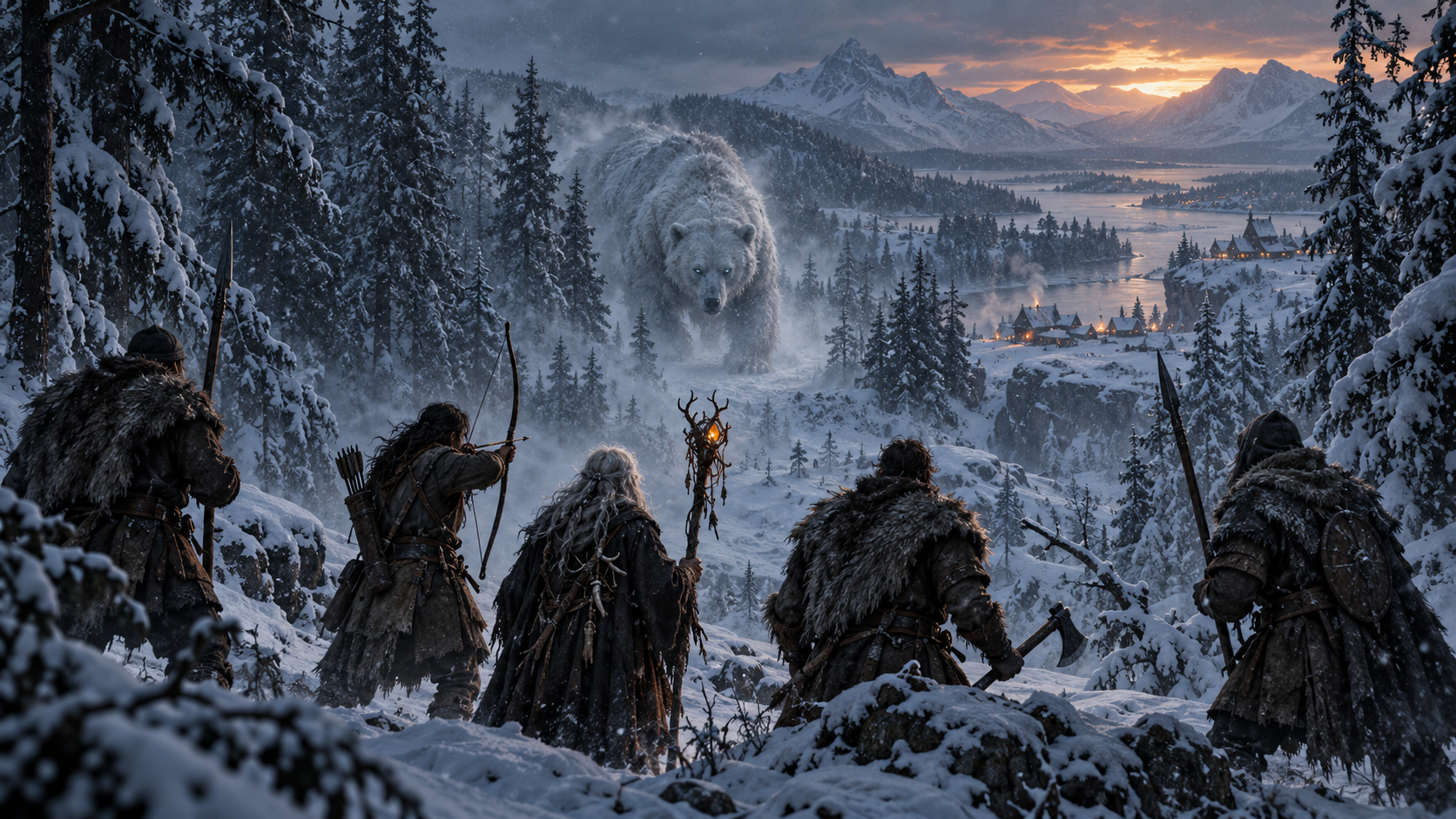
In the village where winter and silence lay as thick as snow, the hunters set out at dawn. Five of them: weathered men with ice in their beards and iron in their blood—and a sorceress. They hunted deer, yes, but more than that, they hunted glory, warmth, proof that they could wrest life from death.
Haldren, the foremost spearman, led with quiet pride. His arms bore scars from wolverines and frostbite. Beside him, Veyr nocked an arrow with practiced ease, his eyes sharp as flint. Morwen, wrapped in raven feathers and ancient invocations, moved without a sound. Old Garran, broad and brutal, carried an axe older than memory. And Pell, the youngest of the five, carried the torch.
On the third day, they found the bear.
A small creature, white as milk, sat in the snow like a child. Its fur curled in soft wisps around its face, and its eyes were dark, deep pools. No growl, no threat—only silence.
“A winter gift,” Old Garran muttered with a grin. “That hide will keep me warm for ten years.”
Veyr drew first. Haldren raised his spear. Pell stepped forward.
And then—it happened.
The forest breathed out. The snow cracked like bone.
The little bear rose—not on paws, but on limbs too long and too jointed. Its back arched, tearing the air with a sound like splitting wood. Fur tore. Muscles swelled. Its jaws opened, revealing rows of needle-sharp teeth, blackened gums, and a tongue like frozen entrails. Its eyes remained dark—but now they watched, ancient and hungry.
Morwen shouted a word of protection—one from the old tongue—but the wind stole it from her. The beast moved faster than a shadow.
Veyr loosed an arrow. It buried itself in the creature's shoulder—and snapped like kindling. Pell ran. The bear lashed out; an arm flew free, blood spilling into the cold.
Haldren charged, spear lowered. He drove the point into the monster's thigh. It barely flinched. One of its claws—now broad as a shield—struck. Haldren's ribs broke. His breath escaped in a cloud of red mist.
Garran roared and swung his axe. It bit deep into the monster's chest—but the wound closed before he could wrench the blade free. The bear seized the haft, tore it from Garran's hands, and drove it into his throat like a spike.
Only Morwen remained.
She stood there, still as frost, hands raised. Her lips moved soundlessly. The air grew heavy. Snowflakes hung suspended in the air. The monster stopped—growling, confused.
With one final whisper, she spoke the binding spell. Not to kill—she knew that lay beyond her power—but to weaken.
The giant shuddered. Its enormous form collapsed inward. Bones cracked, fur receded. The beast shrank back—small and trembling—and took the shape of a little white bear.
Dead.
Morwen sank to her knees. She had no strength left. Cold ate into her fingers, her breathing shallow.
Days later, search parties from the village found her broken staff. They found the axe buried deep in a frozen throat. They found Veyr's bow, unstrung, stained black with unfamiliar blood.
And the bear—small, weak, dead—lay within a circle of blood and ice, its eyes open and staring.
They brought it back. Skinned it. Sold the hide to the highest bidder.
That winter, the village died.
No fire caused it. No storm. Only... cold. A creeping, devouring cold. And among the ruins, villagers swore they had heard something breathing beneath the snow.
The elders say the hide still hangs in a forgotten hall, white as innocence, soft as a child's dream.
But if you listen closely on the coldest night, you can hear the heartbeat.
And it keeps growing louder.
So ends the old fable.
When children ask afterward whether the White One truly exists, the adults of Winterland rarely give the same answer. Some laugh. Some say it is only a story meant to keep children indoors at night.
And some look toward the window before they answer.
For somewhere, it is said, a white hide still hangs in a forgotten hall.
And on especially cold nights, it is said to beat like a heart.
BEARS AND WITCHES
The Four Witches and the Nameless White Bear
Long before the great walls of the NFD stood, before maps could be trusted and before chroniclers began recording every unusual event in neatly bound books, the people of the North lived with things for which they had no certain explanations.
Some of them were stories.
Some were animals.
And some were both.
In an early winter whose exact year was later lost, a small NFD settlement was repeatedly plagued by an enormous white bear.
It did not come regularly.
Not according to any fixed pattern.
Sometimes weeks passed between attacks, sometimes only a few days.
But whenever it appeared, it left people dead.
Broken doors.
Torn-open storehouses.
Blood on snow.
The hunters tried to track it.
They found tracks that vanished into the forest.
The soldiers set traps.
The bear avoided them.
Archers struck it.
The next morning, blood was found in the snow—but no carcass.
And eventually people began to say that this was no ordinary bear.
At that time, a woman named Petunia lived in the NFD.
Later generations called her the Witch of the NFD.
Whether she ever used that title herself, no one knows.
But in the oldest traditions, the fact that she knew magic is treated as more than mere rumor.
Petunia saw the wounded.
She saw the burned-out supply fires.
She saw children who began screaming at night at the slightest scratching against a wooden wall.
At last, she decided that weapons alone were not enough.
She sent messages to three other realms.
The first answer came from AIO.
Scarlet.
A woman with fiery red hair, extraordinary talent, and a temper almost as notorious as her magic.
Helena came from GBR.
Calm, observant, and deeply familiar with older forms of sorcery that even then were understood by almost no one.
Morticia of N3N arrived last.
The sources contradict one another most strongly when it comes to her.
Some describe her as cold.
Others as pragmatic.
Still others call her dangerous.
Yet almost all of them agree on one thing:
Morticia was rarely afraid.
The four women met in Petunia's house at the edge of the settlement.
For three nights, they worked.
They read from books whose pages were already old even then.
They compared signs.
They mixed herbs, ash, animal blood, and substances whose names became illegible in later copies.
The aim was not to kill the bear.
At least, not at first.
Scarlet believed it could be bound.
Driven away.
Perhaps even prevented from ever entering the settlement again.
Helena warned against it.
“Killing an animal is one thing,” she is said to have told them.
“Shutting something out of the world is another.”
Petunia remained silent for a long time.
Then she answered:
“If we do nothing, more people will die.”
Morticia is said to have merely smiled.
“Then we do something.”
The following night, the bear came.
They heard it long before they saw it.
Branches snapped.
Dogs crawled beneath houses.
Horses strained against their tethers.
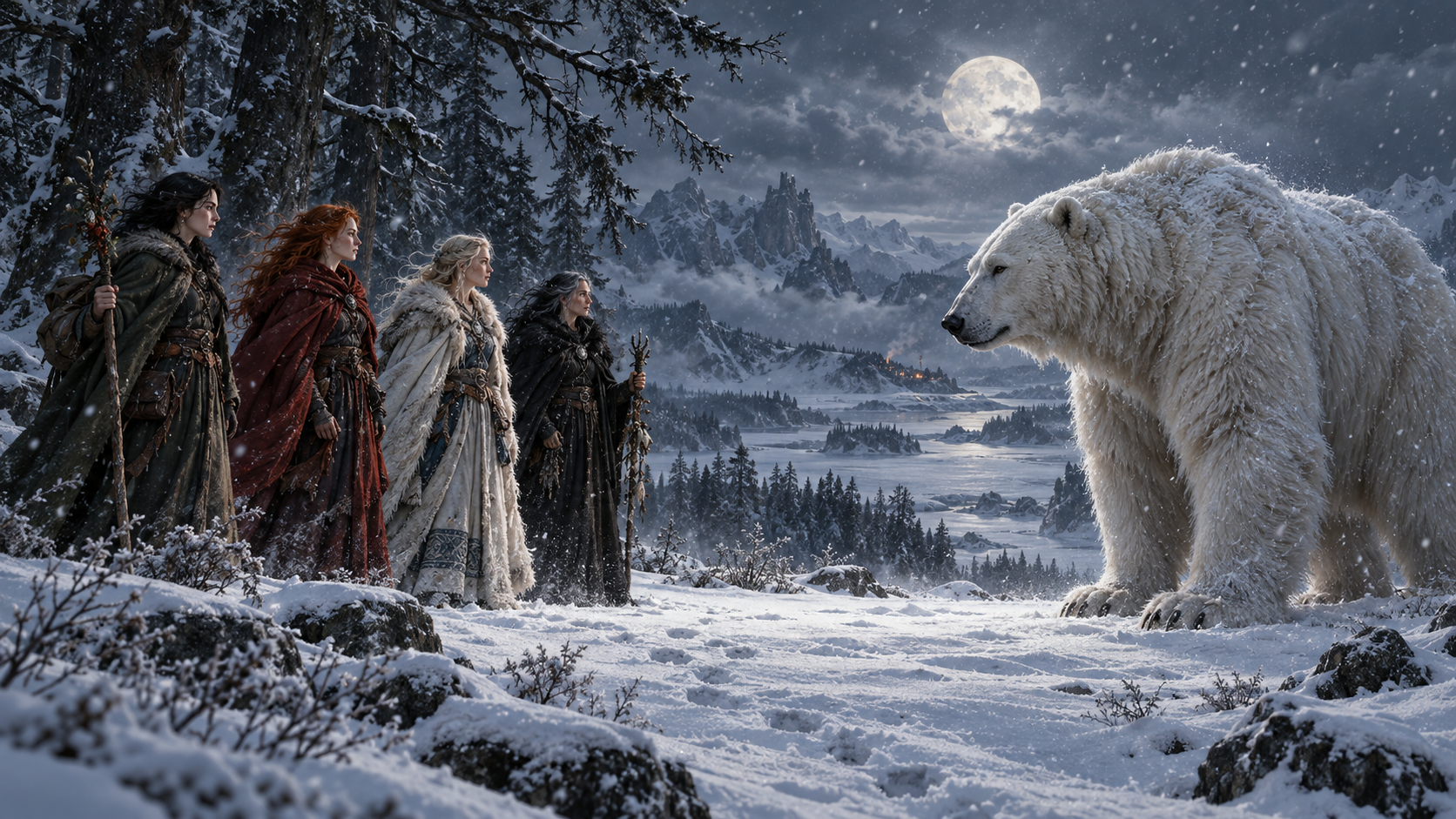
The four witches waited at the edge of the forest.
Signs had been drawn into the snow around them.
Black candles burned despite the wind.
Scarlet began the first part of the ritual.
Helena followed.
Then Petunia.
Morticia came last.
For several moments, nothing happened.
Then the bear emerged between the trees.
Huge.
White.
Blood on one shoulder from an older wound.
It stopped.
And looked at them.
Later storytellers claimed that it understood what the women were doing.
There is no proof of that.
But every known version agrees that the animal did not attack at once.
Scarlet's voice grew louder.
The signs in the snow began to glow.
Petunia raised both hands.
Helena is said to have tried to break off the ritual at that moment.
Why is unknown.
Perhaps she noticed a mistake.
Perhaps she sensed something.
Perhaps that part, too, belongs only to the later legend.
Then the magic slipped out of control.
Morticia's voice faltered.
A single wrong word.
Or a wrong note.
Or perhaps there had been no mistake at all.
The ground shook.
The candle flames suddenly turned white.
A wave of pressure tore through the forest, so powerful that several people in the settlement later claimed their windows shattered at the same instant.
Scarlet screamed.
Helena fell to her knees.
Petunia was hurled several paces backward.
Morticia remained standing.
Then came the light.
For one moment, the entire edge of the forest was brighter than day.
And afterward there was absolute silence.
The bear was still there.
But something had changed.
Its body seemed larger.
Its shoulders higher.
In places, its white fur had darkened, as though something beneath it had burned.
Its eyes gleamed in the half-light.
Red.
Orange.
Perhaps only the reflection of the dying candles.
Perhaps not.
The bear roared.
And attacked.
What happened next is one of the few parts of the tradition described almost identically in several independent accounts.
The animal smashed through the outer houses of the settlement.
People died.
A sentry was hurled against a wall and killed instantly.
One family burned to death inside their own home after an oil lamp was knocked over.
The bear forced its way as far as the central square.
Then it disappeared back into the forest.
No one knows why.
The four witches survived.
But afterward, nothing was as it had been.
Petunia believed the ritual had changed the bear.
Scarlet believed that some force had struck back.
Helena later supposedly spoke of “a door that should never have been opened.”
Morticia said nothing.
At least, no reliable statement from her has survived.
In the months that followed, reports began to arrive from other regions.
Large white bears.
Unusually aggressive.
Some larger than any known animal.
Others supposedly almost impossible to wound.
Some of the stories were certainly exaggerations.
Others could never be verified.
But the similarities were enough.
Before long, people began connecting the events.
The four witches had cursed the world, they said.
Their failed ritual had spread a sickness among the white bears.
Or awakened a demonic power.
Or transformed a single bear into many.
Every realm developed its own version.
And with every generation, the stories grew larger.
Eventually people claimed that every settlement was regularly attacked by monstrous white bears.
Some versions even said the attacks came at fixed intervals.
There is no reliable historical evidence for that.
What does remain documented is the fate of the four women.
Petunia stayed in the NFD.
Her later years are recorded only in fragments.
She is said to have tried to understand the consequences of that night.
And she is said never again to have attempted a ritual of comparable scale.
Scarlet returned to AIO.
There she spent years searching for a counterspell.
Whether she ever believed she had found one is unknown.
Helena began collecting reports of unusual bear attacks.
Some of GBR's later bear chronicles may have been based on her records.
Morticia disappeared.
Exactly when is not known.
Some say it was only a few weeks after the ritual.
Others claim she was still seen years later.
In the legends, she eventually became the one to blame.
The witch who spoke the wrong word.
The woman whose mistake filled the world with white monsters.
Perhaps that is what happened.
Perhaps not.
The oldest NFD chronicles are more cautious.
They confirm four women.
They confirm a ritual.
They confirm a white bear.
And they confirm that something happened that night which the people did not understand.
Everything else came later.
The nameless bear itself was never conclusively found again.
No body was ever recorded.
No trophy.
No grave.
And although later generations repeatedly tried to identify it with other great white bears, there is no evidence for doing so.
It was not demonstrably the White King.
Not Loki.
Not Ursus Diabolus.
Not the Winter Monster.
Not Barrabas.
Not the Twice-Moon Bear.
It remained simply what it had been in the oldest records:
a great white bear without a name.
And perhaps that is precisely why the story is still told today.
Not because it explains where the monstrous white bears came from.
But because it left behind a question no one could answer.
Did the four witches create something?
Awaken something?
Or had the bears always been there?
No one knows.
Only one thing is certain:
On that winter night, four women tried to banish a danger from the world.
And afterward, the world seemed more dangerous than before.
GREY'S STORIES BY THE FIRE — I
FOUR LIGHTS IN THE SNOW
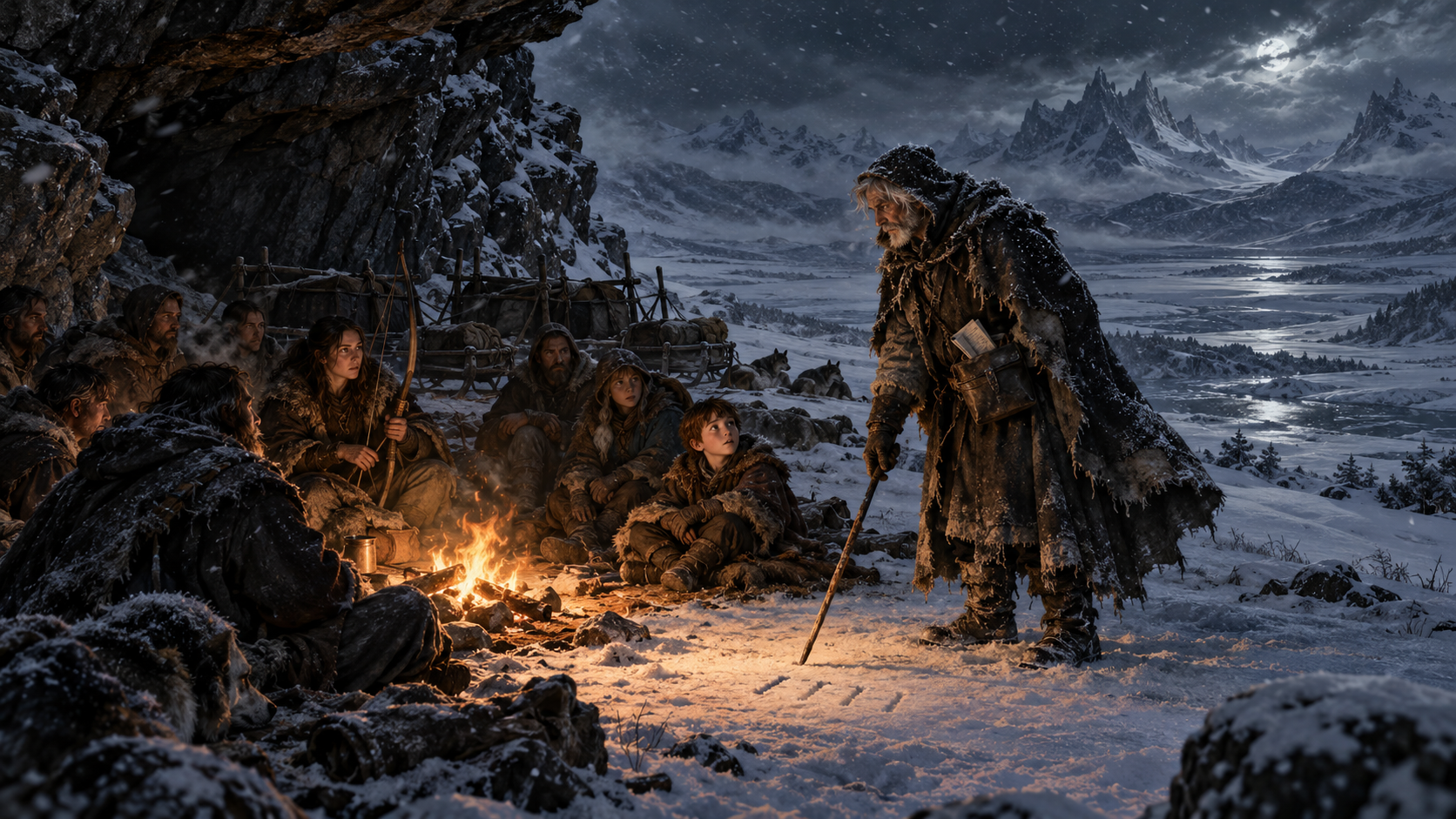
The wind swept low across the tundra.
It drove fine snow over the ground as though determined to erase every track almost as soon as it appeared. Beneath a low ridge of rock, nine travelers had drawn their three sleds together and lit a fire. For one night, merchants, wagon drivers, hunters, an archer, two siblings, and a small family had become something that, on the tundra, could sometimes matter more than friendship.
A community.
The family's boy was named Tomas and was about ten years old. He sat so close to the fire that his mother had to pull him back by the sleeve twice.
Then the archer raised her head.
“There's someone out there.”
A figure emerged from the snow.
Alone.
Slowly.
A very old man, wearing a coat that had been patched so many times it was almost impossible to tell which piece of cloth had once been the original. Grey-white hair showed beneath his hood, and a practical beard covered part of his weathered face.
The archer raised her bow.
The old man stopped.
“If you're going to shoot,” he said, “please try not to hit the coat. It's survived more winters than I have.”
One of the merchants laughed.
The archer did not.
“Name?”
For the briefest moment, the stranger was silent.
“Grey.”
“Grey what?”
“Just Grey.”
“Where are you from?”
Grey looked back into the snow.
“Today?”
Now the wagon driver laughed as well.
Grey was allowed to join them by the fire.
He carried surprisingly little. A small bag. A few loose sheets of paper. A thin book. A pen. Tomas thought he could see traces of ink on his fingers.
“Can you write?” the boy asked.
Grey looked at his hands.
“A little.”
“My father can write his name.”
Grey nodded solemnly.
“Then he should make sure he doesn't forget it.”
Tomas's father pulled a face while the others grinned.
Later, the conversation drifted toward the things conversations on the tundra always reached sooner or later.
Bears.
One merchant snorted.
“Stories. All stories. Stories aren't the truth.”
Grey held his hands over the flames.
“No.”
The merchant looked pleased.
Then Grey added:
“But sometimes the truth is the part of a story people forget the fastest.”
The merchant frowned.
“And sometimes,” Grey said, “a story really is just nonsense invented by a drunken merchant.”
The wagon driver nearly choked with laughter.
Tomas studied the old man.
“Do you know stories about heroes?”
Grey twisted his mouth.
“Heroes are dangerous.”
“Why?”
“Because sooner or later people build statues of them.”
Tomas did not understand.
Grey explained. “Statues don't freeze. They're not afraid. They don't make mistakes. They never lose. They don't argue about jam. And if you look at them long enough, eventually you start believing the person was the same way.”
“Then don't tell a story about heroes,” Tomas said.
Grey looked at him.
“About what, then?”
“People.”
Grey smiled.
“They're the only ones I know.”
The fire crackled.
“Do you know the NFD?” Grey asked.
Tomas nodded at once.
“The kingdom.”
Something moved in Grey's face. So little that Tomas would later have been unable to say whether it had been there at all.
“Yes,” Grey said. “The kingdom.”
Names came at once.
Ket.
Argento.
Nikki.
Darth.
One of the merchants asked about the king.
Grey pushed a piece of wood deeper into the embers.
“That's another story.”
Tomas leaned forward.
“Did you know them?”
Grey stared into the fire for a long time.
“I know stories.”
As far as he was concerned, that apparently settled the matter.
Not for the others.
They wanted the White King.
Kharad.
The talking bear.
Fire Crystals.
The Gunslingers.
Witches.
The great battle.
The fair.
The saber-toothed tigress.
Deathhead.
Darth.
“The first one,” Tomas finally said.
Grey looked at him.
“The first what?”
“The first story.”
Grey picked up a small stick and drew a line in the snow.
“Where does the tundra begin?”
Tomas pointed outside.
“There.”
“And where does it begin out there?”
The boy fell silent.
Grey nodded.
“Exactly.”
He looked around the circle.
“You want to begin with walls. With Fire Crystal workshops. With trade roads. With kings, generals, monsters, and battles.”
He drew a dot.
“But before the walls, there were fences.”
Another.
“Before the Fire Crystal workshops, there was a forge.”
Another.
“Before the trade roads, there was a boy who was convinced that almost everything had a price.”
“Darth,” Tomas said.
Grey raised an eyebrow.
“Perhaps.”
Another dot.
“Before the chronicles, there was a boy who asked too many questions.”
“Argento.”
Grey studied Tomas.
“You're dangerously good at this.”
With the stick, he drew a small circle.
“Before Ket gave orders to others, she was a girl who was remarkably bad at following anyone else's.”
The archer grinned.
“And Nikki?”
“Nikki took things apart.”
“To understand them?”
Grey considered that.
“That's what she claimed later.”
“Did she put them back together?”
“Not all of them survived.”
Now even the archer laughed.
Grey drew four dots in the snow.
Four dots.
Not far apart.
“Four farms,” he said.
The laughter slowly faded.
“Four families.”
He tapped each dot in turn.
“Four children.”
One of the merchants looked at the drawing.
“And from that came a kingdom.”
Grey raised his head.
“No.”
The merchant fell silent.
“From that came people,” Grey said. “The kingdom came much later.”
He brushed the stick across the snow without completely destroying the four dots.
“If you want to understand what happened later, don't begin with the White King. Not with Phaeton. Not with the Fire Crystals. Not with Kharad.”
“Then where?” Tomas asked.
“With four children.”
Grey leaned back.
“They weren't legends. They weren't commanders. They weren't chroniclers. They weren't masters of crystal and fire.”
He looked toward the merchant.
“And they certainly weren't great businessmen.”
“You really don't like Darth,” the merchant said.
Grey looked at him.
“On the contrary.”
The merchant waited for an explanation.
None came.
Grey looked back into the fire.
“They were children. They were cold. They argued. They did foolish things. They were afraid. They stayed together.”
The wind swept over the ridge.
“And long before the tundra knew their names, they knew one another.”
Tomas had forgotten his cold cup.
“What happened?”
Grey looked into the embers.
“Well.”
He pulled his coat tighter around his shoulders.
“Once upon a time, there were four farms.”
The fire crackled.
And Grey began to tell the story.
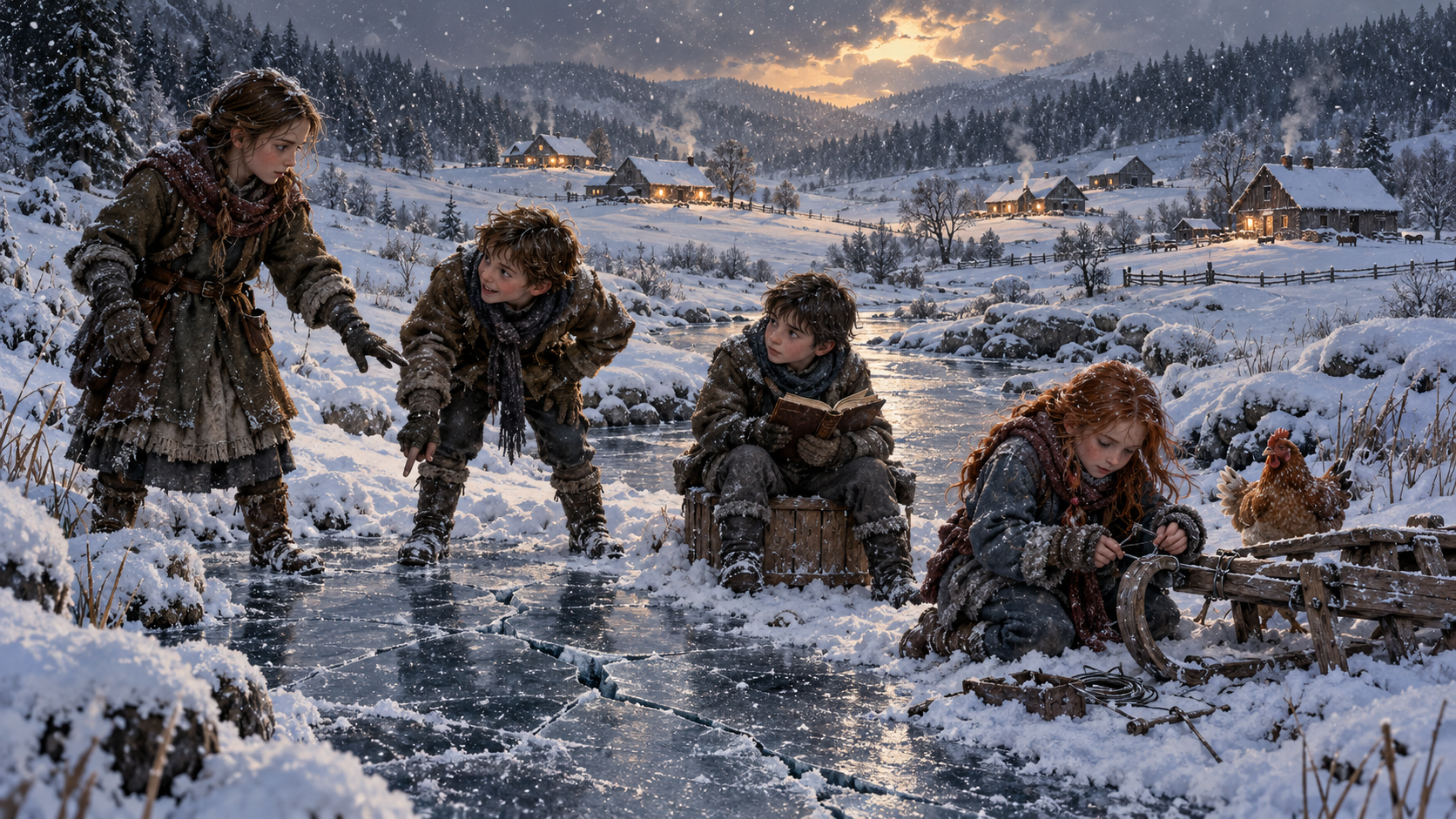
THE FOUR FARMS
The Beginning
There was no village then.
No wall. No watchtowers. No great hall where maps were spread across tables. No NFD. No banners, no titles, and none of the stories that would later be told about them.
There were only four farms.
They stood far enough apart that in heavy snowfall one could no longer see the next from the other, yet close enough that four children believed the whole world consisted of those few houses, the barns, a frozen stream, and the dark forests beyond.
Ket lived on the northern farm.
Argento lived west of it, where his father tried to grow grain in summer even though the soil seemed personally opposed to the idea.
Nikki's family owned the smallest farm, but probably the most tools. After a few years, many of them no longer worked quite the way their original makers had intended.
And Darth lived south of the stream.
Even then, he was convinced that fences existed mainly to challenge people to climb over them.
At some point, the adults had stopped asking why the four were always together.
If a child was missing from one farm, you only had to check one of the other three.
Usually, you found all four.
Sometimes you also found a broken sled, a nervous chicken, and an adult demanding to know whose idea it had been.
The answer was almost never unanimous.
Ket was the oldest.
Not by much.
But by enough that she treated that small difference in age like a military rank.
“We're not crossing the stream.”
“Why?” Darth asked.
“Because the ice is thin.”
“How do you know?”
Ket pointed at a spot in the ice.
“Because you fell through it yesterday.”
Darth looked at the stream.
Then back at Ket.
“That only proves it was thin yesterday.”
Argento, sitting on an overturned wooden bucket reading an old book, did not even look up.
“That may be the stupidest argument I've heard this week.”
“The week has only just started.”
“That worries me.”
Meanwhile, Nikki was kneeling beside an old sled, trying to secure its left runner with two metal clamps and a piece of wire.
Ket watched her.
“Will that hold?”
Nikki tightened the last clamp.
“No.”
Ket waited.
“Would you like to add anything to that?”
“It'll probably hold until the hill.”
Darth grinned.
“Perfect.”
“After that,” Nikki said, “it gets interesting.”
That was more or less how their childhood worked.
Ket tried to keep them alive.
Nikki built things that occasionally made that goal more difficult.
Argento then explained at length why everything that had happened had been entirely predictable.
And Darth usually did exactly what Argento had warned him not to do.
Even so, they were rarely truly at odds.
They knew one another too well.
Ket knew Darth joked when he was afraid.
Darth knew Ket got louder when she was worried.
Nikki knew Argento went quiet when something was truly troubling him.
And Argento knew Nikki always claimed everything was under control about three seconds before something caught fire.
They grew up together.
Not beside one another.
Together.
Their happiest shared memory began with an argument about a goat.
Ket turned fifteen.
Early that morning, she had already announced that she did not want a celebration.
That was a mistake.
Because Darth generally interpreted statements like that as a challenge.
“She doesn't want a celebration,” he said.
Nikki nodded.
“That's what she said.”
“So she needs one.”
Argento looked up from his book.
“Your logic is evolving backward.”
“Thank you.”
“That wasn't praise.”
Darth leaned across the table.
“What does Ket like?”
For three seconds, there was silence.
Nikki said:
“Order.”
Argento added:
“Quiet.”
Darth pulled a face.
“That's a terrible birthday.”
So they did the opposite.
They took over an old barn on Nikki's farm.
From scrap, glass, and two old lanterns, Nikki built something that was supposedly meant to become lighting.
Argento acquired honey, some dried fruit, and a small bottle of alcohol from his parents' stores, which his father had been keeping for medicinal purposes.
Darth stole nothing.
At least, that was what he claimed.
Ket later believed not a word of it.
The real problem was the food.
They wanted to cook something special for her.
None of them could cook.
Argento could read what a cookbook said.
That turned out to be an entirely different skill.
Nikki stared at a mass of dough slowly creeping over the edge of the table.
“Is it supposed to do that?”
Argento flipped through the book.
“No.”
Darth poked the mixture with a spoon.
“Maybe it's alive.”
“Then kill it,” Nikki said.
In the end, there was no cake.
There was a flat, astonishingly hard piece of baked something whose exact composition none of them ever mentioned again.
And then came the goat.
She belonged to Nikki's family and was named Marta.
Marta was a malicious animal.
Darth had always considered goats dangerously underestimated opponents. Ket had laughed at him for years because of it.
That evening, Marta first ate part of the decorations.
Then a piece of cloth.
Then Argento's handwritten birthday message.
Argento stared at the animal.
“That was two pages.”
Marta chewed.
“Two.”
Marta kept chewing.
“I had a structure.”
Darth was already doubled over laughing.
Then Marta jumped onto the table.
Nikki tried to pull her down.
Marta kicked at Nikki.
Darth grabbed for Marta.
Marta rammed Darth.
Darth fell backward into a pile of straw.
At that exact moment, Ket opened the barn door.
She stopped.
Before her were:
an overturned table,
Nikki on the floor,
Argento holding half a sheet of paper,
Darth in the straw,
and Marta in the middle of the birthday meal.
Ket stared at the scene for a long time.
A very long time.
Then she began to laugh.
Not her usual short snort.
Not the crooked grin she normally used to let Darth know he was an idiot.
She laughed so hard that eventually she had to hold on to the doorframe.
Darth crawled out of the straw.
“I don't see what's funny about this.”
That made it worse.
Later, the four of them sat outside the barn.
It was cold, but clear.
There were so many stars above them that the sky looked almost white.
They shared the failed pastry.
Ket got the largest piece.
“This is awful,” she said.
Argento nodded.
“Objectively.”
She took another bite.
“I like it.”
Nikki handed her a small package.
Inside was a knife.
Not a beautiful knife.
A practical one.
The blade was used, but cleanly sharpened. Nikki had replaced the handle herself. Argento had carved a tiny symbol into it.
Four lines.
One for each farm.
Darth had contributed nothing to it.
“I provided moral support.”
Ket studied the blade.
“You probably stole the leather for the sheath.”
Darth said nothing.
Ket looked at him.
“Darth.”
“Found it.”
“Where?”
“With someone else.”
She laughed again.
Many years later, Ket could no longer remember every detail of every battle.
Orders, yes.
The dead, usually.
Faces, sometimes.
But she remembered her fifteenth birthday completely.
The taste of that dreadful pastry.
Marta.
Nikki on the floor.
Argento's outraged face.
And Darth insisting he had been treacherously attacked by a goat.
It may have been the last entirely innocent evening of their childhood.
The worst came the following winter.
The wolves were hungry.
Everyone knew it.
The winter had been hard. Game had grown scarce, and at night the packs could be heard closer to the farms than before.
The adults put out extra lanterns.
Animals were brought into the barns earlier.
No one went out alone after dark.
The four obeyed.
Almost always.
That evening, a calf was missing.
It belonged to Ket's family.
The animal was young and had probably found a damaged section of fence.
Ket found the tracks.
She told no one.
Later, that was the part she remembered most.
Not the wolves.
Not the blood.
That decision.
She took a lantern and her knife.
Argento saw her leave.
Ten minutes later, all four of them were on their way.
Ket was furious.
“You're going back.”
Darth snorted.
“Of course.”
“I mean it.”
“So do I.”
Nikki carried a short wooden pole. She had fixed a small oil lamp to one end.
Argento carried a bow he was not yet particularly good with.
Ket looked at them.
Then she said nothing more.
They followed the tracks.
They found the calf first.
Dead.
The snow around it was dark.
Darth stopped joking.
That was the first warning sign.
The second was the eyes between the trees.
First two.
Then four.
Then more.
Nikki whispered:
“Ket.”
“I see them.”
They were too far from the farms.
Too far from help.
The wolves had already begun to circle them.
Argento counted.
“At least seven.”
“Stop counting,” Darth said.
“Why?”
“Because seven sounds worse than some.”
One wolf came closer.
Ket drew the knife she had received for her fifteenth birthday.
Her hand trembled.
She hated herself for it.
Argento noticed.
He stepped beside her.
“Mine too.”
She looked at him.
His hand really was shaking.
Ket nodded once.
Then the first wolf attacked.
Everything after that happened too quickly.
Argento fired.
His shot was poor, but the arrow grazed the animal and threw it off course.
Ket moved forward.
Too far.
Even then, she did that.
She caught the wolf with her arm and drove the knife sideways into its neck.
The animal screamed.
Ket screamed too.
Darth swung a heavy branch at a second wolf.
Nikki tore the oil lamp from her pole and hurled it into the snow.
Flames ran across the spilled oil.
For a few seconds, the animals backed away.
“Fire!” Nikki shouted.
“Excellent observation!” Argento yelled.
“More of it, idiot!”
They did not build a defense.
Not really.
They were children.
Later, some people told the story differently.
As though four future heroes had already stood shoulder to shoulder and fought.
That was not true.
They were afraid.
Darth fell twice.
Argento lost his bow.
Nikki burned her hand.
Ket was bitten in the forearm deeply enough that the scar remained for years.
They shouted over one another.
They stumbled.
They made mistakes.
And still, they did not leave one another behind.
That saved them.
Nikki kept the fire alive.
Argento spotted a small rocky ridge and shouted for the others to fall back toward it, so the animals could no longer surround them completely.
Ket held the front.
Darth stayed beside her.
A wolf leaped at him.
Ket slammed it aside.
Another came from the left.
Darth struck it with the wooden pole.
Then there was a third.
Later, Argento remembered only its mouth.
Teeth.
Breath.
Saliva.
And Nikki, suddenly standing between them, smashing a burning piece of wood into the animal's face.
It may have lasted five minutes.
To them, it lasted hours.
Then lights appeared between the trees.
Their families.
Shouts.
Dogs.
Torches.
The wolves vanished.
Not all of them.
Two remained dead in the snow.
One dragged itself away, wounded.
The rest dissolved between the trees as though the forest had swallowed them.
Ket remained standing for several seconds.
Then she dropped the knife.
Darth simply sat down.
Nikki stared at her burned hand.
Argento vomited behind a tree.
No one made a joke about it.
That night, they slept in the same house.
Not because it was necessary.
Because none of them wanted to be alone.
The adults let them.
Ket lay awake, staring at the ceiling.
Her arm was bandaged.
Beside her, Nikki eventually fell asleep.
Argento lay on the floor, wrapped in two blankets.
Darth was still sitting by the window.
“Darth?”
“Hmm?”
“Why did you come with me?”
He thought about it for a long time.
“Because Argento went.”
Argento opened his eyes.
“I went because Ket went.”
Nikki spoke without opening hers.
“I went because you three idiots went.”
Ket stared at the ceiling.
“I nearly got you killed.”
This time, no one answered immediately.
Then Argento said:
“No.”
“I should have gone alone.”
“That would have been even stupider.”
Ket turned her head.
Argento looked at her.
He was pale.
Tired.
Very young.
“We should have gotten an adult,” he said. “That would have been the right decision.”
Darth nodded.
“Yes.”
Nikki did too.
Ket waited.
Darth looked out the window.
“But if you ever go into a forest full of wolves alone again, I'm still coming with you.”
Ket closed her eyes.
“You're an idiot.”
“We've already established that.”
She did not laugh.
None of them did.
Many years later, the four disagreed about some of the details.
Who had seen the first wolf.
How many there had been.
Who had killed which one.
Whether Nikki's fire had truly held the pack back or whether the wolves had been hesitant anyway.
There was one thing they never argued about.
It was the worst night of their childhood.
Not because they had nearly died.
But because that night, for the first time, they understood that they could lose one another.
The four farms later ceased to exist as they had known them.
Winters came.
People left.
Others arrived.
Scattered houses became settlements.
Settlements became communities.
Children became people others told stories about.
Ket learned to give orders when everyone else hesitated.
Nikki built things larger and more complicated than any sled from her childhood.
Argento began writing down what others had long forgotten.
And Darth learned to keep laughing even when there was nothing left to laugh about.
But long before anyone knew their names, they had simply been four children.
Four farms.
A stream.
A forest.
A pack of wolves.
And a fifteenth birthday with a goat, an inedible cake, and a knife with four small lines carved into its handle.
Ket still owned that knife many years later.
When someone asked what the lines meant, she usually gave no answer.
Only once is she said to have replied:
“Before we knew who we would become, we already knew who belonged with us.”
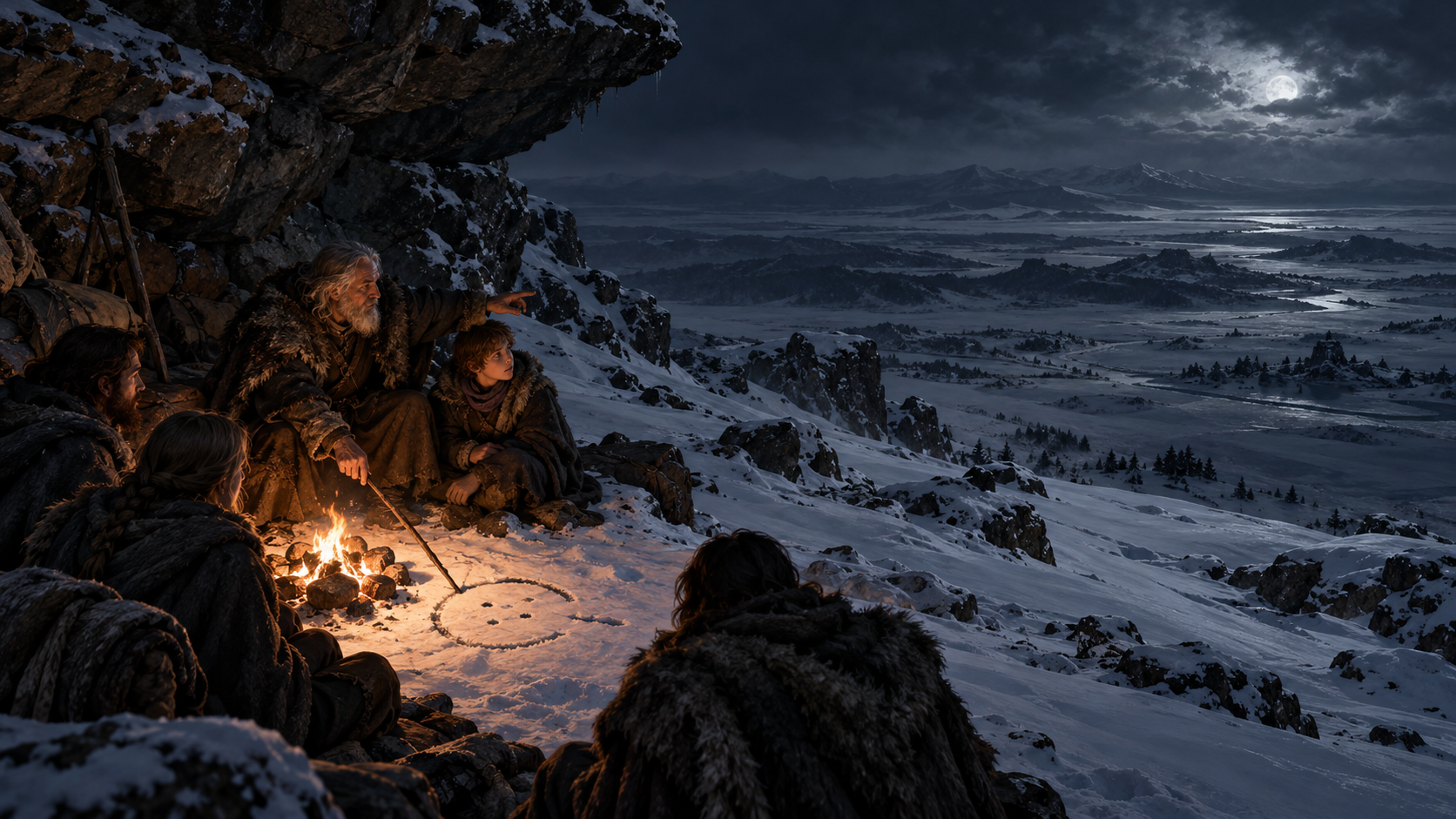
GREY'S STORIES BY THE FIRE — II
BEYOND THE FENCES
After Grey finished telling the story of the four farms, no one spoke for a while.
The fire had grown smaller.
The wind had not.
Tomas held his cup in both hands, though what was inside had long since gone cold. Only moments ago there had been four farms. Four families. Four children. A wolf pack. Fear. Work. Arguments. And a birthday Grey had described with such seriousness that one might have thought a birthday could change the fate of a world.
One of the merchants cleared his throat.
“That's it?”
Grey looked at him.
“What?”
“The story.”
“I'm afraid so.”
“I thought something was going to happen.”
The archer raised an eyebrow.
“A wolf pack attacks four farms.”
The merchant shrugged.
“You know what I mean.”
Grey nodded.
“Ket had a birthday.”
“And?”
“Birthdays are more dangerous.”
The wagon driver laughed.
The merchant gestured into the darkness.
“NFD. Wars. Bears. Fire Crystals. Kharad. Phaeton. Those are stories.”
Grey studied him.
“And four children on farms aren't?”
“Barely.”
Grey sighed.
“That's the trouble with witnesses. After five minutes they remember my words better than I do.”
“Then write them down,” the wagon driver said.
Grey gave him a brief glance.
Only one.
Then he looked back into the fire.
“You want to know when the important story begins.”
Tomas nodded.
Grey shook his head.
“Then you haven't been listening.”
He pointed toward the darkness beyond the fire.
“What do you see?”
Tomas looked out.
“Snow.”
“Anything else?”
“Rocks.”
“And beyond them?”
The boy shrugged.
Grey nodded.
“An entire world.”
He picked up the stick again.
“For children, four farms can be a world. They know every path. Every tree. Every barn. The place where the snow melts first in spring. The door that sticks in the frost. The fence that keeps giving way. The place you hide when you've done something adults aren't supposed to discover.”
“Who hid the most?” Tomas asked.
“Guess.”
“Darth.”
Grey said nothing.
“Nikki?”
Grey remained silent.
“Argento?”
Grey looked offended.
“Now you're being insulting.”
Tomas grinned.
Grey drew a line around four dots.
“A small world is not a bad thing. In a small world, everything seems to have its place.”
He broke the line at one point.
“And the unknown stays beyond the fence.”
He looked at Tomas.
“Until one day you realize a fence cannot hold back the world.”
The archer looked out into the snow.
Grey continued.
“The wolves were a warning. Not the world's first. But perhaps one of the first those four truly understood.”
“What warning?”
“That there are things out there that do not care in the slightest how safe you felt yesterday.”
He paused.
“That also applies to merchants, by the way.”
“One day,” the merchant said, “you'll tell a story where the merchant is the hero.”
“I know several.”
The merchant smiled.
“Really?”
“I didn't say they end well.”
The wagon driver snorted.
“You old bastard.”
Grey nodded.
“I've been accused of that from time to time.”
Tomas waited.
“What happened after the farms?”
Grey looked at him.
“They got older.”
“That's boring.”
“Only to children.”
Grey stretched his hands toward the fire.
“Children think adults eventually become finished.”
Tomas frowned.
“Finished?”
“As people.”
Grey shook his head.
“That's one of adulthood's best-kept secrets.”
The boy's mother smiled.
“Ket, Argento, Nikki, and Darth grew older. They learned. They argued. They found things they were good at.”
Grey paused.
“And things they believed they were good at.”
“Darth,” Tomas said.
Grey nodded approvingly.
“You're learning.”
The four farms remained.
The families remained.
The memories remained.
But the circle grew larger.
Grey drew another circle around the four dots.
“People leave home for many reasons. Because they have to. Because they want to. For work. For safety. Out of curiosity.”
Another circle.
“And some only understand years later what they were actually looking for.”
“Which of them?”
Grey looked at Tomas.
“Yes.”
“That wasn't an answer.”
“It was.”
“A bad one.”
“Those are answers too.”
Someone handed Grey a small bottle of homemade liquor.
He took a sip, grimaced, and took another.
Tomas stared at him.
“Why do you drink it if it's that bad?”
“I'm old.”
Grey handed the bottle back.
“Sometimes we make bad decisions out of tradition.”
They laughed.
Then Grey grew serious again.
“There was no beautiful morning when four children packed their bags at the same time, stood in front of their farms, and decided that now the story would begin.”
He drew the next circle.
“History doesn't work that way.”
The merchant pointed at the drawing.
“And eventually that became NFD.”
“Eventually.”
“When?”
Grey was silent.
“How much later?”
Grey sighed.
“Do you want a story or a ledger?”
The merchant raised his hands in surrender.
“NFD wasn't born in a single day,” Grey said. “It grew. From people. From decisions.”
He smiled faintly.
“And from things that went thoroughly wrong.”
Tomas stared at the circles.
Then he said:
“The Departure.”
Grey paused.
“What?”
“The Departure.”
Tomas's father looked at his son.
“Where did you hear that?”
“Grandfather. That's what he calls the old stories.”
Grey studied the boy.
“The Departure?”
Tomas nodded.
“Grandfather says that's where everything began.”
Grey leaned back.
“Grandfathers like saying things like that.”
“Isn't it true?”
“No.”
Tomas looked disappointed.
“Then why is it called The Departure?”
Grey stirred the fire.
“Because people give things names after they've happened.”
He looked around the circle.
“A name makes something orderly.”
“And history isn't orderly,” the archer said.
Grey nodded.
“Very good.”
Tomas would not give up.
“So The Departure didn't happen?”
“It did.”
“But it wasn't the beginning?”
“It was a departure. Not the beginning.”
Grey pointed at Tomas.
“You set out this morning.”
“Yes.”
“Did your life begin this morning?”
“No.”
“But did something new?”
Tomas thought about it.
“Yes.”
Grey smiled.
“Exactly.”
“What began back then?”
Grey looked beyond the fire.
“The world grew larger.”
He waited.
“And more dangerous.”
Tomas swallowed.
“A bear?”
Grey did not answer.
“A white one?”
The merchant grinned.
“Now it's getting interesting.”
Grey looked at him.
“If someone tells you a story about a white bear and your first thought is, Now it's getting interesting, then you've probably never met a white bear.”
The grin disappeared.
“There are many stories about white bears,” Grey said.
The wind pushed smoke between the travelers.
“Too many.”
“Which ones are true?” Tomas asked.
“Some.”
“And the others?”
“Lies.”
“And the rest?”
Grey nodded approvingly.
“The rest have been told so many times that no one knows anymore where one ends and the other begins.”
“The talking bear?”
“For example.”
“The witches?”
“For example.”
“The White King?”
Grey was silent a moment longer.
“For example.”
The self-proclaimed hunter cleared his throat.
“I heard all white bears came from a single curse.”
Grey looked at him.
“From whom?”
“A man in a tavern.”
Grey nodded solemnly.
“Then we have a man in a tavern. One of the most reliable sources in human history.”
The archer laughed.
Tomas did not.
“Is the curse false?”
“I didn't say that.”
“Then it's true?”
“I didn't say that either.”
“Then what?”
Grey looked at him for a long time.
“That's exactly the question you should keep.”
He raised a hand.
“There are things we know.”
One finger.
“Things someone saw.”
A second.
“Things someone wrote down.”
A third.
“And things people tell.”
He kept his hand raised.
“Sometimes all four are the same.”
Tomas blinked.
“That was only three.”
Grey looked at his fingers.
“Damn.”
The merchant laughed loudly.
“Old age?”
Grey took the bottle of liquor.
“Or this.”
He drank.
“Destroying the evidence.”
Tomas waited until the laughter had passed.
“What happened during The Departure?”
Grey set the bottle aside.
“If I tell you now, I won't need to tell the story.”
“Then tell it.”
Grey was silent.
Tomas added:
“Please.”
Grey nodded.
“I like please.”
“You're doing this on purpose,” the merchant said.
Grey looked at him.
“Of course.”
The travelers moved closer to the fire.
The story of the four farms had felt warm. Small. Familiar.
Now there was something else.
A door.
And Grey sat before it.
Beyond it lay something cold and vast.
“Later,” Grey said, “those four people became names.”
He stared into the flames.
“Names that were written. Sung. Revered. Cursed. Told wrongly.”
The merchant muttered something about Darth.
Grey ignored him.
“People made them larger.”
He looked at Tomas.
“That's why it's important to remember that they weren't.”
“Not large?”
“Not finished.”
Grey placed another piece of wood on the fire.
“When The Departure began, they didn't know where their decisions would lead.”
The flames rose.
“They didn't know what friends they would find.”
A piece of wood split.
“What people they would lose.”
Grey fell silent.
“What names they would one day have to write down.”
His right hand rested in the firelight.
For a moment, the fingers moved slowly.
As though cold had crept into them.
Or a memory.
Then Grey drew the hand beneath his coat.
No one said anything.
“And they certainly didn't know,” he continued, “how many stories people would one day tell about white bears.”
Tomas whispered:
“The Departure.”
Grey nodded.
“The Departure.”
The boy moved closer.
Grey looked around the circle.
“The four farms had taught them where they came from.”
He let the words remain.
Then he said:
“The Departure showed them how large the world beyond their fences truly was.”
The wind swept across the tundra.
No one spoke anymore.
Grey waited until only the fire and the wind could be heard.
Then he began.
“It was a land of ice and snow …”
The Chronicle of the White Waste
11th Day of the Deep Frost — Expedition Log: Seef
The silence here is not peace.
It is merely what remains when the wind has been still long enough for a person to hear the blood flowing through their own veins.
We are three days' travel from the settlement.
The purpose of this expedition is easy to write down and considerably harder to explain:
Find the source of the Great White Bears.
If there is one at all.
For years, people have claimed that the creatures come from somewhere beyond the northern mountain ridges. Some insist that they were once ordinary bears, changed by the Winterland. Others speak of breeding grounds beneath the ice, ancient ruins, disease, hunger, fire crystals, curses, gods, and every other explanation frightened people devise when teeth grow larger than reason.
We know none of this.
That is why we are here.
Yari believes the answer will be disappointingly practical.
Doma has barely spoken since we set out.
Christ spent part of this morning arguing that one of our maps was geometrically impossible.
I am beginning to suspect the map agrees with him.
Tomorrow we continue north.
If we find nothing, we return with nothing.
That is still better than returning with a lie.
— Seef
11th Day of the Deep Frost — Technical Memorandum: Yari
For the record:
The traps along the northern perimeter are still badly constructed.
I have explained this repeatedly.
The current drop devices and pits depend on the weather, rope tension, snow depth, the animal's weight, and apparently divine intervention.
That is not engineering.
That is optimism with sharpened sticks.
I proposed improved reset mechanisms several seasons ago.
The objection was cost.
Apparently it is cheaper to replace destroyed walls, lost supplies, and injured defenders.
I asked Seef to explain the mathematics behind that.
He declined.
As for the supposed “origin” of the Great White Bears:
At present there is no proof that any single origin exists at all.
A cave is possible.
Migration is possible.
Changes in the distribution of prey are possible.
Multiple populations are possible.
Magic is the word people use when they have stopped measuring things.
Doma disagreed with that statement.
Or perhaps he did not.
He stared at me for several seconds and walked away.
Difficult man.
Useful, though.
— Yari
11th Day of the Deep Frost — Field Report: Christ
We were beneath an overhang of ice when the sound reached us.
Not wind.
Not cracking ice.
Fighting.
Heavy fighting.
It came from behind us.
From the direction of the settlement.
Doma heard it first.
Then Seef.
I counted the impacts.
Wood splintering.
Metal.
Screams.
Something large was striking the outer defenses.
Whatever we had been looking for in the north had either never been here—
or it had passed us by.
Seef ordered an immediate return.
We abandoned everything that slowed us down.
Doma took the lead.
Yari complained about the loss of equipment for about thirty seconds before deciding that survival has economic value.
We ran.
No stealth.
No formation worth recording.
Only speed.
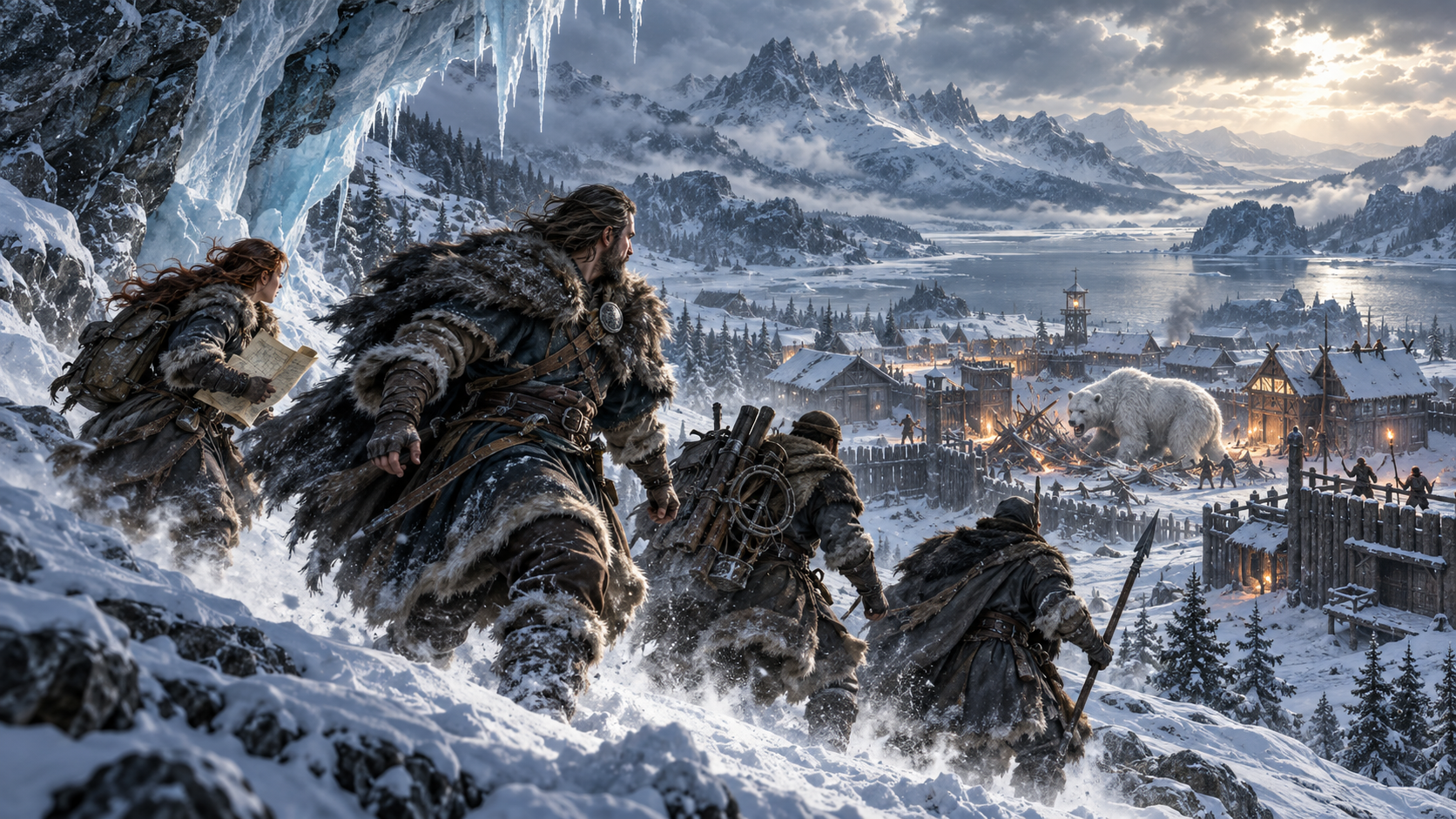
When we reached the ridge above the settlement, we saw the creature.
I have seen large bears.
This was something else.
Whether that means a different species, unusual growth, a mutation, great age, or simply an exceptionally large specimen is beyond the scope of this report.
It was white.
It was enormous.
And it was already inside the defensive line.
So much for the search for its origin.
The origin had found us.
— Christ
11th Day of the Deep Frost — Kill Report: Doma
One bear.
Very large.
Perimeter traps mostly useless.
Yari was right.
Do not tell him I wrote that.
Three guards had already fallen when we arrived.
The bear had broken through part of the outer defenses and reached the supply buildings.
Seef began drawing the defenders away from the creature's front.
Christ and the others pressed its flanks.
Yari shouted something about the watchtower.
Probably important.
I climbed higher.
The bear was too heavily built for a simple body shot.
Heart unreliable.
Shoulder unreliable.
Skull worse.
Neck.
Behind the ear.
That was the opening.
I loaded the heavy bolt.
Waited.
The bear turned.
I fired.
Hit.
The bolt entered at the joint behind its head.
The bear stopped.
Then it fell.
Unfortunately, one of our guards was still too close.
The animal's full weight came down on him before anyone could pull him clear.
He died instantly.
Four dead in total.
More wounded.
One bear dead.
Seef stabbed the carcass several more times afterward.
He claimed he wanted to make sure.
I think he was angry.
Yari inspected the failed traps before he inspected the bear.
Christ helped the wounded.
I retrieved my weapon.
We did not find the source of the Great White Bears.
We found no cave.
No breeding ground.
No place of transformation.
No evidence of curses, experiments, ancient creatures, or anything else people will undoubtedly claim by tomorrow morning.
We found tracks.
We found a bear.
We killed it.
That is what happened.
Anything beyond that belongs in another report.
— Doma
Archivist's Note
The expedition into the White Waste was unable to establish the origin of the Great White Bears.
Later retellings occasionally claim that the expedition discovered where the creatures came from, or proved that ordinary bears had been transformed into the enormous white predators encountered throughout the Winterland.
The surviving reports support neither conclusion.
The expedition ended when the party returned to defend the settlement against an enormous bear's attack.
The creature was killed.
Four defenders died in the attack, including a guard crushed beneath the bear as it fell.
The origin of the Great White Bears remained unknown.
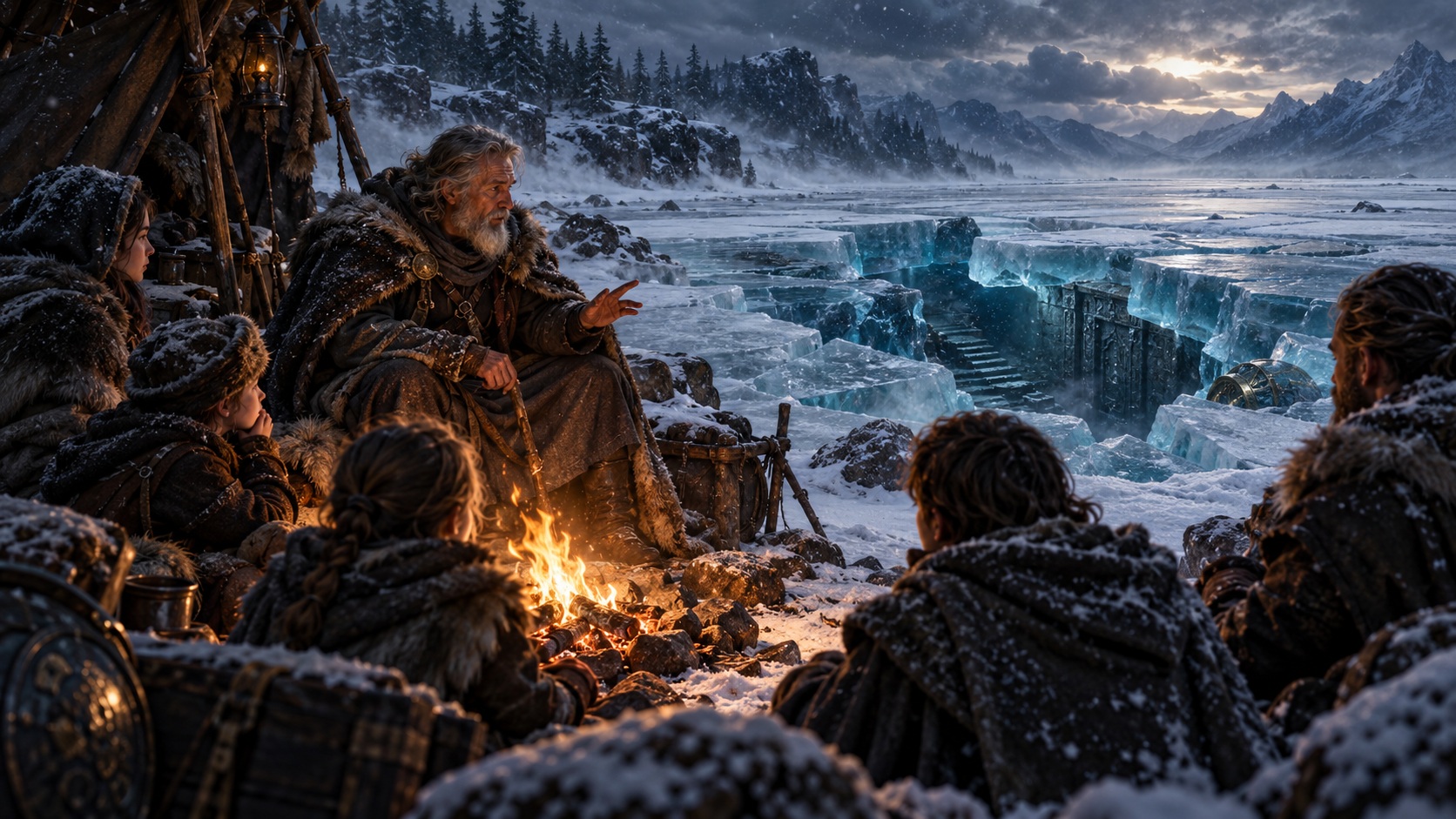
GREY'S STORIES BY THE FIRE III — THE THINGS BENEATH THE ICE
The wind was stronger than usual that evening.
It did not sweep over the walls.
It pressed against them.
Again and again.
As though something outside wanted to come in.
The children sat closer to the fire than usual.
Grey sat in his old place.
His back against the wall.
His hands around a cup that had long since stopped steaming.
For a while, no one spoke.
Then a dull sound came from outside.
Somewhere, the wind had thrown something against a wall.
One of the children looked toward the door.
“Can the wind carry off a town?”
Grey raised an eyebrow.
“A badly built one.”
A few children laughed.
“And a good one?”
“With a good one, it only takes the roofs.”
Now the adults at the other end of the room laughed too.
Grey took a sip.
“But the wind is not the most dangerous thing.”
The laughter faded.
A boy moved closer.
“What is?”
Grey looked into the fire.
“The ice.”
“But ice doesn't move.”
Grey looked at him.
“Then you've never watched it long enough.”
“The Winterland,” Grey began, “is not a still place.”
“It only looks that way.”
He pointed a finger at the floor.
“Beneath your feet, it is at work.”
“The ice presses.”
“It splits.”
“It shifts.”
“It buries.”
“And sometimes it gives back what it took long ago.”
A girl frowned.
“Treasure?”
“Of course.”
Her eyes widened.
Grey nodded gravely.
“Stones.”
The girl pulled a face.
“Those aren't treasures.”
“That depends on how badly you need a stone.”
More laughter.
Grey waited.
Then his voice grew quieter.
“But sometimes people really do find things.”
“What things?”
“Old ones.”
“How old?”
Grey gazed into the fire.
“Old enough that nobody remembers who made them.”
He told them about a hunter who was said to have traveled through the north many years ago.
Nobody remembered the man's name anymore.
Perhaps Grey had forgotten it.
Perhaps the story had never known it.
The hunter had set out after a storm.
For three days, snow had lashed the land.
When the sky finally cleared, nothing was where it had been before.
Hills had disappeared.
Others had appeared.
An old path lay beneath several meters of snow.
And in one place the storm had stripped the ice down to dark stone.
There the hunter found a wall.
Not a whole wall.
Only a section.
Three large stones, neatly set one upon another.
In the middle of nowhere.
“Maybe it was a hut,” one of the children said.
“Maybe.”
“A city?”
“Maybe.”
“A fortress?”
Grey shrugged.
“Maybe it was a particularly ambitious bench.”
The children groaned.
Grey smiled.
“The hunter dug.”
The smile vanished.
“And beneath the ice he found more.”
Steps.
That was the first thing.
They led downward.
Only five were visible.
The rest vanished under ice.
The hunter kept digging.
He found a sixth.
Then a seventh.
On the eighth lay something.
A piece of metal.
Black.
Smooth.
Without rust.
The hunter took it with him.
“What was it?”
Grey lifted his cup.
“A piece of metal.”
“But what was it from?”
“That is the right question.”
“And the answer?”
“We don't have it.”
A child sighed.
“Your stories often have no answers.”
“Neither does the world.”
The child thought about that.
Apparently the explanation did not satisfy him.
Grey went on.
The next morning the hunter returned.
The steps were gone.
Not covered in snow.
Not buried by a collapse.
The ice had moved.
An entire sheet had slid over the place.
Where the wall had stood the day before, there was now a smooth white surface.
The man searched for two days.
He found nothing.
Only the black piece of metal remained.
“Where is it now?”
Grey looked at the boy who had asked.
“Lost.”
“How can something like that get lost?”
“The same way everything else does.”
“Someone puts it somewhere.”
“Someone dies.”
“A house burns.”
“A settlement is abandoned.”
“A name is forgotten.”
Grey looked back into the fire.
“And eventually no one knows it ever existed.”
A girl raised her hand.
Grey regarded her.
“You don't have to raise your hand for a story.”
She lowered it.
“What else is under the ice?”
Grey fell silent.
Outside, the wind howled.
“No one knows.”
“But you must have heard stories.”
“Many.”
“Which ones?”
Grey counted on his fingers.
“Old roads.”
One finger.
“Houses.”
Two.
“Bones.”
Three.
“Weapons.”
Four.
“Signs no one could read.”
Five.
He took his other hand.
“And once, a sled.”
The children waited.
“What was special about the sled?”
“Nothing.”
“Then why mention it?”
“Because its owner had been looking for it for three years.”
A man at the other end of the room laughed aloud.
Grey grinned.
Then he put his hands around his cup again.
“Most things beneath the ice are ordinary.”
“That doesn't make them unimportant.”
“But is there something else down there?”
This time the question came very softly.
Grey did not look at the child immediately.
“What do you mean by something else?”
“Something that isn't ours.”
The fire crackled.
With his boot, Grey pushed a piece of wood deeper into the embers.
“That is a dangerous question.”
“Why?”
“Because when people don't understand something, they are very quick to decide what it must be.”
He looked around the circle.
“A strange sign becomes magic.”
“A sound beneath the ice becomes a monster.”
“An old ruin becomes a temple.”
“And eventually a story becomes truth, though no one remembers where it began.”
The children were quiet.
Grey pointed toward them.
“So remember this.”
“If you find something you don't understand, first say what you saw.”
“Not what you think it means.”
An older boy grinned.
“That sounds like Argento.”
Grey paused.
Then he snorted.
“The boy has learned something after all.”
The storm grew stronger.
This time the door trembled slightly on its hinges.
Some children turned around.
Grey did not.
“So there isn't another world beneath the ice?”
The question came from the smallest girl by the fire.
Grey studied her for a long time.
“Another world?”
She nodded.
“Under ours.”
Grey set down his cup.
“No.”
The girl looked disappointed.
Then Grey added:
“But perhaps there are things from our own world down there that we have forgotten.”
She considered that.
“Is that better?”
“No.”
Grey smiled.
“But more likely.”
Later the children were collected.
One by one.
Coats were fastened.
Scarves wrapped around small faces.
The door opened only briefly each time.
Each time, snow blew inside.
Then the room was almost empty.
Only Grey remained by the fire.
Outside, the storm still raged.
Someone came to stand beside him.
“You're frightening them.”
Grey did not look up.
“A little fear keeps children from climbing into holes.”
“Did it work with Argento?”
Grey thought for a moment.
“No.”
“With Ket?”
“Even less.”
“Then your method isn't very good.”
Grey picked up his cup.
“I'm still working on it.”
That night the storm worsened.
It swept across the plain.
Across old paths.
Across frozen rivers.
Across places no human had visited in years.
Snow was torn away.
Ice broke.
In some places, new drifts formed.
In others, long-hidden things were laid bare.
By morning the wind began to subside.
The Winterland looked as it always did.
White.
Cold.
Endless.
Almost as it always did.
For far beyond the usual paths, something had changed in a ridge of old ice and dark rock.
A narrow fissure had opened.
No one saw it that morning.
No one knew it was there.
Not yet.
The evening before, Grey had said the ice sometimes gave things back.
A few days later, it would become clear that it did not always give back things.
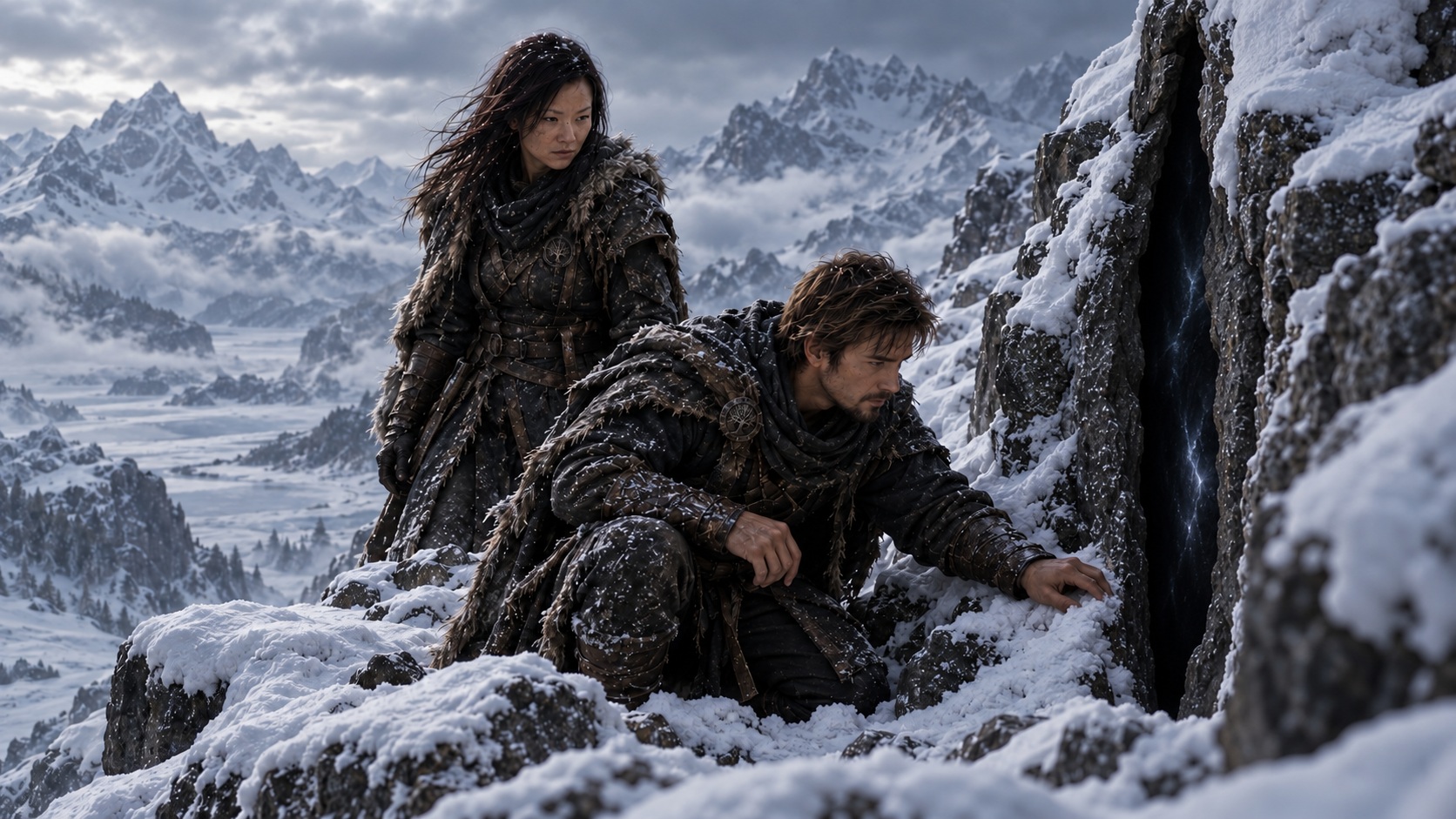
THE RIFT
The fissure appeared after a storm.
At first, no one thought it mattered.
The Winterland was full of fractured ice, collapsed sheets, and cracks that opened without warning. Most vanished beneath the next snowfall.
This one did not.
Ket noticed it first.
Three days after the storm, the fissure was still open.
Five days later, no snow had settled inside it.
On the seventh day, Argento went to look at it.
He returned after dark.
“We need to go back.”
Ket looked up.
“That sounds like the beginning of a bad decision.”
“It probably is.”
“Good. When?”
They set out at dawn.
The fissure lay away from the usual routes, cut into a ridge of old ice and darker rock.
Ket approached carefully.
Argento did not.
He was already kneeling at one edge, brushing snow away with his glove.
“There.”
Ket saw nothing.
“What?”
“Markings.”
She crouched.
At first they looked like scratches.
Then she noticed the repetitions.
Lines.
Curves.
Something deliberate.
“Writing?”
“Maybe.”
“That isn't reassuring.”
“No.”
Argento touched one of the markings.
Nothing happened.
Ket exhaled.
Then the wind fell silent.
They both noticed.
The Winterland was never truly quiet.
There was always wind, ice, distant movement, something.
Here, suddenly, there was nothing.
Argento stood.
The darkness inside the fissure had changed.
Farther in, a faint, pale shimmer appeared.
Ket drew her weapon.
Argento looked at her.
“If it helps, I'm impressed.”
“If it doesn't, I feel better holding it.”
They went inside.
The passage led deeper down than either had expected.
Sometimes there was stone beneath their boots.
Sometimes ice.
Sometimes something that looked like both.
The strange markings appeared again on the walls.
Argento recognized fragments from several ancient records, but never enough to translate them with certainty.
One expression appeared repeatedly.
At least, he thought it did.
Rift.
Ket stopped.
“You think?”
“I said the symbols resemble references I've seen.”
“Which means you think.”
“It means I'm trying not to lie to you.”
“Good habit.”
They went on.
Then the cold changed.
Not gradually.
One moment their breath was freezing against their scarves.
The next, Ket felt warm air on her face.
She stopped.
Argento stopped beside her.
There was light ahead.
Not torchlight.
Not the glow of fire crystals.
Daylight.
They stepped through.
For several moments, neither spoke.
There was no snow.
No frozen ground.
No familiar sky.
Heat pressed against them.
Insects moved through tall vegetation.
Somewhere nearby, water flowed freely.
Plants grew around them in shapes neither recognized.
Ket slowly lowered her weapon.
“Where are we?”
Argento looked behind them.
The opening was still visible as a pale distortion between two dark formations.
“I don't know.”
“Another part of the Winterland?”
“Maybe.”
“That sounded dishonest.”
Argento stared toward the unfamiliar horizon.
“I have no idea where we are.”
“Better.”
They marked the passage's location.
Then they explored the area.
Carefully.
Later accounts made this place seem impossible.
Some versions described crimson forests.
Others claimed the trees had sung.
One retelling insisted that Ket and Argento had encountered a creature with six legs and golden eyes.
Another claimed the creature had spoken without words.
Some said silver threads ran through the earth.
Some called them veins.
Some called them roots.
Some called them the Threads of the World.
Argento himself never confirmed most of these descriptions.
When asked about it years later, he gave only one answer:
“We saw things we didn't understand.”
Ket was less patient.
When someone once asked whether the trees really had spoken, she replied:
“If a tree starts talking to you, hit it first and ask Argento afterward.”
That did not settle the matter.
What is known is that they went deeper into the warm land.
And something happened there.
They found a structure.
On that they agreed.
It was not a building in any familiar sense.
Part cave.
Part ruin.
Part something neither could name.
Pale lines ran across its walls and floor.
They seemed to react to movement.
Or heat.
Or touch.
Argento watched them for a long time.
Ket guarded the entrances.
At some point, something moved outside.
Then several things.
Large.
Fast.
Ket later described them only as predators.
Argento refused to classify them.
A confrontation followed.
Exactly what happened became one of the most disputed parts of the Rift account.
Ket remembered the fight.
Argento remembered trying to understand why the pale lines changed when the violence began.
Both remembered the structure reacting.
The light grew stronger.
The ground shook.
The predators withdrew.
Whether Argento caused this reaction, triggered it by accident, or merely touched something at the right moment was never established.
Argento himself rejected later claims that he had “controlled” the threads.
“I touched something,” he said. “Something happened. Those are the only two facts I can stand behind.”
They continued far enough to realize something important.
The warm place was not safe.
It was merely dangerous in different ways.
There was food.
Water.
Warmth.
Perhaps resources the NFD desperately needed.
But there were also unknown animals, unknown structures, and forces neither Ket nor Argento understood.
And there were signs that others had been there.
Old markings.
Damaged surfaces.
Paths.
Traces of movement.
Possibly conflict.
Possibly settlement.
Possibly something else altogether.
Ket wanted to return.
Argento agreed.
That frightened her more than anything they had seen.
They reached the passage before nightfall.
The opening was still there.
Ket stepped through first.
The cold struck her like a wall.
Argento followed.
For several seconds, they stood back in the Winterland, breathing hard.
Then a sound came from behind them.
Soft.
Almost like tearing fabric.
The pale opening narrowed.
Argento moved toward it.
Ket caught his arm.
“Don't.”
The light collapsed.
The fissure remained.
The passage did not.
They searched for hours.
Nothing.
No warmth.
No daylight.
Only ice, stone, and darkness.
The Rift had closed.
Back at the NFD settlement, they told Seef enough to justify what happened next.
The site was sealed off.
The surviving markings were copied.
Argento searched old records for references to gates, passages, threads, and places beyond the Winterland.
Ket made sure curious people did not turn the investigation into an expedition.
They did not publicize the discovery widely.
Not because they believed the warm place was evil.
Because they did not understand it.
And ignorance combined with desperation was dangerous.
For a people who fought for warmth every winter, the promise of a warm world could start wars before anyone knew whether that world could even be reached again.
So the Rift became a secret.
Years passed.
Stories changed.
Some claimed Ket and Argento had entered another world.
Others said they had merely found a hidden valley warmed by forces beneath the ground.
Some considered the strange pale lines an ancient technology.
Others called them magic.
The word “Weave” appeared in later retellings, although none of the surviving early reports clearly names anything of the kind.
Stories of beings who controlled the seasons, living threads that carried the world's memories, and creatures that spoke directly into the mind cannot be independently confirmed either.
Ket never offered an explanation.
Argento never claimed to have one.
The most he said was:
“The place was real.”
And after a pause:
“Our understanding of it wasn't.”
Much later, scholars noticed similarities between expressions in certain Rift records and passages in unrelated texts about other ancient phenomena.
That led to theories.
Some tried to connect the Rift, the so-called threads, and the Weave with the Heart of Cthuga.
Argento never confirmed any such connection.
No surviving evidence establishes one.
Similarity is not identity.
A mystery does not become an answer merely because it resembles another mystery.
The fissure remained for some time.
The Rift did not reopen.
Perhaps it never could.
Perhaps Ket and Argento had triggered something.
Perhaps the storm had exposed a passage that existed only briefly.
Perhaps the warm land was not another world at all.
No one knows.
But among the oldest sealed NFD records is a short note in Argento's handwriting:
THE RIFT WAS REAL. WE CROSSED IT. WE RETURNED. DO NOT CONFUSE WHAT WE SAW WITH WHAT WE BELIEVE IT MEANT.
Underneath, Ket added in a different hand:
AND IF IT OPENS AGAIN, GET US BEFORE YOU GO THROUGH THE DAMN THING.
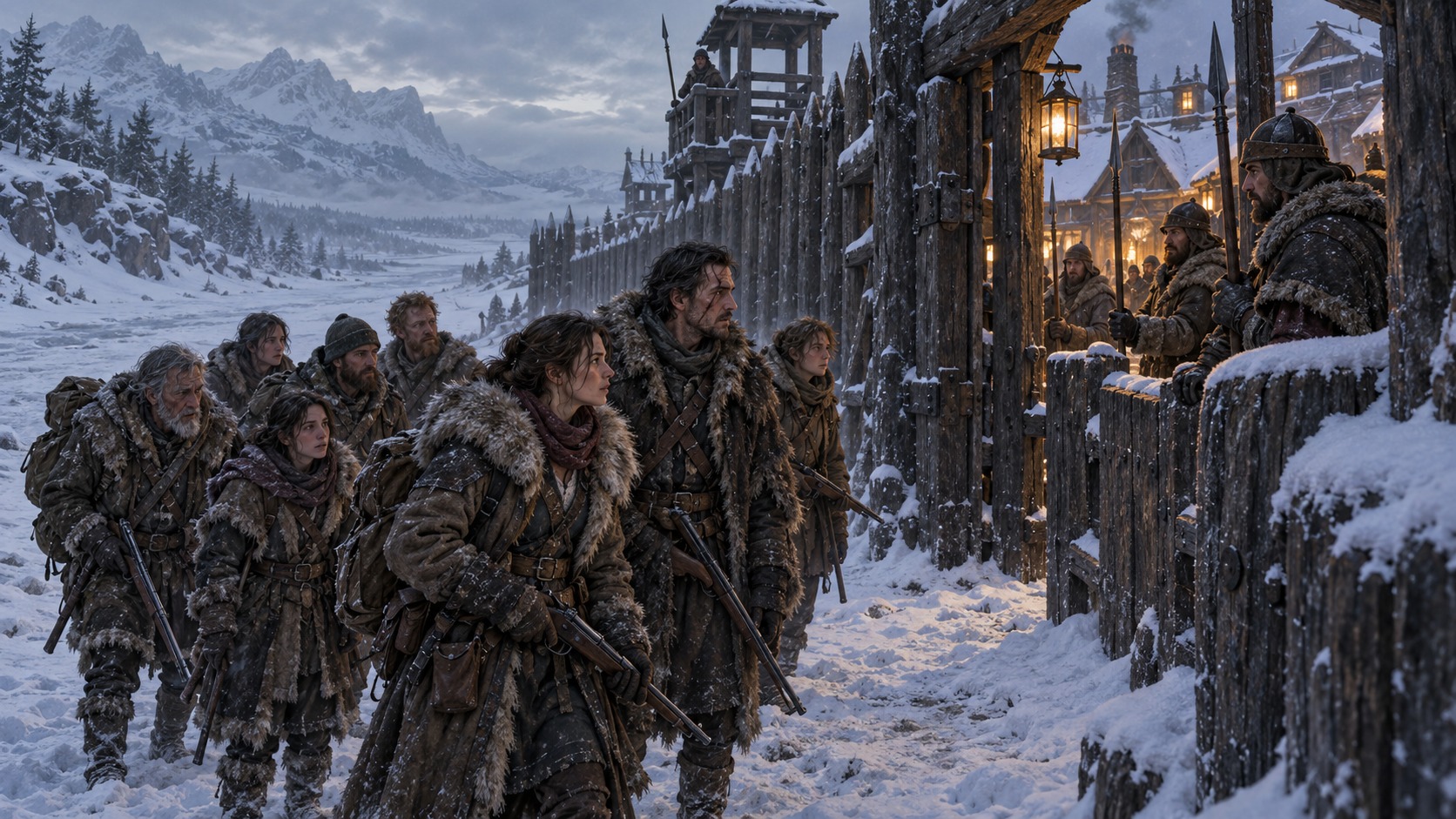
GREY'S STORIES BY THE FIRE IV — STRANGERS AT THE GATE
The fire had grown smaller.
Not weak.
Just calmer.
The large logs had long since settled into dark, glowing red pieces, and whenever the wind swept across the camp, sparks broke free and vanished into the night.
No one had left.
That often happened after Grey's stories.
Especially when he had not properly finished one.
Grey was still in his place.
His hands rested on his staff.
His hat was pulled low over his face.
For a while, no one spoke.
Then one of the children could bear it no longer.
“Well?”
Grey did not move.
“Well what?”
“The Rift.”
A few adults smiled.
They had the same question.
Grey slowly raised his head.
“What about it?”
The child looked at him as though the answer were obvious.
“What was it?”
Grey was silent.
“You said there were signs.”
“Yes.”
“And that shimmer.”
“Yes.”
“And that other place.”
“So the story goes.”
The child moved closer to the fire.
“So what was the Rift?”
Grey studied the child for a long while.
Then he shrugged.
“I don't know.”
The child blinked.
“What?”
“I don't know.”
“But you're telling the story.”
“I am.”
“Then you must know what happened.”
Grey gave a quiet snort.
“That is a dangerous idea.”
Some adults laughed.
The child did not.
Grey leaned forward a little.
“Knowing a story does not mean knowing all the answers.”
“But Argento was there.”
“Yes.”
“Then he knew.”
Grey shook his head.
“No.”
The fire crackled.
“He knew what he had seen.”
Grey tapped his staff with one finger.
“That is different.”
After they returned, Argento searched for answers.
Not for one evening.
Not for two.
For many.
He took old records from boxes no one had opened in years.
He compared maps.
Travel accounts.
Hunters' stories.
Records of caves.
Reports of unusual places.
Some were so old that the ink was barely legible.
Others amounted to little more than a few sentences someone had once written in the margin of a map.
Argento read everything.
Then he read it again.
He compared the copied markings from the fissure with symbols in other records.
Sometimes he thought he recognized something.
Mostly he realized he knew even less than he had thought before.
Ket found him bent over a table one evening.
Several books lay open before him.
Beside them were maps.
Notes.
And a cup whose contents had long since gone cold.
“You should sleep.”
Argento did not look up.
“Later.”
“You said that yesterday.”
“Then it was obviously a good plan.”
Ket picked up one of the sheets.
She studied the marks on it.
“Well?”
Argento leaned back.
“Nothing.”
“Nothing at all?”
“Almost nothing.”
Ket put the sheet down.
“That sounds better.”
Now he looked at her.
“How can nothing sound better?”
“Because yesterday you still thought you'd found something.”
Argento fell silent.
Ket smiled.
“See?”
Then she left.
Argento stayed.
And kept searching.
The child by the fire frowned.
“Did he find the answer?”
Grey scratched his beard.
“Which one?”
“What the Rift was.”
“No.”
“Later?”
Grey looked into the embers.
“Later, Argento found many things.”
“So that's a yes.”
“No.”
“But—”
Grey raised a finger.
“You're making the same mistake again.”
The child folded their arms.
“What mistake?”
“You desperately want an answer.”
“Of course.”
“The world doesn't care.”
An older man at the far end of the fire laughed.
“You should remember that.”
Grey pointed his staff at him.
“So should you.”
The laughter grew.
Then a woman asked:
“What happened to the fissure?”
Grey looked at her.
“Nothing.”
She waited.
So did Grey.
“Nothing?”
“Nothing.”
He let the word hang for a moment.
Then he added:
“That was the problem.”
The place remained sealed off.
The few people who knew of it stayed away.
No warm air returned.
No daylight.
No route into that other land.
Only ice.
Stone.
Darkness.
And questions.
The Winterland around it did not care.
The wind kept blowing.
Snow fell.
People shivered.
Hunters hunted.
Children argued.
Roofs needed repairing.
Wood needed collecting.
Life had the unpleasant habit of going on even after you had seen something that shook your understanding of the world.
And while Argento searched old records for answers, something far more ordinary happened.
Strangers came to the NFD.
Seven of them.
Armed.
Tired.
Marked by winter.
They came without banners.
No music announced them.
No messenger rode ahead.
They simply appeared on the road to the settlement.
Seven figures between snow and wind.
At their belts and across their shoulders they carried weapons not often seen in the NFD at the time.
Firearms.
That was enough to make the guards grip their spears a little more firmly.
The seven strangers stopped before the entrance.
One raised both hands.
Slowly.
So nobody would get foolish ideas.
Or at least no even more foolish ones.
They wanted shelter.
Warmth.
Something to eat.
Perhaps work.
For a while.
They asked for nothing more.
Grey fell silent.
One of the children looked at him expectantly.
“And those were the Gunslingers.”
Grey slowly turned his head.
“Did I say that?”
“Seven strangers with firearms.”
“Lots of people have firearms.”
“Seven?”
“Sometimes.”
“Arriving together?”
Grey considered it.
“Less often.”
A few people grinned.
“So it was them.”
Grey stirred the embers with his staff.
“Perhaps you should let me tell the story.”
The child sighed theatrically.
Grey ignored it.
Strangers were nothing unusual in the Winterland.
But strangers were not automatically welcome either.
The Winterland produced good people.
And bad ones.
Hungry ones.
Desperate ones.
Honest ones.
Dangerous ones.
Sometimes all at once.
A wall kept out bodies, not intentions.
So they let the seven in.
But they watched them.
They were given food.
A place to sleep.
Warmth.
And questions.
Many questions.
Where they came from.
Where they were going.
Why they were armed.
Why seven.
Why together.
Whether anyone was following them.
Whether they brought trouble.
The answers were not always particularly interesting.
That reassured some people.
It made others suspicious for precisely that reason.
Two of the strangers stayed especially vivid in people's memories.
A woman named Marla.
Quick hands.
Watchful eyes.
And a man named Joren.
With an old scar across one side of his face.
The child by the fire immediately raised a hand.
Grey saw it.
“No.”
The hand stayed up.
“I haven't even asked anything yet.”
“You wanted to know how he got the scar.”
Slowly, the hand came down.
Grey nodded with satisfaction.
“Later.”
The strangers stayed in the NFD for two days.
They ate.
Slept.
Helped wherever they were allowed.
Talked with the people.
Not everyone liked them.
Not everyone distrusted them.
Most simply had other problems.
For trust was a luxury in the Winterland.
You could not spend weeks looking every stranger in the eye and wondering what kind of person they were.
At some point, wood had to be chopped.
At some point, soup had to be cooked.
At some point, someone had to shovel out the latrine.
Life was remarkably good at replacing great questions with small tasks.
Grey looked around the circle.
“When does a stranger become a friend?”
Several children answered at once.
“When they help you.”
“When they're nice.”
“When they share their food.”
“When they save you.”
Grey listened to them all.
Then he shook his head.
“No.”
A girl pulled a face.
“Then when?”
“Sometimes never.”
They did not like that.
Grey could see it.
“A stranger doesn't owe you friendship.”
He gestured toward the adults.
“And you don't owe every stranger your trust.”
Then he put both hands back on his staff.
“Trust isn't a door you open once.”
The fire crackled.
“It is something people build together.”
“Like a wall?” a boy asked.
Grey thought about it.
“No.”
“Like a house?”
“Not that either.”
“Then like what?”
Grey shrugged.
“If I knew, I would probably be a much wiser man.”
A woman by the fire laughed.
“That wouldn't be hard.”
Grey looked at her.
“You're getting a very unpleasant role in the next story.”
She laughed even harder.
Then Grey grew serious again.
“But sometimes,” he said, “you don't get time to build trust slowly.”
The wind passed through the camp.
The flames shifted.
“Sometimes the world decides for you when you must find out who will stand beside you.”
No one spoke now.
Grey looked toward the children.
“The seven strangers were in the NFD for two days.”
He raised two fingers.
“Two days.”
Then he lowered his hand.
“Not enough time to become friends.”
A pause.
“Not enough time to know who they really were.”
Another pause.
“Not enough time to trust them completely.”
Grey looked into the fire.
“Then the first warning came from the frozen river.”
A boy moved closer.
“The bear.”
Grey did not answer.
He did not need to.
“And what did the seven do?” the girl asked.
Grey smiled.
Just a little.
“That is the wrong question.”
“Why?”
Grey slowly stood.
He leaned on his staff.
“Because you already know what they did.”
He turned away from the fire.
“After all, you still call them the Gunslingers today.”
The child who had first asked about the Rift called after him:
“Grey!”
He stopped.
“What?”
“So when does a stranger become a friend?”
Grey thought about it for a long time.
Then he glanced back over his shoulder.
“Sometimes you only find out when something tries to break through your palisade.”
He walked away.
Behind him, the fire crackled.
And somewhere far out in the Winterland, the ice groaned.
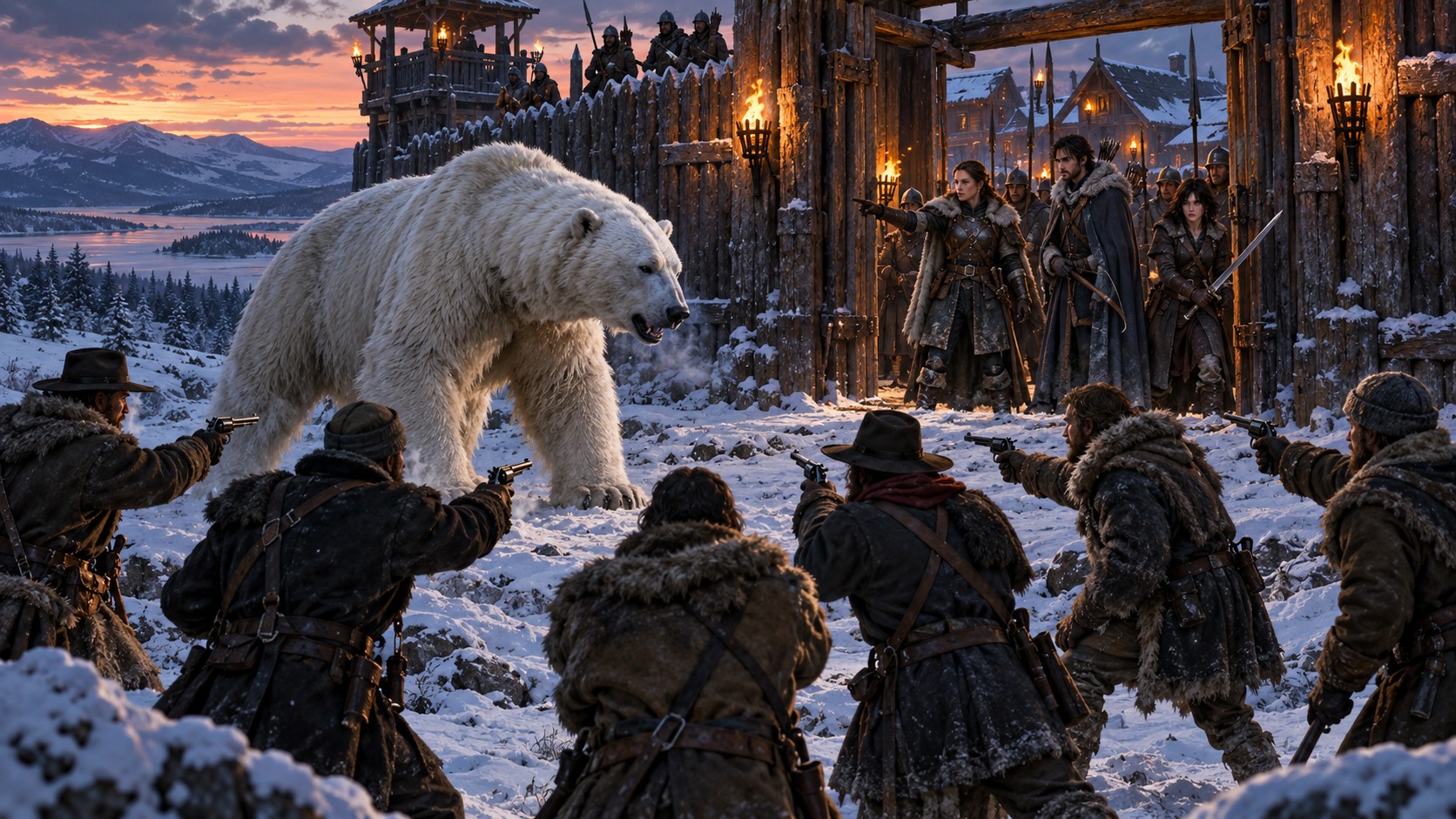
THE GUNSLINGERS
The first warning came from the frozen river.
No roar.
A tremor.
The ice groaned beneath the settlement as something immense moved through the trees beyond the eastern bank.
By the time the alarm sounded, Ket was already at the palisade.
“Positions.”
No speech.
No prophecy.
Everyone knew what was coming.
A white bear burst through the tree line.
Even by Winterland standards, it was enormous, with scars across its muzzle and shoulders, its fur darkened by old blood and frozen mud. It hit the outer barrier so hard that snow fell from the roofs.
Seef stood in the square, directing the defenders.
Deathhead watched the creature instead of the panic around it.
Argento stood beside the old trap map spread across a crate.
Since their return from the fissure, he had spent part of his nights over old records. He searched for references to passages, similar markings, and anything that might explain what he and Ket had seen.
So far, he had found almost nothing.
The fissure itself still lay off the paths, quiet and inconspicuous between ice and dark rock. Anyone who did not know what to look for would barely have noticed it.
None of that mattered today.
And along the palisade waited seven strangers with firearms.
The Gunslingers.
They had arrived two days earlier and asked for shelter.
Now they would earn it.
Among them were Marla, quick with her hands and sharp-eyed, and Joren, recognizable by the scar running across one side of his face.
Ket looked at them.
“Can you hit what you aim at?”
Marla checked her weapon.
“Usually.”
Joren smiled.
“She means yes.”
The NFD had prepared for another attack.
Beneath packed snow near the inner entrance lay a deep pit trap.
It was neither ancient magic nor some forgotten weapon.
It was engineering, hard labor, and several miserable days spent digging frozen ground.
The problem was getting the bear into it.
Seef ordered the defenders to give ground deliberately.
The bear charged.
Spears struck it and slid off.
Bolts hit its shoulders.
The Gunslingers fired in a controlled sequence instead of wasting ammunition in panic.
The bear kept coming.
“Too high!” Deathhead called.
Marla adjusted her aim.
Argento watched the creature's path.
“Left side!”
Ket understood.
She advanced with several fighters and forced the bear to turn toward them.
It took the bait.
The creature lunged.
Ket withdrew.
The snow collapsed beneath its forelegs.
The bear fell into the pit.
The whole settlement seemed to shake.
“Now!”
Shots rang out.
The pit did not hold it long.
The bear tore at the frozen walls, throwing loose earth and ice into the air.
Joren shot its shoulder joint.
Marla hit its chest.
Deathhead's prepared bolt, tipped with glass, shattered against the creature's face and released an alchemical freezing mixture that spread across one eye and part of its muzzle.
The bear recoiled.
No magic.
Chemistry.
And nowhere near enough.
It climbed.
Ket reached the edge first and drove her weapon downward, forcing the animal away from the weakest section.
Seef led more defenders forward.
Argento saw the pit wall begin to give way.
“Back! That side is collapsing!”
A heartbeat later, it caved in.
The bear surged upward through shattered ice.
One of the Gunslingers fired too late.
The shot struck stone and ricocheted.
Joren went down.
“Joren!”
“Leg,” he gasped. “Still attached.”
Marla dragged him out of danger while the others kept firing.
The bear was bleeding heavily now.
But it was still moving.
Argento had been watching the wounds.
Not counting them.
Comparing them.
“The chest shots aren't stopping it!”
“No great revelation!” Ket called.
“The shoulder. Marla's first hit and Joren's shot opened the same side.”
Deathhead saw it.
“Front left.”
“Yes.”
Ket changed the attack at once.
“Everyone on the left side!”
The NFD fighters concentrated their pressure.
The Gunslingers adjusted their fire.
Deathhead waited.
The bear reared up.
For a moment, the injured shoulder opened and the animal exposed the softer place behind its foreleg.
Marla fired.
The bear staggered.
Another Gunslinger shot.
Then another.
Seef pushed forward with the defenders, preventing the creature from turning away.
Ket struck its injured side.
Deathhead's next bolt buried itself deep in the exposed flesh.
The bear sank to one knee.
Then it rose again.
No one cheered.
They all knew better by now.
The final assault was ugly.
No perfect formation remained.
No heroic duel settled it.
The bear tried to reach the settlement.
The NFD would not let it.
Marla fired until her arm bled from a wound she had barely noticed.
Joren sat against a wall with his injured leg stretched out and reloaded weapons for anyone still standing.
Ket fought at the front.
Seef kept the defenders from breaking apart.
Deathhead called out every opening as soon as she saw one.
Argento moved between positions, watching the creature, the terrain, and the collapsing pit.
Then the bear turned its injured side toward them once more.
Marla saw it.
So did Deathhead.
Two shots struck almost at once.
The bear stumbled.
Ket and the defenders drove it back.
Its hind legs slipped into the ruined pit.
The enormous animal fell.
For several seconds, it still tried to rise.
Then it stopped.
No one moved.
Seef waited.
“Stay ready.”
The bear lay still.
Only then did the weapons begin to lower.
Seven Gunslingers had stood on the palisade.
All seven survived.
Several were wounded.
Joren came away with a gunshot wound in his thigh.
Marla's arm needed stitches.
The NFD had wounded too.
But the settlement still stood.
Deathhead approached the carcass and laid a small silver pendant shaped like a snowflake against its fur.
Ket raised an eyebrow.
“Magic?”
“No.”
“Good.”
“An old hunting custom.”
Ket considered it.
“Does it do anything?”
Deathhead looked at the dead bear.
“It tells me the hunt is over.”
Ket nodded.
“Good enough for me.”
Later, people embellished the battle.
They always did.
Songs gave Seef a weapon forged from a fallen star.
Some versions made Ket a witch who commanded the blizzard.
Others claimed Deathhead had frozen the bear with magic.
One particularly ridiculous tale had Argento bind the creature's spirit inside the pit with a forbidden book.
Argento hated that version.
“It was a hole,” he said whenever someone repeated it. “A very big hole. We dug it.”
The Gunslingers found the stories entertaining.
Marla especially liked the magical version.
Joren preferred the one in which the bear was said to have given him his scar.
He had had the scar for years before his arrival.
He corrected no one.
What actually happened was less elegant.
A bear attacked.
A trap partly worked.
People fought.
People bled.
Seven strangers chose to stand beside the NFD though they could have fled.
And together they killed something none of them could have stopped alone.
That was enough.
The rest belonged to the storytellers.
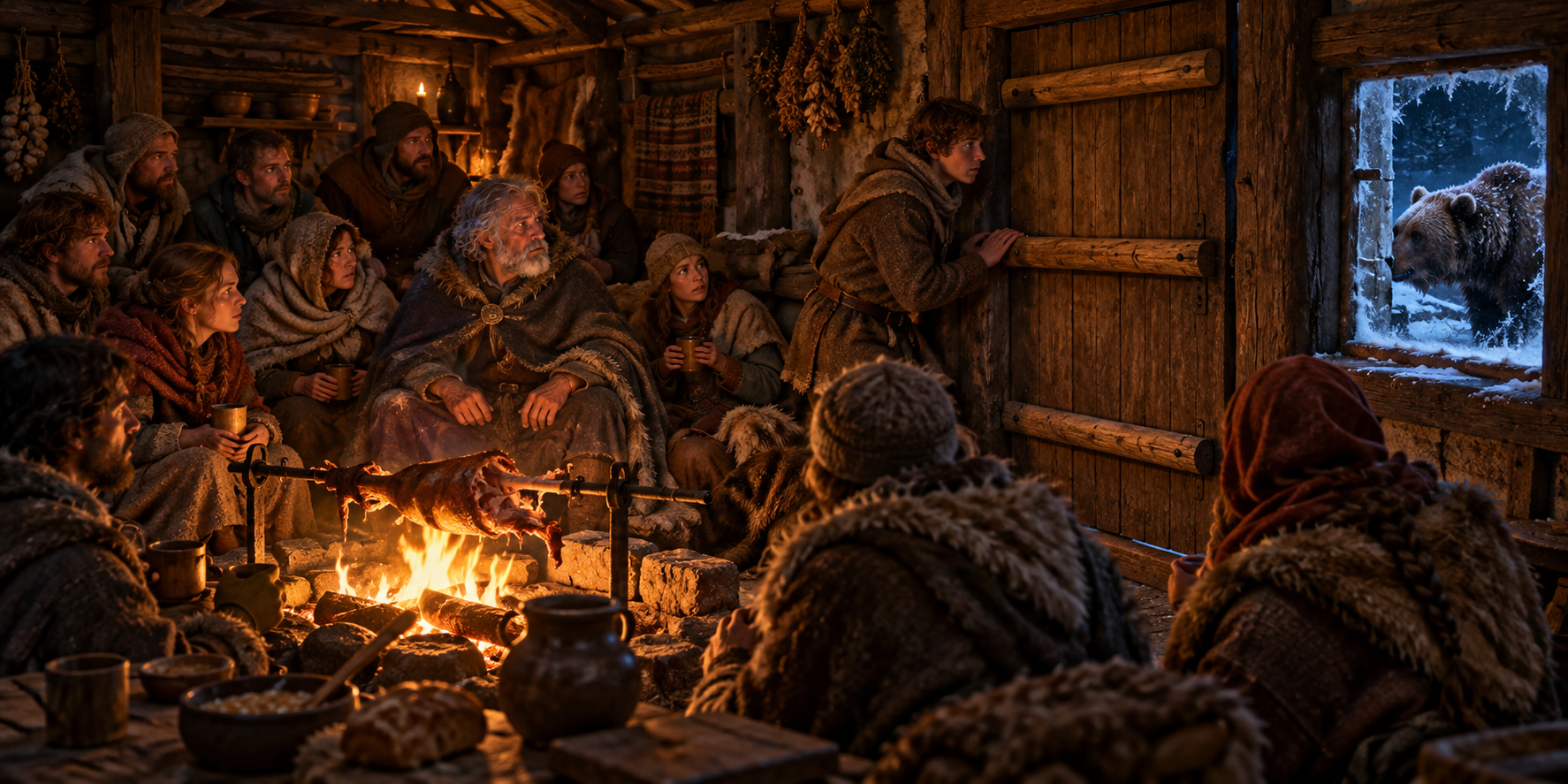
GREY'S STORIES BY THE FIRE V
Three Bolts on the Door
FINAL CANON GERMAN — FRAMING STORY
The original full-text file could not be found. The user confirmed this reconstructed version as binding canon on 16 September 2026.
The hut had three bolts on its door.
One at knee height, one in the middle, and one just below the top beam. When Grey entered, he saw the bolts first. Then the people.
Twelve travelers had crowded into the tundra hut. Wet gloves hung from lines, boots stood before the fire, and a suckling pig turned above the embers. The smell of fat and smoke lingered even when someone briefly opened the door to sweep snow outside.
“Is everyone in?” asked the woman by the fire.
One person counted. Another counted again. Then Grey slid the bottom bolt into place, the middle one, and finally the top one.
“You don't trust the door much,” said a young traveler.
Grey sat down by the fire. “I do. That's why I use it.”
They ate until only bones and a few strips of meat remained of the pig. Outside, the sky lost its last light. Nobody spoke of the Gunslingers, although some knew their story. For this evening, warm food and a roof were enough.
Then something scraped against the outer wall.
Conversation died away. Someone stopped with a bone halfway to their mouth. A heavy breath came through the cracks, followed by a short, wet snort.
The young traveler rose and went toward the door.
“Don't open it,” Grey said.
“Maybe someone outside needs help.”
“That's what we have them for.” Grey pointed at the bolts.
Something pressed against the beams. The wood creaked, but the door stayed in place. The middle bolt trembled. One of the travelers reached for a poker; the woman by the fire moved the pig farther from the wall.
Through the narrow gap beside the window, they saw shaggy brown fur. A bear. It sniffed at the pig, pressed its muzzle against the beams, and slowly made its way along the hut. Its belly was hollow. Frozen mud clung to its paws.
Nobody spoke until its heavy footsteps had faded behind the hut.
A man was the first who could no longer bear the silence. “Was that one of them?”
“A hungry bear,” Grey said.
They waited longer. The bear did not return. At last the young traveler laid a hand on the middle bolt. It was secure.
“I thought it would break through.”
“That was a wall,” Grey said.
“A good one, too.”
The fire sank. The woman added a log. A few people laughed softly now that they could breathe again; the man with the poker put it back.
“You know many stories about bears,” the woman said. “And about people who've encountered them.”
“People tell the most stories about people.” Grey looked toward the door. “Especially those they don't really know.”
“For example?”
“Virel.”
One of the travelers raised his head. “Master Virel.”
At the far end of the fire, someone said, “If you believe the stories?”
Grey turned the empty cup in his hands. “Almost any of them.”
The travelers drew closer. Grey gave them time to settle.
“At some point, no one knows where the person ends ... and the story begins.”
A gust crossed the roof. The three bolts held.
Grey looked from one face to the next.
“Who wants to hear what supposedly happened ... when a stranger came?”
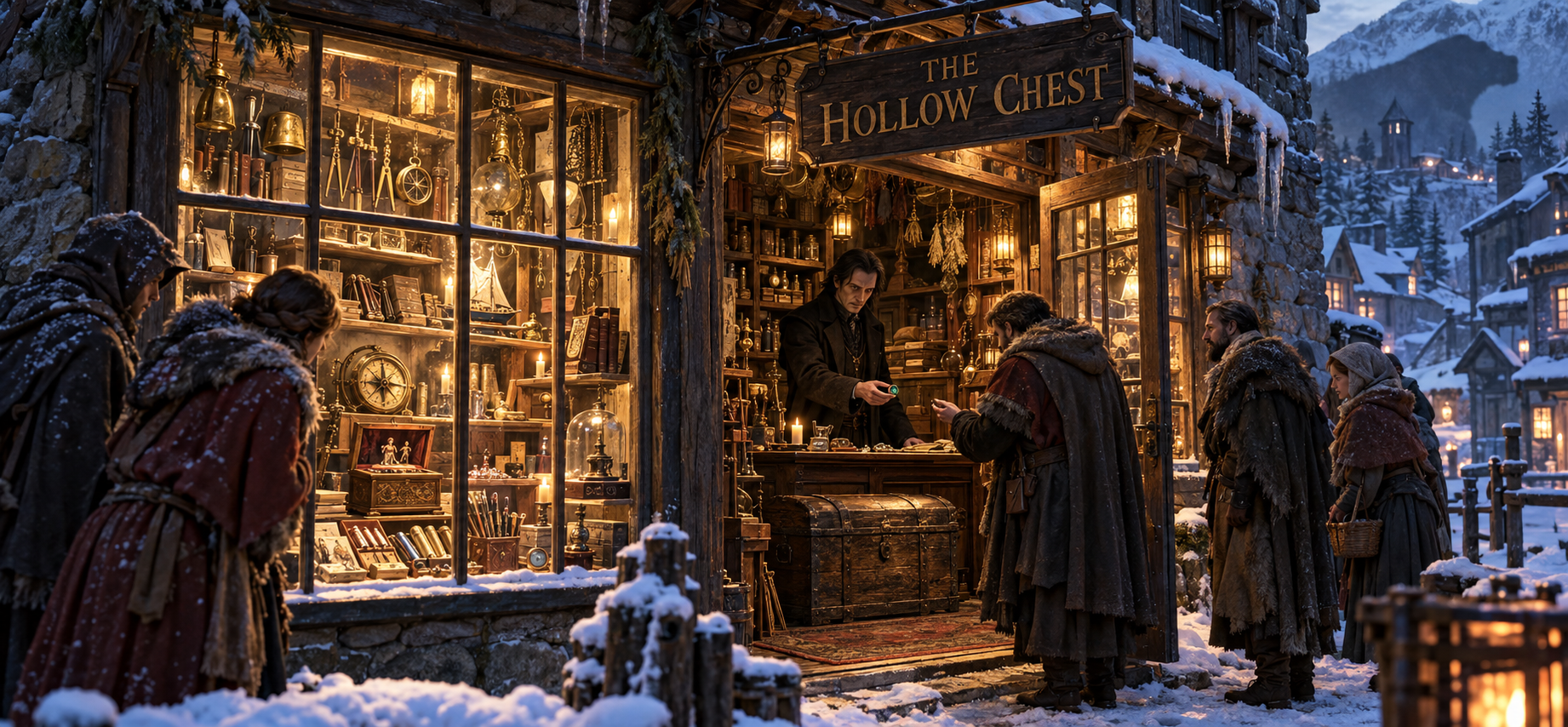
WHEN A STRANGER COMES
An NFD Winter Legend
This story has been told in the NFD for a long time. No one knows exactly where it came from. Some say merchants brought it from the south. Others claim it arrived with a caravan from regions absent from every NFD map.
Only one thing is certain: the story is not about the NFD.
It is about a foreign settlement beyond the known trade routes—and a man who called himself Master Virel.
One winter, Virel appeared there wearing a black coat. He took over an abandoned smithy and opened a small shop he called The Hollow Chest. Its shelves held things no one in the settlement had ever seen: mechanical birds, mirrors showing younger faces, daggers set with red stones, strange books, and little figures carved from black wood.
The strangest thing was his prices.
Virel asked for hardly any money. Sometimes he took food. Sometimes an object. And sometimes a promise was enough.
Edrik, the old keeper of records, distrusted him from the start.
Caelen, the librarian, did not. He bought a golden compass that Virel claimed could show its owner what he truly sought. A few days later, Caelen broke into the home of the settlement's leader, Orven. When they caught him, he kept repeating that the compass had led him there.
Mireya bought a painted violin. Afterward, she claimed to hear music at night even though the instrument lay untouched in its case.
Sivra, the weaver, acquired a silver needle. Virel was said to have told her she could sew dreams together with it. What happened to Sivra afterward varies from one version of the story to another. Some say she vanished. Others say she never slept again.
Toren, the settlement's finest archer, bought a new bowstring. Virel promised that it could hear hearts.
Three days later, Toren shot at his own friends.
When Ragna and Harek overpowered him, he is said to have cried:
“Their hearts sounded wrong.”
Now Edrik began to write everything down. Caelen's compass. Mireya's music. Sivra's needle. Toren's madness. He spoke with Aldren, Merrik, and Kael and warned Orven to have Virel's shop closed.
But Virel already had customers throughout the settlement.
When Edrik finally went to see him himself, Virel placed a green jade ring on the table.
“For you,” he said.
Edrik refused.
The next morning, the ring lay on his windowsill.
From this point on, the accounts contradict one another.
In one version, Edrik saw Master Virel standing outside his window that night—but not as a man. An enormous bear supposedly stood beyond the glass, while Virel's black coat lay in the snow like an empty skin.
In another version, there was no bear. Edrik merely realized that Virel was turning people against one another, selling them exactly what would strengthen their worst desires.
That is probably where the legend's best-known line comes from:
“The stranger was no man. The man was only the fur the bear wore.”
On the thirteenth night of frost, Virel is said to have brought out a black mirror.
After that, the settlement fell apart.
Some blamed the objects. Others spoke of poison. Still others later claimed that Virel had needed no sorcery at all. He had merely known the greed, fear, and anger already inside the people.
Ragna gathered the defenders. Harek, Aldren, Merrik, and Kael fought beside her. Orven tried to lead the inhabitants out of the settlement's center.
And then, according to the best-known version, Master Virel stepped in front of The Hollow Chest, opened his coat—and became a gigantic bear with red eyes.
Ragna is said to have finally struck him through the heart with her blade.
No one knows whether that really happened.
The following spring, travelers supposedly found bones in the ruins. Some thought they were human. Others thought they were the remains of a bear.
The stories cannot even agree on whether the settlement survived.
In the NFD, the tale is still told today, especially when a foreign merchant makes an offer that sounds too good to be true.
And sometimes travelers claim to have seen a man in a black coat far out in the snow. An old chest stands beside him.
He smiles and asks only:
“What do you wish for?”
That is why the NFD version of the story always ends with the same warning:
“Never accept a gift from a stranger who will not tell you what it costs.”
CANONICAL STATUS
This tale is an early NFD winter legend. Whether Master Virel, the foreign settlement, or the supernatural events really existed remains unconfirmed. The tradition itself is canon, not a historically verified literal account.
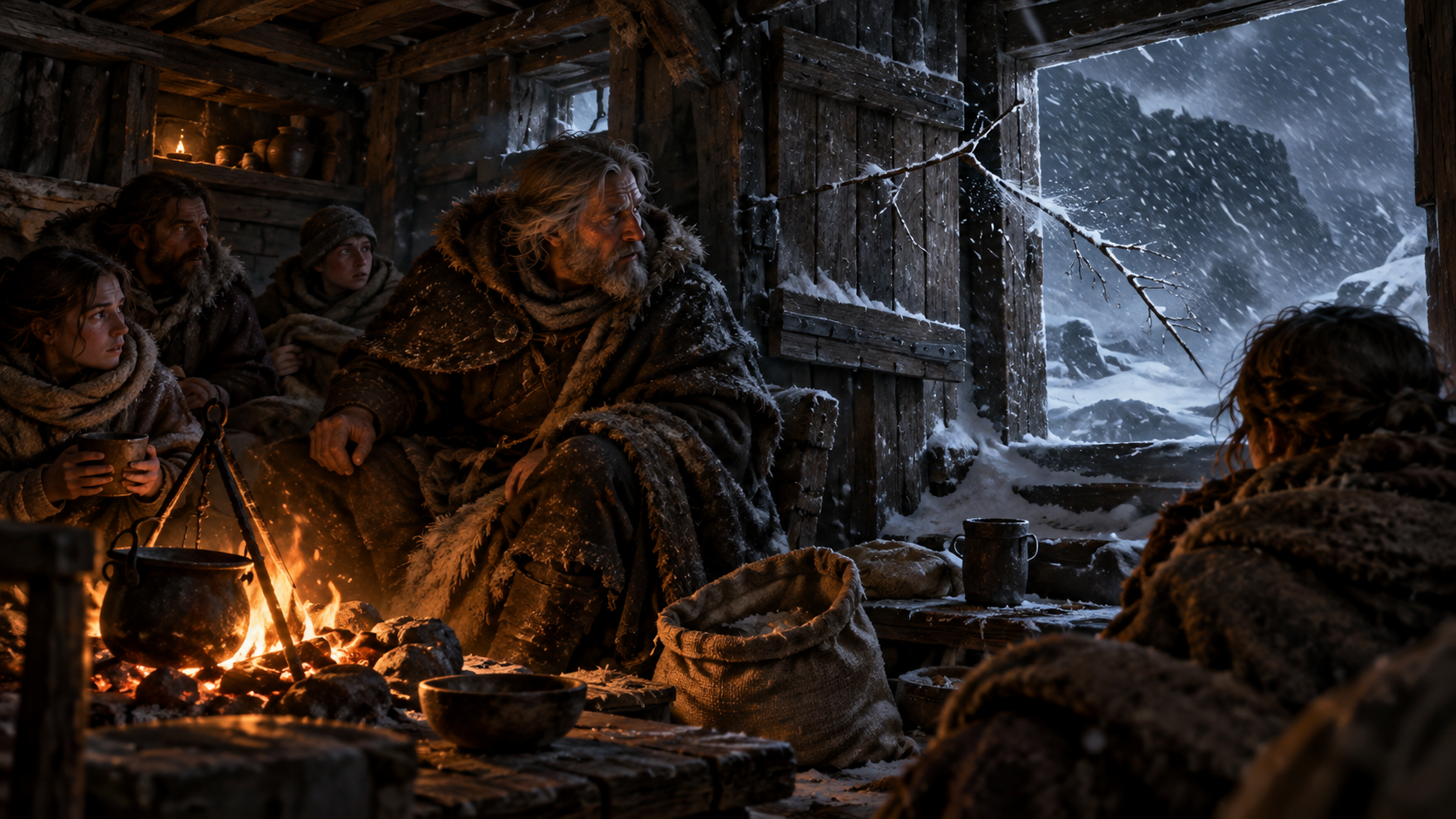
GREY'S STORIES BY THE FIRE VI
The Sound in the Storm
When they woke in the morning, the world had disappeared.
Not figuratively.
It was simply gone.
Where trees had stood the evening before, there was only white.
Where the narrow path led down from the hut into the hollow, there was only white.
Even the small rocks outside the window had vanished.
Snow clung to the glass.
The wind whipped around the hut and pressed against its walls, as if trying to find out how much force it would take to lift the building from its foundations.
Someone stood at the window.
“I can't see anything.”
Grey was already by the fire.
“Then the window is working perfectly.”
A few laughed.
Not many.
After the story of the stranger and Master Virel, they had gone to sleep late.
The fire had burned low.
The smell of the suckling pig still hung in the hut, but hardly anything remained of the feast itself.
A few bones.
A piece of crackling.
Some fat in a bowl.
And Grey.
Grey sat there wrapped in his blanket, studying the embers as if a blizzard were merely another sort of bad weather.
Someone went to the door.
He lifted the first bolt.
Then the second.
At the third, he paused.
“Perhaps you should leave that one,” Grey said.
“Why?”
“Because there's about half a mountain behind the door.”
The man looked at him.
“How would you know?”
Grey pointed to the window.
“Because the other half is in front of it.”
More people laughed this time.
The third bolt was opened anyway.
Three men pushed against the door.
Nothing.
Again.
The wood groaned.
A narrow gap opened.
Snow fell inside.
Not a little.
An entire wall of it.
They immediately pushed the door shut again.
First bolt.
Second.
Third.
“Well,” Grey said.
“Looks like we're staying a while longer.”
At first, that was no problem.
They had a roof.
They had fire.
They had company.
And they still had food.
The last meat was cut from the bone.
Someone found half a loaf of bread.
Another found a small bag of dried berries.
They shared it.
Grey received a particularly small piece of meat.
He studied it for a long time.
Then the man who had given it to him.
Then the meat again.
“Am I meant to smell it, or may I eat it too?”
Laughter.
“Old people need less.”
Grey nodded.
“Then I hope you live to be very old.”
They played cards.
They told bad jokes.
One person snored on a bench.
Two argued over who had cheated in the last game.
The wind howled.
Nobody cared.
Not yet.
At midday, the fire grew smaller.
Not because they were warm.
Because someone had counted the wood.
Then he counted it again.
The second count yielded no more.
“How long?” someone asked.
“If we keep the fire as it is?”
“Yes.”
The man looked at the woodpile.
“Until tomorrow.”
The cards were played more slowly.
“And if the storm is still here tomorrow?”
Nobody answered.
Grey stood.
He took two logs from the fire.
Pushed them back to its edge.
“Then we get a little cold today.”
“That's your plan?”
“No.”
Grey sat down again.
“That's mathematics.”
In the afternoon, the remaining meat became broth.
Lots of water.
Little meat.
Very little.
Nobody complained.
That was worse than if they had.
They ate in silence.
The wind strengthened.
At times the roof trembled.
Everyone looked up then.
Except Grey.
Grey ate his broth.
Slowly.
“Aren't you afraid the roof will give way?”
“I am.”
“You don't look it.”
Grey raised his spoon.
“Should I scream while I eat?”
Someone grinned.
Briefly.
Then came the next gust.
The smile vanished.
By evening, the window was completely buried in snow.
There was nothing left to see outside.
Only the sound of the wind.
The fire was small.
The shadows on the walls grew larger.
Someone added another log.
The man who had counted their supplies took it out again.
“Don't.”
“I'm cold.”
“We all are.”
“Then we need a fire.”
“We'll need a fire tomorrow too.”
The man released the log.
It lay beside the hearth.
No one said anything.
Grey watched the flames.
“Stories are cheaper.”
A few heads turned toward him.
“What?”
“Stories.”
Grey pulled the blanket tighter around his shoulders.
“They warm you. They don't need wood.”
“Your stories usually make everything worse.”
“Then at least they work.”
A quiet laugh.
Again, only briefly.
Then—
something scratched at the outer wall.
No one moved.
It was not a loud sound.
That was precisely why they all heard it.
A slow—
Krrrssch.
Then nothing.
Someone looked toward the door.
Another toward the window.
Grey looked into the fire.
“What was that?”
No answer.
The wind howled.
A gust pressed against the hut.
Then again:
Krrrssch.
Longer this time.
As if something hard were being dragged across the wood.
A man stood.
He reached for his knife.
“Sit down.”
Grey had said it softly.
The man remained standing.
“There's something out there.”
“Of course.”
Grey nodded toward the wall.
“Snow.”
“That wasn't snow.”
“Wind.”
“Not wind either.”
Grey looked at him.
“Then apparently you already know what it is.”
The man did not answer.
“No?”
Grey waited.
“Then don't give it a name.”
The sound did not return.
For an hour.
Maybe two.
Time was difficult to measure inside the hut.
The fire shrank.
The wind remained.
No one played cards anymore.
They sat closer together.
Not only because of the cold.
Eventually someone said:
“Maybe a branch.”
“There isn't a tree close enough.”
“Then ice.”
“Ice doesn't scratch.”
“How do you know?”
“Because I've heard ice before.”
“Maybe an animal.”
Silence.
The word remained in the room.
Animal.
Someone looked at the door.
At the three bolts.
Grey noticed.
“Yesterday you laughed at those bolts.”
Nobody answered.
“Today you like them.”
“Perhaps the old custom had a purpose after all.”
Grey raised an eyebrow.
“Bolting a door during a blizzard isn't an old custom.”
“And three bolts?”
Grey looked toward the door.
“That's suspicion with a craftsman's ambition.”
This time, no one laughed.
Later, someone began talking about food.
Not deliberately.
That made it worse.
Roast meat.
Bread.
Potatoes.
Thick soup.
Butter.
Someone mentioned cheese.
Another told him to shut up.
It nearly became an argument.
Grey ended it by placing his own empty bowl between the two of them.
“If you absolutely must fight, do it over something that still exists.”
They looked at the bowl.
Then at each other.
The argument died.
The second night began.
No one knew exactly when.
There was no sunset outside.
Only a slow darkening of the white.
The fire was mostly embers now.
Their breath was visible.
Some shared blankets.
Grey sat in the same place.
Someone asked:
“Have you ever lived through a storm like this?”
Grey did not answer at once.
“Yes.”
“Worse?”
“Yes.”
“How much worse?”
Grey looked at him.
“Enough.”
The conversation could have ended there.
But someone asked:
“Were you alone?”
A small pause.
“No.”
“With whom?”
Grey smiled.
Not kindly.
Not unkindly.
Just Grey.
“That would be another story.”
Krrrssch.
They all started.
This time it came from the other side of the hut.
A knife was drawn.
Then another.
Someone grabbed an axe.
Grey raised his head.
Krrrssch.
Slowly.
Across the wood.
Then—
THUD.
Something struck the wall.
A woman cried out.
Someone sprang toward the door.
“Don't!”
Several voices at once.
The man stopped.
His hand was already on the first bolt.
There was something outside.
Or nobody knew whether there was something outside.
That was worse.
THUD.
Dust sifted down from a beam.
The fire crackled.
Then came a sound none of them could explain.
Low.
Muffled.
Almost like a groan.
It lasted only a few seconds.
Then the wind swallowed it.
No one spoke.
Grey rose.
Slowly.
He went to the door.
Put a hand on the top bolt.
Checked it.
Then the middle one.
Then the bottom one.
All three were secure.
Grey returned to the fire.
“What was that?” someone whispered.
Grey sat down.
“A sound.”
“Very helpful.”
“We know no more than that.”
“It could be a bear.”
Grey looked up.
Now the hut was utterly still.
“Could be.”
“Or something else.”
“Could be.”
“What, then?”
Grey said nothing.
“Grey.”
He looked at the questioner.
“If you don't know what's outside, don't give it a name.”
“Why not?”
Grey turned back toward the embers.
“Because names turn sounds into stories.”
The wind swept across the roof.
“And stories are sometimes harder to get rid of than whatever caused them.”
Hardly anyone slept that night.
The sound came three more times.
A scrape.
A dull blow.
Once, that deep, almost plaintive groan.
Some later claimed it had come from nearer the door.
Others said from beneath the window.
One swore he had heard footsteps.
Another disagreed.
Grey said nothing about it.
Toward morning, the wind weakened.
Not suddenly.
It simply lost its fury little by little.
The howl became a whistle.
The whistle a whisper.
Then they heard something that had become strange after two days.
Nothing.
Absolute silence.
They waited anyway.
An hour.
Perhaps longer.
Then Grey stood.
“Now.”
They opened the three bolts.
Together they pushed against the door.
The snow yielded slowly.
Light fell in.
Cold.
Pale.
Beautiful.
They dug their way out.
The world was back.
Changed.
But there.
Trees had collapsed under the weight of snow.
Branches lay everywhere.
One had struck the hut.
A long, bent branch rested against the outer wall.
The wind had dragged it across the boards again and again.
Krrrssch.
Someone laughed.
Loudly.
With relief.
“A branch.”
Others began laughing too.
The tension drained from them.
“Just a damned branch.”
Grey stood a little apart.
He studied the branch.
Then the wall.
Then the snow.
“See?” someone said to him.
“A branch.”
Grey nodded.
“The scratching, probably.”
The laughter stopped.
“Probably?”
Grey walked along the wall.
Where the branch had lain, there were long marks in the wood.
He examined them.
Then went on.
“And the blows,” someone said.
Grey pointed to the broken end.
“Those too.”
“And the other sound?”
Grey stopped.
“Which one?”
No one answered immediately.
The deep sound.
The groan.
Almost like—
No.
No one said it.
Grey looked out at the snow-covered trees.
There were no tracks.
At least none that meant anything after two days of storm.
The snow was smooth.
Untouched.
“Probably the branch too,” someone said.
Grey nodded.
“Probably.”
They returned to the hut.
The fire grew larger again.
Wood could be gathered outside.
Someone found provisions in a small shed whose door had previously been blocked by snow.
Bread.
Dried meat.
Onions.
Never had onions been greeted with such enthusiasm.
Soon the hut smelled of soup.
The mood improved.
But it was not as before.
Something had stayed behind.
Not outside.
Inside them.
Someone studied the scratches on the wall.
“Strange.”
“What?”
“Last night I was certain there was an animal out there.”
“So was I.”
“I thought it was a bear.”
“Me too.”
Grey stirred his bowl.
“Interesting.”
“What?”
“You heard a branch.”
He took a spoonful of soup.
“And some of you saw a bear.”
“We didn't see anything.”
Grey looked up.
“Exactly.”
Silence.
Then someone asked:
“Is that how stories about monsters begin?”
Grey considered it.
“Sometimes.”
“And other times?”
“Other times there really is a monster outside.”
No one laughed.
Grey kept eating.
“That wasn't helpful.”
“I hear that often.”
That evening they sat around the fire again.
The storm was over.
The door was clear.
No one had to stay.
Still, no one left.
Perhaps because it was already growing dark outside.
Perhaps because the soup was good.
Perhaps because, after the past two nights, no one wanted to walk through the forest alone.
Grey probably knew.
He did not say.
Instead, he watched the flames for a long time.
Then someone said:
“Which is worse?”
Grey looked up.
“What?”
“If there really is something outside.”
The man pointed to the door.
“Or if you only believe there is?”
Grey did not answer immediately.
The fire crackled.
“There is something worse.”
“What?”
“No longer knowing which of those is true.”
No one spoke.
Grey took a thin twig and used it to push a piece of wood deeper into the embers.
“A blizzard can deceive a person.”
He looked into the flames.
“First it takes away the path.”
A spark rose.
“Then distance.”
Another.
“Then time.”
Grey set the twig aside.
“And if it lasts long enough, eventually it takes away certainty.”
“Certainty about what?”
“Everything.”
Outside, snow fell from a branch.
Several heads turned toward the wall at once.
Grey noticed.
A barely visible smile.
“There was once a man,” he said, “who claimed he had walked in circles for three days in a blizzard.”
Nobody moved.
“Three days?”
Grey nodded.
“Was he alone?”
Grey looked into the fire.
For a very long time.
Then he said:
“In the end, yes.”
The hut grew quiet.
“What was his name?”
Grey slowly raised his eyes.
“Angus.”
The name meant nothing to them.
Not yet.
“What happened to the others?”
Grey was silent.
“Grey?”
He studied the faces around the fire.
The empty bowls.
The blankets.
The three bolts on the door.
Then the scratches on the wall.
“Last night, you heard a branch.”
No one argued.
“And some of you saw a bear.”
Silence again.
Grey turned to the fire.
“Angus was not so lucky.”
Someone swallowed.
“What did he see?”
Grey took a log.
Laid it on the embers.
The flames crept up it.
“I don't know.”
“But you know his story.”
Grey nodded.
“Who was Angus?”
Grey looked into the flames.
Then he said:
“The one who came back.”
Something cracked in the forest outside.
This time, no one turned around.
Grey began to tell his story.
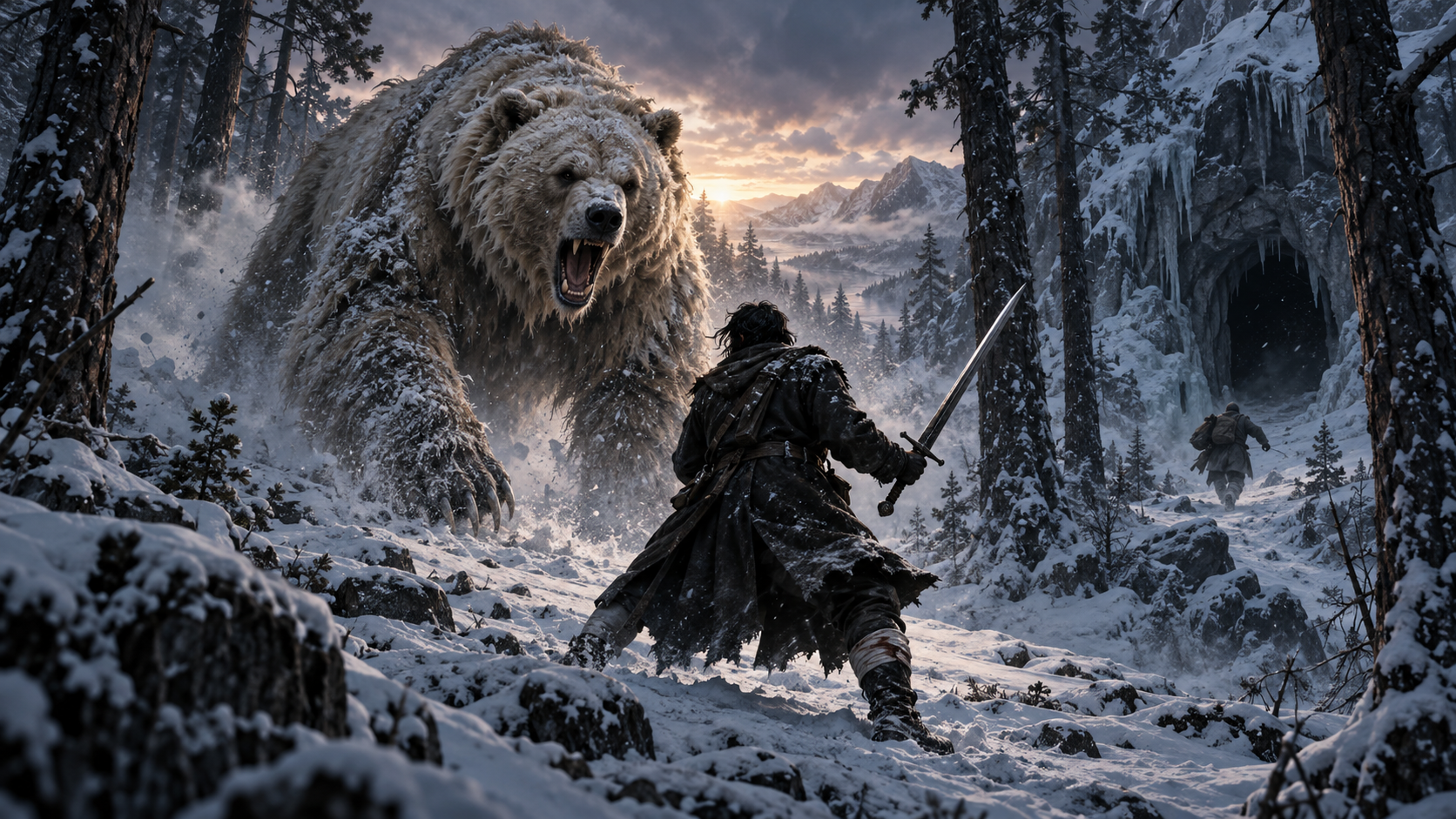
THE FROSTBOUND CHRONICLE OF ANGUS
Entry I: The Descent
“We took the eastern path at dusk, searching for the heartroot herbs Alice swore would cure the fever. The sky hung above us like a leaden shroud, hiding every star.
Devil walked ahead.
At least, that was the name he had given us. Whether it was also the name his mother had given him was another matter entirely. He rarely spoke of himself, and when he did, every answer seemed to produce two new questions.
‘Snow deceives better than wolves,’ he muttered when Ripley noticed the unnatural darkness.
By nightfall, the blizzard had us walking in circles.
Ripley, inexperienced but stubborn, tried to keep our bearing with an old method she claimed to have learned from a wandering wise woman: a marked needle, a shallow bowl of water, and some words I did not understand. Whether the words meant anything, I cannot say. The needle spun uselessly in circles.
Then the ice beneath her boots opened like a grave.
Alice's eyes, though—sharp as the north wind—gleamed for another reason. She spoke of old gods, boundaries, and places where sensible people did not linger.
Devil looked at her.
For the first time since I had known him, I thought I saw fear in his face.
We are cold, we are hungry, and the forest breathes strangely here.”
—Angus
Entry II: The Sign
“On the third morning, the bear found us.
Not the animal itself.
Its sign.
A tree had been split like kindling. The claw marks were coated with ice, although no fresh snow had fallen overnight.
Ripley found them first.
Alice knew the old stories. She called the creature the Monster Bear—a name from northern legends for a bear said to guard the boundary between the world of the living and something the oldest traditions call the Silent Realm.
I asked whether she believed it.
Alice laughed.
It sounded brittle.
‘Superstition.’
But when I asked why the blizzard had blinded us for three days, she did not answer.
Tonight we huddled close to the fire.
I heard Devil muttering beyond the circle of light.
I caught only fragments.
A brother.
Blood in the snow.
A bear.
When I asked him about it, his face went blank.
‘Only one comes back,’ he said.
Then he looked me straight in the eye.
‘And I intend to be that one.’”
—Angus
Entry III: The Hunt
“Alice is dead.
The bear came at midnight.
All day we had heard its throaty roar, a sound so deep I felt it in my ribs before my ears registered it.
Ripley threw burning branches in its path and shouted words from old rites she was struggling to remember. Alice stood beside her, staff raised, yelling at us to move.
Then the creature burst from the snow like a storm made flesh.
Four meters tall, perhaps more.
Its fur was not white.
It was the color of old bone.
Alice charged.
Brave.
Foolish.
Perhaps both.
The bear struck once.
Her skull broke beneath its paw.
Devil dragged me between the pines.
Behind us, Ripley screamed.
I wanted to turn back.
Devil would not let me.
‘She is lost.’
I do not know whether he truly knew that.
I do not know how Devil knows half the things he knows.
This is not a bear.
This is a killing.
And we are its verse.”
—Angus
Entry IV: Devil's Decision
“Only Devil and I remain.
This morning we found Ripley.
Her throat was torn open. One hand still clutched the small metal pendant she had always worn beneath her coat.
Devil knelt beside her for a long time.
He knew the symbol on the pendant.
I asked what it meant.
He refused to answer.
His thigh is badly injured. A shard of ice pierced it during the attack, but he insists on continuing to lead.
‘It thinks we're running,’ he said. ‘We won't give it that satisfaction.’
Later we found another track.
Devil drove his sword into the frozen earth beside it.
The weapon is old. Older than he admits. There are markings beneath the leather wrapped around its hilt, but whenever he notices me looking, he covers them.
‘It is slowing down,’ he claimed.
I do not believe him.
Last night he drank something from a small black vial.
I asked if it was medicine.
‘Something like that.’
Afterward his lips turned blue.
I thought he was praying.
Then I realized I did not know the language.”
—Angus
Entry V: The Survivor's Account
“The bear attacked at dawn.
Devil was already waiting.
Sword raised.
Snow gathered on his shoulders.
For a moment he looked less like a man preparing to die than someone keeping an appointment.
‘Go,’ he told me.
I refused.
Then he spoke my name.
Not Angus.
My real name.
A name I had never told him.
I ran.
Behind me I heard the bear roar, the clash of steel, and Devil laugh once—just once—as though a suspicion he had carried for years had finally been confirmed.
Then he shouted for me to keep running.
Below the ridge, I found a cave.
Ancient signs were carved into its walls.
Alice had spoken of such places in the old stories: doors, tombs, boundaries—depending on which frightened scholar had translated them.
I could hear the bear coming closer.
I remembered fragments of Alice's words and repeated them.
Nothing happened.
So I shouted them.
The ground moved.
Or perhaps the cave simply collapsed.
Everything went dark.
The bear roared.
Then—
Silence.
When I woke, the storm was over.
The stars were stars.
The snow was snow.
I found no tracks leading back to the cave.
No bear.
No Devil.
No bodies.
Nothing.
I write this down because memories change when fear is allowed to live in them too long.
Alice is dead.
Ripley is dead.
Devil ...
I cannot write that Devil is dead.
I never saw him die.
And somehow that frightens me even more.”
—Angus
Postscript
(Recovered from the ashes of a distant fire)
“They say the bear spares no one.
That is not true.
It spares one.
One to carry the story onward. One to warn the next fools who think a forest is made of nothing but trees.
I no longer know whether the Monster Bear was an animal, a legend, or merely a name Alice gave to something none of us understood.
I know Alice died.
I know Ripley died.
I know Devil knew things he should not have known.
And sometimes, when winter is very still, I dream of a man standing among the trees with an old sword in his hand.
Waiting.
Not for the bear.
For me.”
—Angus
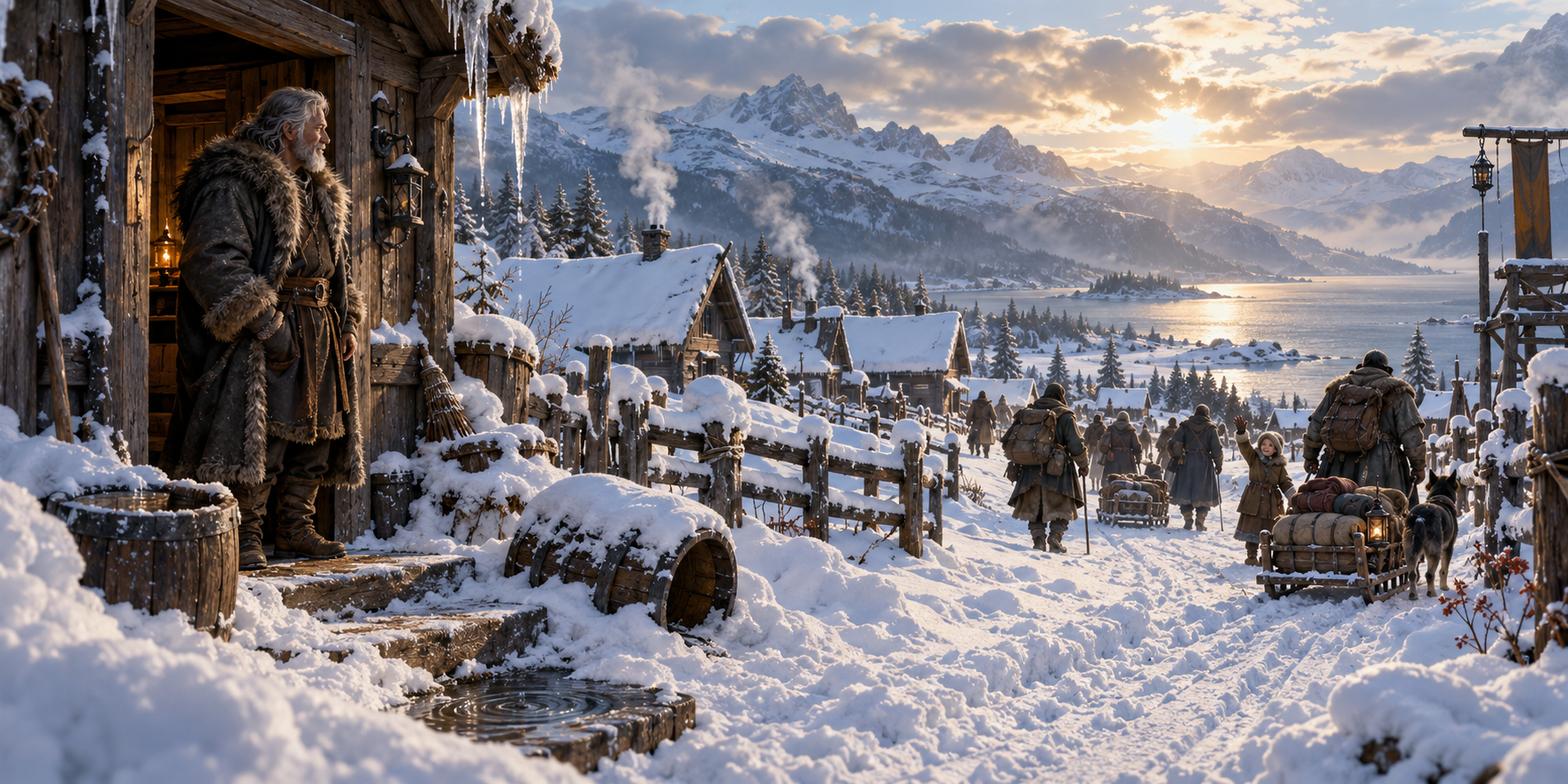
GREY'S STORIES BY THE FIRE VII
When the Snow Stopped
By morning, the wind was gone.
Not weaker.
Not moved on.
Gone.
Grey opened the door and stood there for a while.
Before him, the world lay beneath fresh snow.
Drifts reached the fences. Some roofs had turned almost entirely white. Where snow had raced across the ground like smoke the day before, little glittering hills now stood.
A pale sky hung over the mountains.
And somewhere, water was dripping.
Grey listened for a long time.
Drop.
Pause.
Drop.
After all those days of wind, that tiny sound seemed almost strange.
Someone moved behind him.
“Over?”
Grey did not turn.
“Yes.”
He said no more.
No one needed to ask again.
Later the people came out of their houses.
Doors opened.
Shutters were thrown back.
Snow was pushed from the steps.
Someone laughed when he sank knee-deep into a drift.
Someone else cursed an overturned barrel.
Horses were led out of their stables.
Harnesses checked.
Sleds loaded.
The world began moving again.
Grey sat on a block of wood outside the house and watched them.
For the past few days they had sat close together by the fire.
Strangers.
Travelers.
Merchants.
Hunters.
People whose paths might never have crossed under ordinary circumstances.
The storm had not asked where they came from.
So they had shared bread.
Blankets.
Wood.
Stories.
Now the sky asked them to take their own roads again.
The first left before noon.
He raised a hand.
“Perhaps we'll meet again.”
Grey nodded.
They both knew they probably would not.
Then came the next group.
A sled crunched across the packed snow.
A child waved to Grey until the trees swallowed the sled.
Others went north.
Others west.
Two men argued over which pass would become usable first.
A woman retied her luggage three times, although it had been secure the first time.
No one wanted to admit they were delaying their departure.
Grey said nothing about it.
He knew the feeling.
Sometimes goodbye was easier if you pretended that one more strap needed tightening.
By afternoon it was quieter.
Where voices had mingled yesterday, only tracks remained.
Many tracks.
Boots.
Hooves.
Sled runners.
They ran together across the square.
Then separated.
Grey walked a little way out.
He stopped where one path became three.
One set of tracks led east.
One south.
One disappeared between the dark fir trees.
He watched them.
For a few days the storm had made all these paths into one.
Now they belonged to each traveler again.
Grey pulled his coat tighter.
Behind him, the door creaked.
Someone else left the house.
A brief farewell.
A handshake.
Then footsteps in the snow.
Grey did not look back.
As the sun sank lower, almost no one remained.
The fire in the large room had burned down.
Empty cups stood on the table.
A blanket lay rolled in a corner.
Someone had forgotten a single glove by the wall.
Grey picked it up.
He studied it briefly.
Then set it on the windowsill.
Perhaps someone would return.
Perhaps not.
Grey began to tidy up.
He put the benches back.
Gathered wood splinters from the floor.
Pushed the cups together.
Then he stopped before the fire.
Only red embers remained.
Here they had sat.
Here one person had told a story.
Then another.
And eventually Grey himself had begun.
Of four lights in the snow.
Of things beyond the fences.
Of what lay beneath the ice.
Of strangers at the gate.
Of three bolts on a door.
Of sounds in the storm.
Some had laughed.
Some had not believed him.
Some had moved closer to the fire afterward.
That was enough for him.
Grey took a log and laid it on the embers.
A small flame appeared.
Just one.
The next morning, Grey packed too.
Not much.
He had never needed much.
A blanket.
Some bread.
A knife.
A little dried meat.
His belongings disappeared into an old bag.
Then he stepped outside.
The sun stood above the white plain.
For the first time in days, he could see far.
Very far.
Grey closed the door behind him.
He rested a hand on the wood for a moment.
Then he walked away.
In the square, yesterday's tracks had already softened.
Sun and a light wind had worn away their edges.
Grey reached the fork in the road.
There he stopped.
East.
South.
The fir trees.
He smiled.
Then he chose a path.
Which one, no one could later say for certain.
And perhaps that was for the best.
For some years later, people at fires far apart from one another told of an old man who had sat with them during a great storm.
Some called him Grey.
Others did not know his name.
But almost all remembered the same thing:
When snow struck the windows outside and someone said the night was too long, the old man moved closer to the fire.
Then he looked into the flames.
And said:
“Good.
Then we have time for a story.”
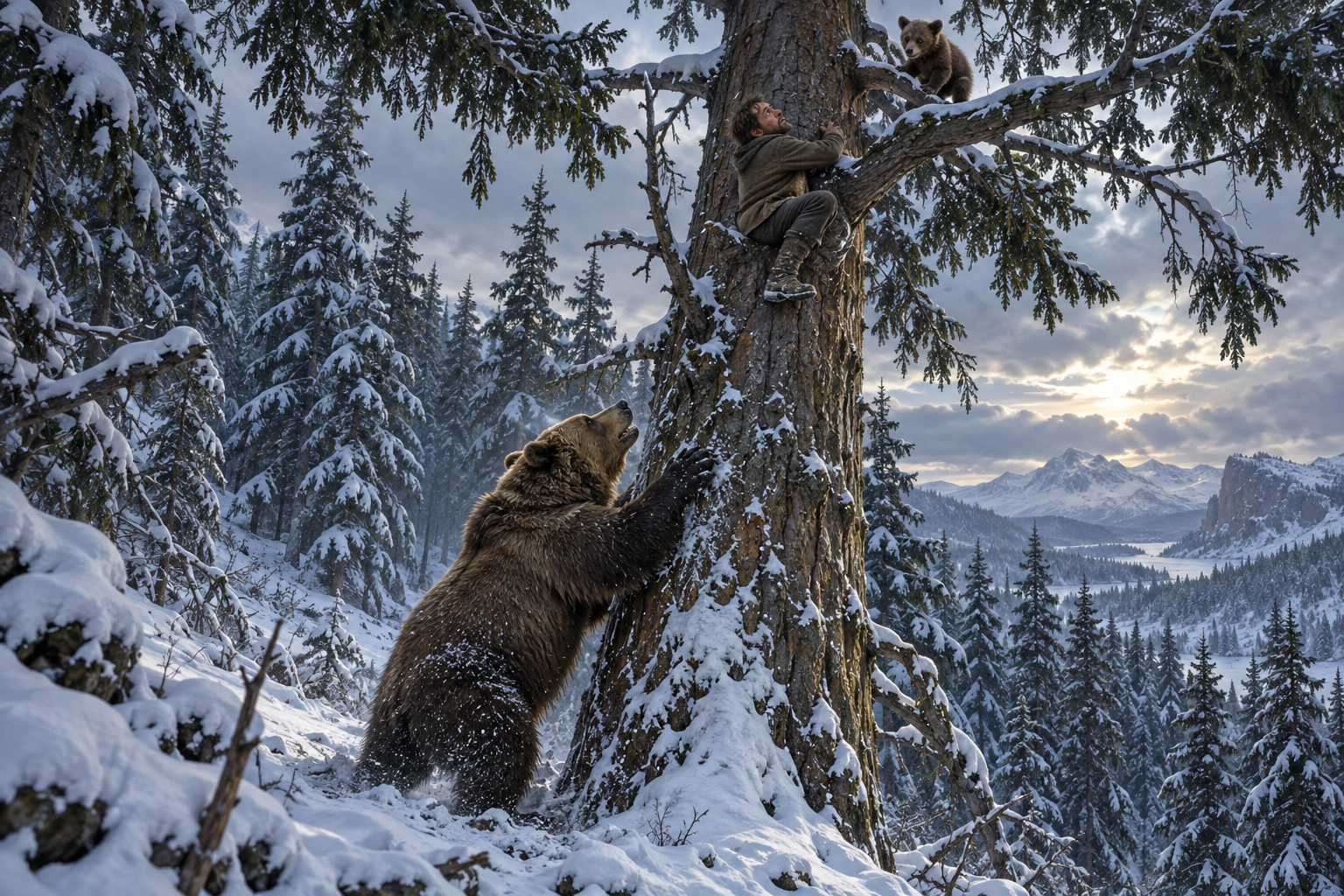
JOHN AND THE TREE
A Story from the Forests of the Winterland
As in previous years, John had found work in the forests.
He was no famous warrior. No commander. No hero whose name was sung in songs.
John kept the paths clear.
With an axe over his shoulder, he traveled through the forests around the settlements, removing fallen branches, marking safe routes, and cursing every tree that fell precisely where it would cause the most work.
Before the season began, the forestry workers regularly had to listen to the old hunters.
Bear rules.
Do not run.
Do not touch cubs.
Secure your food.
And one of the older hunters declared, with the certainty of a man who considered disagreement a personal insult:
“Young bears can climb. The really big ones can't. If one chases you, find a sturdy tree.”
John had not given it much thought at the time.
That would change.
A few weeks later, he was working alone on a remote path.
His axe struck a dead branch.
Once.
Twice.
Then John heard something behind him.
He turned.
A huge female bear stood on the path.
John did not move.
Neither did the bear.
For a brief moment, they studied each other.
Then the bear laid back her ears.
“Damn it.”
John ran.
Later, he could not say which tree he had chosen. He remembered only running toward a trunk, dropping his axe, and climbing as though his entire life had been preparation for this very moment.
The bear reached the tree right behind him.
Her claws tore a strip of bark from the trunk.
John climbed higher.
The bear did not leave.
She began tearing at the tree.
Bark flew.
Wood splintered.
The trunk shook.
John clung to a branch.
“The old bastard lied.”
The bear struck the trunk again.
Then John heard a sound.
Not from below.
From above.
A soft, plaintive whimper.
John slowly raised his head.
About three meters above him, a bear cub sat among the branches.
John closed his eyes.
Now he understood.
The mother had not wanted him.
At least not originally.
He had climbed between a mother and her cub.
“Of course.”
The cub whimpered.
Below, its mother answered with a deep rumble.
The tree shook again.
John looked down.
Then up.
Then down again.
There was no good solution.
So he took the only bad one.
He climbed toward the cub.
The closer he came, the louder it cried.
And the louder it cried, the more furiously its mother tore at the trunk.
“I know,” John muttered. “I think it's a lousy idea too.”
The cub hissed.
John reached the branch beneath it.
The tree creaked.
Not the ordinary creak of a tree in the wind.
A deep, dying sound.
John looked at the trunk.
The bear had already torn away a frightening amount of wood.
He had to act.
John carefully stretched out one foot.
The cub swiped at him.
John withdrew his foot.
“Fine. Then we'll do this the rude way.”
On the second attempt, he kicked harder at the branch right beside the cub.
The little bear lost its grip.
It fell.
John held his breath.
The cub landed in soft snow, rolled over once, and sat there looking dazed.
Its mother instantly stopped dismantling the tree.
She ran to her cub.
Sniffed it.
The cub scrambled to its feet.
Then both vanished among the trees.
John stayed up there.
One minute.
Five minutes.
Perhaps twenty.
He wanted to be absolutely sure.
At last he climbed down, picked up his axe, and set off home on trembling knees.
He had gone quite some distance when a tremendous crash thundered through the forest behind him.
John spun around.
The tree lay on the ground.
The very tree in whose crown he had sat a few minutes earlier.
John stared at it for a long time.
The next morning, he appeared at work again.
The old hunter was sitting by the fire, explaining the bear rules to some new forestry workers.
“And if a large bear chases you,” he began, “then find—”
John set his axe on the table.
The hunter fell silent.
John sat down across from him.
“About that rule with the tree,” he said.
The hunter swallowed.
John smiled.
“We need to talk.”
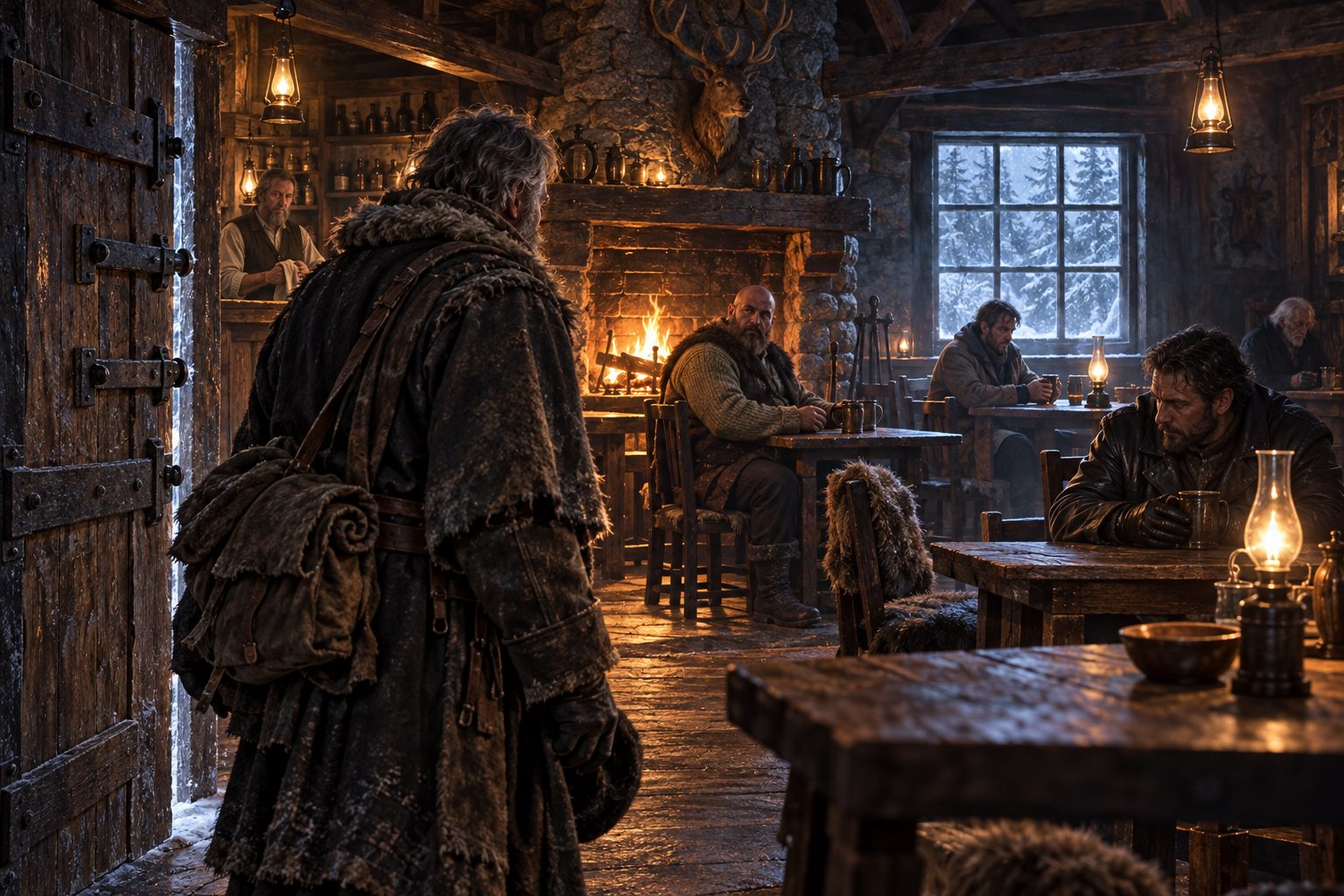
GREY'S STORIES BY THE FIRE VIII
The Four Guests
Grey had learned that in winter you did not ask whether a path was the right one.
You asked only whether it led anywhere.
Since leaving the place with the tree behind, he had traveled through the forest for three days.
Perhaps four.
In winter, days were poor units of measure.
It grew light.
It grew dark.
In between, you walked.
The snow between the trees sometimes reached above Grey's knees. Where wind swept between the trunks, there was hardly any. Twenty steps farther on, it piled against fallen firs like a wall.
Grey walked slowly.
Not because he was tired.
He was that too.
But because the forest had grown too quiet.
No birds.
No hares.
Not even the tiny tracks of mice that usually emerged from beneath the roots and disappeared back into the snow after a few steps.
Grey stopped.
He looked back.
His own footprints were the only ones.
“Good.”
He pulled his coat tighter.
“Then we agree.”
The forest did not answer.
Grey went on.
He spotted smoke in the late afternoon.
A thin gray line between black trunks.
Grey stopped and watched it.
Smoke meant people.
People meant fire.
Fire perhaps meant soup.
And at that point, soup was a more persuasive argument to Grey than caution.
He followed the smoke.
The village consisted of nine houses.
Grey counted twice.
Nine.
A well.
A small stable.
A shed whose roof sagged beneath the weight of snow.
And a tavern.
At least, that was what a weathered board above the door claimed.
THE OLD STAG
The painted animal beneath it looked more like a goat someone had offended.
Grey studied the sign.
“Convincing.”
Then he opened the door.
Warmth struck him.
Grey stood still for a moment.
Not much warmth.
But enough.
A fire burned in a stone fireplace on the opposite wall. Two oil lamps hung from the beams. The room smelled of wet wool, woodsmoke, old grease, and something that might once have been stew.
A woman stood behind the counter.
Old.
Broad shoulders.
Gray hair.
She studied Grey.
Grey studied her.
“Bed?” she asked.
“If you have one.”
“Food?”
“If you have some.”
“Money?”
Grey sighed.
“Unfortunately, that too.”
The woman nodded.
Apparently, that concluded all social formalities.
Grey knocked snow from his boots and stepped inside.
Then he noticed the other guests.
Four.
One sat near the fireplace.
A tall man with a bald head and a beard that fell to his chest.
The second sat by the window.
Thin.
Almost gaunt.
His coat was still fastened though the room was warm.
The third sat alone at a table near the stairs.
He wore gloves.
Black leather.
Both hands lay flat on the tabletop.
The fourth sat in the darkest corner.
Grey could barely make out his face.
Four men.
Four tables.
None spoke.
Grey looked at the innkeeper.
“Friendly place.”
No response.
She set a bowl before him.
Grey studied its contents.
“What is it?”
“Stew.”
“Of course.”
Grey sat down.
He ate slowly.
The stew was better than it looked.
Admittedly, that was not a great achievement.
As he ate, Grey watched the other guests.
Not openly.
Grey had lived long enough to know that people rarely liked being watched while acting suspiciously.
The man by the fire did not drink.
There was a cup before him.
Full.
The thin man at the window looked outside.
He had not moved since Grey came in.
The man with the gloves did not move at all.
And the fourth—
Grey raised his spoon.
The fourth man had vanished.
Grey looked into the corner.
The chair stood there.
Empty.
Grey looked toward the stairs.
No one.
Toward the door.
Closed.
He looked at the innkeeper.
She was polishing a cup.
Grey took another spoonful of stew.
“Of course.”
Ten minutes later the fourth man was sitting there again.
Grey had not heard him return.
He was simply there.
Grey set down his spoon.
Now he could make out the man's face a little better.
Old.
Very old.
His skin was pale.
Not sickly.
Not dead.
Simply pale.
The man looked at Grey.
Grey looked back.
Then the old man smiled.
Just a little.
Grey raised his cup.
The old man did the same.
His cup was empty.
Later, the wind began.
It came suddenly.
A long howl between the houses.
The shutters rattled.
The fire in the hearth flickered.
The innkeeper went to the door and slid a second bolt into place.
Then a third.
Grey noticed.
“Bad storm?”
“No.”
“Then the number of bolts is very reassuring.”
The woman looked at him.
“The door stays shut at night.”
“Because of wolves?”
“No.”
Grey waited.
The woman returned to the counter.
“Of course.”
The man by the window spoke first.
“You came from the north.”
It was not a question.
Grey looked at him.
“Among other places.”
“Did you see the tree?”
Grey paused.
“Which tree?”
The man did not smile.
“Then you saw it.”
The man with the gloves slowly lifted his head.
“They say something happened there.”
Grey studied him.
“Something happens everywhere.”
“Not something like that.”
Grey was silent.
The tall man by the fireplace finally picked up his cup.
He did not drink.
“The forests are changing.”
Grey leaned back.
“Forests do that.”
“Not in winter.”
Now the old man in the corner spoke.
His voice was little more than a whisper.
“This winter is different.”
Grey looked at him.
“People say that about every winter that makes them cold.”
The old man smiled again.
“You will smell it.”
Grey did not answer.
An hour passed.
Perhaps two.
The conversations died again.
The fire dwindled.
Grey thought about his bed.
Then he smelled it.
At first, he thought a piece of wood in the hearth was too wet.
A bitter smell.
Grey raised his head.
Smoke.
But not the smoke from the hearth.
Different.
Heavier.
Sweeter.
Grey looked at the fire.
The flames were low.
Blue at their edges.
He stood.
The innkeeper noticed.
“What?”
Grey went to the window.
The thin man moved aside for him.
For the first time.
Grey wiped the misted glass with his sleeve.
Outside, the village lay beneath snow.
Still.
Dark.
Nothing was burning.
Grey opened the window latch.
The innkeeper struck the counter with her hand.
“Don't!”
Grey paused.
“Why?”
“The window stays closed.”
Grey looked at her.
Then at the second bolt on the door.
Then the third.
He opened the window a crack anyway.
Cold air came in.
And with it the smell.
Smoke.
Unmistakably.
Far away.
But strong enough for the wind to carry it through the forest.
Grey closed the window again.
“Something is burning somewhere.”
The man with the gloves slowly shook his head.
“No.”
Grey looked at him.
“I know smoke.”
“I don't doubt it.”
“Then?”
The man did not answer.
The old man in the corner did.
“Nothing is burning.”
Grey looked at him for a long time.
“Then I'd like to know where the smoke is coming from.”
The old man no longer smiled.
“So would we all.”
Grey slept badly that night.
His room was above the taproom.
A bed.
A chair.
A small window.
He needed no more.
Grey put his knife beside the pillow.
Then he lay awake.
The floorboards creaked below him.
Footsteps.
Slowly.
One.
Two.
Three.
Four.
Pause.
Then again.
One.
Two.
Three.
Four.
Grey sat up.
The footsteps stopped.
He waited.
Nothing.
Grey lay down again.
Then someone knocked on his door.
Once.
Grey did not move.
Again.
Grey took the knife.
“Who is it?”
No answer.
He stood.
Went to the door.
Waited.
Then opened it.
The corridor was empty.
Grey looked left.
Right.
Nothing.
Snow lay on the floorboards in front of his door.
Only a little.
As though someone had stood there in wet boots.
Grey knelt.
There was an impression in the snow.
Not a boot sole.
Not a paw.
Something broad.
With deep grooves.
Grey did not touch the snow.
He stood again.
Closed the door.
Pushed the chair against it.
“Good.”
He lay down again.
“Now it's getting interesting, at least.”
By morning, the four guests were gone.
All four.
Grey came downstairs.
The tables were empty.
The innkeeper stood behind the counter.
“Left early?” Grey asked.
“Who?”
Grey stopped.
“The four men.”
The woman looked at him.
“Which men?”
Grey fell silent.
The innkeeper set a cup before him.
“You were my only guest yesterday.”
Grey looked at the four tables.
Then at the dark corner.
There was no chair there.
Grey went over.
He studied the floor.
Dust.
No tracks.
Nothing.
“That's inconvenient.”
“What?”
“Nothing.”
Grey took his coat.
Outside the tavern, the village was awake.
A man chopped wood.
A woman carried a bucket from the well.
A child dragged a sled behind them.
Perfectly ordinary.
Grey looked toward the forest.
Above the treetops, the sky was gray and heavy.
No smoke.
He walked to the edge of the village.
There he stopped.
Four tracks lay in the snow.
They simply began there.
None led from the village to that place.
Four lines of prints.
They led together into the forest.
Grey studied them.
One track came from heavy boots.
One from narrow ones.
A third was barely visible.
The fourth—
Grey knelt.
Broad.
Deep grooves.
Exactly like the print outside his door.
Grey straightened.
The wind came from the forest.
And again he smelled smoke.
Stronger this time.
Grey pulled his coat tighter.
Behind him, the tavern door opened.
The innkeeper stood there.
“You should go west.”
Grey looked east.
That was where the four tracks led.
“Why?”
“Because there's nothing in the east.”
Grey studied the tracks.
Then the forest.
Then the innkeeper again.
“People say that astonishingly often about places where something turns up later.”
The woman went pale.
“Don't go there.”
Grey shouldered his pack.
He tightened his gloves.
And went east.
After an hour, the four tracks vanished.
Not gradually.
Not beneath fresh snow.
They ended.
Right among the trees.
Grey stopped.
Untouched snow lay before him.
He looked back.
Four tracks.
Then nothing.
Grey stood there for a long time.
At last he shook his head.
“Rude.”
He continued.
The forest grew denser.
And warmer.
Grey noticed only after a few minutes.
He stopped.
Breathed out.
His breath was still visible.
But fainter.
He pulled off a glove.
The air really was warmer.
Only a little.
But enough.
In the middle of winter.
In the middle of the forest.
Grey looked between the trees.
Nothing.
Then he heard something.
Very far away.
A deep sound.
Not thunder.
Not a tree breaking beneath the weight of snow.
It sounded—
Grey listened.
The sound came again.
Deep.
Slow.
Almost like a breath.
Then silence.
The wind shifted.
The smell of smoke hit Grey at full strength.
He stopped.
For the first time in a long while, he made no joke.
Something drifted through the air between the trees ahead.
Grey held out his hand.
A black flake landed on his palm.
Ash.
Still warm.
Grey looked up.
The sky was gray.
Snow began to fall.
White flakes.
And black ones among them.
Grey closed his hand around the ash.
Then he looked east.
Something was waiting out there.
Something bringing warmth to a forest that should long since have frozen.
Something whose smoke could be smelled though nothing was burning.
Grey continued on his way.
Behind him, the last houses of the little village disappeared among the trees.
Ahead, the snow grew thinner.
A few more steps.
Then Grey stopped again.
There was no frozen ground beneath his boot now.
The earth was soft.
Warm.
And somewhere deep in the forest, wood cracked.
Not like wood in a fire.
Like wood just catching fire.
Grey looked into the darkness between the trunks.
“Good,” he said softly.
This time the forest answered.
A distant, deep rumble rolled through the trees.
Grey drew his knife.
And walked on.
The Chronicler's Postscript
No reliable name for the little settlement appears in later records.
Nor does any surviving map from the period show a tavern called The Old Stag.
Grey, however, insisted that he had spent a night there.
When asked who the four men had been, he never gave a clear answer.
Many years later, he is said to have said only:
“Perhaps they were four men.
Perhaps they were four warnings.
And perhaps the old innkeeper was right.
I should have gone west.”
Then, they say, he laughed.
But Grey never laughed about what he found to the east the following day.
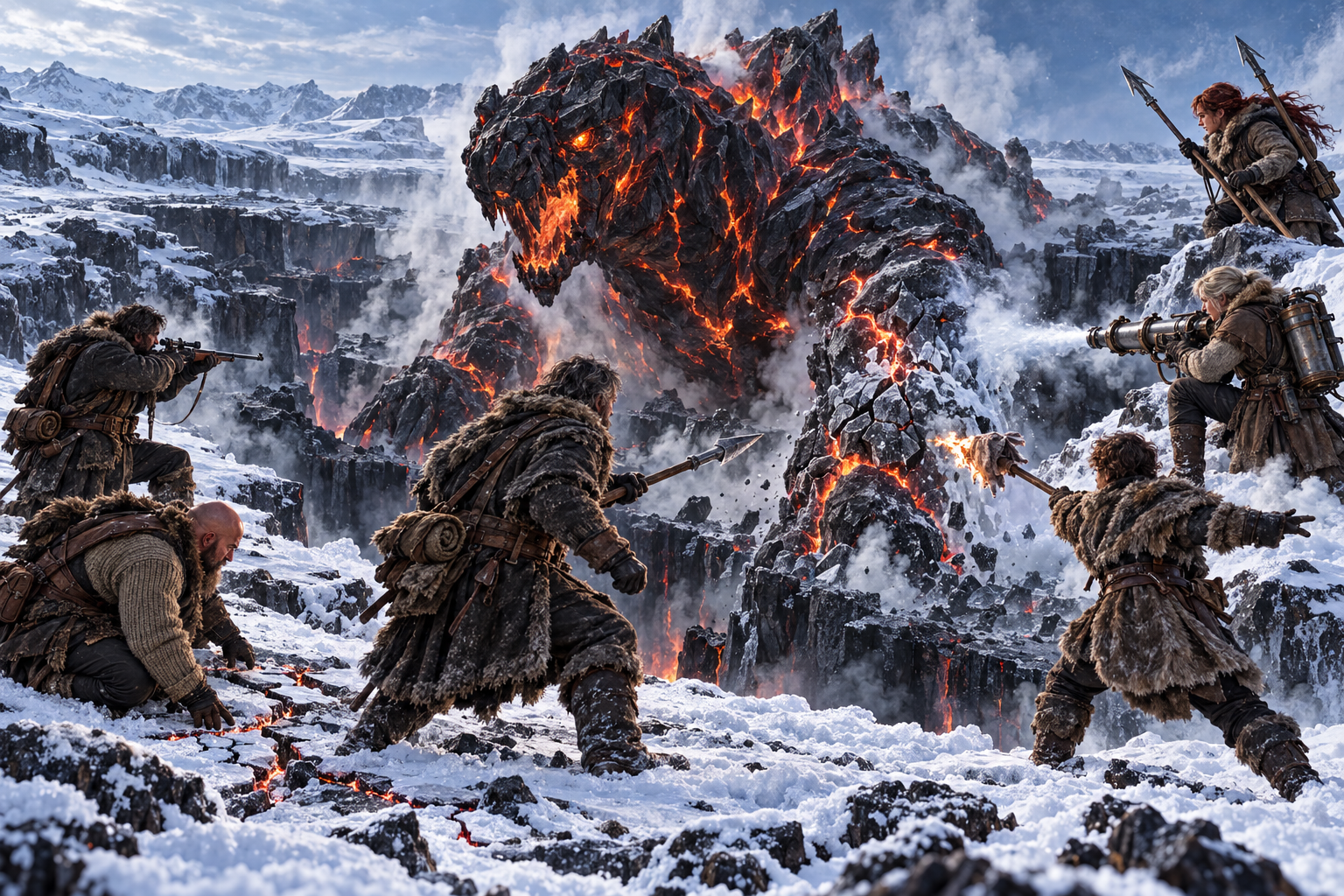
THE FIREBEAST
The frost of the Northern Borderlands did more than bite.
It devoured.
Ket crouched beside the last track and ran two fingers along the edge of the melted snow.
Behind her, Argento examined the blackened trail leading to the Obsidian Rift. Deathhead watched the surrounding ridges while Seef stood at the edge of the broken ground.
“The tracks end here,” Seef said.
Ket shook her head.
“No. They change.”
Ahead of them, snow had turned to water.
Beyond that, water had turned to steam.
The Obsidian Rift cut through the tundra like an old wound. Heat rose from its depths in dry waves, and wherever it touched the frozen ground, the ice hissed.
Argento looked down into the darkness.
“Whatever left these tracks is down there.”
A tremor answered him.
Stone shifted.
Then something began to climb upward.
The Firebeast did not so much emerge from the ravine as pour itself out of it.
It was enormous—a four-legged mass of dark, cracked material resembling volcanic rock. Light burned beneath its surface. With every movement, glowing fissures opened along its limbs and shoulders, and the heat radiating from it was strong enough to drive the NFD party back.
Deathhead fired first.
Her projectile struck one of the darker areas on its flank.
The shaft blackened almost instantly.
“Too hot,” she said.
The beast attacked.
Ket shouted for the others to spread out.
A burning limb struck the ground where Seef had stood a heartbeat before.
Ice exploded into steam.
Argento watched the creature turn.
The brighter cracks widened with every movement.
“Those fissures—”
“I see them,” Ket replied.
Seeing them was easier than reaching them.
The beast drove them toward a ridge where the ice narrowed between rock and the open Rift.
Then a voice called from above.
“DOWN!”
Ket did not know the speaker.
She obeyed anyway.
Something struck the Firebeast square in the chest.
A huge cloud of frozen powder burst across its surface.
The sound that followed was like stone splitting in winter.
Part of the creature's outer shell broke open.
Two figures descended from the ridge.
The first was a woman carrying two heavy harpoons.
The second was a man with a strange pressure-driven launcher, steam rising from its barrel in the cold.
“Ninkasi,” the woman said curtly.
“Breeze,” said the man.
Seef stared at them.
“Wonderful. Explanations later.”
“The best kind,” Breeze replied.
The Firebeast roared.
Ninkasi pointed to the glowing openings behind its shoulders.
“Stop trying to strike through the shell. Watch the openings.”
“You know this creature?” Argento asked.
“I know enough about it to prefer it dead.”
That was not an answer.
But there was no time to demand a better one.
Breeze fired again.
The sudden cold struck the beast's foreleg.
The dark material shattered.
The creature stumbled.
“Thermal shock,” Argento said.
Breeze looked at him.
“Exactly.”
Ket was already moving.
“Deathhead—aim for the fissures. Seef, keep it moving. Argento, with me.”
The fight changed.
Not because the Firebeast had grown weaker.
Because the NFD now knew where not to strike.
Deathhead stopped wasting shots on the hardened surface and began aiming at the newly opened cracks.
Seef drew the creature's attention and forced it to turn again and again.
Breeze repeatedly cooled parts of its shell, creating fractures wherever the heat beneath pressed hardest against the surface.
Ninkasi waited.
Then she ran.
She drove a harpoon into a broken area near the shoulder, pulled herself upward, and reached the glowing opening behind the creature's neck.
The second harpoon struck across it.
The opening narrowed.
The Firebeast jerked violently.
The glow within it intensified.
“That only made it angrier!” Seef called.
“No,” Ninkasi answered as she jumped back to the ground.
“It made it hotter.”
Argento understood.
“Inside.”
Ninkasi nodded.
“It can release heat through those openings. Narrow them and the pressure rises.”
“Can we kill it that way?”
Ninkasi studied the ever-brighter cracks.
“We're about to find out.”
Ket saw one of its hind legs buckle.
“Now!”
They attacked together.
Not the shell.
The fractures.
Deathhead's shots struck the open fissures.
Breeze split open another area with a further blast of cold.
Argento thrust his weapon into the weakened joint and pulled it free before the heat could overwhelm him.
Seef struck from the other side.
The Firebeast collapsed.
Deep inside its chest, something pulsed.
Once.
Twice.
Ket saw it.
“I see it too,” Argento said.
Seef threw her his spear.
Ket caught it.
She ran.
The creature tried to rise.
Too late.
Ket drove the spear through a broken part of its chest and into the pulsing light beneath.
For one impossible moment, everything was still.
Then the Firebeast shattered.
The shock wave hurled them into the snow.
The heat vanished.
Dark fragments of its shell scattered across the ice.
And then the cold returned.
THE CORE
They waited before approaching the remains.
At the center of the broken creature lay several jagged crystalline fragments.
They glowed faintly.
Not with the tremendous light that had filled the Firebeast while it lived.
This was something slower.
Almost rhythmic.
Seef crouched beside them.
“Fire crystals?”
“Don't touch them,” Argento said.
Seef stopped.
Ninkasi came closer.
“You've seen anything like this before?” she asked.
“We have fire crystals,” Ket said.
Ninkasi looked at her.
Then back at the fragments.
“I didn't ask what you call them.”
Argento noticed.
“What do you call these?”
Ninkasi hesitated.
“Core fragments.”
“That tells us where they came from. Not what they are.”
“It's all I know for certain.”
Breeze lowered his launcher.
“They store heat.”
“So do fire crystals,” Seef said.
“These things survived inside that creature,” Deathhead replied. “That doesn't mean they're the same.”
Argento crouched beside a fragment without touching it.
The similarity was troubling.
Crystalline structure.
Stored warmth.
A faint inner glow.
But resemblance was not proof.
“Have you ever sold any of these?” he asked Ninkasi.
“I've seen traders pay a great deal for fragments taken from creatures like this.”
“What do they do with them?”
“Heat. Experiments. Sometimes things no one explains to the person who brought them the material.”
Ket studied her for a long time.
“And you hunt these creatures?”
Ninkasi wiped soot from her face.
“Sometimes.”
Again, no real answer.
At last Seef wrapped one of the fragments in several layers of insulating cloth.
“We're taking them with us.”
“Separate from the fire crystals,” Argento said.
Seef nodded.
“And nobody puts one in a furnace just to see what happens.”
Breeze smiled.
“I was just beginning to like you.”
STRANGERS
They made camp far from the remains.
Ninkasi and Breeze could have left.
They did not.
Over the meal, Ket finally asked the question she had postponed during the fight.
“How did you know how to kill it?”
Ninkasi looked into the fire.
“Experience.”
“With this exact creature?”
“With things that burn from within.”
Argento watched her.
It was obvious she knew more than she wanted to say.
Breeze was easier to read.
He was tired, hungry, and sincerely glad to be sitting beside a fire that was not trying to kill him.
Eventually, Seef gestured toward the settlement.
“Do you two have anywhere to go?”
Ninkasi and Breeze exchanged a look.
“Nowhere we absolutely need to be tonight,” Breeze said.
“Then come back with us,” Seef replied. “Eat a proper meal. Sleep somewhere with walls.”
Ninkasi raised an eyebrow.
“Is that an invitation?”
“It's dinner.”
“And after that?”
“We'll see.”
Ket smiled faintly.
“He doesn't get much warmer than that.”
Ninkasi studied her.
Then nodded.
“Dinner.”
No one called it an alliance.
No one called them members of the NFD.
Not yet.
But as the group returned across the tundra, Ninkasi and Breeze walked with them.
And carefully packed among their supplies lay the Firebeast's fragments.
Later comparisons would reveal similarities to fire crystals.
They would also reveal differences.
Whether the two substances shared an origin, whether one could become the other, or whether their resemblance was merely another trick of the frozen world remained unanswered.
The NFD had gone into the tundra to hunt an unknown creature.
They returned with two strangers.
And a new question.
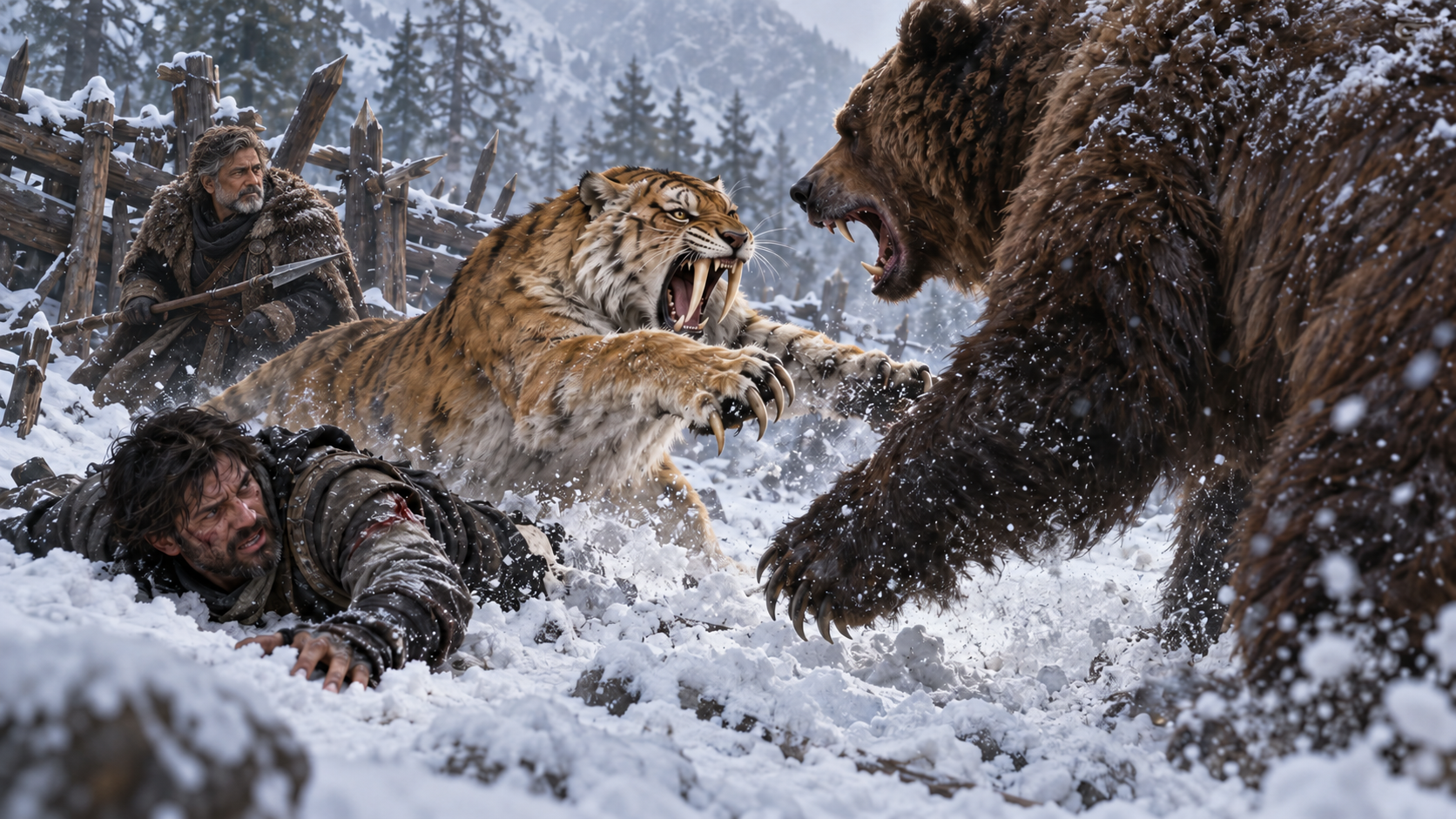
FROSTBOUND LOYALTY
The wind howled through the trees of the Winterland, driving fine snow across the ridges above the settlement.
Seef stood at the village's northern edge, Tooze by his side.
The saber-toothed tigress had grown enormous. Her shoulders reached almost to Seef's chest, her winter coat was thick, and her long fangs caught the pale morning light whenever she raised her head toward the forest.
People still kept their distance from her.
They had learned that this was wise.
Seef put a hand on her neck.
Tooze answered with a deep rumble.
To anyone else it might have sounded like a warning.
Seef knew better.
He had found her years earlier.
Tooze had been little more than a cub then—cold, hungry, and alone in the snow.
Seef never learned why a saber-toothed cub had been there at all, or what had happened to the rest of her kind.
He had brought her back.
There had been arguments.
Some wanted to drive the animal away before she grew large enough to be dangerous.
Seef refused.
He fed her.
Protected her.
Trained beside her.
And Tooze grew.
What had begun as a young Seef's stubborn decision became something deeper.
Tooze followed him through blizzards.
She slept near him when the nights grew dangerously cold.
She learned his voice, his gestures, and the smallest shifts in his posture.
Seef learned hers.
They barely needed commands.
They understood each other.
Not everyone understood the pair.
Darth least of all.
“She's watching me.”
Darth stood on the other side of the fire.
Tooze lay beside Seef and seemed to be sleeping.
“She watches everyone,” Seef said.
“No. She's watching me.”
Seef looked down at Tooze.
One golden eye opened.
It looked directly at Darth.
Darth stepped back.
Seef tried not to smile.
“That doesn't help,” Darth muttered.
“She likes you.”
“Bullshit.”
Tooze yawned.
Her enormous saber teeth became visible.
Darth immediately took another step back.
“See?”
“She yawned.”
“She displayed weapons.”
“She has teeth, Darth.”
“Swords grow out of her skull.”
Nearby, Ket laughed.
Darth glared at her.
“Laugh now. If that thing ever decides one of us tastes good, I'll remind you of this conversation.”
“You'll have to get close enough,” Ket said.
Darth looked at Tooze again.
“No.”
Some found his mistrust funny.
But it was not only a joke.
Darth was genuinely afraid of her.
He hid it behind insults, warnings, and arguments, but Seef could see it.
Tooze probably could too.
And that made Darth more nervous still.
Three days later, the tracks appeared.
Large bear tracks.
Many of them.
Argento knelt beside one print while Seef watched the tree line.
Ket stood behind them.
Deathhead had already gone farther along the slope to examine a possible approach route.
Darth kept several paces between himself and Tooze.
“More than one,” Argento said.
Seef nodded.
“I can see that.”
“I'm trying to find out how many.”
“Then do it faster.”
Argento looked up.
“That's not how counting works.”
Suddenly Tooze raised her head.
Everyone fell silent.
Her ears moved.
Then came the growl.
Low.
Dark.
Different from the sound beside the fire.
Seef knew this one.
“Back to the settlement.”
Ket did not ask why.
Neither did Argento.
Darth was already moving.
The bears came with the storm.
No one knew what had driven so many of them toward the settlement at once.
Hunger.
Territory.
The brutal winter.
Perhaps something farther north had driven them south.
There was no time to find the answer.
The first bear hit the outer defenses shortly after dawn.
Then a second appeared.
Then three more.
The NFD defenders formed up under Ket's orders while Argento watched the terrain and shouted corrections whenever the animals tried to skirt their line.
Deathhead attacked from a distance whenever she had a clear opening.
Seef stayed near the center.
Tooze stayed with Seef.
Until she did not.
A bear broke through part of the barricade.
One defender fell.
The animal charged.
Tooze moved before Seef gave any command.
She struck the bear from the side.
The impact hurled both animals into the snow.
Tooze's claws raked its shoulder.
The bear turned on her.
Seef was already moving.
Together, they drove it back.
Around them, the battle broke apart into snow, screams, and blood.
Then Seef heard Darth scream.
Not a battle cry.
A scream.
He turned.
Darth had fallen.
A bear stood over him.
His weapon lay somewhere in the snow.
For a fraction of a second, Darth did not move.
He stared up at the animal.
Then something struck the bear.
Tooze.
She rammed it so hard that it was thrown away from Darth.
The two animals rolled through the snow.
Tooze regained her feet first.
The bear struck.
Tooze avoided most of the blow, closed the distance, and sank her fangs into its throat.
Blood stained the snow dark.
The bear collapsed.
Tooze stood over it.
Then she turned.
Toward Darth.
Darth froze.
Tooze's muzzle was smeared with blood.
Her long fangs were red.
She took a step toward him.
Darth slid backward.
“Stay away from me.”
Tooze stopped.
Seef reached them.
“She just saved your life.”
“I know.”
Darth's voice was barely audible.
Tooze watched him.
Darth stared back.
Something had changed in his face.
Not gratitude.
Not trust.
Fear.
Pure, unmistakable fear.
The fighting continued.
Tooze returned to Seef's side.
Together with the others, they held the settlement.
By midday, the surviving bears had withdrawn into the storm.
No one celebrated at once.
There were wounded to carry.
Walls to repair.
Blood to clear from the snow.
Darth sat alone near one of the damaged buildings.
Seef found him there.
Tooze followed.
Darth noticed her and stood immediately.
“No.”
Seef stopped.
Tooze halted beside him.
“You're alive because of her.”
“I know.”
“She chose you over the bear.”
“I know.”
“She could have left you there.”
“I know, Seef.”
Darth looked at Tooze.
The tigress returned his gaze calmly.
His hands trembled.
“That's the problem.”
Seef frowned.
Darth swallowed.
“I saw what she did to it.”
“She saved you.”
“I saw what she did.”
Tooze lowered her head slightly.
Darth stepped back.
“I was wrong about one thing,” he said. “She is loyal to you.”
“To us.”
Darth shook his head.
“To you.”
Seef did not answer.
Darth continued.
“She protected me because I belong to your people. Maybe that should reassure me.”
“It should.”
“It doesn't.”
He looked again at the blood on Tooze's fangs.
“I'm not going near that animal.”
Then Darth walked away.
After that day, Darth's behavior toward Tooze changed.
Before the attack, he had complained about her.
Argued about her with others.
Warned everyone about her.
Afterward, he mostly stopped speaking about her at all.
He simply kept his distance.
When Tooze entered a room, Darth found a reason to stand somewhere else.
When Seef went out with her, Darth joined them only when necessary.
At the fire, he chose seats from which he could always see her.
And whenever Tooze looked straight at him, Darth suddenly became very interested in whatever was happening in the opposite direction.
No one made much fun of him.
Not after they had seen what Tooze could do.
Darth never again claimed she would inevitably turn on the NFD.
She had saved his life.
He knew that.
But knowledge and fear were different things.
His skepticism remained.
His fear grew stronger.
And in time Darth made a point of withdrawing whenever Tooze was near him.
Tooze, for her part, seemed utterly indifferent.
Much later, Seef sat outside with Tooze beside him.
Snow drifted softly across the settlement.
He ran a hand through the thick fur at her neck.
“You frightened him.”
Tooze rumbled.
“You know you frightened him.”
Another rumble.
Seef smiled.
“He'll probably never trust you.”
Tooze pressed her enormous head against his shoulder.
Seef nearly lost his balance.
“All right.”
He scratched her behind the ear.
“I trust you.”
Tooze closed her eyes.
For her, that was apparently enough.
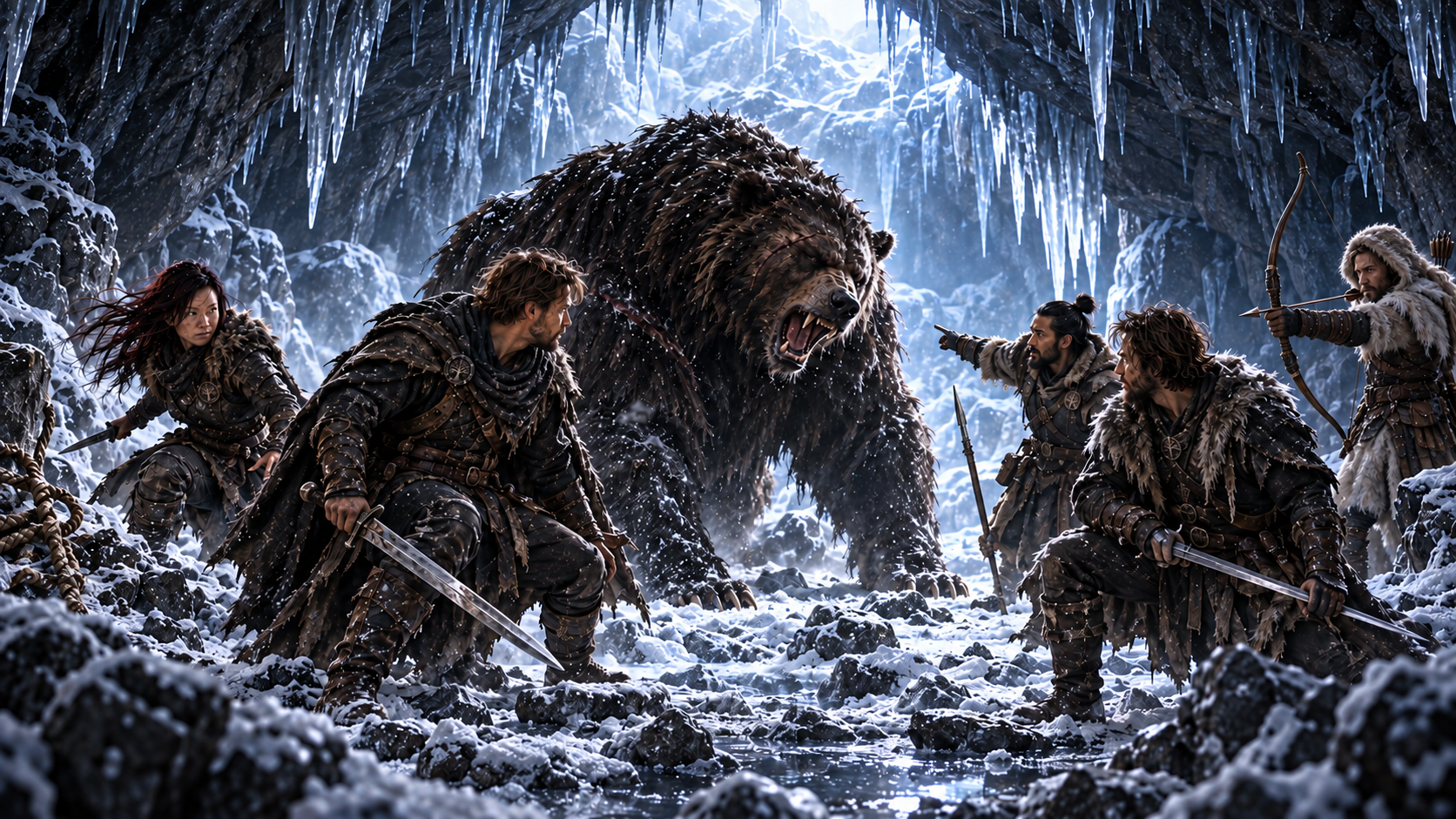
THE HUNT FOR LOKI
The wind came down from the mountains that night.
It howled between the houses, drove snow across the paths, and made even the watchfires seem small and weak.
Ket was not sleeping.
Later she would say she had known something was wrong minutes before it happened.
Then the window shattered.
Wood splintered. Glass flew across the room. A huge black paw struck the frame.
Ket reached for her weapon.
Too late.
Something seized her.
She saw fur. Teeth. Two eyes that held more than an animal's hunger.
And then she heard a voice.
Deep. Rough. Almost human.
“You're coming with me.”
Ket froze.
Not from fear.
From surprise.
“You can speak?”
The gigantic bear pulled her through the ruined window into the snow.
“Obviously.”
Then Loki vanished with her into the night.
In the morning, Joker found the tracks.
He knelt before the broken window and studied the prints in the snow.
Joker was not a man who needed many words. Years of fighting had taught him that most problems did not grow smaller through long discussions.
Cabai stood beside him.
Cabai studied the tracks longer.
“Big.”
“I can see that.”
“Very big.”
Joker looked at him.
“I can see that too.”
Flake Snow joined them, a bow already over his shoulder.
“Four meters, if the stories are true.”
“Stories about what?” Argento asked.
Flake Snow looked toward the mountains.
“Loki.”
Joker straightened.
He knew the name.
A bear said to recognize traps.
A bear that watched hunters before attacking them.
A bear that some claimed could understand humans.
Others claimed more.
That he spoke to them.
Until now, Joker had thought such stories nonsense.
Ket was missing all the same.
That was enough for him.
“We bring her back.”
Cabai nodded.
Flake Snow checked his arrows.
Argento tightened his gloves.
Four people set off into the mountains.
The hunt lasted several days.
Cabai led them.
Where others saw only snow, he saw a trail: broken branches, displaced stones, blood on a rock ledge.
Loki moved quickly.
But he did not hide his tracks completely.
“He could,” Cabai said on the third day.
Argento looked at him.
“Could what?”
“Lose us.”
Joker stopped.
“Then he wants us to follow.”
No one said anything.
None of them liked that.
On the fifth day, they found the cave.
It lay high on a jagged mountainside. Bones lay before the entrance. Some were old.
Others were not.
Joker drew his sword.
“Ket!”
His voice echoed into the darkness.
Nothing.
Then laughter came from the cave.
Deep.
Slow.
Wrong.
Argento looked at Joker.
“That wasn't a human.”
A voice answered from the darkness:
“Well spotted.”
Flake Snow already had an arrow on the string.
Then Loki emerged.
Even on four legs, he was immense. When he reared up, his body seemed almost to fill the cave entrance.
His fur was dark and crossed by old scars.
And behind him sat Ket.
Alive.
Her hands were bound, but she was awake.
“You took your time,” she said.
Joker let out an audible breath.
Loki looked over his shoulder.
“Ungrateful creature.”
Ket looked up at him.
“You abducted me.”
“I chose you.”
“That's called abduction.”
Loki considered it.
“Humans have too many words.”
“And you talk too much.”
Loki bared his teeth.
It might have been a smile.
With a four-meter bear, the difference was hard to tell.
Joker stepped forward.
“Let her go.”
Loki looked at him.
“No.”
“Then we'll take her.”
“You may try.”
Cabai whispered:
“Don't bunch together. He's too big. Spread out.”
Loki tilted his head.
“The little thinker.”
Cabai froze.
Loki had heard him.
“I like you,” the bear said.
“The feeling isn't mutual.”
Then Flake Snow fired.
The arrow struck Loki's shoulder.
The bear roared.
The cave shook.
Argento and Joker separated at once.
Loki charged.
His paw struck the ground where Joker had stood a heartbeat earlier.
Argento struck from the side.
His blade drew a bloody line across Loki's foreleg.
Loki spun.
“You.”
Argento retreated.
“Me?”
“You smell like trouble.”
“Many people say that.”
The paw came down.
Argento ducked.
Stone splintered behind him.
Flake Snow's second arrow struck Loki's neck.
The bear roared and turned toward the archer.
That was what Cabai had been waiting for.
“Now!”
Joker leaped forward.
His sword struck Loki's side.
At the same time, Ket threw herself against the rock to which her bonds were fastened.
Once.
Twice.
On the third attempt, the already damaged rope tore.
“Ket!” Joker called.
“Keep him busy!”
“We're trying!”
Loki knocked Joker to the ground.
Argento rushed between them.
The next paw grazed his shoulder and hurled him against the cave wall.
For a moment, everything went black.
When Argento could see again, Loki stood above him.
Blood dripped from the bear's mouth.
“You fight well.”
Argento reached for his sword.
“Thank you.”
Loki raised his paw.
“That wasn't a compliment.”
An arrow struck him just below the jaw.
Loki recoiled.
Flake Snow had landed his third hit.
Joker regained his feet.
Ket had meanwhile pulled a knife from Joker's belt.
Cabai pointed to Loki's injured side.
“Left! He's guarding his ribs!”
Argento understood.
He attacked.
Joker came from the other side at the same time.
Loki could not fend off both.
Argento got through.
His blade sank deep into Loki's flank.
The bear roared.
Joker struck after him.
Loki staggered.
But he did not fall.
Instead, he rose once more to his full height.
Four meters of blood, fur, and fury.
Everyone drew back.
Loki looked first at Joker.
Then Cabai.
Flake Snow.
Argento.
Finally Ket.
His voice was now only a rough whisper.
“You think you understand why I took her.”
Ket held the knife firmly.
“Then explain it.”
Loki laughed softly.
“No.”
His legs gave way.
The enormous body struck the stone floor.
The cave fell silent.
For a long time, nobody moved.
Flake Snow kept an arrow trained on Loki.
Cabai waited.
At last Joker stepped closer.
Loki was no longer breathing.
“Dead,” Joker said.
Ket came to them.
She studied the enormous bear.
Argento wiped his blade clean on the snow outside the cave entrance.
“Did he tell you why he wanted you?”
Ket did not answer immediately.
“He talked a lot.”
Joker raised an eyebrow.
“And?”
“Half of it was delusions of grandeur.”
“And the other half?”
Ket looked back into the dark cave.
Where Loki had held her, signs had been carved into the rock.
Not claw marks.
Signs.
Deliberately made.
Ket studied them for a long time.
“The other half,” she said at last, “worries me.”
Joker wanted to ask more.
Ket was already walking toward the exit.
“We're leaving.”
Cabai looked at the signs once more.
“Shouldn't we find out what they mean?”
Ket stopped.
“Someday.”
She looked at Loki.
“But not today.”
They left the cave.
Later, many stories arose about the hunt for Loki.
Some made Ket a princess.
Others made Joker the captain of a royal guard.
Some even claimed Loki had wanted to make Ket his winter bride.
Ket usually contradicted those stories.
Usually.
There was only one thing she never contradicted.
Loki had spoken.
Not like a trained animal.
Not through any spell.
Not in Ket's imagination.
He had spoken.
And before they left the mountains, Ket asked just one more question:
Why had Loki chosen her, of all people?
No one had an answer.
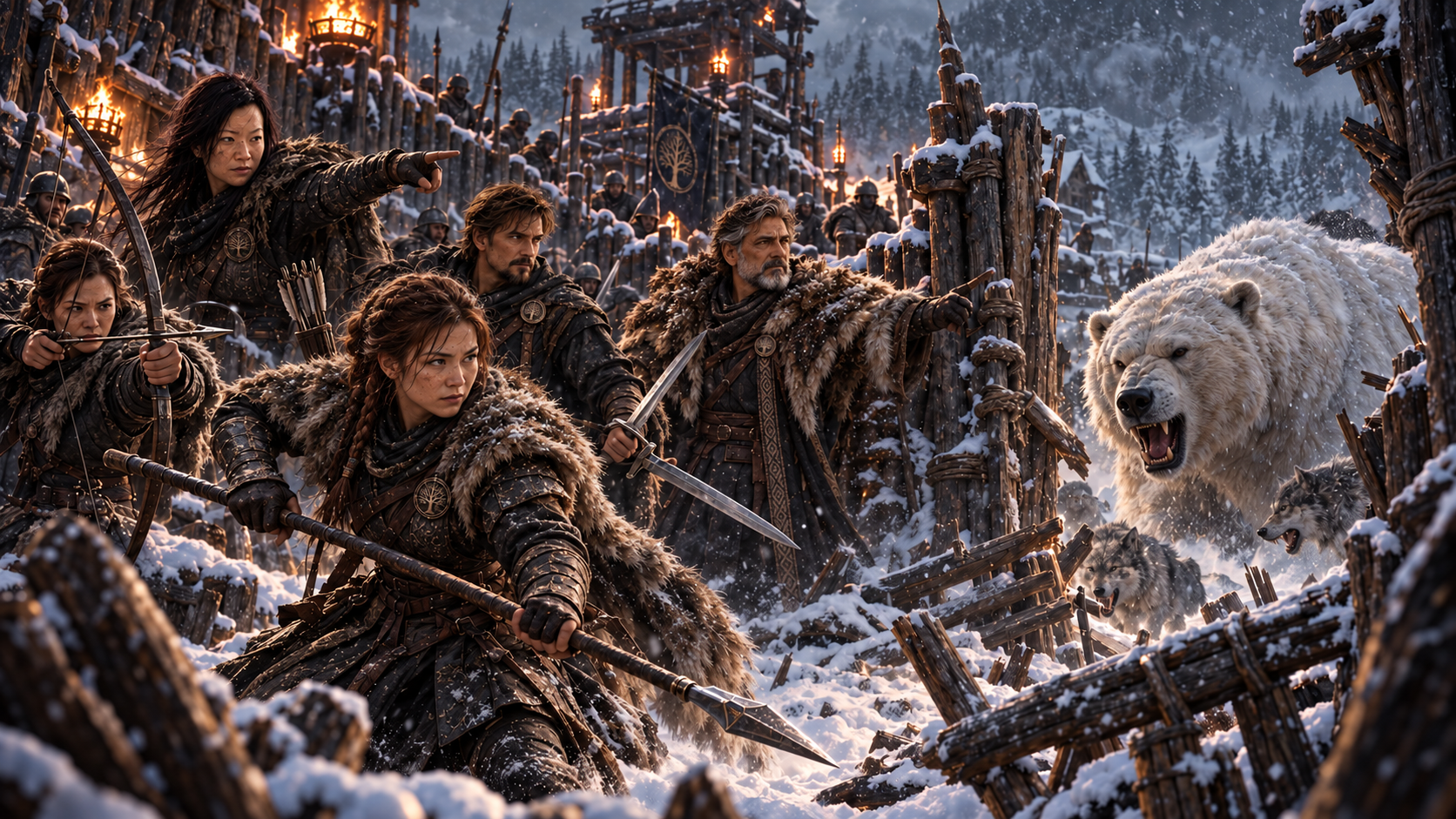
THE FROZEN FORTRESS
The village lay buried beneath a relentless winter. Frost crowned the roofs, ice coated the streets, and tall snowdrifts pressed against the wooden walls. The walls protected the inhabitants from the howling wind and the creatures beyond the snow line.
Enormous pines stood like silent sentinels. Sometimes wolves roamed the outer forests, driven closer to the settlement by hunger and the hard winter.
At the settlement's heart, Chief Seef stood before the assembled defenders.
“We must be prepared,” he said. “Strength alone will not keep this place standing.”
Over the years, training grounds had grown around the settlement: for archers, infantry, scouts, spearmen, and those learning the more difficult craft of command. These were not separate castes, but disciplines. The best fighters learned more than one.
THE RECRUIT'S DETERMINATION
Yuki entered those training grounds as a young and inexperienced recruit.
She had already lost the village she had once called home. She rarely spoke of what had happened there, and accounts of its destruction often contradicted one another. What mattered was that the place no longer existed—only burned timber beneath the snow and memories Yuki preferred to keep to herself.
Chief Seef saw something in her.
“She has fire,” he told Argento.
Argento, the settlement's librarian and chronicler, watched Yuki during her first exercises.
“Fire is useful,” he said. “If someone teaches it where to burn.”
Deathhead gave Yuki her first serious training.
THE ARCHER'S TRIALS
Deathhead watched Yuki raise the bow.
“Strength without precision is useless,” she said. “Draw.”
Yuki obeyed.
Her first arrow struck too low.
Deathhead looked at the spot.
“That won't save you on a hunt. Again.”
Days became weeks.
Yuki learned the bow's pull, the wind's effect, the rhythm of breathing, and the patience to wait for a clean shot. Her arms ached. The skin on her fingers split. More than once she wanted simply to throw the bow into the snow.
Deathhead never allowed it.
One morning, Yuki released the string.
The arrow struck the center of the target.
Deathhead gave a curt nod.
“Not bad.”
Yuki smiled.
“Again,” Deathhead said.
The smile disappeared.
THE INFANTRY CRUCIBLE
Ket's training was worse.
Ket did not care how impressive a fighter looked while standing upright. She wanted to know whether that fighter could still think after being knocked into the snow.
“War isn't a dance,” she told Yuki. “Make a mistake in training and you'll get bruises. Make it outside these walls and someone dies.”
Yuki learned swordplay.
She learned to hold a line, move beside other fighters, and recognize the moment when discipline mattered more than courage.
Ket threw her down again and again.
“Too slow.”
Yuki stood up.
Again.
“Your feet.”
Again.
“Stop staring at my sword. Watch me.”
Again.
Eventually Ket stopped correcting every movement.
That frightened Yuki more than the shouting.
One morning, Ket watched Yuki rise from the snow for perhaps the twentieth time.
“You're stubborn.”
Yuki wiped blood from her lip.
“I'm not finished.”
Ket almost smiled.
“Good.”
THE MIND OF WAR
Argento's lessons were different.
There were weapons in the room, but also maps, old reports, and accounts of battles fought by people long dead.
Argento put a spear in Yuki's hands.
“A weapon is only part of a battle,” he said. “Where you stand matters. Who stands beside you matters. The ground matters. Timing matters.”
He showed her old formations and then why some had failed.
He made her study retreat routes.
Supply lines.
Fields of fire.
The difference between defending a wall and defending the people behind it.
Yuki practiced with the spear, but Argento cared less about whether she could pierce a target than whether she understood why a spear line should stand in one place and not another.
Slowly, the lessons of Deathhead, Ket, and Argento came together.
Bow.
Sword.
Spear.
Movement.
Discipline.
Judgment.
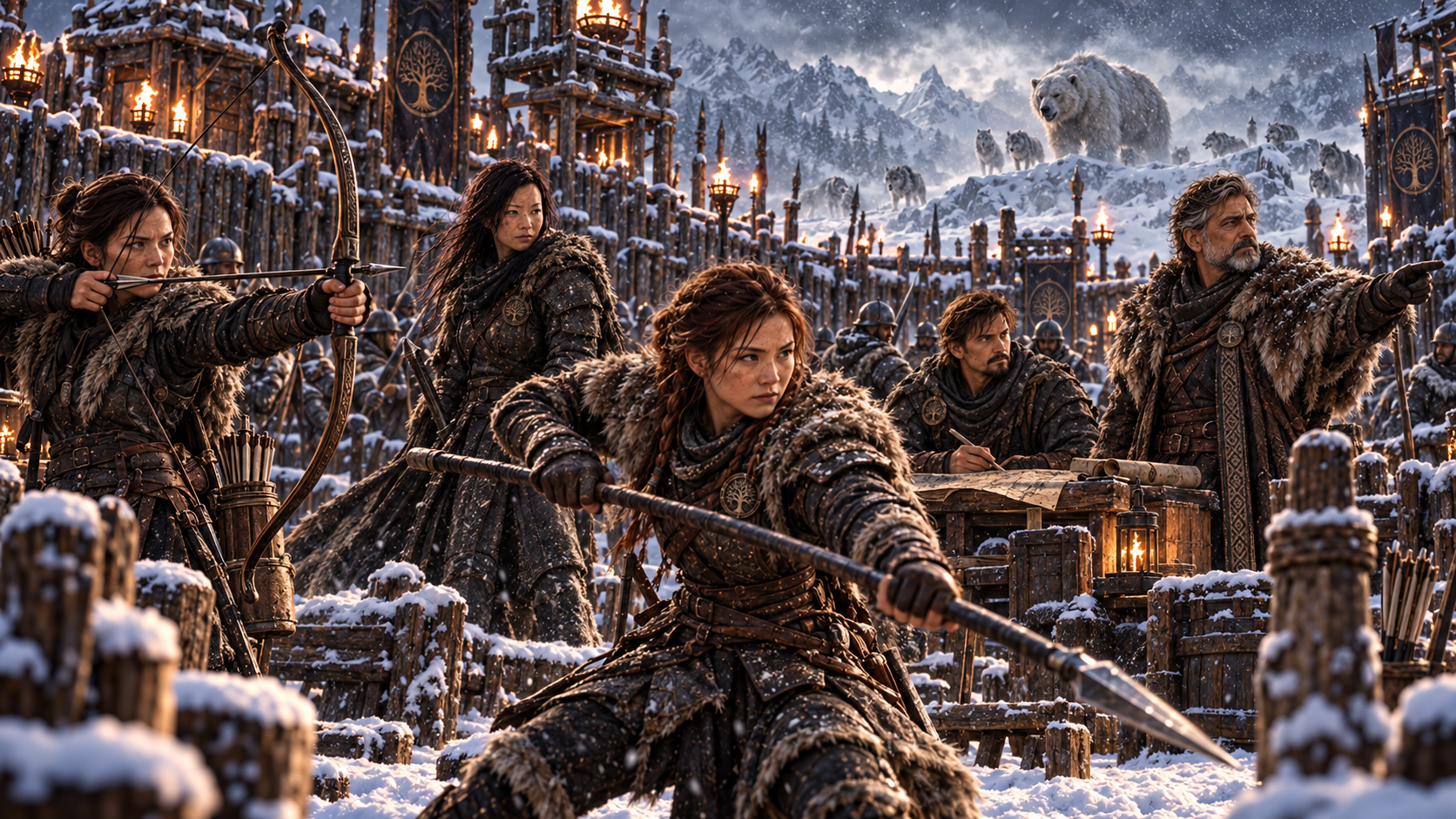
One evening, Argento closed a book.
“You're no longer a trainee.”
Yuki waited.
“You're a warrior.”
She grinned.
Argento raised a finger.
“Don't become insufferable about it.”
“No promises.”
THE BEAR IN THE STORM
The attack came during heavy snowfall.
The wolves came first.
Then a large white bear emerged from the storm.
Later stories gave the animal many descriptions and sometimes far grander names. None can be confirmed. There is no evidence that this bear was the White King, the Gunslingers' bear, Loki, Ursus Diabolus, the Winter Monster, or any other named creature in the surviving chronicles.
To the people on the wall that night, it was simply a very large and very dangerous bear.
The alarm sounded.
Seef called the defenders to their positions.
Ket took command of the line.
Deathhead found a clear firing position.
Argento watched the terrain and the animals' movements.
Yuki stood among the defenders.
She fired first.
Her arrow struck the bear's shoulder.
It kept coming.
The wolves reached the defenses.
Yuki changed weapons.
Suddenly everything she had learned mattered at once.
Deathhead's patience.
Ket's discipline.
Argento's insistence that a battle was larger than the enemy directly before you.
Yuki did not fight alone.
None of them did.
The defenders drove the wolves back from the wall's weakest section while the bear advanced. Yuki moved with the line, using bow, blade, and spear as the situation required.
When the bear finally broke through far enough to threaten the defenders behind her, Yuki saw an opening.
She drove in the spear.
The animal collapsed in the snow.
For several seconds, no one moved.
Then the remaining wolves withdrew into the storm.
Yuki stood breathing hard, staring at the fallen bear.
Seef came to her.
“This is what you trained for.”
Yuki nodded.
“No,” Argento said behind them. “She trained so she would know what to do when training alone was no longer enough.”
Ket looked at Yuki.
This time she truly smiled.
Deathhead lowered her bow.
“Not bad.”
Yuki had to laugh.
“Again?”
Deathhead looked toward the dark forest.
“In the Winterland?”
She shrugged.
“Probably.”
EPILOGUE
Later accounts called Yuki a master of war.
Whether that title arose that night or was added to the story later is uncertain.
Something simpler is certain.
Yuki had arrived as a recruit.
Deathhead had taught her precision.
Ket had taught her discipline and close combat.
Argento had taught her to see the battlefield as a whole.
And when the settlement was attacked, Yuki proved that she had learned from all three.
The white bear killed during this attack remains a separate animal in the chronicle. No surviving evidence connects it to any of the other named bears of the Winterland.
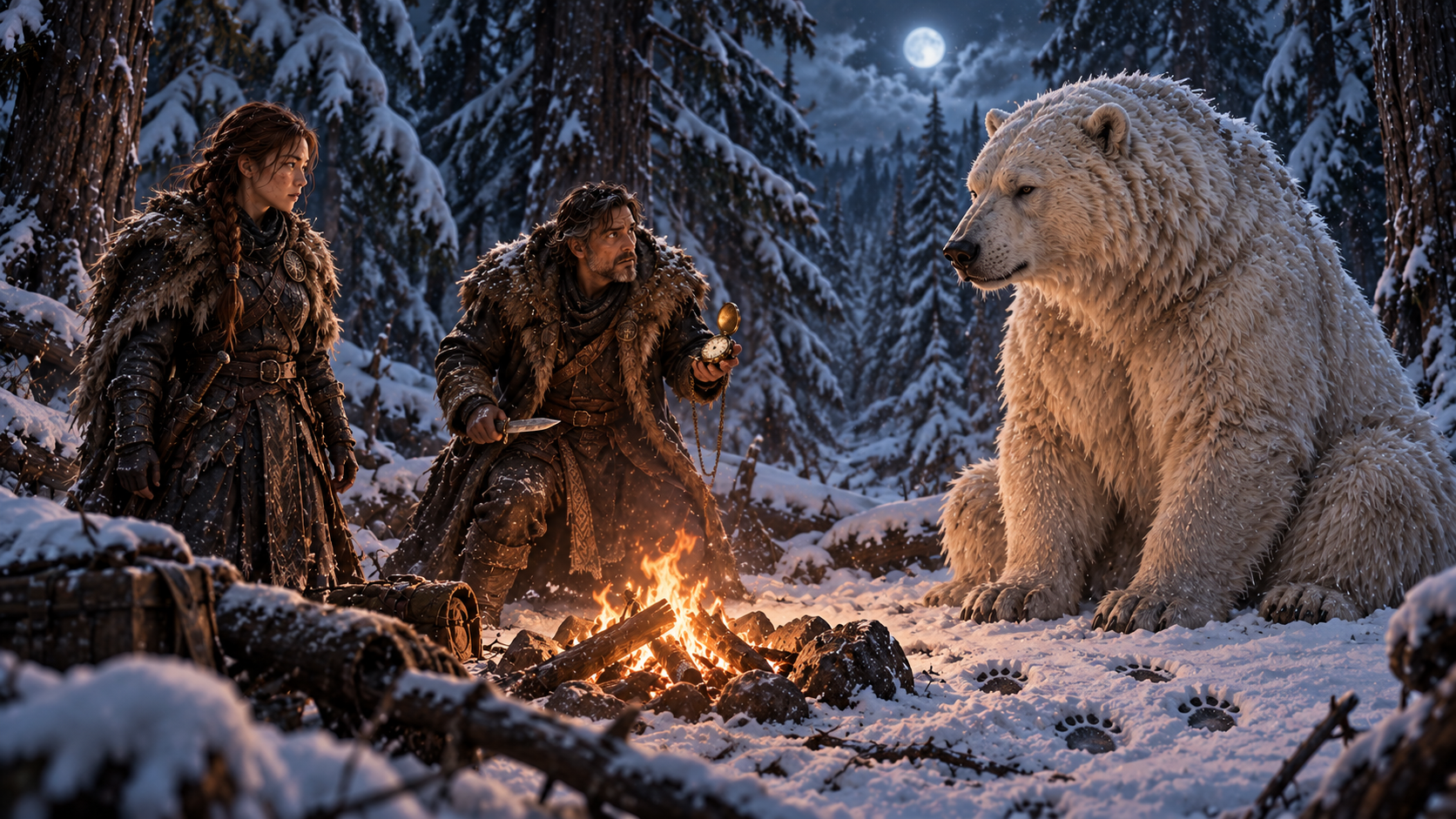
HERA AND GUNNAR
The Druidess and the Bear
Art Drowning checked his golden pocket watch for the twelfth time.
Then snapped it shut.
Then opened it again.
“That won't bring her back any faster,” Yuki said.
Art gave her a dark look.
“Six hours.”
“I can count.”
“She said two.”
“Hera says a lot of things.”
That silenced Art.
The little campsite lay among enormous snow-covered firs. The fire burned low. Beyond its light began the Winterland's darkness.
Hera had set out in the morning to scout the route ahead.
To Art she was an odd woman with even odder habits.
To Yuki she was something else.
A memory.
Hera came from the same village as Yuki. The village of which almost nothing remained now but charred timber beneath the snow.
Some had called Hera a druidess back then. Others, a herbalist. Some, a witch.
She knew plants other people did not even know they could touch. She knew when animals would grow restless before a storm. She could tend wounds, reduce fevers, and make people reconsider their foolish ideas with a single look.
In some ways, she had been to that village what Petunia was to people elsewhere.
And then there were the stories.
Hera could take the form of animals.
Yuki claimed to have seen her as a bird herself.
Art claimed Yuki had drunk too much.
Each considered their own explanation proven.
A branch snapped.
Art reached for his knife.
Yuki stood.
Something large moved between the trees.
“Hera?”
The sound came closer.
Heavy.
Slow.
Damn heavy.
Then an enormous bear stepped into the circle of light.
Art froze.
Yuki did not.
The bear stopped.
He studied Art.
Then Yuki.
Then the fire.
At last he sat down.
“Don't move,” Art whispered.
Yuki tilted her head.
“He actually looks quite friendly.”
“That's a bear.”
“I can see that.”
“A big bear.”
“I can see that too.”
The bear snorted.
Art later swore that the snort had sounded offended.
Yuki took a step toward the animal.
“Are you here because of Hera?”
“Yuki.”
The bear looked at her.
Then nodded.
Art stared at him.
“No.”
The bear nodded again.
“No. Absolutely not.”
Yuki grinned.
“I think he understands us.”
Art rubbed his face.
“Of course. Why should anything be normal today?”
The bear rumbled.
A distinctly strange conversation followed.
Art insisted until his death that Gunnar had never really spoken. Yuki, meanwhile, claimed to have understood every single word.
What actually happened is almost impossible to establish now.
Only one thing is certain: at some point they learned his name.
Gunnar.
And Gunnar knew about Hera.
Quite a lot, in fact.
He scratched marks in the snow, pointed north, and reacted with marked disdain whenever Yuki mentioned Hera's name.
“I don't think he likes her,” Yuki said.
Gunnar snorted.
“That was clear enough.”
Art folded his arms.
“Ask him where she is.”
Yuki did.
Gunnar rose, walked a few paces, and stopped.
He looked back.
“He wants us to follow.”
“Or he wants to eat us somewhere he won't have to drag us back to camp.”
Gunnar rumbled.
Yuki laughed.
“He just insulted you.”
“How would you know?”
“His tone.”
They followed him.
Just under an hour later, they found Hera's tracks.
Feathers lay beside them.
Art picked one up.
“Bird.”
Yuki grinned triumphantly.
“Don't say anything.”
“I haven't said a word.”
“Your face did.”
The tracks continued north and finally ended at a rocky outcrop.
There they found Hera's bag.
Her herbs.
A knife.
And a note.
Art unfolded the paper.
Yuki. If you find this, I am already gone. Do not look for me. There are things from our old village that would have been better left buried. I must find out whether they truly are.
And if Gunnar has found you: do not feed him after sunset. He becomes insufferable.
— Hera
Yuki read the note twice.
Her smile had vanished.
Art watched her.
“What does she mean by things from your village?”
“I don't know.”
That was a lie.
Art knew it.
Yuki knew he knew.
Neither spoke of it.
Behind them, Gunnar pawed impatiently at the snow.
Art turned.
“And what are we going to do with you?”
Gunnar sat down.
“No.”
The bear lay down.
“No.”
Gunnar demonstratively curled up beside Yuki.
Yuki sat against his back.
“We could take him with us.”
“We are not taking a bear.”
Gunnar opened one eye.
“Absolutely not.”
The eye closed again.
Yuki scratched the animal behind his ear.
“He needs meat, fish, and probably honey.”
Art stared at her.
“How do you know?”
“He told me.”
“The bear doesn't speak.”
Gunnar opened an eye again.
Yuki grinned.
“He says you're slow on the uptake.”
Art was silent for a while.
Then he took out his golden pocket watch.
Looked at it.
Snapped it shut.
And sighed.
“Fine.”
Yuki beamed.
Gunnar raised his head.
“But only until we find Hera.”
Gunnar made a sound suspiciously like a satisfied rumble.
Art pointed at him.
“And you sleep outside.”
Gunnar slowly looked around.
Forest.
Snow.
Mountains.
Then he looked back at Art.
Yuki burst out laughing.
Art put his watch away.
“I hate you both.”
That was how Gunnar came to them.
And Hera vanished.
What she was seeking in the north, why she expressly warned Yuki about the secrets of their burned home village, and why Gunnar of all creatures knew which way she had gone remained unanswered at first.
Years later, Yuki still claimed that Gunnar had said to her that evening:
“The druidess will return.”
Art did not believe a word of it.
Gunnar himself never commented.
At least, not when Art was around.
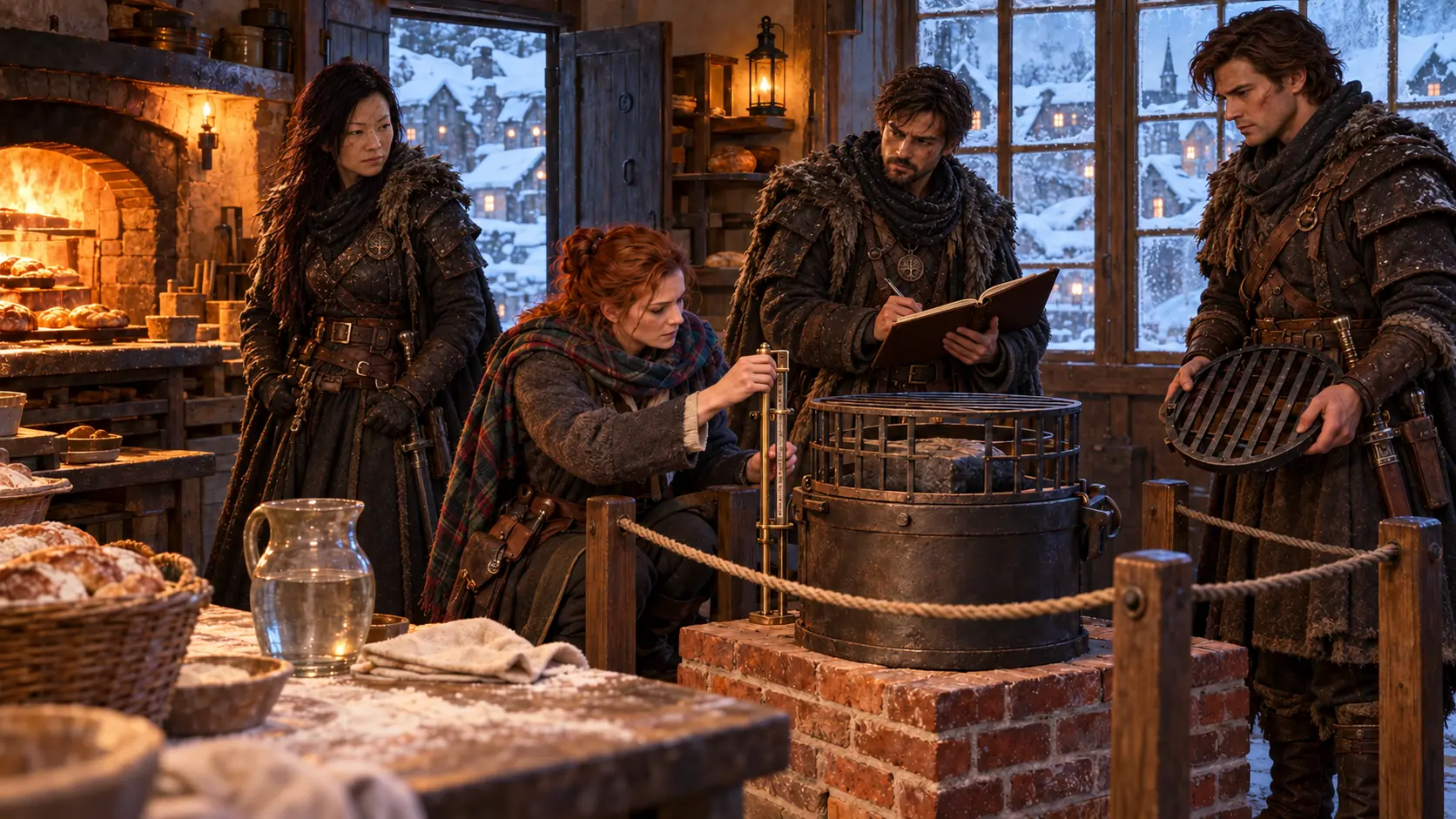
THE BEGINNING OF THE FIRE CRYSTAL ERA
The First Warm Night
The stove went out an hour before dawn.
Argento noticed when his ink thickened. He moved the jar closer to the embers that were no longer embers and looked at the list before him: wood for the workshop, wood for the bakery, wood for the houses at the northern edge. Behind each line were people already receiving less than they needed.
Then came a knock.
Nikki entered carrying a heavy box filled with sand under one arm. She set it on the table. In the sand lay a dark stone scarcely larger than a hen's egg.
“Don't touch it.”
Argento took his hand off the table.
“I wasn't going to.”
“You were looking at it as though you were.”
The stone gave off warmth. Not much. Enough for Argento to feel it when he held his palm above it.
“Where did it come from?”
“A shipment from the mountains. Two men brought six pieces. They thought I could tell them what they'd found.”
“Can you?”
“Not yet.”
Nikki placed three sheets on the table. Numbers, times, small drawings of iron mounts. Argento pushed the inkpot aside.
“This one lay beside a forge fire yesterday afternoon,” she said. “Not in the fire. Beside it. I put it in sand, then in iron. Hours later it was still warm.”
Argento studied the stone.
“Does it burn?”
“No. It absorbed heat. And releases it again.”
“Like a brick from the stove.”
“Perhaps. Just more slowly.”
She said perhaps even though she had spent an entire night taking measurements. That was precisely why Argento listened.
In the morning Seef, Ket, and Darth came to Nikki's workshop. On one bench stood an ordinary stone; on the other, the find from the mountains. Both had spent the same length of time beside the same embers. Beside them lay strips of wax that Nikki had attached at regular intervals. The ordinary stone was cold. The wax beside the other was soft.
“And how many of these stones do we have?” Seef asked.
“Six. One cracked. I haven't heated two of them yet.”
“Then we have three we can even discuss,” Ket said.
Darth looked at the cracked stone resting apart in an iron bowl.
“What happens if I touch it?”
“In the best case, nothing,” Nikki said.
“I like the best cases.”
“I don't want to try the others yet.”
Seef went to the wood list Argento had pinned to the wall.
“We need warmth today. Not only after you've answered every question.”
“And I need a night when nobody puts a glowing piece of stone under their blanket,” Nikki replied.
Ket looked between them.
“One trial. Somewhere we can watch.”
They chose the bakery.
Its ovens were heated anyway. People came and went. Nobody had to take an unknown stone home. Nikki had a container made of thick iron, with a grate above it and handles that could only be moved with tools. Darth built a wooden guard around the place where it would stand, then took it apart again when Nikki pointed out the fire risk.
“Clay, then,” he said.
“Clay, then.”
They heated the stone beside the oven. Not with a new fuel. With the fire already burning for bread. When the bakery closed, they carried the container to a brick plinth in the entrance room.
A woman who brought dough every morning stopped in front of it.
“Is it supposed to burn all night?”
“It doesn't burn,” Nikki said. “But it is hot. Please stay behind the line.”
Argento drew a line across the floorboards with charcoal. The woman looked at him.
“And if someone forgets the line?”
It was the first question that day for which nobody had a good answer.
Ket posted a guard at the door. Darth fetched a second row of bricks. Nikki attached a grate that could not be opened with bare hands. The trial did not begin until the woman said she would carry her dough past that spot again the next morning.
During the night, the warmth slowly declined. Not evenly; Nikki recorded every change. Once, the iron casing cracked audibly and all four people in the room started. The iron stayed closed.
Shortly before morning, the woman returned with her dough. She set down the basket in the entrance room and rubbed her stiff fingers together. Nikki showed her the place behind the grate where the air was still warm. The woman stood at a safe distance until she could retie the cord around her basket. Then she looked at the water jugs. None had frozen.
The bakery had not become a warm house. But for the first time in weeks, the woman did not have to carry her dough to the oven with numb hands.
“How much wood did we save?” Seef asked the next day.
“We won't know until we can compare the same week without the stone,” Argento said.
“But you wrote it down yesterday.”
“How much wood we used. The stone didn't create any.”
Nikki nodded. “We're using some of the oven's heat later. If we have to burn longer or hotter to do that, we might gain nothing. And the casing costs iron and labor.”
Seef studied the grate. “Then we keep measuring.”
A week later Nikki placed another stone in a heavy mount against the blast furnace's outer wall. During the working shift, it absorbed some of the heat already escaping there. Overnight it slowly released that warmth to the wall and the iron tools laid out nearby. In the morning both were less cold; the smith could start the next shift more evenly. He still had to heat the furnace with fuel. Two days later, a thin iron plate warped on a poorly built mount. Nikki ordered the blast furnace stopped, despite the smith's objections.
“That costs us a day's work.”
“A broken furnace costs more.”
Darth carried the failed plate to her table. “I can get new fittings.”
“Not until we know how thick they need to be.”
He put the plate down and stayed. “Then I'll help measure.”
Word spread all the same. Some called the stones a gift from the mountain. Others thought them a bad bargain, since an unsupervised container could burn a child. A merchant offered Seef money for two pieces. Seef sent him away. That evening, three families stood outside the workshop asking for a stone for their homes.
Ket let them in one by one. She promised none of them anything.
When the door closed again, Seef suggested giving the next tested stone to the infirmary. Nikki agreed if she could build the casing herself and explain there how to operate it. Ket required every container to stand firmly, be kept clear of cloth and wood, and have a named person responsible for it. Darth was to procure the necessary grates and fittings. Argento wrote down where each piece went.
“You're keeping a list for six stones?” Darth asked.
“Five,” Argento said. “One cracked.”
“That's reassuring.”
“Not to me.”
At first, the bakery and workshop each received one tested stone. The next went to the infirmary. There were none for the homes yet. Seef explained this himself to the waiting families. One mother was angry; Argento could not blame her. The rim of their drinking water froze every night.
Nikki asked her to come to the workshop the next day. She did not want to promise her a stone. She wanted to know how the stove in her house was built.
That was how work began that no one later could tie to a single day: heavier casings, distances from wood, records of heating and cooling, tests at the blast furnace, and the question of who received the scarce pieces first. A few weeks later the first small containers stood in homes. They did not replace a fire. They retained its warmth after it burned low.
Eventually the mother from the northern edge received one too. Nikki had inspected her stove and measured a fixed place for the container, far from bedding and the door. On the first morning afterward, the woman brought Argento a jug of water. There was no ice at its rim. “Write down that we still need wood for this,” she said. “But write this down too.” Argento recorded both.
One evening Argento noticed a dog stop at the workshop door. Beside the door stood a container holding three heated stones. The animal sniffed, shook itself, and went on. The next day the same dog slept right beside it when the container was cold.
Argento recorded both observations. Nothing more.
Late that night, he found Nikki still at her table. The cracked casing lay before her, with a new drawing beside it. Through the window, the bakery's light was visible. Someone opened the door, carried out a basket of bread, and carefully shut it again.
“Will it work?” Argento asked.
Nikki looked at her measurements.
“Some of it. If we keep testing.”
Argento took the wood list from the wall. On its back he began a new one: bakery, blast furnace, infirmary. He left space for the homes and for mistakes they had not yet discovered.
He did not put a date above the list. Only years later did he add one.
Beneath it he wrote: Beginning of the Fire Crystal Era.
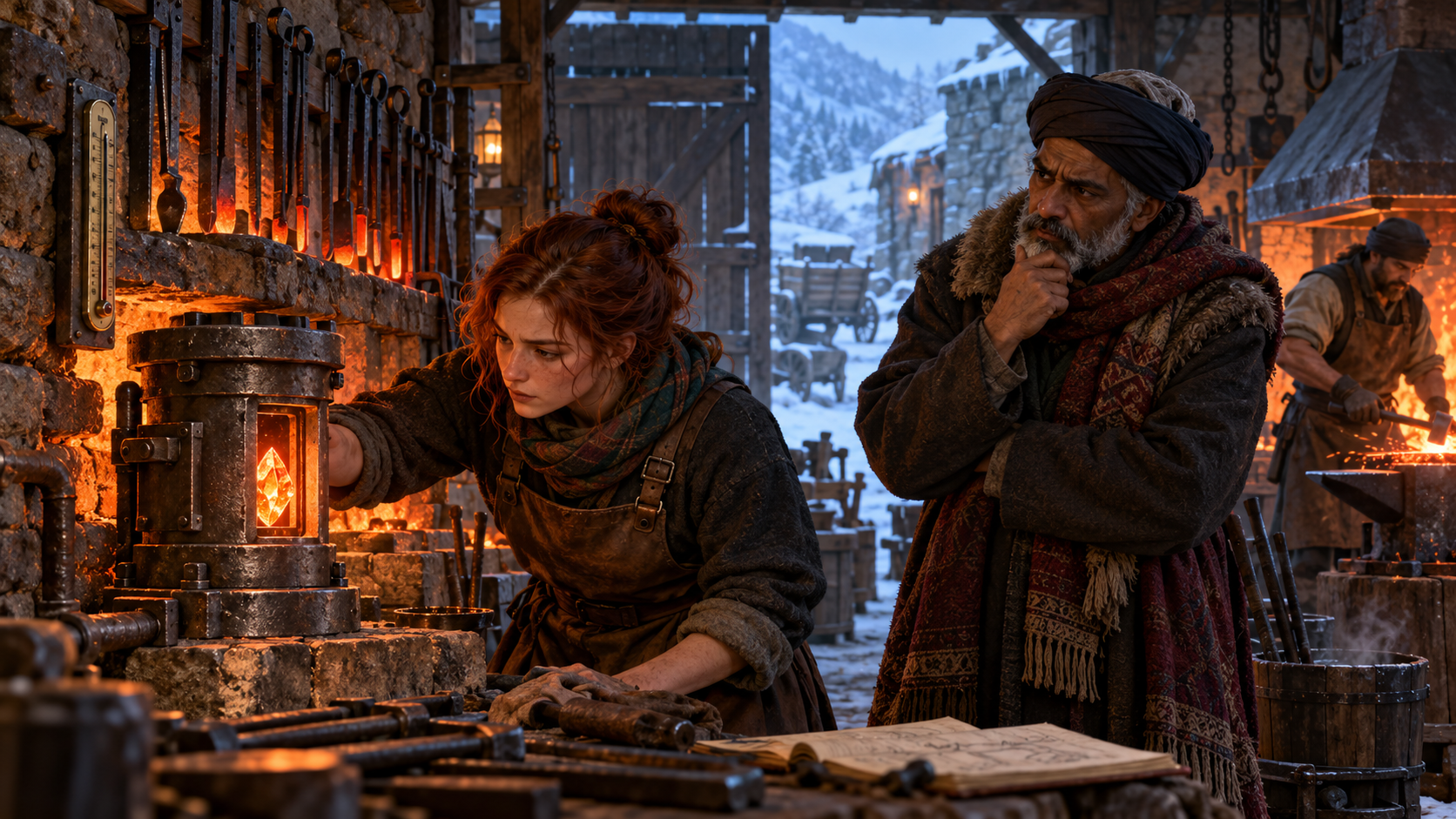
FIRE II
The biting winter wind howled through the gnarled branches of the forest, a mournful sound echoing the deepening darkness over the valley.
For generations, the people of the north had learned to live with cold. They knew wood, coal, oil, animal fat, and every scrap of fuel that held warmth long enough.
But now something new had entered their lives.
Fire crystals.
Rare stones from deep veins of the earth that could store heat and release it again over a long period.
They were no miracle.
They made no one stronger.
They made no one braver.
And they took away no one's fear.
But they changed what was possible.
In the NFD workshops, blast furnaces cooled more slowly between shifts and could be restarted more evenly. The crystals did not replace fuel; they stored some of the heat already being produced and released it later to furnace walls and tools laid out nearby. Metal could thus be worked more reliably. Tools lasted longer. Blades could be forged more cleanly. In some houses, small crystal pieces sat in heavy metal containers to keep rooms warm for hours.
Fire crystals were still rare.
No one yet knew exactly how much heat they could store.
And no one knew what would happen if they were handled incorrectly.
Nikki spent more time in the workshop than anywhere else.
She kept lists of temperatures, cooling times, and damage to metal casings. Some crystals remained stable for days. Others lost their heat suddenly. One had heated an iron plate enough to warp the metal.
“This isn't magic,” Nikki said once, as Seef stood beside her looking at a faintly glowing crystal.
Seef raised an eyebrow.
“That reassures me surprisingly little.”
Nikki did not grin.
“It shouldn't.”
Argento watched the development with a different concern.
He recorded where crystals were being used, how much wood they might save, and which workshops could suddenly work longer.
But he also noted something else.
Animals sometimes avoided the vicinity of larger crystal stores.
Not always.
Not all animals.
Dogs grew restless when several heated crystals lay close together. Horses snorted more often. In some places, wild animals' tracks curved strangely around storehouses.
It was not proof.
Only a pattern.
And patterns were rarely meaningless to Argento.
Three days later, hunters found the first torn-apart deer.
Not eaten.
Only ripped apart.
The next morning, another lay at the forest's edge.
Then a dog.
Ket ordered more patrols.
Nikki checked the crystal stores.
Argento examined the tracks.
The print was broad.
Too broad for an ordinary bear.
But size alone did not explain what he saw.
The animal had repeatedly broken through deep snow, pushed itself up again, and kept going although one hind paw was clearly injured.
“Frenzy,” Joker said.
Argento knelt by a track and ran two fingers over its frozen edge.
“Perhaps.”
Ket stood behind him.
“What do you mean, perhaps?”
Argento pointed to several prints.
“It isn't moving like an animal searching for food. It isn't pursuing anything. It avoids nothing. It takes paths, abandons them, and doubles back.”
Nikki looked toward the NFD.
“The crystals?”
Argento straightened.
“Possible.”
“That's not an answer.”
“It's the only one we have.”
They decided not to let the bear reach the town.
At the forest's edge, they dug a deep pit and fitted it with sharpened stakes. Not as a guaranteed killing trap—the animal was too big for that—but to control its movement.
Ket oversaw the preparations.
Flake Snow held the open side with several riders.
Joker waited among the trees.
Nikki stood behind a low wall of snow with two fire crystals in padded metal containers.
Argento had his bow.
But he carried a map too.
While the others worked, he walked the forest edge several times.
He measured distances.
Checked the wind direction.
Examined the frozen hollows.
Then he stuck three little wooden markers into the snow.
Ket noticed.
“What are you doing?”
“Thinking about where he will run.”
“You haven't even seen him.”
Argento looked toward the dark forest.
“No. But I know where we mustn't let him run.”
Then came the roar.
It did not sound as though it belonged to an animal of this world.
The bear burst from the trees.
Enormous.
Matted fur.
Blood on one flank.
Its eyes red with agitation.
But nothing about it seemed supernatural.
It was injured.
Exhausted.
And entirely out of control.
“Now!” Ket called.
Flake Snow's riders swept in from the side.
The bear reacted at once.
Not with fear.
With fury.
It struck at the first horse, narrowly missed, and charged onward.
Argento fired.
The first arrow struck its shoulder.
No effect.
The second went deeper.
The bear roared and changed direction.
“Left!” Argento called.
Ket looked at him.
“Left! He always takes the open side!”
Ket responded at once.
“Flake! Close the left line!”
The riders drew together.
The bear turned away.
Straight toward Argento's wooden markers.
Toward the pit.
But the animal stopped a few steps short.
It smelled the disturbed earth.
Argento cursed quietly.
“He knows.”
Joker was already moving through the trees.
“Don't attack!” Argento called.
Joker stopped.
The bear swung around.
Straight toward Nikki.
She reached for one of the metal containers.
“Nikki!” Ket called.
Nikki pulled open the lid.
The fire crystal inside glowed faintly.
Not brightly.
Not magically.
Only hot.
She hurled it into the snow in front of the bear.
The crystal landed.
Snow hissed.
Steam rose.
The animal stopped for a moment.
Not stunned.
Not paralyzed.
Confused.
It backed away from the sudden heat.
Only one step.
But Argento saw it.
“Now!”
He fired.
The arrow struck above the foreleg.
The animal dipped briefly.
Joker sprang from cover.
His blade struck the same side.
The bear swiped at him.
Joker was knocked down, rolled over one shoulder, and came up again.
Ket charged forward and, with several fighters, forced the animal farther left.
Argento fired once more.
Not at the head.
Not at the chest.
At the injured hind leg.
The bear buckled.
The ground beneath it broke.
With a dull crash, the animal fell into the prepared pit.
For a moment, there was only heavy breathing.
Then one final roar.
Joker approached the edge.
Ket raised her hand.
“Wait.”
The bear tried to rise again.
It could not.
Ket looked at Argento.
Argento looked down for a long time.
“Finish it.”
Joker jumped down.
A little later, it was quiet.
No one cheered.
Nikki went to the fire crystal still lying in the snow.
The ice around it had melted.
She picked it up with tongs and put it back in its metal container.
Ket stepped beside her.
“Did it cause this?”
Nikki looked at the crystal.
“I don't know.”
Argento joined them.
“Then we'll write down exactly that.”
Ket looked at him.
“What?”
“That we don't know.”
Later they examined the animal.
There were no foreign markings.
No unusual wounds.
No crystals in its body.
Nothing to prove that the fire crystals had changed the bear.
But Argento remembered the wild tracks bending away.
The restless dogs.
The animal's changes of direction.
And the moment the bear had backed away from the heat.
That evening, he wrote in his chronicle:
The fire crystals have changed our daily lives.
They give us warmth.
They save wood.
They let our blast furnaces cool more slowly.
They make better tools possible.
But we do not yet understand them.
Perhaps the bear was merely injured and mad with pain.
Perhaps the crystals' heat changed its behavior.
Perhaps we are looking for a cause because we fear a new power we ourselves have brought into our town.
None of these possibilities is proven.
Beneath it he wrote only one more sentence.
Progress is no proof of control.
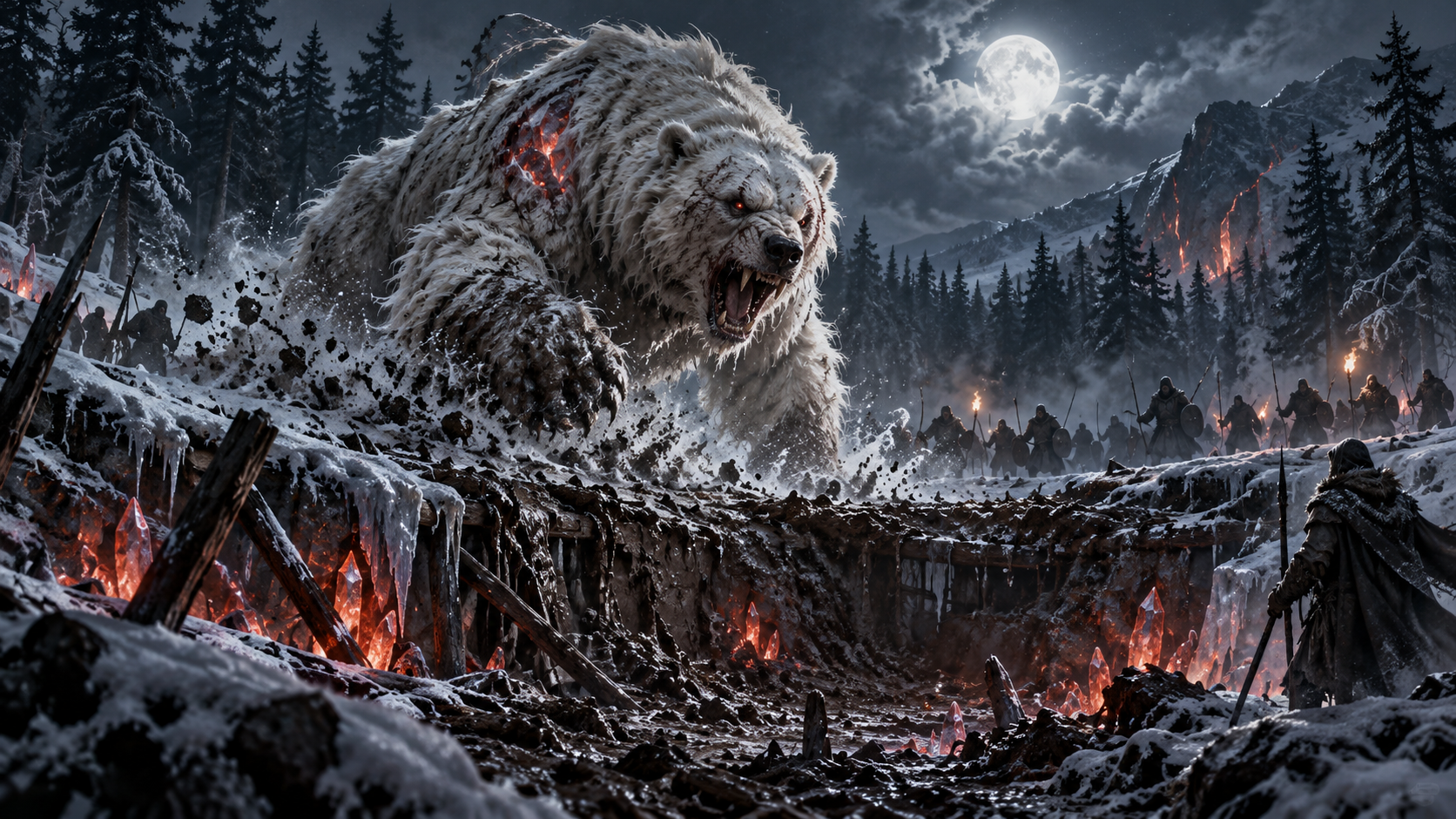
CRYSTAL FRENZY
This is the myth of the Bear Pit, told in whispers when the winter moon hangs low and silver in the sky.
The false peace of our settlement.
The wealth of our settlement rested not on gold but on the shimmering, dangerous substance called fire crystals.
They were mined deep underground and glowed with an inner, furious heat, yet at the same time they laid a strange, beautiful stillness over the world.
They calmed the blood.
The primal human rage that had fueled generations of senseless conflict.
Prosperity blossomed: the furnace roared cleanly, strength was measured in steel, and the hunt was methodical, never desperate.
Every citizen shared in this cool crystalline utopia—a fragile shield against the old days.
But the crystals were a sedative, not a cure.
The price was paid in the forest. When the great white Ursa, a creature older than the castle walls, encountered an exposed vein of raw crystals, their influence did not calm her heart; it shattered her soul. The creature went mad.
She was no longer a bear but the White Terror, a vast machine of crystallized malice.
The pit and the blade.
The young Queen stood at the edge of the prepared battle pit—a deep, muddy hollow dug for this purpose—and felt the forest's cold seep into her bones.
She watched the animal break through the outer battle line, its hide damp with the steam of its own fevered blood, its roar a sound that shattered the carefully preserved peace of the crystals.
Argento, the First Archer, sent iron-tipped oak shafts flying with the cold, controlled efficiency supposedly fostered by the crystals. The arrows struck, but did not stop the animal. “It feels nothing!” he roared, drew a broadsword, and watched it ignore the pain and charge his position.
The front line buckled beneath the creature's weight. Flesh tore, bones broke, and the crystalline snow immediately absorbed the spilling blood.
“Hold the flank!” the Queen ordered, her voice thin but sharp enough to cut through the slaughter.
Ben struggled among the panicked warhorses to keep them from bolting into the dense trees. The crystalline light seemed to make the horses nervous and heighten their primal fear. He fought desperately with the reins as the bear's shadow fell over them. Then a blur of forest green struck the white terror.
Nikki the Elf moved like frozen water. She was swift, pure support. She did not try to wound the bear, but to distract it.
A series of quick, low strikes against the tendons of the animal's hind legs bought Ben the precious seconds he needed to calm the horses and guide the flanking soldiers into a tight formation. The maneuver successfully drove the horror closer to the pit's edge.
The Assassination
The horror, blinded by its inner torment, staggered backward, its enormous paws sinking into the muddy lip of the pit. With a roar like breaking ice, it fell heavily into the mire below and lay dazed for a moment.
That was the signal.
While Argento and the surviving soldiers rained down spears and stones, buying scarcely more than a breath of time, Jota moved. He was the silent shadow, the assassin made for precision rather than a long fight. He had not measured himself against the animal's strength; he had watched only for its weakness.
Jota had recognized the crystalline infection. It showed as a dull, unnatural glow beneath the creature's left shoulder blade—the heart of its corrupted fury.
Silently he descended the muddy slope, ignoring the screams and spraying blood. He moved past soldiers still fighting the bear's flailing claws and slipped beneath the creature's huge foreleg.
A single viciously curved dagger—not hardened by crystal magic, but forged from pure, cold steel—found its mark.
Jota did not stab the heart. He found the place where infected muscle met bone, exactly where the crystal's localized corruption lay. The blade sank deep and severed the core of the madness.
The White Terror did not scream. It simply collapsed in on itself. The insane, aggressive glow left its fur, and it fell—a great mass of wet, bloody dust and bone, killed not by brute strength but by the quiet, surgical removal of its poisoned frenzy.
Victory was won in the blood-soaked pit. But as the Queen looked at the steaming carcass, she understood the truth: the fire crystals had not ended rage; they had merely displaced it, turning wild animals into bombs and peace into a temporary, deadly myth.
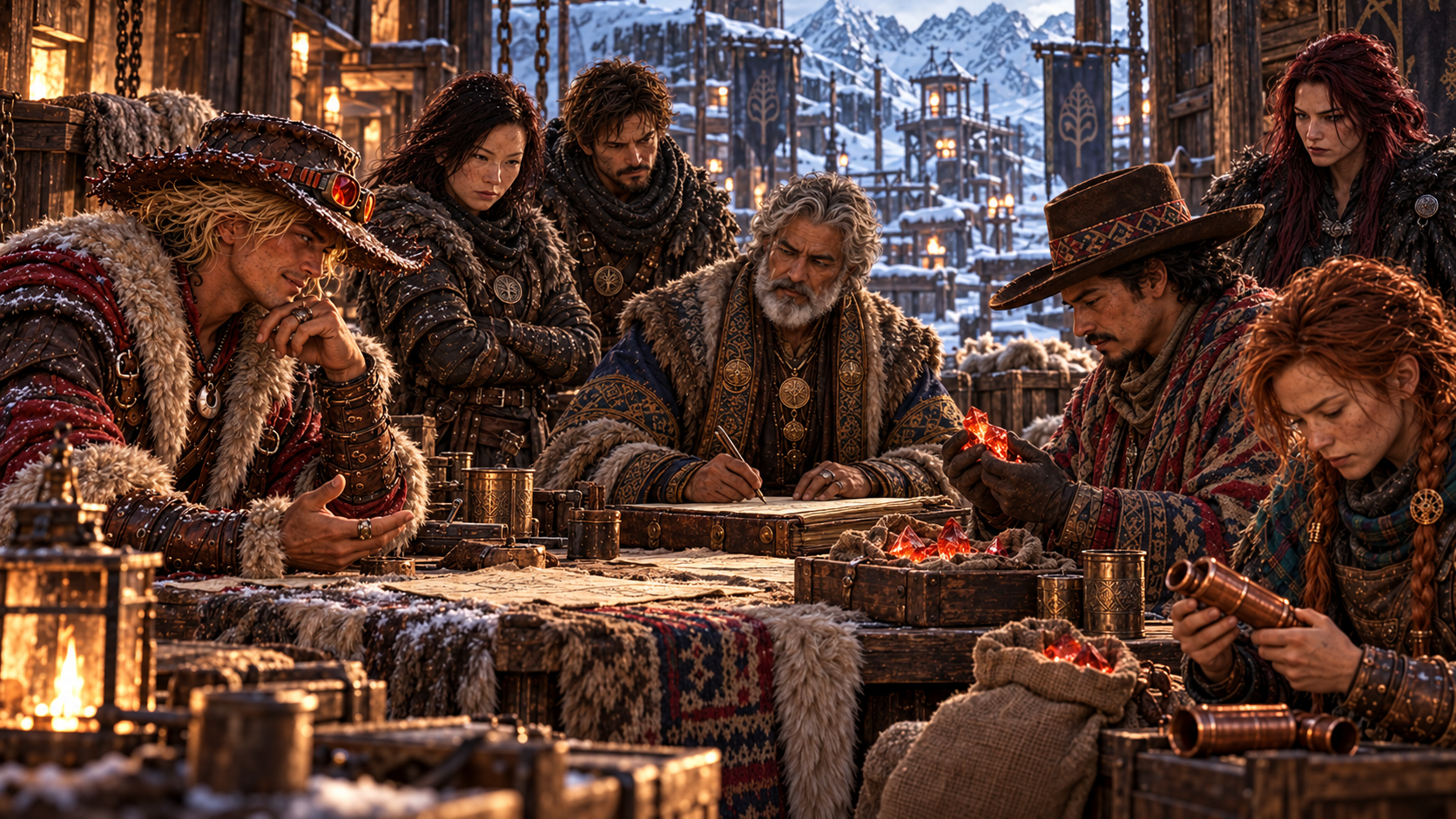
BAHITI — THE RIDER OF FIRE AND FROST
Nobody in the NFD knew exactly when Bahiti had decided that a sled was no longer enough for winter transport.
Perhaps it was the day a runner broke for the third time in one week.
Perhaps he had simply spent too much time with smiths.
Or perhaps Bahiti was just Bahiti.
The only certainty was that one morning a sound thundered through the snowy streets that belonged to neither horse nor sled.
Ket stepped out of the guardhouse.
A black dot raced down the hill.
Then she made out wheels.
“No.”
The dot grew larger.
“No, no.”
Bahiti shot into the settlement on a machine made of iron, brass, leather, and parts whose original purposes probably even Nikki could no longer have identified.
Black smoke trailed behind him.
He braked.
The rear wheel skidded sideways over the snow.
The machine stopped right in front of Ket.
Bahiti grinned.
“Delivery.”
Ket looked at him.
Then at the motorcycle.
Then at him again.
“What is that?”
“Progress.”
“It's on fire.”
Bahiti looked back.
“Only a little.”
He slapped a smoking spot with his glove.
The flame went out.
“See? Progress.”
Bahiti had already been one of the region's most reliable supply riders.
He brought potatoes from southern farms, honey, salt, cloth, spare parts, and occasionally things nobody had ordered.
Once he delivered twelve crates of pickled turnips.
Seef asked why.
Bahiti replied:
“They were cheap.”
Three months later, everyone was still eating turnips.
After that, Seef asked fewer questions.
The motorcycle changed everything.
Where a sled needed half a day for some routes, Bahiti needed only hours.
The vehicle was loud.
It was uncomfortable.
It was dangerous.
And it worked.
Mostly.
Argento studied the construction one morning outside his archive.
“How do you keep the engine running in this cold?”
“Engineering.”
“Bahiti.”
“Very good engineering.”
“Bahiti.”
The rider sighed.
Then he opened a metal hatch by the tank.
Behind it sat a small fire crystal in a copper mount, connected by thin heat lines to the engine block and fuel supply.
Argento was silent.
Bahiti closed the hatch.
“Before you say anything: it's perfectly safe.”
“Where did you get it?”
“That's a completely different question.”
“Where?”
Bahiti looked toward the street.
“From the north.”
“Bought it?”
“Not directly.”
Argento closed his eyes.
“Stolen.”
“Borrowed.”
“With permission?”
“That would unnecessarily restrict the meaning of borrowed.”
An hour later, Bahiti sat before Seef, Ket, Argento, and Moidark.
Deathhead leaned against the wall.
Nikki had examined the motorcycle by then and was present only because she wanted to understand how Bahiti ran the crystal's stored heat so close to the engine and fuel line without overheating the whole contraption.
“So,” Seef said.
Bahiti smiled.
“So.”
“You stole fire crystals.”
“One.”
Ket set a little cloth bag on the table.
Three more crystals clicked together inside it.
Bahiti looked at them.
“Technically, those don't count.”
“Why?”
“They're spares.”
Moidark picked up one crystal and studied it.
Fire crystals had become far too valuable for their disappearance to be dismissed as a petty theft. Smithies, workshops, and increasingly other technical facilities depended on them.
“Which mine?” he asked.
Bahiti said nothing.
Deathhead smiled.
“I can retrace the route.”
Bahiti looked at her.
“Iron Ridge.”
“Thank you.”
“That was unfair.”
“I didn't do anything.”
“Exactly.”
The situation was awkward.
The NFD needed fire crystals.
The smithies were already working with scarce supplies.
At the same time, Bahiti's machine proved that stored crystal heat was useful beyond large furnaces. Properly directed, it could preheat a conventional fuel engine and help it run more steadily in extreme cold.
By then Nikki had almost completely dismantled the motorcycle.
Bahiti noticed only when she walked in carrying a component.
“What are you doing with my carburetor?”
“Improving it.”
“It was good.”
“No.”
“It worked.”
“Sometimes.”
“That's enough.”
Nikki sat down.
“No.”
Seef rubbed his forehead.
“Can we please get back to the theft?”
“Borrowing,” Bahiti said.
Everyone looked at him.
“All right.”
Moidark finally had a solution.
The NFD held large stocks of wool, hides, and some finished metal goods.
Iron Ridge had fire crystals.
“We send the stolen crystals back,” Moidark said.
Bahiti pulled a face.
“All of them?”
“All of them.”
“Even the one in the motorcycle?”
“That one too.”
Bahiti put both hands on the table.
“That's barbaric.”
Moidark ignored him.
“At the same time, we offer the mines regular trade. Wool, hides, and tools for fire crystals.”
Seef nodded slowly.
“And if they want to hang Bahiti?”
Deathhead shrugged.
“Then we ride fast.”
Bahiti pointed at her.
“Finally, someone with a sensible plan.”
They set out two days later.
Moidark led the negotiations.
Deathhead accompanied him.
Bahiti transported the crystals.
Ket sent two more people along, mainly to make sure Bahiti did not “borrow” something else on the way.
The motorcycle had to travel without its fire crystal.
Its ordinary fuel engine was the same, but without crystal heat it started less readily in the cold and ran considerably rougher.
Bahiti complained the entire way.
“Slow.”
Deathhead rode beside him.
“We're going quite fast.”
“Slow.”
“You're spoiled.”
“I've experienced progress. After that, everything is slow.”
The men of Iron Ridge were not pleased.
The foreman set the returned fire crystals on a table.
Then looked at Bahiti.
“You.”
Bahiti smiled carefully.
“Me.”
“You stole them.”
“That's a very negative description of a complicated economic transaction.”
Deathhead turned away.
Moidark had to cough.
The foreman remained perfectly serious.
“I should break your hands.”
Bahiti considered it.
“That would make future deliveries difficult.”
For the first time, the corner of the foreman's mouth moved.
Only a little.
Moidark seized the moment.
By evening, they had an agreement.
The NFD would regularly supply wool, hides, tools, and certain spare parts.
In return, Iron Ridge would provide a fixed quantity of fire crystals.
Not enough to waste.
But enough to reliably supply the smithies.
And enough for experiments with new machines.
Bahiti even received a fire crystal back.
Officially.
With paperwork.
Quantity, origin, and intended use were recorded.
Argento insisted.
So did Moidark.
Seef signed.
Ket signed as a witness.
The foreman of Iron Ridge added his name below.
Bahiti studied the document.
“So much paper for one little crystal.”
Argento handed him the pen.
“Your signature.”
“Why?”
“So this time everyone involved knows you have it.”
Bahiti signed.
Then he put the crystal back in his motorcycle.
On the return journey, Deathhead heard the familiar roar behind her.
Bahiti shot past.
Snow sprayed over her coat.
“BAHITI!”
His voice came from the distance.
“PROGRESS!”
The motorcycle was rebuilt several times later.
Nikki improved the cooling.
Bahiti increased the power.
Nikki reduced it again.
Bahiti secretly increased it.
Nikki noticed.
This process repeated for months.
Eventually Argento stopped keeping records of it.
For the NFD, however, the episode mattered more than it first seemed.
Trade with Iron Ridge continued.
Fire crystals increasingly came to be seen not merely as sources of warmth and valuable trade goods, but as technical heat stores whose retained heat could be directed in a controlled way to furnaces, workshops, preheating, and other limited uses.
Bahiti's motorcycle was not the first machine on which someone had experimented with the stored warmth of fire crystals.
But it was probably the loudest.
Bahiti himself remained a supply rider, trader, mechanic, and a man with a remarkably flexible idea of ownership.
He did not steal all the time.
At least, he often stressed that point.
Moidark later put it more diplomatically:
“Bahiti has a pronounced talent for spotting flows of goods before their owners know they exist.”
Ket put it more briefly:
“Count your crates.”
Years later a sign actually hung in the NFD warehouse:
CHECK INVENTORY BEFORE BAHITI DEPARTS.
Someone had written beneath it:
HIS MOTORCYCLE TOO.
And below that, unmistakably in Bahiti's handwriting:
TOO LATE.
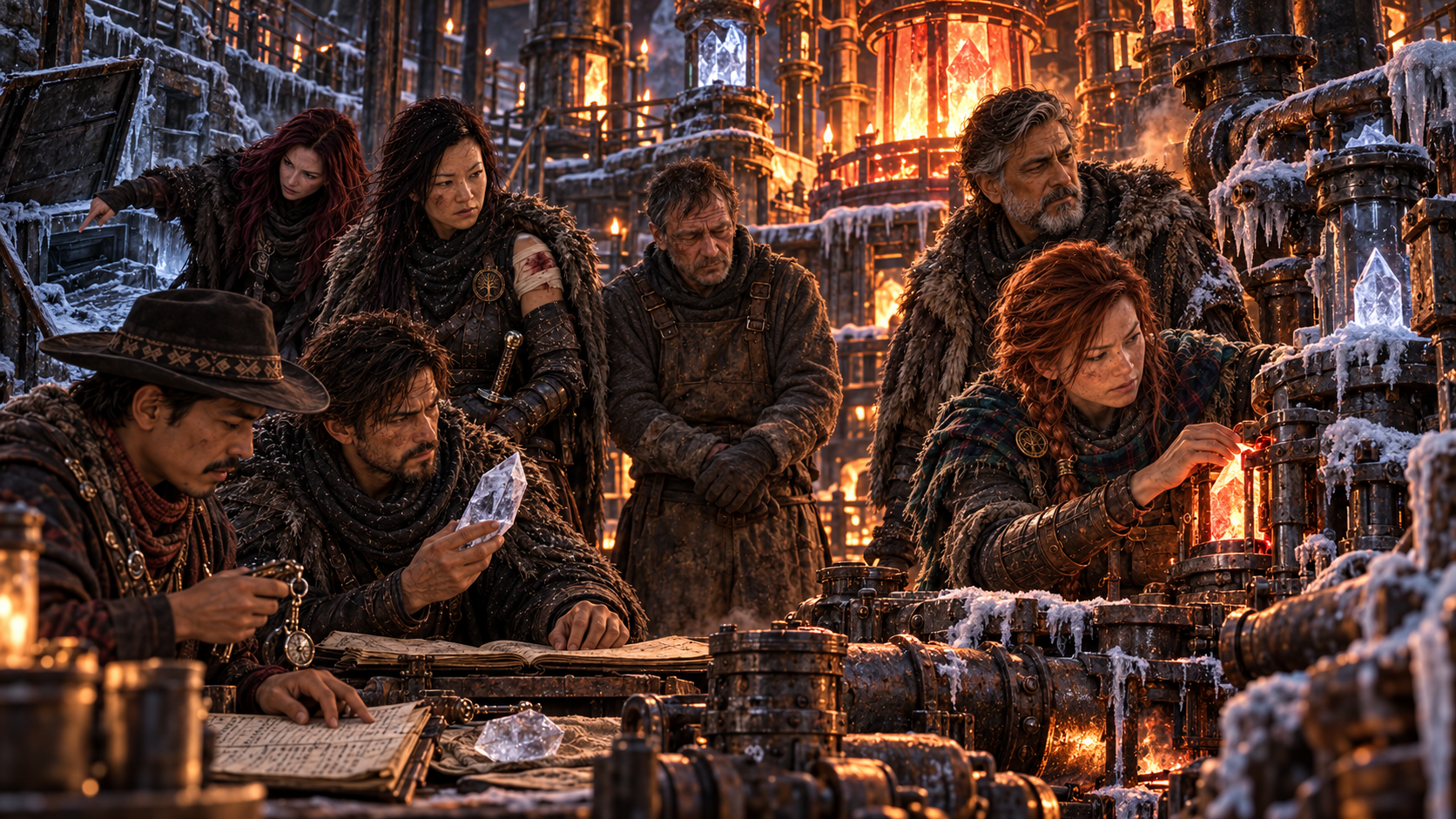
THE COLD BENEATH THE CRYSTALS
The Great Furnace had long since become more than a smithy.
Since fire crystals had spread through the Winterland, the NFD had begun using their heat systematically. The furnace supplied workshops, heated water, and fed a simple network of pipes that kept at least part of the settlement warm during the harshest winters.
That was why people noticed immediately when something went wrong.
On the morning of the Frost Moon, the crystals in the core no longer glowed an even red.
Several had turned pale and could scarcely retain their stored heat.
The facility rapidly lost output as a result.
Metal pipes cooled. Water began freezing in tanks. Within hours, the temperature in several buildings fell dangerously.
Seef stood with Ket before the open maintenance shaft.
“Accident?” he asked.
Ket shook her head.
“No.”
Argento examined one of the crystals they had removed.
“It has been treated.”
“Could that happen by itself?”
“Not like this.”
Seef looked at the blue glimmer.
“Then we have a saboteur.”
They assembled the few people with access to the crystal store and furnace installation.
Moidark had already begun comparing keys, guard rosters, and delivery lists.
Deathhead reported footprints near an old maintenance entrance. No proof of an intruder—but enough to have the entrance checked.
Then Moidark placed a small, pale-discolored splinter on the table.
“Found under Jota's sleeping place.”
Jota stood by a pillar.
He had aged. A scar ran across his cheek. Many years earlier, he had worked on modifications to the Great Furnace and knew the facility better than almost anyone.
“Someone could have put it there.”
“They could,” Moidark said.
Argento picked up the splinter.
“But the change is complex. The crystal was treated over a long period with certain salts and alternating temperatures. Only a few people in the NFD would even know how to attempt that.”
Jota looked at him.
“And because I know, it was me?”
Ket stepped closer.
“Was it?”
For a long time Jota said nothing.
Then:
“Yes.”
Seef exhaled slowly.
“Why?”
Jota looked toward the window.
Outside, the next snowfall was beginning.
“So you would remember.”
Nobody replied.
“My wife died during the Great Frost. My daughter too.”
Argento knew the records.
Hundreds had died then, when the old heating system collapsed during an exceptionally severe cold spell.
“Lira,” Jota said.
Seef looked at him.
“My wife's name was Lira.”
His voice hardened.
“I was told the failure was an accident. Material fatigue. Bad crystals. Bad luck.”
“That was the investigation's conclusion,” Seef said.
“Your investigation.”
“Yes.”
Jota laughed bitterly.
“I believe someone tampered with the crystals back then.”
Silence.
“And I believe someone on the council knew.”
Ket looked at Seef.
The chief did not answer at once.
Then he said:
“Belief isn't proof.”
“The evidence disappeared.”
“Or it never existed.”
Jota clenched his hands.
“My wife and daughter existed.”
“No one disputes that.”
“In your books they were two lines.”
Argento lowered his gaze.
That was true.
Two names.
Two dates of death.
A number beneath the heading: Victims of the Great Frost.
No one could now establish whether Jota's suspicion about the old disaster was true.
The old records were incomplete.
Some contradicted one another.
Others had been lost.
There was no evidence of a cover-up.
But there was no evidence that could definitively disprove Jota's suspicion decades later either.
What Jota had done this time, however, was certain.
He had tampered with the fire crystals.
And the settlement was beginning to freeze.
“The next storm reaches us tonight,” Ket said. “If the furnace isn't working by then, people will die.”
Jota was silent.
“Was that your plan?” she asked.
“No.”
“Doesn't matter. It can still happen.”
For the first time, the hardness left Jota's face.
Seef stepped before him.
“If you want justice, you demand an investigation. You don't kill people who had nothing to do with your family's deaths.”
Jota looked at the floor.
“I wanted someone to listen.”
Moidark answered:
“We're listening now.”
Then he turned to Argento.
“The old fire crystals under the archive.”
Argento understood immediately.
“They were stored because some had become unstable.”
“Do they work?”
“As heat stores? Yes.”
“Then we need them.”
The old storeroom lay beneath the archive.
Its original entrance had been partly flooded years before. Water had seeped in, then frozen and damaged several passages.
Deathhead studied the plan.
“The southern entrance might still be open.”
Moidark picked up a lantern.
“I'll go.”
Ket gathered her gear.
“Me too.”
Seef looked at them both.
“No heroics.”
Ket opened the door.
“Then send someone else.”
Seef said nothing more.
The descent took almost two hours.
In places, Ket and Moidark had to wade through icy water up to their knees.
Elsewhere they crawled beneath collapsed beams.
At last they found the old storeroom.
Many of the fire crystals originally stored there were broken or unusable.
But not all.
They filled a transport crate with the most stable specimens.
On the return journey, part of the damaged tunnel collapsed.
Ket was struck on the shoulder.
Moidark pulled her out from under a beam.
Then they dragged the crate onward together.
When they reached the surface, both were soaked, injured, and barely able to stand.
Nikki and the furnace workers were already waiting.
They checked the old crystals one by one.
Then they installed the first.
Slowly, the core temperature stabilized.
A second crystal followed.
Then a third.
Heat output rose again.
The Great Furnace came back to life.
Jota remained under guard throughout.
Moidark went to him.
“Lira.”
Jota raised his head.
“What?”
“That was your wife's name.”
Jota nodded.
“And your daughter?”
Jota told him her name.
Moidark wrote it down.
Argento stood beside him.
He opened the old register of the Great Frost.
This time he did not enter only two names.
He added who they had been.
Family.
Age.
Place of residence.
Whatever could still be determined from the surviving records.
Not because that made Jota's suspicion true.
Because the dead could be more than numbers.
The later investigation confirmed Jota's sabotage of the Great Furnace.
It did not confirm his claim about the original Great Frost.
Even years later, it remained open whether someone had indeed tampered with fire crystals at that time or whether grief had led Jota to give the catastrophe a cause because an accidental death seemed more unbearable than a guilty person.
Seef nevertheless ordered the old files reorganized.
Not to vindicate Jota.
Because missing answers were not the same as answers.
Jota was held responsible for the sabotage.
What exactly had happened during the Great Frost remained an open question in NFD history.
The Great Furnace continued to run.
And afterward a new register was created in the archive.
Not merely:
Two hundred dead.
But two hundred names.
When Argento showed Moidark the new register weeks later, Moidark turned its pages in silence.
“Better,” he said.
Argento nodded.
“Jota nearly froze the settlement for it.”
“Yes.”
“That doesn't make him a hero.”
“No.”
Argento closed the book.
“But Lira was still a person.”
Moidark stood.
“That's exactly why we write it down.”
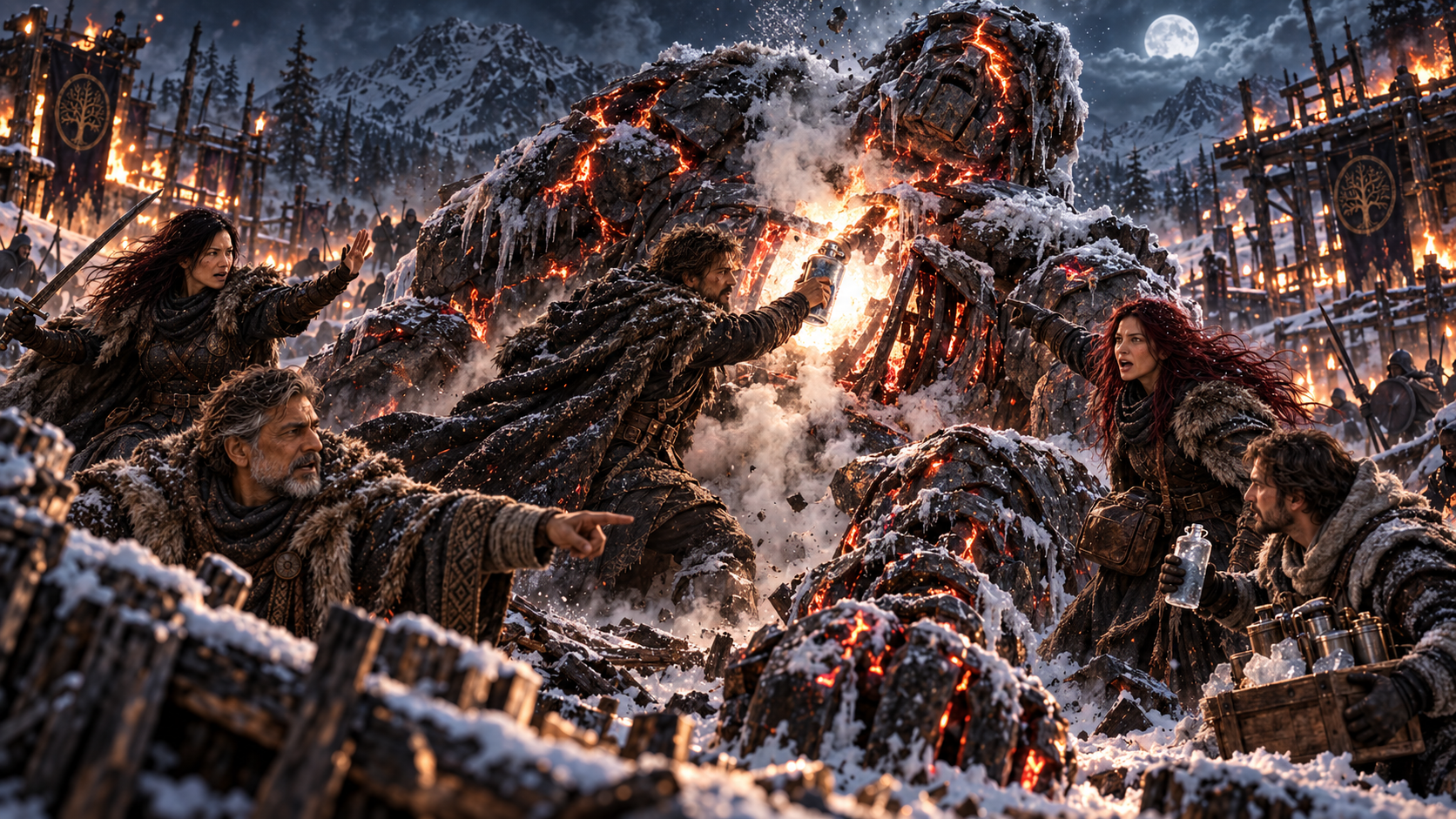
THE BURNING THREAD
Through a Fire That Consumes, a Winter That Remembers
I. Chief Seef
The wind howled through the pines like a dying man's last breath.
Three nights before, the Golem had emerged from the eastern forest.
Nobody knew where it had come from.
Some claimed it had risen from an old buried forge. Others spoke of ruins beneath the forest, forgotten machines, ancient weapons, or curses. Argento had found fragments of old accounts describing things that sounded disturbingly similar.
None proved anything.
What Seef knew was simpler.
The thing burned.
It had already broken through part of the eastern defenses and destroyed several buildings. Wherever its blackened body passed, snow turned to steam and wood caught fire.
The survivors had retreated to the sturdiest stone buildings while Ket organized what remained of the defenses.
“We can't fight it the same way again,” Ket said.
“No,” Seef replied.
He looked at Argento.
“Found anything?”
“Perhaps.”
Seef hated that word.
But it was better than nothing.
II. Ket
Ket had fought enemies who bled.
This one did not.
Arrows burned before they could penetrate deeply. Spears struck its hardened surface and came away scorched. In the previous attack, someone had tried oil.
The Golem had walked through the flames as if they were food.
Ket stood with Argento, Seef, and Christ over a rough map.
Christ had brought containers packed tight with ice and snow from one of the coldest storerooms.
“Cold,” Ket said. “That's the plan?”
“Cold and timing,” Argento answered.
“That sounds like half a plan.”
“It is.”
Ket stared at him.
Argento pointed to a sketch.
“In the last attack, I saw this opening in its chest. Not all the time. Only when it moved in a certain way.”
“A vent?”
“Possibly.”
“A mouth?”
“Possibly.”
“You're becoming tiresome.”
“That's usually a sign I'm thinking.”
Christ almost smiled.
Argento continued.
“The old records disagree on nearly everything. But several mention sudden cooling. One describes a fire-walker that became motionless after ice entered an opening in its body.”
“Does it say blessed ice?” Christ asked.
“In one copy.”
“And in the others?”
“One says glacial water. Another simply says cold.”
Christ looked slightly disappointed.
“Perhaps prayer isn't required, then.”
“I didn't say that.”
Ket rubbed her forehead.
“What do we actually know?”
Argento tapped the sketch.
“It has an opening. Extreme cold might affect whatever is inside.”
Ket nodded.
At last.
Something she could work with.
III. Argento
Most of the archive had survived, although one section had burned badly during the second attack.
Argento had spent hours searching the remains.
He found references scattered across unrelated records: smiths' constructs, fire-walkers, bodies of black stone, inner heat.
Some sounded like superstition.
Some contradicted one another.
A damaged text contained a line to which he kept returning:
Stillness quenches flame.
It was not an instruction.
Perhaps it did not even refer to the creature outside.
But together with what Argento had observed, it was enough to attempt something.
Christ prepared a small reinforced vial filled with intensely chilled water and ice.
“You still want to do it yourself?” Ket asked.
“I saw the opening.”
“Then describe it.”
“I have.”
“And?”
“You still need someone close enough to recognize the right moment.”
Ket's face hardened.
“You are not expendable.”
“No one is.”
“That's not an answer.”
“No.”
Argento took the vial.
“I know where to strike.”
IV. The Golem
It came after nightfall.
The trees began to glow before the creature itself could be seen.
Then the Golem stepped into the open.
Its body resembled blackened stone streaked with lines of inner fire. With every movement, glowing fissures opened and closed along its torso.
No one knew whether it was a creature, a construct, or something between the two.
Ket did not care.
“Positions!”
The NFD defenders moved.
They did not try to kill it.
They controlled it.
Noise from one side.
Movement from the other.
Withdrawal before contact.
Again and again, they forced the Golem to turn.
Deathhead watched the shifting fissures and called out what she saw.
“Opening left!”
“Get clear!”
“Chest!”
Argento waited.
The Golem struck a barricade and smashed it.
Seef's people retreated exactly as Ket had ordered.
Then the creature straightened.
The opening appeared.
Argento ran.
V. The Burning Thread
Ket saw him vanish beneath the Golem's reach.
For a moment she thought he had been crushed.
Then he rolled through melting snow and rose directly beneath the creature's chest.
The heat struck him at once.
His coat began to smoke.
“ARGENTO!”
He heard Ket.
He did not stop.
The opening widened.
There was no heart inside.
At least none anyone understood.
White heat pulsed behind layers of cracked material.
Argento thrust the vial into the opening.
Glass shattered.
The intensely chilled water hit the superheated material within.
The result was not an explosion.
It was a hiss.
Long.
Deep.
Then a crack.
Soft at first.
Then everywhere at once.
The abrupt temperature change caused the already stressed material inside to fracture. Steam burst from the fissures. Something in the creature's chest jammed as cracks ran through the glowing layers.
The Golem stopped.
Its raised arm froze in place.
The glow inside it became irregular and faded.
Then its body collapsed.
Ket ordered everyone back.
Part of the creature broke apart as it struck the ground.
Heat burst outward.
It caught Argento.
He vanished into steam and fire.
VI. Christ
Christ reached him with Ket seconds later.
Argento lay on his side.
His clothing had burned through in several places.
The left side of his face was blackened and raw. His right hand had been exposed to terrible heat. Across his back, fire had burned deep through cloth and skin.
He did not move.
Ket dropped beside him.
“No.”
Christ placed two fingers against Argento's neck.
Nothing.
Then—
a pulse.
Weak.
Another.
“He's alive.”
They carried him inside.
For days, fever held him between waking and darkness.
No one could explain why his recovery progressed so quickly.
The healers treated the burns, cleaned the wounds, and expected the worst.
Instead, the injuries closed remarkably well.
Argento regained his strength.
Then his ability to walk.
Then, to Ket's annoyance, his ability to argue.
But the Golem left its marks.
The left side of Argento's face remained scarred.
His right hand healed and remained functional, but the skin bore permanent burn scars.
His back bore them too.
The wounds healed.
The memory did not.
VII. What Remained
The Golem's remains were removed from the settlement's center and examined.
Nobody found a simple answer.
There were markings on parts of its hardened surface.
Whether they were writing, construction marks, or natural patterns remained disputed.
There were signs that something inside the creature had produced or stored tremendous heat.
But nobody could establish who—or what—had created it.
If it had been created at all.
Some time later, Seef stood with Argento before the black remains.
“You nearly died because of a line in an old book.”
Argento's scarred face tightened.
“No.”
Seef looked at him.
“I nearly died because I combined an unreliable line in an old book with an observation.”
“That's worse.”
“Probably.”
Seef looked at Argento's right hand.
“Are you healing?”
“Yes.”
“Completely?”
Argento looked at his dark reflection in a nearby window.
“No.”
Seef said no more.
The surviving fragment of the old text was preserved afterward.
Not because the NFD believed every word in it.
Because one line had proved useful enough to remember:
Stillness quenches flame.
The Golem's origin remained unknown.
Some continued to call it an ancient weapon.
Others believed it had once been a guardian.
A few insisted it was simply a creature no one understood.
Argento refused to settle on an answer without evidence.
The Golem was dead.
The NFD had survived.
And Argento carried proof of that night on his face, on his right hand, and across his back.
The fire was gone.
The scars remained.
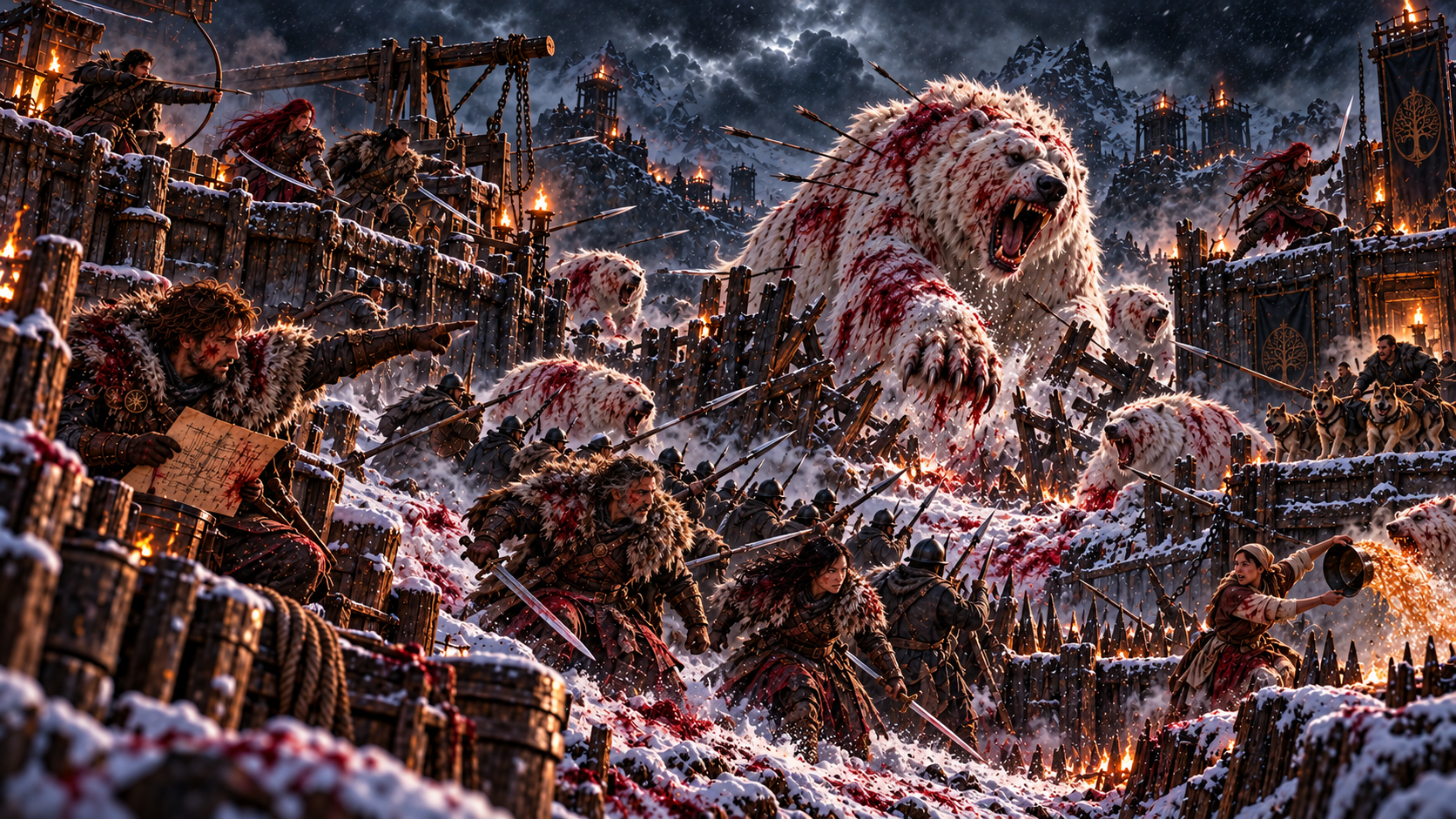
THE SHOWDOWN WITH THE WHITE KING
The first bear appeared shortly before dusk.
At first the guards on the western wall saw only movement between the snow-covered pines. Then a huge white bear stepped out of the forest.
He was larger than most animals the NFD hunters had encountered.
Seef stood on the battlements watching him.
“Close every gate.”
No one argued.
The bear came no closer.
He stood among the trees for a while, raised his head, and vanished again.
The next morning, the scouts found his tracks.
And others beside them.
Many more.
Argento spent the day in the archive.
In an old chronicle, he found a story of a “White King,” an enormous bear said to be followed each winter by a whole company of his kind.
When Seef read the text, he snorted.
“You believe that?”
“No.”
Argento put the chronicle on the table.
“But someone saw a lot of bears at the same time long ago. That interests me more than the part about the king.”
The old records also contained sketches of large pit traps and reinforced catching devices.
No secret weapons.
No magic.
Only wood, iron, ropes, and a great deal of work.
Seef studied the drawings.
“We can build that.”
“An improved version,” Argento said.
“Of course.”
The NFD began digging that same day.
Asha was among those who observed the animals' behavior.
Some called her a druidess because she spent more time in the forest than in the settlement and knew every herb, every track, and almost every animal.
Asha herself never claimed to speak with the forest.
When she saw the tracks, she knelt in the snow for a long time.
“They aren't moving normally.”
Ket looked at the prints.
“What is normal?”
“Bears don't simply gather in these numbers.”
“How many?”
Asha looked toward the forest.
“Too many.”
Joker helped Nikki with the defensive machines.
Several heavy launchers stood behind the western wall. They were crude, slow, and not particularly accurate against moving targets.
Against a group of large animals, precision mattered less.
“Ready?” Seef called.
Joker checked the tension.
“Ready enough.”
Nikki looked at him.
“What does that mean?”
“That I'm betting they'll work.”
“I hate it when you say things like that.”
“That's why I say them.”
The bears came at night.
Not two.
Not three.
A whole group moved out of the forest toward the settlement.
Later accounts disagreed over the exact number.
What is certain is that at least twelve large bears reached the area around the western gate alone.
Among them was the exceptionally large white bear the guards had first seen.
The chroniclers later called him the White King.
Whether the other animals truly followed him or had merely come to the settlement for the same unknown reason was never proved.
“Fire!”
Nikki's crew released the first launcher.
A heavy stone struck the ground before the oncoming group.
The second hit a bear from the side and threw it into the snow.
Then the animals reached the prepared obstacles.
Stakes.
Ditches.
Ropes.
Heavy traps.
Some bears dodged them.
Others did not.
At the western gate, the defense nevertheless broke.
Wood splintered.
Twelve bears pressed through the damaged passage.
Doma stood behind it with the spearmen.
“Hold the line!”
The first bear lunged.
Doma thrust his spear forward.
The point struck its throat.
The bear fell.
“Eyes and throat! Don't waste your blows on the fur!”
The rank behind him closed up.
What followed was no clean fight.
It was cramped.
Loud.
Bloody.
And far too close.
Jota fired from the wall.
His arrows were heavy and barbed.
He aimed at legs, eyes, and exposed flanks.
One hit knocked a bear off balance.
Another forced a different animal to change direction.
Jota kept shooting until his fingers bled.
Yari waited.
He was no ghost or supernatural assassin.
He was simply exceptionally good at being somewhere other than where an enemy expected him.
When one of the largest bears caught on a barricade and turned toward the spearmen, Yari came from behind.
His blade struck the exposed throat.
Once.
Then again.
The bear collapsed.
Yari immediately moved beyond the other animals' reach.
Deathhead fought where the line had already fallen apart.
Two blades.
Short movements.
No unnecessary blows.
One bear caught a hind leg in a heavy trap.
Deathhead waited until it twisted around.
Then she moved in from the side and drove her blade between its ribs.
As the animal fell, she withdrew her weapon.
“One.”
She said no more.
Moidark had no armored lions and no army of snow monkeys.
What he had were a few trained dogs, runners, and people who listened to his signals.
They kept escape routes clear, carried messages between defensive lines, and helped separate individual animals from the group.
Moidark himself stood near the inner gate, trying to work out where the defenses would fail next.
“Reinforce the north side!”
A runner raced away.
Seconds later a bear slammed into the barricade there.
Moidark looked at Seef.
“Sometimes I hate being right.”
“Not today,” Seef said.
Then he drew his sword.
A bear reached the supply street.
Kat stood in the kitchen doorway.
She was a cook.
She was not a soldier.
Before her stood a cauldron of hot broth.
The bear came closer.
Kat looked at the cauldron.
Then at the bear.
“All right.”
She gripped the cauldron with both hands and hurled its contents.
The hot liquid struck muzzle and eyes.
The bear roared and retreated.
Straight into a prepared barrier.
Later, some soldiers claimed Kat had then said:
“A little seasoning never hurt anyone.”
Kat denied it for the rest of her life.
No one believed her.
Ket led the mobile reserve.
No runes.
No magic wand.
No summoned blizzard.
Only soldiers she had drilled for weeks.
When the wind rose during the battle and thicker snow blew across the square, Ket used the poor visibility.
“Now!”
Her people opened a prepared passage.
Several bears followed the apparent gap.
Then heavy barriers closed behind them.
Ahead lay the pit traps.
Two animals fell in.
Another caught at the edge and was driven back by spearmen.
Later songs turned this into Ket's great ice spell.
Years later Ket commented on that version only with:
“If I could command blizzards, I wouldn't have blown one into my own face.”
The White King remained last.
He was wounded.
Several arrows stuck in his fur.
Blood ran across his chest.
Still, he broke through another barrier.
Seef, Ket, and several fighters withdrew into the prepared area.
There, Argento's old sketch had led to a particularly large pit trap.
Not large enough for legends.
But large enough for a bear.
The White King pursued them.
The snow beneath him broke.
Wooden boards tipped.
The animal fell into the pit.
The fight did not last much longer after that.
Some bears were dead.
Others injured.
Some escaped back into the forest.
The defenders killed the animals that had remained trapped inside the settlement and still posed an immediate danger.
By morning the western gate had been destroyed.
Several buildings were damaged.
People were wounded.
And the NFD still stood.
The White King was found dead in the pit trap.
Whether he truly had any special standing among the other bears remained unclear.
There was no “king's brood.”
No evidence of a curse.
No evidence of a forest spirit.
Only an unusually large gathering of bears and an exceptionally large white member among them.
Why so many animals had come to the settlement at once was never conclusively explained.
Days later, Seef stood before the repaired sections of the western gate.
“We won,” he said.
Doma snorted.
“The gate would disagree.”
Nikki looked at the broken beams.
“The gate fought badly.”
Joker grinned.
“I bet on the gate.”
Ket slowly turned toward him.
“How much?”
Joker's grin vanished.
“Nothing.”
“Joker.”
“Almost nothing.”
Behind them, Argento opened his new chapter.
He wrote the heading:
The Showdown with the White King.
Then he paused and added underneath:
Note: The title is more dramatic than the evidence.
Moidark read over his shoulder.
“At last, you're learning.”
Argento lowered his pen again.
“I'm crossing that out.”
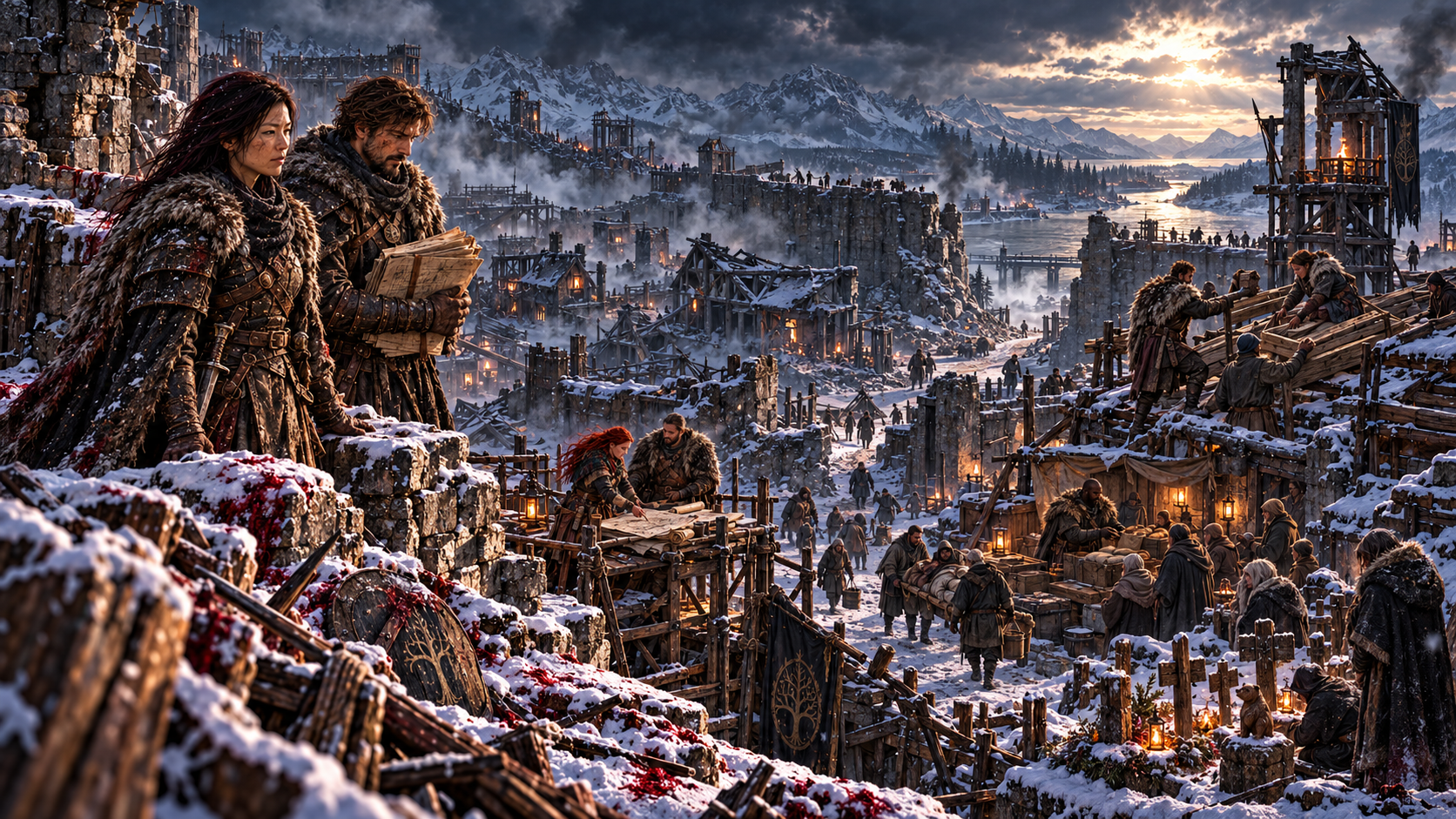
AFTER THE WHITE KING
I — What Remained of Winter
The snow had been red.
Not everywhere.
Not anymore.
But in some parts of the town, it had kept its color.
Where blood had soaked deep enough into the ice.
Where no one had had time to shovel snow over it.
Where the dead had lain.
Ket stood on the wall.
Or what remained of it.
The wind passed through shattered beams and over broken battlements.
Below her lay the NFD.
Her town.
At least, it had looked like her town yesterday.
Today it looked like something pulled from a fire and then forgotten in the snow.
Roofs had collapsed.
Windows had shattered.
Three houses along the northern road were only black skeletons.
The western stretch of wall was destroyed for almost fifty paces.
A watchtower lay across the street.
The palisades before the southern gate had been torn down.
Bear traps stood everywhere.
Broken spears.
Shields.
Blood.
And people.
The living moved among the ruins.
Slowly.
Very slowly.
Some carried the wounded.
Some carried wood.
Some water.
Some searched.
Ket knew what they searched for.
She had done it herself.
All night.
“Sixty-seven.”
The voice came from behind her.
Ket did not turn.
She knew who stood there.
Argento.
He held a thick bundle of papers beneath his arm.
The leather of his gloves was torn in several places.
The old scars on his right hand showed beneath the fabric.
The wind had reddened the left side of his face.
Where fire had once taken his skin and left him another, the cold made it look almost white.
Ket looked back over the town.
“Are you sure?”
Argento was silent for a moment.
“No.”
Ket closed her eyes.
“Damn it.”
“Sixty-seven confirmed.”
Now she looked at him.
“And missing?”
“Eleven.”
Ket said nothing.
Neither did Argento.
That was one reason she could bear to have him beside her just then.
He did not try to say something comforting.
He did not say they had won.
He did not say it could have been worse.
He did not say the dead had fallen for the NFD.
He simply stood beside her.
After a while Ket asked:
“Wounded?”
Argento opened his bundle.
“One hundred forty-three treated. Twenty-two of them seriously injured.”
“How seriously?”
“Seven might not survive the night.”
Ket inhaled slowly through her nose.
“Supplies?”
“Darth is counting.”
“That frightens me.”
Argento looked at her.
For a tiny moment, the corner of his mouth moved.
“Me too.”
Ket almost laughed.
Almost.
Then they heard someone shout below.
They both looked down.
Three men lifted a beam.
A woman crawled underneath.
She pulled out a child.
Alive.
For a moment, some people cheered.
Then the cheering stopped again.
There was too much to do.
Ket climbed down from the wall.
The square before the old storehouse had become the town's center.
Not because anyone had planned it.
Because the building still stood.
These days, a roof was already an argument.
Darth stood on a barrel.
About eighty people waited before him.
“No!”
He raised both hands.
“I'll say it again!”
Someone in the crowd called:
“You've already said it four times!”
“Then there is a small chance you'll understand it on the fifth!”
A few people laughed.
Not many.
But enough.
Darth pointed to the sacks behind him.
“This isn't a market.”
“You're standing on a barrel!”
“That doesn't automatically make me a merchant.”
Ket stopped.
Argento murmured beside her:
“Not yet.”
Darth heard him.
“What's that supposed to mean?”
“Nothing.”
Darth pointed at him.
“I know your nothing.”
Then he turned back to the crowd.
“Every household gets flour, dried meat, and two portions of root vegetables today. Anyone with children under twelve gets an extra portion.”
A man raised his hand.
“And beer?”
Darth stared at him.
“Yesterday we were attacked by an army of giant white bears.”
“I know.”
“Sixty-seven people are dead.”
“I know.”
“Half the town is in ruins.”
“I know.”
Darth leaned forward.
“And your most important question is beer?”
The man shrugged.
“It was a long night.”
More people laughed this time.
Even Darth.
Briefly.
Then he was serious again.
“The beer stays sealed.”
Indignant murmurs.
“Until we know how much clean water we have.”
The murmuring stopped.
Ket joined him.
“How bad?”
Darth jumped off the barrel.
“Worse than I'd hoped. Better than I'd feared.”
“Numbers.”
“Grain for maybe three weeks.”
Ket looked at him.
“At normal rations?”
“No.”
“How long at half?”
“Five weeks. Perhaps six.”
“Meat?”
“Two weeks.”
“Salt?”
“Enough.”
“Water?”
“If the southern cistern is clean, no problem.”
Argento wrote.
Darth noticed.
“Are you writing everything down?”
“Yes.”
“Why?”
Argento looked up briefly from his paper.
“Because otherwise we'll remember it incorrectly tomorrow.”
Darth fell silent.
Then nodded.
“Write that I saved the beer.”
“No.”
“Falsifier of history.”
Ket moved on.
Eirik Frostmark had not stopped working since sunrise.
His hands were bleeding.
Not from fighting.
From wood splinters.
Half the roof of his own house was gone.
Still, he was repairing his neighbor's house.
“Higher.”
The young man on the ladder raised the beam.
“More.”
“Eirik, I can't.”
“Another finger's breadth.”
“Which finger?”
Eirik looked up.
“Any one you still have.”
The beam slid into its groove.
“Now.”
Two men drove the bolts in.
Eirik stepped back.
His wife Sanna stood beside him.
She had a blanket around her shoulders.
“Our roof.”
“I know.”
“Tore is freezing.”
“I know.”
“Liv says it's dripping over her bed.”
“There isn't a bed anymore.”
Sanna looked at him.
Eirik closed his eyes.
“That was bad.”
“Very.”
“Sorry.”
Sanna handed him a hammer.
“Our house is next.”
Eirik took it.
“The infirmary first.”
“Then our house.”
“Then the smithy.”
Sanna took the hammer back.
“Then our house.”
Eirik looked at his wife.
“Yes.”
“Good.”
Ket had heard their exchange.
“Frostmark.”
Eirik turned.
“Ket.”
“How many roofs can you secure today?”
He looked down the street.
“With enough people? Ten.”
“You'll get twenty.”
“With dry wood?”
Ket said nothing.
Eirik nodded.
“Then six.”
Sanna said:
“Seven.”
Eirik looked at her.
“Six.”
“Seven.”
“Sanna.”
“You married me.”
“I'm realizing that again just now.”
Ket actually smiled.
For a moment only.
Then she pointed toward the infirmary.
“That first.”
Eirik nodded.
“That first.”
“And after that, your house.”
Sanna looked at Ket in surprise.
Ket was already walking on.
The infirmary smelled of blood.
Of hot water.
Of herbs.
Of fear.
Norma Eisengrund sat beside a young soldier.
She was no healer.
But the healers did not have enough hands.
So she held his.
The boy was perhaps eighteen.
Perhaps younger.
“Don't fall asleep.”
“I'm tired.”
“I believe you.”
“Just for a moment.”
“No.”
Norma squeezed his fingers.
“Tell me your name.”
“Pavel.”
“Good. Pavel what?”
“Rinn.”
“Where do you live?”
“South Street.”
“What number?”
Pavel smiled weakly.
“We don't have numbers.”
“Then we should invent some.”
At the other end of the room, someone screamed.
Norma did not look over.
Pavel did.
“Is that—”
“Look at me.”
He looked at her.
“My daughter is called Maja.”
“Nice name.”
“She is six.”
“I don't have children.”
Norma swallowed.
“Then you'll have some later.”
“Maybe.”
“Not maybe.”
She gripped his hand more firmly.
“Later.”
Argento stood in the doorway.
He had watched them.
Then he wrote down a name.
Pavel Rinn.
Alive.
For now.
That afternoon the first funeral began.
There were not enough coffins.
That was the first truth.
The second was worse.
There was not enough dry wood to build them.
Ket had proposed burying the dead individually.
Eirik Frostmark had explained that would take days.
The ground was frozen.
The town did not have days.
So pits were dug.
Wide.
Deep.
Together.
Ket hated it.
But she had agreed.
That, she realized, was leadership.
Not giving orders.
Deciding which bad possibility was less terrible.
Argento stood at the edge of the first pit.
He held paper in his hand.
“Alden Marr.”
A woman wept.
“Berek Sol.”
An old man removed his cap.
“Cara Venn.”
Someone whispered:
“No.”
Argento continued reading.
Every name.
Slowly.
No titles.
No ranks.
No stories.
Only names.
Until he said:
“Kjell Tannvik.”
Astrid Tannvik stood among her children.
Lina was ten.
She understood enough.
Nils was fifteen.
He understood everything.
Hagen Tannvik stood behind them.
Old.
Straight-backed.
Motionless.
Astrid had not wept.
Not during the night.
Not when they found Kjell.
Not when they carried him from the street.
Not when they brought her his coat.
Now she heard his name.
And something inside her broke.
Lina clung to her mother.
Nils stared into the pit.
His face was hard.
Too hard for fifteen years.
Ket saw him.
She knew that look.
She had seen it on young soldiers.
On men who wanted to die the next morning because they had lost someone the evening before.
Nils took a step forward.
Hagen put a hand on his shoulder.
“Don't.”
“I want to see him.”
“No.”
“Grandfather.”
“You remember his face.”
Nils looked at him.
Hagen's voice trembled.
“Keep that one.”
Nils stopped.
Argento waited.
He did not read the next name until Astrid could breathe again.
That evening, Ket and Argento sat on the steps of the command building.
Nobody had sent them there.
They had simply ended up there somehow.
Ket held a cup.
Its contents were cold.
She no longer remembered what it had been.
Argento wrote.
“Stop.”
He kept writing.
“Argento.”
“Hmm?”
“Stop.”
He put down his pen.
Ket looked at the street.
People walked with lanterns among the ruins.
“Kjell Tannvik.”
Argento said nothing.
“I knew him.”
“I know.”
“He was at the southern barricade.”
“Yes.”
“I sent him there.”
Argento looked at her.
“Yes.”
Ket turned toward him.
“Is that all you have to say?”
“What do you want to hear?”
“That it wasn't my fault.”
Argento was silent.
Ket laughed bitterly.
“You really are bad at this.”
“You don't want me to lie to you.”
“No.”
“Then I can't tell you that you had nothing to do with it.”
Ket looked ahead again.
Argento took the cup from her hand.
He smelled it.
“What is this?”
“No idea.”
He set it aside.
“You sent Kjell there.”
Ket nodded.
“You sent eighteen others there too.”
“Yes.”
“Eleven of them are alive.”
Ket closed her eyes.
“That makes seven dead.”
“Yes.”
“Is that meant to help?”
“No.”
“Then why say it?”
Argento thought.
“Because I think someone has to keep the numbers when everyone else can only keep the guilt.”
Ket looked at him.
For a long time.
Then she said:
“Don't write that down.”
Argento picked up his pen.
“Too late.”
She struck his arm.
Not hard.
He smiled.
And for the first time since the attack, Ket laughed.
Only once.
Only briefly.
But she laughed.
On the third day, hunger began.
Not real hunger.
Not yet.
But the fear of it.
That was almost as dangerous.
A line formed outside the storehouse.
Mira Haldersen stood in it.
Her eleven-year-old son Jannik beside her.
“I'm hungry.”
“I know.”
“Very hungry.”
“I know.”
“When will there be bread?”
Mira looked toward the storehouse.
“When we get flour.”
“But we have flour.”
“Not enough.”
“You're a baker.”
“That doesn't create grain.”
Jannik considered this.
“It would be useful if it did.”
Mira smiled.
An argument started ahead of them.
A man claimed his family had received too little.
Darth held a slate.
“Four people.”
“Five.”
“Yesterday there were four.”
“My sister is living with us now.”
“Since when?”
“Today.”
Darth looked at Argento.
Argento leafed through his records.
“Lea Dorn. House on the eastern road destroyed. With the Venn family since last night.”
The man fell silent.
Darth raised an eyebrow.
“Your sister lives both with you and with the Venn family?”
“Maybe she's very fast.”
Darth pointed toward the back of the line.
The man went.
Mira stepped forward.
Darth checked the list.
“Haldersen. Four people.”
“Yes.”
“Two adults, Elin nineteen, Jannik eleven.”
Jannik raised his hand.
“I'm almost twelve.”
Darth looked at him.
“That's bad news for your rations.”
Jannik lowered his hand.
“Then I'm eleven.”
“Clever boy.”
Darth handed Mira a sack.
She lifted it.
Her face changed.
“It's less.”
“Yes.”
“How much less?”
“A quarter.”
Mira looked at him.
“I can't bake for four with that.”
“I know.”
“What if I add water?”
“Then you have wet bread.”
“Darth.”
His face became serious.
“Mira.”
She had known him long enough.
“How bad?”
Darth answered quietly.
“If no more supplies come, very bad.”
Mira looked at the sack.
Then at the people behind her.
“Give me two more.”
“No.”
“Not for us.”
Darth waited.
“For the oven.”
“Mira—”
“I can make more from three sacks than twenty families can separately.”
Darth looked at Argento.
Argento shrugged.
“She is right.”
Darth sighed.
“I hate it when other people are right.”
“It happens often.”
“Now you aren't getting any bread at all.”
Mira got the sacks.
The next morning, South Street smelled of bread.
For the first time since the attack, part of the town smelled like home again.
Nikki stood in the middle of a ruined street.
Before her lay a house.
Or its wall.
She looked at the wreckage.
Then the street.
Then the houses opposite.
“Too narrow.”
Rurik Eisengrund, examining a bent metal support beside her, looked up.
“What?”
“The street.”
“It has always been this way.”
“Exactly.”
Rurik looked at her.
“That sounds like trouble.”
Nikki walked twelve paces.
Turned around.
Walked back.
“If another bear gets through here—”
“I'd prefer that didn't happen.”
“—we can't form up.”
Rurik set down the support.
Nikki pointed between the houses.
“Four people side by side. No more.”
“Five if they're thin.”
“Our soldiers aren't thin.”
“With Darth's rations, they soon will be.”
Nikki ignored that.
“And fire.”
She pointed to the burned buildings.
“One house burns.”
Then to the next.
“It spreads.”
The next.
“And spreads again.”
Rurik understood.
“Space between buildings.”
“Yes.”
“Wider roads.”
“Yes.”
“Fewer houses.”
“No.”
Nikki smiled.
“Better houses.”
Rurik groaned.
“That will be expensive.”
“What will?”
Darth had suddenly appeared behind them.
“Nothing,” Rurik said.
“I heard expensive.”
Nikki turned.
“We need to rebuild the town.”
Darth went pale.
“No.”
“Yes.”
“No.”
“Darth.”
“The town is broken. That's completely different from deliberately breaking it more.”
Nikki showed him her sketch.
“Wider main roads. Firebreaks. Workshops away from homes. Supplies stored in more than one place. Greater spacing at the walls.”
Darth studied the drawing.
“What will it cost?”
Nikki smiled.
Darth looked at Rurik.
“Why is she smiling?”
“Run.”
On the sixth day, Pavel Rinn died.
Norma was beside him again.
This time she could not keep him awake.
Argento came later.
Norma was still sitting there.
“You can go,” he said.
“I know.”
“Your family is waiting.”
“I know.”
Argento looked at Pavel.
“Eighteen?”
“Seventeen.”
Argento paused.
He crossed out something on his paper.
Wrote it again.
Norma watched him.
“What are you actually doing?”
“I don't know yet.”
“You've been writing for days.”
“Yes.”
“Every name?”
“Yes.”
“Why?”
Argento looked at Pavel.
“So they don't become just a number.”
Norma looked toward the door.
“Sixty-seven.”
“Sixty-eight now.”
Norma closed her eyes.
“No.”
Argento said nothing.
“The battle is over.”
“Yes.”
“Then he shouldn't be allowed to die afterward.”
“I'm afraid winter doesn't care when we declare a battle over.”
Norma stood.
“Write down that he was afraid.”
Argento looked at her.
“And that he didn't scream anyway.”
He wrote.
“And that he said Maja was a beautiful name.”
Argento wrote that too.
Norma left.
A week later, the first merchant arrived.
Alone.
One sled.
Two dogs.
A man with a beard that looked as though it had stored several winters.
Darth received him at the southern gate.
“Welcome to the NFD.”
The merchant examined the ruined wall.
“Looks cozy.”
“We're renovating.”
“With catapults?”
“New style.”
The man grinned.
Darth grinned back.
“What have you got?”
“Salt. Lamp oil. Nails. Cloth. Dried beans.”
Darth's grin vanished.
“Beans?”
“Yes.”
“How many?”
“Four sacks.”
Darth walked around the sled.
“What do you want?”
“Fire crystals.”
“No.”
“Then silver.”
“Not much.”
“Furs.”
Darth considered it.
“We have those.”
“Good ones?”
“Very good ones.”
The merchant pointed toward the ruined town.
“You aren't exactly in a strong bargaining position.”
Darth stepped closer.
“Neither are you.”
The man raised an eyebrow.
“Why?”
“Because you traveled three days through winter to get here.”
Darth pointed at the beans.
“And you don't want to haul those back.”
The merchant smiled.
“What's your name?”
“Darth.”
“Merchant?”
“No.”
Argento stood a few paces away, writing.
Darth noticed.
“Not yet.”
The beans lasted nine days.
But they meant more than nine days of food.
They meant roads still existed.
That people lived somewhere beyond the ruined town.
That trade was possible.
Darth began keeping lists.
Bad lists.
Argento corrected them.
Darth began recording prices.
Even worse lists.
Argento corrected those too.
By the end of the second week, Darth had his own book.
On its first page he wrote:
THINGS WE NEED.
Underneath:
EVERYTHING.
Argento crossed it out.
Darth wrote it back in.
The Tannviks did not return to their house.
A bear had torn out the front wall.
Kjell had still seen the damage.
On the morning of the attack, he had told Hagen:
“I'll fix that tomorrow.”
There was no tomorrow for him.
Astrid stood before the ruin.
Nils beside her.
Lina held a little wooden figure.
Hagen opened the door.
It fell off its hinges.
“That's bad,” he said.
Astrid laughed.
It was not happy laughter.
But it was her first since Kjell's death.
“Only noticing now?”
Hagen leaned the door against the wall.
“I wanted to be sure.”
Eirik Frostmark came across the street.
Sanna followed.
Liv and Tore carried boards.
“Where should it go?” Eirik asked.
Astrid looked at him.
“What?”
“The wood.”
“We didn't order anything.”
“Ket did.”
Astrid looked toward the street.
Ket was not there.
“We can't pay.”
Eirik set down the first board.
“Good thing I don't have an invoice.”
Sanna handed Astrid a hammer.
“You're helping.”
Astrid looked at it.
“I can't do that.”
“Then you'll learn.”
Nils had already picked up a board.
Eirik showed him how to hold it.
Tore looked at Lina.
“Want nails?”
Lina nodded.
Tore gave her a handful.
“Don't eat them.”
Lina looked at him indignantly.
“I'm ten.”
Tore shrugged.
“I don't know you.”
Lina laughed.
Only once.
But Astrid heard it.
She turned away.
And wept.
Quietly.
Sanna stood beside her.
She said nothing.
The weeks passed.
The NFD changed.
Not quickly.
Not beautifully.
But visibly.
The first new roofs were lighter than the old ones.
The repaired walls had different stones.
You could see where the town had been wounded.
Ket insisted no one hide those marks.
“Why?” Nikki asked.
Ket looked at the new western wall.
“Otherwise one day we'll believe it never fell.”
Argento wrote the sentence down.
Ket noticed.
“Stop doing that.”
“No.”
Then the storm came.
It did not announce itself with thunder.
Not with dark clouds.
Not with any dramatic sign.
In the morning, the sky was white.
By noon, it was whiter still.
In the afternoon, the world vanished.
The wind hit the town like a wall.
Snow raced horizontally through the streets.
Within an hour, paths were gone.
Within two, doors were blocked.
Within three, the first repaired roof collapsed.
Ket stood in the command building.
“Bring in all the building crews!”
A soldier shook his head.
“Frostmark is still outside.”
Ket cursed.
“Where?”
“North Street.”
She reached for her coat.
Argento stepped in front of the door.
“No.”
Ket looked at him.
“Move.”
“You can't see five paces.”
“Eirik is out there.”
“Then we send a group.”
“I am the group.”
“You're the person who decides where the groups go.”
Ket stepped closer.
“Argento.”
“Ket.”
For a moment, they faced one another.
Then Nikki came in.
“The roof of the old smithy won't hold.”
Ket turned at once.
“People inside?”
“Rurik. Norma. The children.”
Ket pointed to four soldiers.
“With Nikki.”
Then to six more.
“North Street. Find Frostmark.”
Argento stepped aside.
Ket stayed.
She hated him for it.
And knew he was right.
Rurik Eisengrund braced himself against the smithy's door.
The wind pushed against it from outside.
Norma held Maja close.
Oskar tried to put a prop beneath a roof beam.
“It won't hold!” he shouted.
Rurik shouted back:
“Then tell the beam that!”
A crash.
Dust sifted from the ceiling.
Maja screamed.
Norma pulled her beneath the worktable.
“Oskar!”
“I'm here!”
The door flew open.
Snow shot inside.
Nikki stood outside.
Four soldiers behind her.
“OUT!”
Rurik pointed to the forge.
“If it goes out—”
Nikki caught his coat.
“If you go out, the forge is useless too!”
That convinced him.
They ran.
Twenty paces.
No more.
It felt like a mile.
Oskar carried Maja.
Norma clung to his belt.
Rurik lost his bearings in the snow.
Nikki caught his hand.
Then they reached the neighboring house.
Seconds later, they heard a deep crash behind them.
The smithy collapsed.
Rurik stood in the doorway.
He said nothing.
Norma placed a hand on his back.
“We'll build it again.”
Rurik looked outside.
“Again.”
“Yes.”
“I liked the old one.”
Norma rested her head against his shoulder.
“So did I.”
Eirik Frostmark was not found until after dark.
He lay under a fallen beam.
Alive.
Sanna was beside him.
She had refused to leave him alone.
Liv and Tore were in the storehouse.
Ket was there when they brought Eirik in.
His leg was broken.
Sanna had frostbite on two fingers.
Liv ran to them.
Tore followed.
Eirik saw Ket.
“Seven.”
Ket did not understand.
“What?”
“Roofs.”
He grimaced in pain.
“I said we could do seven.”
Ket knelt beside him.
“You're an idiot.”
“Sanna says that too.”
Sanna raised her injured hand.
“For years.”
Ket looked at Eirik.
“You won't work a single day until the healer allows it.”
“The NFD needs—”
“The NFD needs people who can still walk next year.”
Eirik wanted to argue.
Sanna said:
“Say yes.”
Eirik sighed.
“Yes.”
The storm lasted four days.
Four days without sky.
Four days without horizon.
Four days in which the NFD learned to be afraid again.
Not of bears.
Not of enemies.
Of cold.
Of a sound in the roof.
Of a door that would no longer open.
Of a fire growing smaller.
Mira Haldersen baked almost without stopping.
Bram hauled flour.
Elin delivered bread to the shelters.
Jannik carried wood.
On the second day, Mira found him asleep beside the oven.
“Jannik.”
No answer.
She was frightened.
Then he snored.
Mira sat beside him.
She drew his head onto her lap.
Bram came in.
“He shouldn't sleep here.”
“Tell him.”
Bram looked at his son.
“Tomorrow.”
On the third day, the western shelter ran out of firewood.
Ket still had two stores.
One at the infirmary.
One at the supply house.
“We split the infirmary's store,” she said.
An officer shook his head.
“Then there won't be enough there until tomorrow.”
“If we don't share it, thirty people in the west will freeze tonight.”
“And if the storm doesn't end tomorrow?”
Ket was silent.
Everyone looked at her.
Before, she would have given a military order.
Short.
Clear.
Final.
Now there was no good order.
Only people.
Argento stood at the back of the room.
He said nothing.
Ket looked at the map.
Then the numbers.
Then Darth.
“How much furniture is in the trading house?”
Darth blinked.
“What?”
“Tables. Chairs. Shelves.”
“Ket.”
“How much?”
“A lot.”
“Burn it.”
Darth looked as though she had put a dagger through his heart.
“My shelves?”
“Yes.”
“The good ones?”
“All of them.”
“We could use the bad ones—”
“Darth.”
He closed his eyes.
“I will remember this day.”
Argento raised his pen.
Darth pointed at him.
“Don't you dare.”
Argento wrote.
That night Darth's shelves burned.
No one in the western shelter froze.
On the morning of the fifth day, the wind stopped.
Just like that.
The silence was almost more frightening.
Ket opened the door.
Snow reached her chest.
She dug her way out.
Other doors opened.
People emerged.
Slowly.
One by one.
The NFD still existed.
Changed.
Damaged again.
But there.
Ket climbed onto a snowbank.
From there she saw the town.
One roof was missing.
Then another.
The smithy was destroyed.
Part of the northern wall lay buried under snow.
But smoke rose from chimneys.
People moved.
Children shouted.
Somewhere a dog barked.
And somewhere someone laughed.
Ket sat down in the snow.
Argento came to her.
His book was beneath his coat.
“How many?” Ket asked.
Argento knew at once what she meant.
“Three.”
Ket closed her eyes.
“Names.”
“Orin Feld.”
She nodded.
“Mara Vest.”
She nodded again.
“Hedda Cor.”
Ket exhaled.
“Three.”
“Three.”
“And wounded?”
“Many.”
“Dead in total?”
Argento opened his book.
“Seventy-one since the attack.”
Ket looked at him.
“Sixty-seven.”
“In the attack.”
“Pavel.”
“Afterward.”
“And the three in the storm.”
“Yes.”
Ket took the book from him.
Argento let her.
She leafed through it.
Pages full of names.
Numbers.
Places.
Food.
Damage.
Statements.
Little drawings.
Maps.
On one page was written:
Kjell Tannvik.
Underneath:
Southern barricade.
Married to Astrid.
Children: Nils, Lina.
Ket ran a finger over the name.
“This isn't a list anymore.”
Argento looked at her.
“No.”
“What is it?”
He looked out over the town.
“Perhaps the beginning of remembering.”
Ket handed the book back.
“Then keep going.”
Argento nodded.
Spring came late.
First water dripped from the roofs.
Then the streets turned brown.
Then black.
Then, for the first time, the earth was visible again.
The NFD smelled terrible for a few weeks.
No one complained.
The stench meant thaw.
Thaw meant life.
Eirik Frostmark walked again.
With a stick.
Sanna watched every step.
“I can walk alone.”
“I can see that.”
“Then stop.”
“No.”
Liv was now working regularly with her father.
Tore collected nails.
No one knew where he got them.
Eirik suspected theft.
Tore called it recycling.
Darth called it talent.
Mira Haldersen's bakery oven got a proper roof.
Bram built a counter in front of it.
Elin painted a sign.
HALDERSEN'S BREAD.
Jannik studied it.
“Boring.”
Mira put her hands on her hips.
“What would you write?”
Jannik thought.
“BREAD.”
“It says that.”
“Bigger.”
Mira laughed.
The next morning, the word BREAD was indeed larger.
No one admitted changing it.
Rurik and Norma Eisengrund rebuilt the smithy.
Not where it had stood before.
Nikki had insisted on that.
There were now twelve paces of open ground between the smithy and the nearest home.
Rurik studied it gloomily.
“Waste.”
Nikki folded her arms.
“Fire safety.”
“Waste.”
“If your smithy burns, Norma's house won't.”
Rurik considered it.
“Fire safety.”
Nikki grinned.
The new smithy got a broader roof.
Two exits.
Its own water supply.
And, at Norma's request, a small window.
“Why a window?” Rurik asked.
“So I can see when you do something stupid again.”
“Then you'll need a bigger one.”
For the Tannviks, it took longer.
Astrid began working again.
At first for a few hours.
Then every day.
Nils began checking traps with Hagen.
He spoke little.
Too little.
One day Ket found him at the southern training ground.
He held a sword.
Too large for him.
“Who gave you that?”
Nils started.
“No one.”
“Then it has legs.”
He said nothing.
Ket took the sword from him.
“I want to learn to fight.”
“Why?”
“So something like this never happens again.”
Ket looked at him for a long time.
“I can't promise you that.”
“Then teach me to kill them.”
There it was again.
That look.
Ket sat down on the low wall.
“Your father wasn't a soldier.”
“I know.”
“He stayed anyway.”
Nils looked at the ground.
“He should have run.”
Ket did not answer at once.
“Perhaps.”
Nils looked at her in surprise.
“Perhaps I should have ordered him to go.”
“Then he'd still be here.”
“Perhaps.”
Nils' eyes filled with tears.
“Why didn't you?”
The question struck harder than any blow.
Ket could have said there had been no time.
That the line had to hold.
That others would have died without Kjell.
All true.
All insufficient.
“Because in that moment, I thought I needed him there.”
Nils stared at her.
“And?”
“I wasn't wrong.”
Ket swallowed.
“But that doesn't make your father any less dead.”
Nils began to cry.
Angrily.
Without a sound.
Ket stayed seated.
She did not touch him.
She let him choose.
After a while, he sat beside her.
“Will you still teach me swordplay?”
“If your mother agrees.”
“She'll say no.”
“Then my answer is no too.”
“That's unfair.”
“That's leadership.”
Nils snorted.
“Then I never want to be a leader.”
Ket looked across the training ground.
“That might be wise.”
In the second month after the storm, Nikki stood on scaffolding.
A map lay beneath her.
Not the old town.
The new one.
Wider streets.
Separate storehouses.
New wells.
Fireplaces.
Workshops.
Escape routes.
Spaces for markets.
A larger training ground.
Darth studied the drawing.
“Market?”
Nikki pointed to it.
“Here.”
Darth bent over the map.
“Too small.”
“You don't even have a market yet.”
“That's why I need to think ahead.”
Argento joined them.
“What are you planning?”
Darth pointed to the space.
“The future.”
Nikki said:
“He's planning money.”
“That is my future.”
Argento looked at the map.
Then at the town.
“We should name the streets.”
Nikki looked at him.
“Why?”
Argento raised his book.
“Because ‘third broken house behind the old well’ isn't a good archival system in the long run.”
Darth nodded gravely.
“For the first time, he's saying something sensible.”
“I've been writing your trade ledgers for months.”
“For the second time.”
Later, Ket stood alone before the first burial ground.
The snow had almost vanished.
Someone had erected wooden plaques.
Names were written on them.
Sixty-seven.
Only those who had fallen in the attack.
Not Pavel.
Not those who had died in the storm.
They would have another place.
Argento had insisted on it.
“Different events,” he had said.
“The same remembrance.”
Ket walked along the names.
Until she reached Kjell Tannvik.
A little wooden figure lay there.
A bear.
Poorly carved.
Perhaps by Lina.
Ket knelt.
“I'm sorry.”
No one answered.
Of course not.
Footsteps crunched behind her.
Astrid.
Ket stood.
“I wanted—”
“I know.”
Astrid stood beside her.
They were both silent for a while.
“Nils was with you.”
“Yes.”
“He wants to fight.”
“Yes.”
Astrid closed her eyes.
“Kjell would have hated that.”
“Then Nils should know it.”
“He does.”
Astrid looked at her husband's name.
“He just isn't listening right now.”
Ket nodded.
“I know that feeling.”
Astrid looked at her.
For the first time, not as a commander.
Not as the woman who had sent Kjell to the barricade.
Simply as Ket.
“Was he brave?”
Ket answered at once.
“Yes.”
“Was he afraid?”
Ket thought of the fight.
Of snow.
Blood.
Roaring.
Of Kjell standing with a spear beside the barricade.
“Yes.”
Astrid nodded.
“Good.”
Ket did not understand.
Astrid touched his name.
“He always feared he'd be a coward when it mattered.”
Ket looked at the plaque.
“He wasn't.”
Astrid wept.
This time Ket stayed.
That evening, Ket and Argento sat again on the steps of the command building.
Almost as they had after the attack.
Except that the street before them looked different.
Wider.
Still full of mud.
But wider.
Children ran along it.
Tore Frostmark chased Jannik Haldersen.
Lina Tannvik followed.
Maja Eisengrund stood at the side and shouted instructions, though nobody had asked her to.
Ket watched them.
“Nikki is rebuilding our town.”
“Yes.”
“Darth will become a merchant.”
“He denies it.”
“Of course.”
“Rurik repaired his first new plow today.”
“Good.”
“Mira needs more flour.”
“Not good.”
“Eirik says the north wall will be finished in three weeks.”
Ket nodded.
Argento wrote.
“And you?” she asked.
“What?”
“What will you become?”
Argento paused.
“I am Argento.”
“That wasn't the question.”
He looked at the book in his hands.
It had grown thicker.
Much thicker.
Loose papers were tucked between its pages.
Maps.
Letters.
Names.
“I don't know.”
Ket gestured toward it.
“Looks as though you're finding out.”
Argento was silent.
Then he asked:
“And you?”
Ket looked toward the wall.
Soldiers were training.
Then toward the street.
The children.
The bakery.
The new smithy.
The houses.
The graves.
Before, she would have said:
Commander.
Soldier.
Leader.
Now that was no longer enough.
“I don't know either.”
Argento nodded.
“Good.”
Ket looked at him.
“Why good?”
“Then I'm not the only one.”
She nudged him with her shoulder.
That night Argento wrote for a long time.
Not about battles.
Not about monsters.
Not about heroes.
He wrote:
Eirik Frostmark.
Broken leg during the great storm.
Carpenter.
Secured seven roofs before the storm arrived.
Sanna Frostmark.
Frostbite on two fingers.
Continued working on the reconstruction.
Liv Frostmark.
Fourteen.
Learning her father's craft.
Tore Frostmark.
Eight.
Collects nails.
Origin unclear.
Argento paused.
Then he wrote:
Probably best not to ask.
He turned the page.
Bram Haldersen.
Supply work.
Mira Haldersen.
Baker.
Organized the bread supply during the storm.
Elin Haldersen.
Nineteen.
Delivered food to shelters.
Jannik Haldersen.
Eleven.
Still claims to be almost twelve.
Argento smiled.
Then:
Rurik Eisengrund.
Smith.
Lost the old smithy in the storm.
Built a new one to Nikki's design.
Norma Eisengrund.
Helped the wounded after the battle.
Was with Pavel Rinn when he died.
Oskar Eisengrund.
Seventeen.
Carried his sister out during the evacuation of the smithy.
Maja Eisengrund.
Six.
Very loud.
Argento considered it.
Crossed it out.
Wrote:
Exceptionally assertive.
Then came the last family.
Hagen Tannvik.
Trapper.
Astrid Tannvik.
Kjell's widow.
Nils Tannvik.
Fifteen.
Wants to learn to fight.
Lina Tannvik.
Ten.
Argento paused.
Then:
Kjell Tannvik.
Fell at the southern barricade in the battle against the White King's army.
One of sixty-seven.
Argento studied the last sentence.
Then crossed it out.
Not the name.
Not the death.
Only:
One of sixty-seven.
He set his pen to the page again.
Kjell Tannvik.
Astrid's husband.
Father of Nils and Lina.
A son of this town.
Fell at the southern barricade.
Argento put down his pen.
Outside he heard hammers.
Someone was still working.
The NFD never slept completely.
Not anymore.
Perhaps it never had.
Argento went to the window.
From there he could see the new western wall.
The light-colored beams of the Frostmarks.
Smoke above Haldersen's oven.
The new roof of the Eisengrund smithy.
Farther back, the Tannviks' repaired house.
And beyond it, the graves.
Sixty-seven names.
The town had not become what it had been before.
It never would.
Ket had come to understand that.
Nikki probably had much earlier.
Darth would likely claim someday that he had known it from the start.
And Argento?
Argento began to understand that rebuilding did not mean bringing back what had been lost.
You could rebuild a burned house.
But it was not the same house.
You could rebuild a wall.
But the new stones knew nothing of the old ones.
You could rebuild a smithy.
Widen a street.
Relight an oven.
Put a new roof on a house.
But you could not rebuild a person.
For that, there was only memory.
Perhaps that was why he kept his books.
Not to hold the past in place.
But to prevent the future from pretending it had never existed.
He opened the book once more.
On the last page he wrote:
Winter did not end with the death of the White King.
Beneath it:
For some, that was where it began.
Argento waited.
Then wrote on.
We thought victory would save us.
Instead, it only gave us the chance to save ourselves.
He set down the pen.
Outside, no snow was falling.
For the first time in a long while.
The next morning, Ket stood at the southern gate.
The sun shone over the tundra.
Weak.
Pale.
But warm enough for water to drip from the roofs.
A road ran south before her.
Muddy.
Damaged.
But open.
Something moved in the distance.
A sled.
Then a second.
Then a third.
Darth came running.
“Ket!”
She pointed south.
“I see them.”
Darth stopped beside her.
His eyes widened.
“Three.”
“Yes.”
“Those are merchants.”
“Perhaps.”
“Those are merchants.”
Argento came up behind them.
Nikki too.
Darth grinned.
Not the small grin of a man about to make a joke.
The broad grin of a man who had just seen a future.
“We need a market.”
Nikki groaned.
Ket looked at Argento.
He was already writing.
“Of course,” she said.
Behind them, the NFD woke.
Eirik Frostmark cursed a crooked beam.
Sanna told him the beam was not the problem.
Mira Haldersen opened her oven door.
The smell of fresh bread drifted along the street.
Jannik tried to steal the first warm piece.
Bram caught him.
Norma Eisengrund opened the new smithy's window.
Rurik struck the first glowing steel of the day on the anvil.
Oskar added coal.
Maja told him, unasked, how to do it properly.
Hagen Tannvik pulled a small sled toward the southern gate with Nils.
Astrid hung laundry outside the repaired house.
Lina placed her crudely carved bear figure on the windowsill.
Ket saw all of it.
A few weeks before, she would have seen only the wall.
The guards.
The defenses.
Today she saw the people behind them.
Perhaps that was her real task.
Not to command a fortress.
But to make sure that something worth defending existed behind its walls.
“Open the gate,” Ket said.
The guards obeyed.
The southern gate opened slowly.
Beyond lay the tundra.
Beyond lay other settlements.
Other people.
Trade.
Dangers.
Stories they did not yet know.
Darth was already walking out to meet the merchants.
Nikki called after him:
“Don't promise anything!”
“I never promise anything!”
Argento raised his head.
“That is demonstrably false.”
“No one asked you!”
Ket laughed.
Not briefly this time.
Then she followed them.
The NFD was wounded.
Seventy-one people had died since the attack.
Sixty-seven of them in the fight against the White King and his bears.
Their names stood on wooden plaques.
Their families went on living.
Their houses were repaired.
Their children grew older.
Their friends told stories about them.
And Argento wrote down their names.
So that no one would ever call them only a number.
Winter was over.
Not its consequences.
Not the memory.
Not the scars.
But winter itself.
Three sleds waited before the southern gate.
Darth was already bargaining.
Nikki was already planning.
Argento was already writing.
And Ket?
Ket stood for a moment in the open gate.
The town behind her.
The world ahead.
Then she began to move.
For the NFD had survived.
Now it had to learn to live.
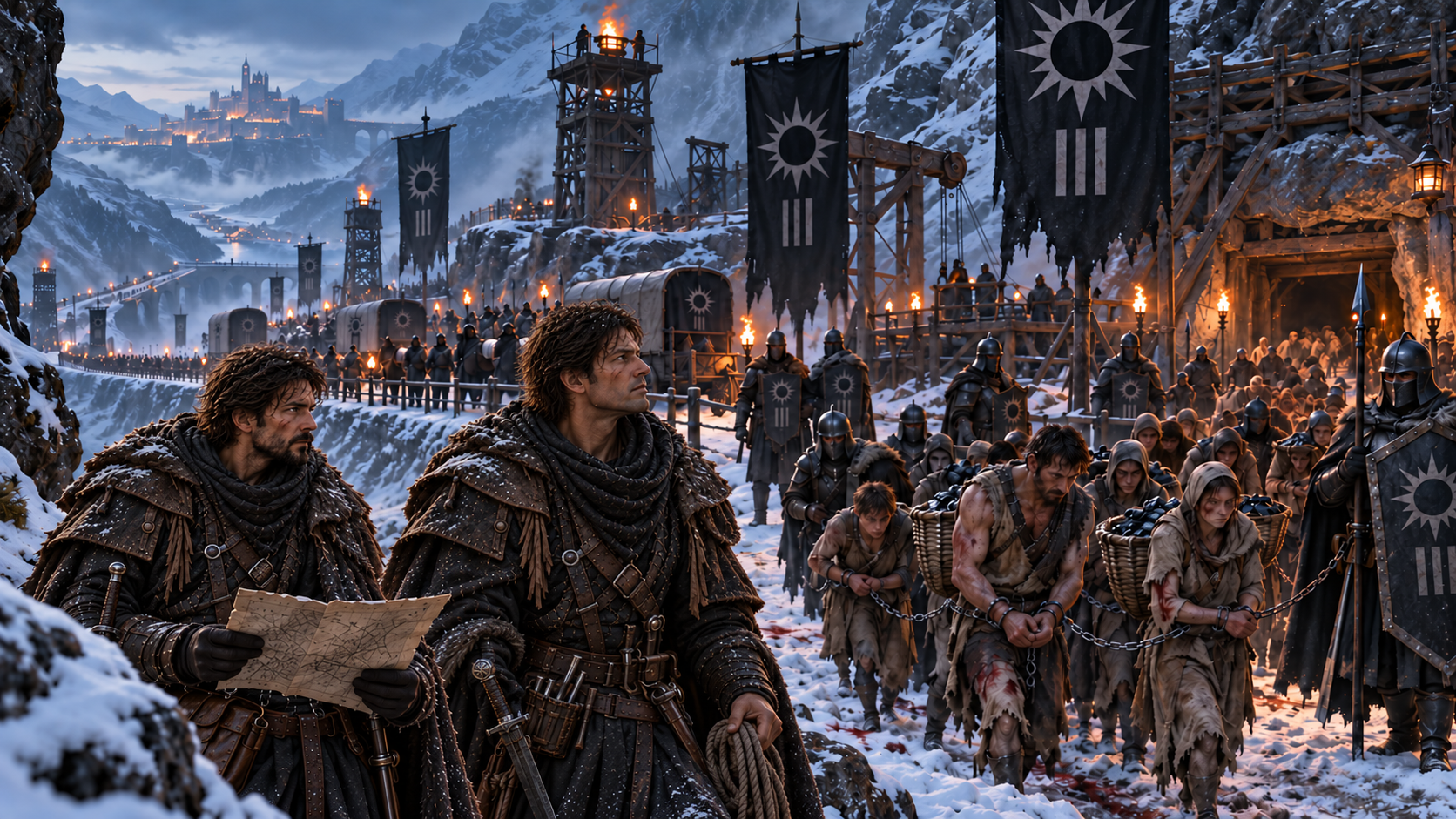
AFTER THE WHITE KING — II The Roads of Phaeton
Winter had stopped killing the NFD.
That did not mean it had grown kinder.
It still lay on the roofs, in the lanes, and along the walls. Snow clung to the joints of the new houses. Ice hung like glass teeth from the gutters. When the first fires were lit each morning, smoke crept up between the buildings and vanished into a sky that had seemed the same color for months.
But the town lived.
That was the difference.
Where charred beams had jutted from the snow after the White King's attack, walls stood again.
Where wounded had lain, children ran.
Where Ket had once had to cut ration lists, merchants now stood with sacks of grain.
Nothing was good yet.
But much was better.
And for a town that had buried sixty-seven of its people, that was almost a miracle.
Argento did not write that sentence down.
He only thought it.
He sat by the window of a small room that had once been a storeroom and was now so full of paper, maps, wooden tablets, and rolled parchments that Darth claimed Argento would one day be buried beneath his own history.
Argento had replied that at least it would be a fitting death for a chronicler.
Darth had said:
“No. Fitting would be getting killed by an invoice.”
Ever since, an invoice for three barrels of beer had lain on Argento's desk.
Darth had placed it there deliberately.
Argento had filed it under:
Darth — unnecessary documents.
That morning, however, something else occupied him.
A map lay before him.
Not a map of the NFD.
A larger one.
Trade routes.
Settlements.
Mountain passes.
Old mines.
Frozen rivers.
Roads that existed only in winter.
Others that vanished precisely in winter.
In recent weeks Argento had spoken to every merchant who came through the gates.
Some had told stories.
Others rumors.
Some had lied.
Argento had learned that lies could still be useful.
If three people told the same lie, you had to find out who had taught it to them.
Seven black marks stood on the map.
All west or southwest of the NFD.
Argento was adding an eighth.
The door opened.
Ket entered.
She stopped.
Looked at the desk.
At the maps.
Then at Argento.
“Did you sleep?”
“Yes.”
Ket looked at the cup beside him.
The water inside had frozen.
“When?”
Argento was silent.
Ket pulled up a chair.
She sat across from him.
“What happened?”
Argento turned the map.
Ket studied it.
“The black dots?”
“Merchants who never arrived.”
“Robbed?”
“Perhaps.”
“Bears?”
“No.”
The word came quickly.
Too quickly for a guess.
Ket noticed.
“Why not?”
Argento pointed to the marks.
“Bears don't take wagons.”
Ket looked at him.
Argento ran a finger across the map.
“Here. A merchant from Frosthavn. Wagon gone. Horses gone. Three escorts gone.”
His finger moved.
“Here. Two ore shipments.”
Farther on.
“A caravan with tools.”
Farther.
“Food.”
Ket bent over the map.
“Bandits.”
“That's what I thought at first.”
“And now?”
Argento picked up a small scrap of parchment.
Only one name was written on it.
VARK
Ket read it.
Her expression scarcely changed.
But Argento had known her long enough.
“You know the name.”
“I've heard it.”
“Where?”
“Years ago.”
Ket leaned back.
“Soldiers talk. So do merchants. Sometimes about the same men.”
Argento waited.
“General Vark,” Ket said at last.
“General of whom?”
Ket looked at the map again.
“Phaeton.”
Outside, a hammer struck wood.
A child laughed.
Someone called for a sack of flour.
Ordinary life in the NFD went on.
The room fell quiet.
“What is Phaeton?” Argento asked.
Ket waited a few seconds before answering.
“An army.”
Darth initially called it a business problem.
That surprised no one.
“If merchants disappear,” he said, “fewer merchants arrive.”
Nikki looked at him.
“Impressive.”
“Thank you.”
“That wasn't praise.”
“I'll take what I can get.”
They stood in the new assembly hall.
The wood still smelled fresh.
The beams were wider than before. So were the doors.
Nikki had insisted.
After the White King's attack, she had spent weeks walking through ruined streets and noticing things no one had considered when the town was first built.
Paths too narrow.
Buildings too close together.
Fire able to leap from roof to roof.
Wounded people who could not be moved quickly enough.
Wagons blocking one another.
She had acted on what she saw.
The new NFD would not simply be rebuilt.
It would be better.
Her new town plan hung on one wall.
Argento's map on the other.
Ket stood between them.
Darth studied the black dots.
“How many?”
“Eight confirmed transports,” Argento said.
“Confirmed missing?”
“Confirmed not to have arrived.”
“That's not the same thing.”
“That's why I said it that way.”
Darth nodded.
“Good.”
Nikki folded her arms.
“And this Vark?”
Ket answered.
“Phaeton officer.”
“That doesn't help me.”
Ket looked at her.
“Phaeton has moved across the tundra for as long as I can remember.”
“A town?”
“No.”
“An empire?”
“No.”
Darth grinned.
“A particularly bad trading company?”
Ket ignored him.
“A legion.”
Now even Darth fell silent.
Ket stepped up to the map.
“They take what they need. Food. Weapons. Ore. Animals. People.”
Nikki frowned.
“People?”
“Labor.”
The word hung in the room.
Argento said:
“Slaves.”
Ket nodded.
“If a settlement is strong enough, they sometimes trade. If it's weak enough, they take.”
Every trace of humor had left Darth's face.
“And if they're evenly matched?”
Ket looked at him.
“Then they make sure it grows weaker.”
She pointed to the trade routes.
“They don't have to attack a town. Not immediately. They cut off roads. Take shipments. Buy off merchants. Threaten others. Let prices rise. Wait.”
Argento studied the black dots.
Suddenly they formed a different picture.
Not isolated raids.
A line.
“Isolation,” he said.
Ket nodded.
“Exactly.”
Nikki looked toward the door.
Construction went on outside.
“Why us?”
“Perhaps it isn't us yet,” Ket said.
Argento looked at the name.
Vark.
“Then we need to find out who it is.”
Darth volunteered.
Ket forbade it.
Darth volunteered again.
Ket forbade it at greater length.
On the third attempt Darth said:
“You can keep me here, of course.”
Ket looked at him.
“Good.”
“But then we'll send someone who knows less about trade.”
“Darth.”
“And less about how merchants lie.”
“Darth.”
“And less about which goods—”
“Darth.”
He fell silent.
Ket waited.
“I'll take Argento.”
“No.”
Argento looked up.
“Why am I in this discussion now?”
“Because you can read maps.”
“Others can too.”
Darth pointed to the eight marks.
“But you found those.”
Ket rubbed her forehead.
Nikki smiled.
“I think you're losing.”
Ket shot her a look.
Nikki raised both hands.
“I'm only saying what I observe.”
In the end, six went.
Darth.
Argento.
Four experienced NFD soldiers.
No banners.
No uniforms.
An ordinary trade wagon.
Furs.
Tools.
Salt.
Two crates of goods whose contents Darth refused to disclose.
Ket personally inspected their equipment.
“You observe.”
“Yes,” Darth said.
“You don't seek a confrontation.”
“Of course not.”
“If you find Phaeton, you withdraw.”
“Immediately.”
Ket looked at Argento.
“Why don't I believe him?”
“He has a trustworthy voice.”
“Thank you,” Darth said.
Argento added:
“Probably on purpose.”
Ket stepped closer to Argento.
For a moment she was not the NFD's leader.
Only Ket.
“Come back.”
Argento nodded.
“That's the plan.”
“Plans rarely work.”
“Then I'll write a better one.”
She looked at him a moment longer.
Then she left.
For three days they found nothing.
On the fourth they found a wagon.
Or what remained of it.
It stood askew in a drift.
No horses.
No cargo.
No bodies.
Darth knelt beside a wheel.
“Not robbed.”
Argento looked around.
“Why?”
“The wheel is intact.”
“That proves nothing.”
“It does.”
Darth pointed to the tracks.
“The wagon was pushed here.”
Argento knelt beside him.
Now he saw it.
Many boots.
Ordered.
No chaotic signs of a fight.
“Soldiers.”
Darth nodded.
One of their companions called out.
“Here!”
They found blood behind a rock.
Not much.
Beside it lay a broken arrow.
Argento picked it up.
Black shaft.
No decoration.
Darth studied it.
“Phaeton?”
“Perhaps.”
“You say perhaps a lot.”
“That's why I'm still alive.”
That evening they found the first sign.
A post.
A piece of black metal attached to it.
Stamped into the metal was a symbol.
A stylized sun.
But not a warm one.
Its rays were straight.
Hard.
Like spears.
One of the soldiers cursed.
“Phaeton.”
Argento copied the sign.
Darth looked west.
Smoke lay on the horizon.
Not the thin smoke from one house.
Several fires.
Many.
“There.”
The settlement was called Kharad.
At least, it had once been called that.
Argento later found the name on a half-burned signpost.
They watched the place from a ridge.
Darth lay beside Argento in the snow.
Neither spoke.
A valley spread beneath them.
Houses.
Workshops.
Warehouses.
A mine.
And soldiers.
Dozens.
Perhaps hundreds.
Black and dark-gray clothing.
Metal armor.
Spears.
Crossbows.
Shields.
Wagons.
Horses.
No improvised gang.
No robbers.
An army.
A great banner stood in the valley's center.
The black sun.
Argento counted watchtowers.
Six.
Darth counted wagons.
Twenty-three.
Then they saw the workers.
A long line of people emerged from the mine.
Men.
Women.
Some adolescents.
All carrying baskets.
Ore.
A man stumbled.
A soldier struck him with a stick.
He fell.
No one helped him.
Not because no one wanted to.
Because the line had to keep moving.
Argento's fingers closed around the edge of his notebook.
Darth whispered:
“Shit.”
A second soldier approached the fallen man.
Pulled him up.
Shoved him back into the line.
Argento did not write.
For the first time in a long time, he did not write.
He only watched.
Later he would remember every detail.
The man.
The stick.
The ore that had fallen from the basket into the snow.
The dark stones against the white.
Darth touched his arm.
“We go.”
Argento nodded.
Then a horn sounded.
Soldiers moved in the valley below.
Not because of them.
A rider came up the road.
Several men accompanied him.
The guards at the gate stepped aside.
The rider wore no helmet.
Even at that distance, they could tell the other men kept their distance from him.
He dismounted.
An officer hurried toward him.
The rider slapped him across the face.
Once.
The man did not fall.
The rider said something.
The officer saluted.
Darth whispered:
“Friendly fellow.”
Argento watched him.
“Vark?”
“No idea.”
Then Argento saw the banner behind the rider.
Beside the black sun, it bore a second sign.
Three vertical strokes.
Ket had described it.
Rank insignia.
General.
Argento wrote one word.
VARK.
They should have left.
That was the plan.
Ket had said so expressly.
Observe.
Confirm.
Return.
Then Darth saw the boy.
Perhaps sixteen.
Perhaps younger.
He ran out of a warehouse.
A sack over his shoulder.
Bread spilled from it.
A guard noticed.
The boy ran.
Two soldiers followed.
Darth's hand was already on his weapon.
Argento caught his wrist.
“No.”
Darth looked at him.
Below, the soldiers caught the boy.
They knocked him down.
“Argento.”
“If we intervene now, we die.”
One soldier kicked the boy.
“Argento.”
“And we help no one.”
Darth's jaw tightened.
Then a woman appeared.
She ran from the workers' line.
“No!”
They heard her cry even up on the ridge.
A soldier struck her back.
The boy lay in the snow.
Vark walked slowly toward him.
He studied the bread.
Then the boy.
He said something.
The boy answered.
Vark nodded.
He picked up the bread.
Gave it to him.
The boy stared at him.
For a moment, nothing happened.
Then Vark pointed toward the mine.
The boy stood.
He went back.
The woman followed.
Darth breathed out.
“What was that?”
Argento knew.
“A lesson.”
“For whom?”
Argento looked at the hundreds of workers.
“Everyone.”
Vark did not have to kill someone.
Not every time.
It was enough for everyone to know he could.
They withdrew at night.
Two hours later they found their horses dead.
Clean cuts.
No tracks.
Darth knelt in the snow.
“We were seen.”
Argento looked back.
The valley lay in the distance.
“When?”
“No idea.”
One of the soldiers whispered:
“Then they know we're here.”
Darth stood.
“No.”
He studied the dead animals.
“They know someone is here.”
Argento looked at him.
“Not much difference.”
“There is.”
Darth picked up his pack.
“As long as they don't know who.”
They went on foot.
In the morning, they heard dogs.
Then the hunt began.
Phaeton was fast.
Disciplined.
No screaming pursuers.
No wild shooting.
They herded them.
Farther and farther north.
Argento noticed first.
“They don't want to catch us.”
Darth panted.
“That's an unusually positive interpretation.”
“They're steering us.”
Darth stopped.
“Where?”
Argento looked at the landscape.
Then he understood.
“Away from our route.”
Phaeton wanted to know where they had come from.
Darth grinned despite everything.
“Then let's disappoint them.”
They ran east.
For two days.
Hardly any sleep.
Once Argento saw three riders on a hill.
They did not attack.
They watched.
By the next morning, they were gone.
When the six finally reached the NFD gates, Ket was already there.
She had been waiting for hours.
Darth raised his hand.
“Good news.”
Ket looked at their torn clothing.
The blood.
The missing horses.
“I'd like the bad news first.”
Darth pointed at Argento.
“He was right.”
Ket briefly closed her eyes.
“And the good?”
“We're alive.”
Ket stepped forward.
She briefly embraced Darth.
Then Argento.
Only for a moment.
Tightly.
After that, she was the leader again.
“Assembly hall. Now.”
Argento told them everything.
Kharad.
The mine.
The workers.
The watchtowers.
The soldiers.
The wagons.
The ore.
Vark.
Ket interrupted only once.
“How many?”
“At least one hundred fifty soldiers visible.”
“So there are more.”
“Probably.”
Nikki stood at the window.
“What are they making with the ore?”
Darth answered:
“What does an army make with ore?”
No one had to say it.
Weapons.
Armor.
Tools.
Nails.
Chains.
War.
Argento placed his map on the table.
“That's not all.”
He drew lines between the missing transports.
Then between Kharad and the trade routes.
“They already control three routes.”
Darth understood immediately.
“And merchants avoid the others.”
Argento nodded.
“Prices in the NFD have risen over the last six weeks.”
Nikki turned.
“Because of Phaeton.”
“In part.”
Ket looked at the map.
“They're isolating the region.”
“Yes.”
“Why?”
Argento replied:
“Because an isolated town eventually accepts anything.”
Darth said softly:
“Even Phaeton's prices.”
Ket added:
“Or Phaeton's protection.”
Silence.
Nikki came to the table.
“Then we make more ourselves.”
Ket looked at her.
“What?”
“Everything.”
“Nikki—”
“If they block tools, we make tools. If they block nails, we forge nails. If they block spare parts, we manufacture spare parts.”
Darth grinned.
“I like that.”
Nikki pointed at him.
“You find new trade routes.”
“I like it less.”
“Argento finds out which other settlements are affected.”
Argento nodded.
They all looked at Ket.
Ket studied the map.
Months earlier her task had been to carry a ruined town through winter.
Now she had to prevent an army from slowly strangling it.
Moidark had spread out his own lists in the meantime.
“The price rises aren't a coincidence,” he said. “Three merchants independently reported the same missing goods. Copper, tool steel, salt, lamp oil. Always on routes where Phaeton appears.”
Deathhead placed a piece of black leather on the table. It bore an incised mark Argento already knew from two other reports.
“Found at an abandoned wagon,” she said. “No battlefield. The people were taken.”
Seef looked at Kharad for a long time.
“They don't only want roads,” he said. “They want to decide who may live along them.”
Ket nodded.
Then she made the decision she most hated.
“We don't attack Kharad.”
Darth opened his mouth.
“No.”
He closed it again.
“One hundred fifty visible soldiers,” Ket said. “Probably many more. Fortified position. Watchtowers. Riders. We'd lose.”
Nikki asked:
“And the people there?”
Ket did not answer at once.
It was the worst question.
Because it had no good answer.
“We don't forget them.”
Argento looked at her.
Ket looked back.
“Write down their names if you can learn them.”
He nodded.
“I will.”
“And everything about Phaeton.”
“Yes.”
Ket looked at Vark's name.
“Especially him.”
Seef remained in the room after the meeting.
“You want to go,” he said.
Ket did not answer.
“So do I.”
She looked at him.
Seef pointed to the numbers. “Leadership doesn't mean taking every battle you feel morally bound to fight.”
Ket clenched her jaw.
“They will die there.”
“Yes.”
“And we do nothing.”
“No,” Seef said. “We do something harder. We make sure we are strong enough next time.”
Ket looked at Kharad again.
“We don't forget them.”
“No,” Seef said. “We don't.”
In the following weeks, the NFD changed again.
Not through a battle.
Through preparation.
Nikki had the workshops expanded.
Old metal parts were collected.
Nails were no longer discarded.
Damaged tools were repaired.
Scrap acquired value.
Darth disappeared for days.
Returned with merchants nobody knew.
Some came from the north.
Others by routes absent from every official map.
Once he brought four wagons of salt.
Ket did not ask how.
Argento did.
Darth answered:
“Trade secret.”
Argento wrote:
Origin unknown. Darth refuses to explain. Probably problematic.
Darth read it later.
Underneath he wrote:
But cheap.
Argento left it there.
Ket reorganized the guards.
Not for bears.
For people.
Observation posts appeared beyond the town.
Riders patrolled the roads.
Merchants were questioned.
Not interrogated.
Questioned.
And slowly Argento's map grew.
New black dots.
New names.
New stories.
One settlement had paid protection money.
Another had been forced to hand over soldiers to Phaeton.
A village was deserted.
Two merchants reported columns of prisoners.
An old man said Phaeton had plundered his home once before, twenty years earlier.
Another said:
“Phaeton isn't coming.”
Argento asked:
“What do you mean?”
The man looked at him.
“Phaeton is already here.”
The letter arrived on a windless morning.
A lone rider approached the NFD.
Black coat.
Black sun.
Archers on the wall aimed at him.
Ket stood at the gate.
Argento beside her.
Darth.
Nikki.
The rider stopped twenty paces away.
“Who leads this town?”
Ket replied:
“I do.”
The man studied her.
Then the walls.
The new buildings.
He did not smile.
“General Vark sends his regards.”
Darth whispered:
“How thoughtful.”
Ket held out a hand.
“The letter.”
The rider tossed a sealed roll into the snow.
Argento picked it up.
Black wax.
The sun.
Ket opened it.
She read.
Then gave the parchment to Argento.
The message was brief.
No threat.
No ultimatum.
No command.
Only an offer.
Phaeton guaranteed safe trade routes.
Protection for NFD merchants.
Access to ore.
Access to southern markets.
In return Phaeton demanded regular tribute.
Food.
Fire crystals.
Metal.
And the right to station Phaeton soldiers inside the town.
Darth read over Argento's shoulder.
“That's protection money.”
Ket said:
“No.”
Everyone looked at her.
“That's surrender dressed as a contract.”
The rider waited.
“General Vark expects an answer.”
Ket took a step forward.
“Then he'll get one.”
Argento looked at her.
Ket spoke loudly enough for the guards on the wall to hear every word.
“The NFD pays no one for the right to be free.”
The rider's expression did not change.
“Is that your answer?”
“Yes.”
He nodded.
Turned his horse.
Then stopped again.
“General Vark said you would say that.”
Ket froze.
The rider looked back over his shoulder.
“He also said he has patience.”
Then he rode away.
That evening Argento stood on the wall.
The NFD's fires shone beneath him.
The town had grown larger.
Stronger.
More alive.
But beyond the walls lay the tundra.
And somewhere out there, Phaeton.
Ket came to stand beside him.
Neither spoke for a while.
“You were afraid,” Argento said.
“Today?”
“Yes.”
Ket looked outward.
“Of course.”
“No one noticed.”
“Then I did my part.”
Argento studied the town.
“The White King was simpler.”
Ket looked at him in surprise.
“A giant white bear that nearly destroyed us?”
“Yes.”
“You have a strange idea of simple.”
Argento smiled faintly.
“We knew what he wanted.”
Ket understood.
The White King had attacked.
He had teeth.
Claws.
Violence.
Phaeton had contracts.
Trade routes.
Ore.
Soldiers.
Patience.
“Vark doesn't want to destroy the town,” Ket said.
“No.”
“He wants us to open the gate ourselves one day.”
Argento nodded.
Below, a child ran across the street.
Two workers carried wood into a workshop.
Loud cursing came from Darth's warehouse.
Nikki shouted something back.
Ket had to smile.
Only briefly.
Then she looked out again.
“Then we'll make him wait a long time.”
Argento took out his notebook.
On a new page he wrote:
PHAETON
Underneath:
General Vark.
Then:
Kharad. Mining region occupied. Population enslaved. Ore production under military control.
He paused.
Under that sentence he wrote:
Phaeton wages war before the first arrow flies.
Ket read the words.
“Keep that.”
“I intend to.”
Something moved in the distance.
One light.
Then a second.
Then a third.
Torches on a faraway ridge.
Ket called the guards at once.
The bell rang.
Soldiers ran to the walls.
Argento watched the lights.
They drew no closer.
They stayed there.
Three small fires in the darkness.
Observers.
Phaeton.
Darth ran up the stairs, panting.
“Attack?”
Ket shook her head.
“No.”
Nikki followed him.
“Then what?”
Argento looked out.
The three lights kept burning.
They now knew the NFD could see them.
That was why they were there.
“A message,” Argento said.
Darth looked at him.
“Which one?”
Argento closed his notebook.
“That they know where we are.”
No one spoke.
The NFD burned with light beneath them.
A town that had survived a king.
A town that had buried its dead.
A town that had learned to build again.
But this time no monster waited outside.
No beast.
No white shadow in the snow.
People stood out there.
People with roads.
People with mines.
People with chains.
People who had not come to destroy the NFD in one night.
They intended something far more dangerous.
They intended to wait.
Until the NFD needed them.
Ket put both hands on the cold wall.
“Double the watch.”
Darth nodded.
Nikki was already heading for the stairs.
Argento remained a moment longer.
He looked at the three fires.
Then down at the lights of his town.
And for the first time he understood that history did not always begin with a battle.
Sometimes it began with a road that suddenly stayed empty.
A merchant who did not return.
A sack of ore.
A contract.
Or three little fires in the night.
Argento opened the book once more.
Beneath his last sentence he wrote:
The White King wanted to kill us.
Phaeton wants to decide how we live.
Then he shut the book.
The three fires kept burning over the tundra.
And far behind them, General Vark waited.
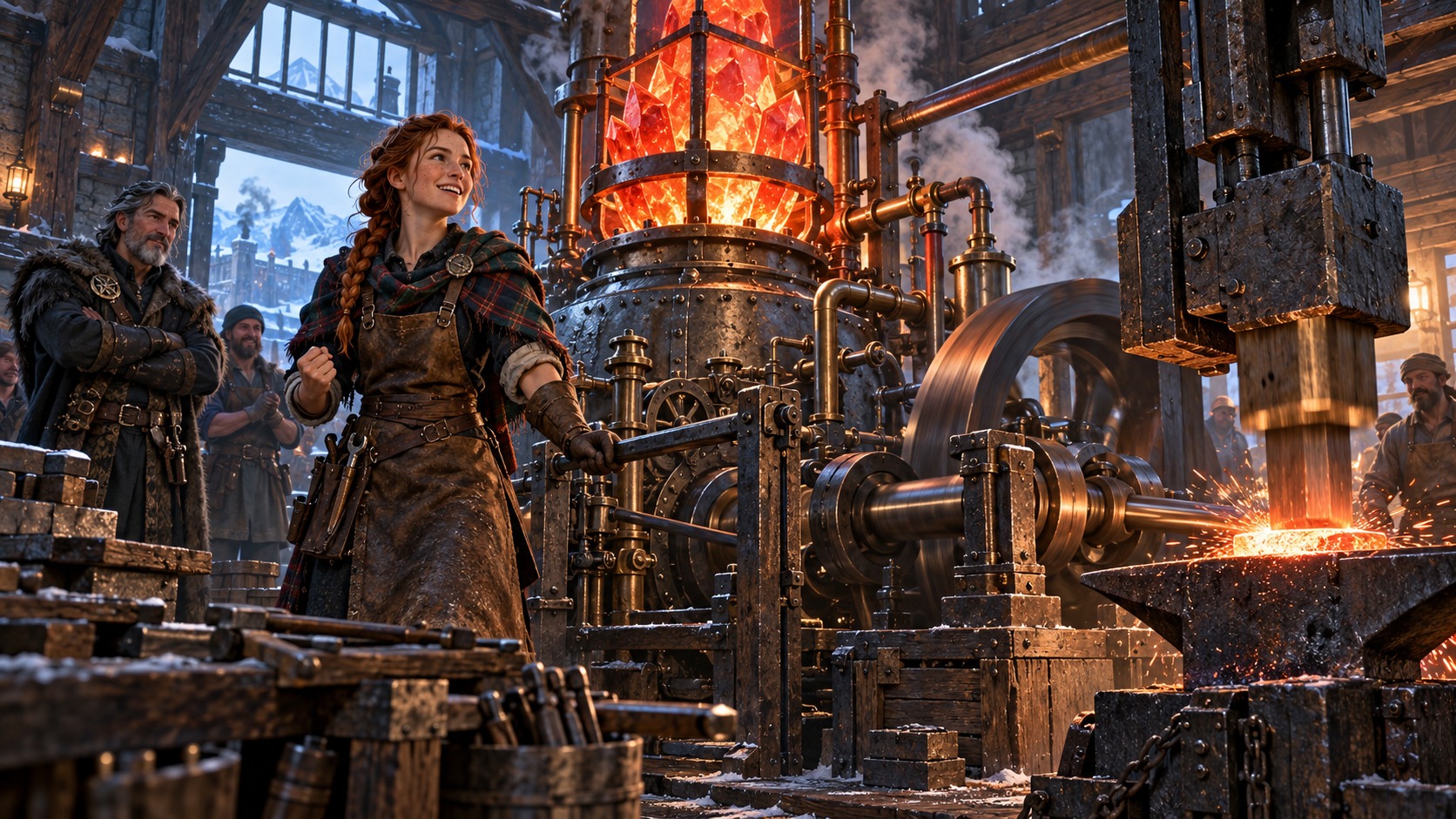
AFTER THE WHITE KING — III THE HEART OF FIRE
The third part of the five-part story arc
I — WHAT CANNOT BE BOUGHT
The hammer fell.
Once.
Twice.
On the third blow, the bolt split.
Nikki cursed.
Quietly.
That made it worse.
She slowly put the hammer on the workbench and looked at the small piece of metal that had jumped across the workshop floor.
Three hours of work.
Gone.
“Again,” she muttered.
Someone cleared his throat behind her.
Nikki closed her eyes.
“If you're Darth and you're about to offer me clever advice, I'll kill you with this hammer.”
“Then I'm lucky.”
Argento stood in the doorway.
He carried several books under one arm and a rolled map under the other.
Nikki looked at him.
“Books can kill you too.”
“At least that would be thematically appropriate.”
She had to grin.
Briefly.
Then she looked back at the broken bolt.
Argento came closer.
The workshop looked as though a storm had decided to become an engineer.
Metal plates lay on tables. Gears were stacked in wooden crates. Copper wire hung from beams. Small fire crystals rested in padded containers on a shelf. Drawings lay between them.
Dozens.
Perhaps hundreds.
Pumps. Furnaces. Valves. Pipes. Gearboxes. Tools.
And the same design, again and again.
A large circle.
Surrounded by pipes.
A crystal at its center.
Argento put down the books.
“How long did you sleep?”
“Enough.”
“That's not a length of time.”
“Then don't ask.”
He said no more.
That was one of the things Nikki appreciated about him.
Argento could be silent without his silence making a demand.
She picked up the bolt.
“The metal is bad.”
“From Darth's shipment?”
Nikki nodded.
“It's not his fault.”
By now she had to add that every time.
Since Phaeton had begun systematically pressuring the trade routes, every delivery had become a gamble.
Iron arrived late. Copper became unaffordable. Tools vanished on the way. Merchants suddenly demanded twice the price. Some never arrived at all.
Others spoke of roadblocks.
Inspections.
Men in heavy armor.
General Vark.
And places where Phaeton now decided who was allowed to sell and who was not.
Kharad had been only the clearest example.
Not the only one.
Nikki held up the bolt.
“Too much slag.”
Argento studied it.
“Can you improve it?”
“You can improve almost anything.”
“That sounds optimistic.”
“It wasn't an optimistic statement.”
She threw the piece of metal into a crate.
Many other failed attempts already lay there.
“You just need the right material, the right tools, enough time, and someone who doesn't ask every five minutes when you'll be finished.”
Argento glanced toward the door.
“Ket?”
“Ket.”
“Darth?”
“Darth.”
“Seef?”
“Seef.”
“Half the town?”
Nikki looked at him.
“The entire town.”
Outside came a metallic crash.
Then a man's voice.
“I DIDN'T DO ANYTHING!”
Nikki and Argento looked toward the door together.
Darth.
Nikki sighed.
“Of course.”
II — A TOWN GROWS HUNGRY
The war against the White King had nearly destroyed the NFD.
Afterward, Phaeton showed them that you did not need to attack a town to wound it.
You only had to ensure that nothing reached it.
No iron.
No salt.
No tools.
No spare parts.
No medicines.
No good nails.
No lamp oil.
No leather.
No wagon axles.
No decent saw blades.
Darth did what Darth always did.
He found ways.
Detours. Middlemen. Barter. Old contacts. New contacts. Contacts whose very existence Ket later wanted him to explain.
But even Darth could not conjure goods that were no longer sold anywhere.
The NFD had to learn to make things itself.
And that was the start of Nikki's war.
Not with a sword.
Not with a bear.
Not with a general.
With nails.
It really had been the nails.
The NFD smithy could make them.
Of course.
But not enough.
Not quickly enough.
Not consistently enough.
Thousands had been needed during the reconstruction after the attack.
For houses.
Roofs.
Gates.
Wagons.
Workshops.
Warehouses.
Ket had had to set priorities.
A roof got nails.
A piece of furniture perhaps not.
A military wagon got new fittings.
A farmer's cart was repaired as long as it could be.
One morning Nikki had stood before a crate containing thirty-seven usable large nails.
She counted them.
Twice.
Then she decided she never wanted to count nails again.
That had been the beginning.
III — NIKKI'S PLAN
Before Nikki presented her plan, Chief Seef already had three complaints on his desk.
Too expensive. Too risky. Too many workshops at once.
He set the letters aside.
“Explain it to them,” he told Nikki. “Not me.”
“You're the Chief.”
“And you're the one who must keep a blocked trade route from choking us again.”
Moidark stood by the wall and raised a list. “I can get parts.”
Nikki shook her head. “That's the point. You shouldn't have to.”
Moidark smiled. “I find that commercially insulting.”
“You'll survive.”
Seef leaned back. “Then build it.”
That ended the political discussion.
For Nikki, the technical one began.
The meeting took place in a former warehouse.
Ket stood at the head of a long table.
Argento sat beside her with writing materials.
Darth had turned a chair backward and sat on it as if the whole meeting were a personal insult.
Seef leaned against the wall.
Several smiths, carpenters, and craftspeople had come.
And Nikki stood before a large wooden board.
Her drawing was on it.
Darth raised his hand.
Nikki ignored him.
Darth raised it higher.
“No.”
“I haven't even asked yet.”
“That's why.”
Ket hid a smile.
Nikki pointed to the drawing.
“We're building a central power plant.”
Silence.
Darth's hand fell.
Even he listened now.
“Not just a bigger furnace,” Nikki went on. “A system. Fire-crystal core. Heat exchanger. Pressure system. Mechanical power transmission.”
She pointed to different areas of the drawing.
“Crystal energy heats a sealed boiler. Pressure drives pistons. The pistons turn a main shaft. From there we distribute the power.”
One smith frowned.
“To where?”
Nikki smiled.
Now came the part she had been waiting for.
“Everywhere.”
She unrolled a second drawing.
A mill.
A saw.
A forge hammer.
A pump.
A lathe.
“We're wasting muscle power on jobs machines can do.”
Ket studied the drawings.
“How much could we produce?”
“If it works?”
“If.”
Nikki thought briefly.
“For simple metal parts, perhaps five times as much. For some woodwork, even more. Pumps could run continuously. Mills too.”
She pointed to another plan.
“And later we could build smaller systems.”
Argento looked up from his notes.
“You don't want to build a machine.”
Nikki looked at him.
He understood.
“No.”
She rested a hand on the drawing.
“I want to change how we make things.”
Now the room was utterly silent.
Ket studied the plan for a long time.
Then Nikki.
“What do you need?”
Nikki produced a sheet of paper.
Darth groaned.
“Why do I feel I'm not going to like this part?”
Nikki handed him the sheet.
He read it.
His face changed.
“Nikki.”
“Yes?”
“It says copper.”
“Correct.”
“A lot of copper.”
“Also correct.”
“Do you know what copper costs right now?”
“That's why you're here.”
Darth looked at Ket.
“She has turned evil.”
Ket nodded.
“I know.”
IV — THE HEART
Three weeks later the first large fire crystal lay on Nikki's workbench.
It was larger than her fist.
Reddish-gold light moved deep within it.
Not like fire.
More like something remembering that it had once been fire.
Nikki had seen many fire crystals.
Worked with them.
Taken them apart.
Installed them.
Measured them.
Sometimes cursed them.
But this one was different.
Purer.
Stronger.
And expensive.
Very expensive.
Darth stood beside her.
“Just so we're clear.”
“No.”
“I only wanted—”
“No.”
“You don't even know—”
“You want to tell me what it cost.”
Darth was silent.
“And I don't want to know.”
“Very sensible.”
Nikki carefully picked up the crystal with padded tongs.
“Where did you get it?”
“I thought you didn't want to know anything.”
She looked at him.
Darth grinned.
“From someone who knows someone.”
“Darth.”
“It's clean.”
“Darth.”
“Almost clean.”
“DARTH.”
He raised both hands.
“No Phaeton.”
That was enough for now.
Nikki placed the crystal in its mount.
Metal clamps closed around it.
She tightened the first screw.
Then the second.
Then the third.
The red light reflected in her eyes.
“There you are.”
Darth studied the construction.
“Does it have a name?”
“No.”
“Every good machine needs a name.”
“No.”
“The Great Darth-O-Matic.”
“Out.”
“Nikki's Nail Machine.”
“Out.”
“Fire Fart One.”
Nikki threw a rag at him.
Darth vanished through the door laughing.
Nikki remained alone.
She looked at the crystal.
The machine's heart.
She placed her fingertips on the mount's cold metal.
“You and me,” she said softly.
“Now we'll show them we don't need them.”
V — THE FIRST BLOW
The machine ran.
Not well.
But it ran.
On the first attempt, a seal burst.
On the second, a piston jammed.
On the third, a shaft broke.
On the fourth, a table caught fire.
On the fifth, Darth lost part of his left eyebrow.
He later claimed that had been intentional.
On the sixth, the hammer moved.
Only a few centimeters.
Then it stopped.
Nikki cried out with joy.
On the seventh attempt, it rose fully.
And fell.
BOOM.
The entire workshop shook.
Dust sifted down from the beams.
Darth ducked.
Ket instinctively reached for her sword.
Argento dropped his pen.
Nikki stood in the middle of the room.
And laughed.
BOOM.
The hammer rose.
BOOM.
Again.
BOOM.
Again.
The smith placed glowing iron beneath it.
BOOM.
The metal flattened.
BOOM.
Once more.
BOOM.
Nikki turned a valve.
The hammer slowed.
Then stopped.
Nobody spoke.
Nikki turned around.
Twenty people stared at her.
“What?”
The smith looked at the worked iron.
Then at his old hand hammer.
Then back at the machine.
“Holy shit.”
Darth began to clap.
Argento followed.
Then Ket.
Then everyone else.
Nikki stood there.
Dirty.
Tired.
With oil on her face.
And suddenly she did not know what to do with her hands.
She had prepared no speech.
So she said:
“That was only the beginning.”
VI — THE NEW WORKSHOP
The beginning grew larger.
Much larger.
A second shaft was connected.
Then a third.
A saw followed.
Then a simple lathe.
Then a pump.
People came just to watch.
Children pressed their noses against the windows.
Craftspeople argued over who would get machine time next.
Ket eventually had to establish a schedule.
Argento kept lists.
Darth began talking about production contracts.
Nikki banned the phrase “production contract” from her workshop.
Darth switched to “commercial friendship agreement.”
Nikki banned that too.
But the change was impossible to miss.
For the first time in months, stocks of certain spare parts grew.
New nails filled crates.
Uniform.
Straight.
Hundreds of them.
One day Nikki picked one up.
She studied it for a long time.
Then tossed it back.
She would never again have to count thirty-seven nails.
So she thought.
VII — THE PRICE OF PROGRESS
The first warning signs were small.
A seal lasted only half as long as expected.
A pipe vibrated.
The crystal core grew hotter.
Nikki adjusted the cooling.
It helped.
For two days.
Then the pressure rose again.
She fitted another valve.
It helped.
For a week.
Then the main shaft began to shake under heavy load.
“Shut it down,” one smith said.
Nikki shook her head.
“We'll reduce output.”
“The thing is running too hot.”
“I know.”
“Then we shut it down.”
Nikki looked across the hall.
At the workers.
At the orders.
At the crates.
At the materials they could finally make again.
Outside, carpenters waited for fittings.
Ket needed parts for the gates.
The farmers needed pump parts.
Darth had promised a merchant two hundred nails.
The NFD needed this machine.
At least that was what Nikki told herself.
“Half power,” she decided.
The smith looked at her.
“Nikki.”
“Half power.”
He did not argue again.
That evening Nikki sat alone before the crystal core.
Light pulsed inside it.
Slowly.
Red.
Gold.
Red.
Gold.
Almost like a heartbeat.
Nikki put her hand against the casing.
Too hot.
Far too hot.
“What are you doing?”
Argento stood behind her.
She started.
“Damn it.”
“Sorry.”
“You walk too quietly.”
“I hear that a lot.”
He sat beside her.
Nikki stared at the core.
“I can't get rid of the heat.”
Argento said nothing.
“The crystal is releasing more energy than my calculations predicted.”
“Then your calculations are wrong.”
Nikki glared at him.
“Thank you.”
“Or our information about fire crystals is incomplete.”
She liked that better.
Argento took out a small notebook.
“I've searched old records.”
Nikki raised an eyebrow.
“Which old records?”
“Very old ones.”
“That's not an answer.”
“That's what I always tell Ket.”
He opened a page.
“There are accounts of crystals whose output did not remain steady under sustained load.”
Nikki took the book from him.
“Why didn't you tell me sooner?”
“Because yesterday I didn't yet know what to look for.”
She read.
And grew quiet.
The old accounts were fragmentary. Observations, not explanations. Warnings, not established theory.
Nikki looked at the core.
“We're treating something as predictable that we don't yet fully understand.”
Argento nodded.
“That would be my cautious wording.”
Nikki stood.
“Then tomorrow we shut it down.”
This time she did not argue.
VIII — THE FAILURE
Deathhead had a simple view of safety assurances.
She did not believe them.
That was why one evening she stood in Nikki's new facility and asked: “What should I break?”
Mara Eisengrund looked horrified.
Nikki did not.
“Anything you can.”
Deathhead raised an eyebrow. “Finally, a sensible engineer.”
In the following hour, she cut a pipe, blocked a valve, removed a safety device, and simulated an attack on the main supply.
The old system would have failed.
The new one lost two workshops and kept the rest of the town running.
Nikki remained dissatisfied.
“Two is too many.”
Deathhead looked at her. “I just tried to destroy your work.”
“And you weren't good enough.”
Deathhead smiled for the first time that evening. “Not yet.”
Nikki intended to shut the facility down in a controlled way the next morning.
She was too late.
Half the town heard the first blast.
Argento was in the archive.
Ket on the training ground.
Darth in the market.
All three looked toward the workshop district at once.
A column of black smoke rose.
Then came the second blast.
Ket ran.
Darth dropped a bag of coins.
Argento left everything behind.
Someone screamed inside the workshop.
A pipe had burst.
Steam filled the room.
People stumbled outside.
“OUT!”
Nikki stood at the main valve.
“EVERYONE OUT!”
A worker lay on the floor.
Two men pulled him toward the door.
The crystal core now shone fiercely.
Nikki looked at the pressure gauge.
The needle was at its limit.
“No.”
She wrenched open the first valve.
Nothing.
The second.
Nothing.
The main line was blocked.
The machine accelerated.
BOOM.
The hammer struck.
BOOM.
Faster.
BOOM.
BOOM.
BOOM.
The shaft screamed.
Metal began to glow.
Nikki reached for the emergency lever.
It would not move.
“Come on.”
She pulled.
Nothing.
“COME ON!”
A gear shattered.
A piece of metal flew past her head and struck a beam.
Then Ket stood in the doorway.
“NIKKI!”
“GET OUT!”
“COME!”
“I CAN'T!”
Ket started inside.
Darth caught her from behind.
“No!”
“LET ME GO!”
“EVERYTHING IN THERE IS COMING APART!”
Nikki could barely hear them.
She saw only the core.
If the boiler burst, it would destroy more than the workshop.
The neighboring houses stood too close.
Too many people.
Her machine.
Her responsibility.
Her mistake.
She reached for a heavy wrench.
And went to the crystal core.
IX — NIKKI
Argento would later write that nobody knew exactly what Nikki had done in those minutes.
Nikki herself would claim she had merely acted logically.
Darth would claim she had been completely insane.
Ket would not laugh about it at all.
Nikki opened the first maintenance hatch.
Heat struck her.
She screamed.
Not from fear.
From pain.
Her gloves began to smoke.
She dropped the wrench.
Picked it up again.
Three locking rings stood between her and the crystal's mount.
The first was jammed.
Nikki struck it.
Once.
Twice.
Three times.
It came loose.
The machine screamed.
The second ring.
She turned it.
Nothing.
She threw her whole weight against it.
The metal moved.
Slowly.
Millimeters.
Then the ring sprang open.
One more.
The last.
A pipe exploded behind her.
Nikki was thrown to the floor.
For a moment she heard nothing.
Only a high whine.
She lay on her back.
The beams moved above her.
Or perhaps her head was moving.
She did not know.
Then she saw the crystal.
Within reach.
Much too hot.
She thought of thirty-seven nails.
Of people waiting for spare parts.
Of houses.
Of pumps.
Of the town.
And suddenly she understood her real mistake.
Not the technical one.
The technical error was complicated.
The other was simple.
She had believed the NFD needed the machine.
She had been wrong.
People had to build it.
People had to maintain it.
People had to decide when enough was enough.
A machine was not progress.
It was only a tool.
Nikki stood.
The last locking ring glowed.
She took the wrench.
“You don't belong above this town,” she said.
Then she turned it.
X — STILL
The main shaft stopped.
Not slowly.
Immediately.
The sound was terrible.
Gears broke.
Belts snapped.
The great hammer stopped halfway through a stroke.
The crystal broke free from its mount.
Nikki did not catch it.
She was not completely mad.
It fell into the prepared emergency container.
Nikki kicked the catch.
The heavy metal lid slammed shut.
Darkness.
Silence.
Then part of the ceiling collapsed.
Ket reached Nikki seconds later.
She found her among steam, metal, and debris.
Alive.
Burned.
Bleeding.
Angry.
Nikki looked at her.
“Don't touch anything.”
Ket stopped.
“What?”
“It's all still hot.”
Ket stared at her.
Then a short, incredulous laugh escaped her.
Not because it was funny.
Because Nikki was alive.
Darth came up behind her.
He looked at the wrecked workshop.
Then Nikki.
Then the workshop again.
“So.”
Nikki raised a warning finger.
“Don't.”
Darth closed his mouth.
Argento appeared last.
He said nothing at all.
He looked at Nikki.
She looked back.
Then he looked at the ruined machine.
“Thirty-seven,” Nikki said.
Argento frowned.
“What?”
“Nothing.”
XI — WHAT REMAINS
The facility was destroyed.
Almost completely.
Three workers had been seriously injured.
Seven more lightly.
No one had died.
That was luck.
Nikki called it failure.
Ket disagreed.
Nikki disagreed with Ket.
They argued for two days.
On the third day Ket brought food to Nikki's workshop.
On the fourth they spoke again.
On the fifth Nikki began a new drawing.
Argento found it.
“No.”
Nikki looked up.
“No what?”
“You're building that thing again.”
“No.”
Argento studied the plan in surprise.
No central machine.
No enormous main shaft.
Instead, several small systems.
Separate crystal chambers.
Independent safety valves.
Mechanical emergency shutoffs.
Cooling circuits.
Redundant pipes.
“Smaller,” Argento said.
“Safer.”
“Less power.”
“Per machine.”
He understood.
“More machines.”
Nikki nodded.
“If one fails, the whole town doesn't stop.”
“And if one explodes?”
“Then I've made even more mistakes than the first time.”
Argento smiled faintly.
Nikki grew serious again.
“And nobody builds one without knowing how to shut it down.”
That was the first rule.
Many more would follow.
XII — THE CITY OF WORKSHOPS
It took months.
The first small system drove only a pump.
The second, a saw.
The third, a forge hammer.
None was impressive.
None shook the ground.
None made twenty people stare in amazement at once.
But they worked.
And when one failed, Nikki repaired it.
Then others learned to repair them.
Ket made safety rules mandatory.
Every system got a mechanical emergency shutoff.
Every operator had to know where it was.
No one was allowed to service a crystal core alone.
Argento copied Nikki's instructions neatly, added observations, and made duplicates.
Darth obtained material and discovered very quickly that the NFD no longer merely needed to buy less.
It could sell more too.
Nikki began teaching.
First three apprentices.
Then seven.
Then twelve.
She claimed to hate it.
No one believed her.
And eventually something happened that Nikki had not planned.
Others began modifying her machines.
A smith made a better lever.
A miller changed the gearing of his drive.
A carpenter built a small mechanical drill.
And Mara Eisengrund, a young mechanic of the Eisengrund family, stood before Nikki one morning holding a component in both hands.
“I think I've simplified the valve control.”
Nikki took it.
Turned it.
Checked the joint.
Checked it again.
Mara grew increasingly pale.
“Is it wrong?”
Nikki looked up.
“No.”
“Oh.”
“It's better.”
Mara said nothing.
Nikki handed the part back.
“Build another.”
Mara grinned.
“And then you'll show me exactly why it's better.”
The grin faded a little.
“Today?”
“Of course today.”
Nikki walked on.
Behind her, she heard Mara curse quietly.
Nikki smiled.
And realized this might be the greatest achievement of her life.
Not the machine.
Not the crystal.
Not the hammer.
But that someone else had taken her idea and carried it farther.
XIII — ARGENTO'S CHRONICLE
Argento later wrote:
Phaeton wanted to convince us we could not endure without their roads, their merchants, and their permission.
They were wrong.
Nikki answered their blockade not with a battle.
She answered it with a workshop.
Yet Nikki too had been wrong.
At first she believed independence meant building one machine that could do everything.
In the end, she created something greater.
People who knew how to build machines.
People who knew how to improve them.
People who passed on their knowledge.
Phaeton could confiscate a shipment.
Phaeton could block a trade route.
Phaeton could steal ore.
But knowledge was harder to besiege.
Argento added a date beneath this entry.
Then paused.
Thought.
And wrote one more sentence.
On that day the NFD began to cease being merely a town of survivors.
It became a town of builders.
XIV — THE NAIL
Many weeks later Ket entered Nikki's workshop.
Nikki sat at her table.
Drawings for a new water pump lay before her.
“You should sleep.”
“You've coordinated this.”
“Who?”
“You and Argento.”
Ket sat.
A small wooden box stood on the table.
Ket opened it.
Nails.
Hundreds.
She took one out.
“Darth says we could sell these by now.”
Nikki pulled a face.
“Of course Darth says that.”
“He says he already has buyers.”
“Of course he does.”
Ket rolled the nail between her fingers.
“Remember when they were scarce?”
Nikki did not answer immediately.
Then she reached into the box.
She counted.
One.
Two.
Three.
Ket watched her.
Four.
Five.
Nikki stopped.
She smiled.
Then threw the nail back.
“No.”
Ket raised an eyebrow.
“No?”
“I'm not counting nails anymore.”
Outside a mechanical hammer began to strike.
Slowly.
Evenly.
BOOM.
Pause.
BOOM.
Pause.
BOOM.
Nikki listened.
This time the walls did not shake.
She stood and went to the window.
Smoke rose above the NFD rooftops from several small workshops.
No enormous machine.
No single heart.
Many.
All over the town.
Nikki folded her arms.
Ket stood beside her.
“Satisfied?”
Nikki considered it.
“No.”
Ket smiled.
“Good.”
Nikki looked at her.
“Why good?”
Ket gestured toward the town.
“Because I'm beginning to understand how you work.”
Nikki laughed.
Then looked outside again.
The trade routes lay far beyond the walls.
Phaeton still threatened them.
The legion still held Kharad.
General Vark was still out there.
None of that had vanished.
And the people of Kharad had not been forgotten.
But something had changed.
Phaeton had tried to starve the NFD.
Instead, it had given Nikki a reason to build something.
Not a wonder weapon.
Not a machine that solved every problem.
A foundation.
Workshops.
Knowledge.
People who passed that knowledge on.
Nikki took one of the new nails from the box.
Small.
Straight.
Unremarkable.
She placed it on the windowsill.
And left it there.
Not as a tool.
As a reminder.
Of thirty-seven nails.
Of a machine that had nearly killed people.
Of a mistake.
And of what had grown from it.
The hammer struck again.
BOOM.
This time it did not sound like war.
It sounded like work.
Like a town that was alive.
Like the future.
END — STORY III
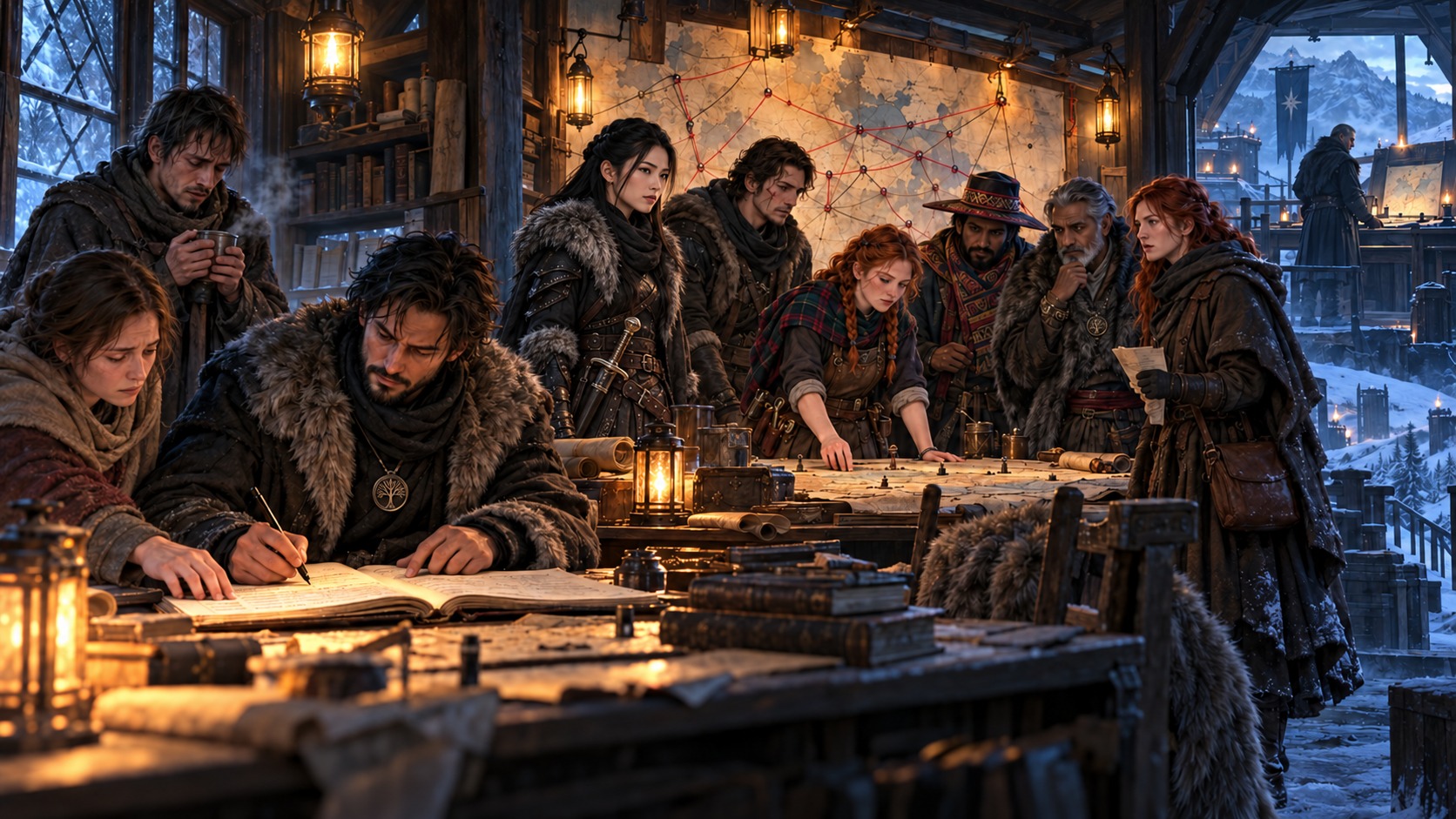
AFTER THE WHITE KING — IV THE NAMES OF KHARAD
The fourth part of the five-part story arc
I — THE FIRST NAME
The man's name was Jarek.
That was the first thing Argento wrote down.
Not Phaeton. Not Kharad. Not mine. Not escape.
Jarek.
He sat in the back room of the archive holding a steaming cup in both hands. His fingers trembled.
“Once more,” Argento said gently. “Only if you can.”
Jarek spoke of Kharad: the mines, the forced laborers, hunger, beatings, missing people, and children who had learned to stay quiet when Phaeton soldiers passed.
Argento carefully separated observation, estimate, and rumor.
“If you don't know something, we write down that you don't know.”
“You don't believe me?”
“I do. But belief and knowledge aren't the same thing.”
Then Argento asked, “Who else is there?”
“Many.”
“Names.”
And Jarek began.
II — THE BOOK
On the first evening, it held forty-seven names. Soon there were one hundred twenty-six.
Argento introduced marks: seen alive, death confirmed, fate unknown, taken by Phaeton. He added dates and sources.
Ket studied the pages.
“You're making a list.”
“No. I'm making a memory.”
“For whom?”
“For us. For them. And perhaps one day for someone who wants to know who was responsible.”
“How many are missing?”
Argento looked at the blank pages.
“I don't know.”
III — THE MAPS
The refugees brought more than names. They brought routes.
Argento marked trade roads, side paths, mine roads, bridges, checkpoints, and camps.
When Darth entered the archive, an entire wall was covered in maps, threads, notes, and numbers.
“What the hell is that?”
“A map.”
“It looks like a madman ate an atlas and spat it back out.”
Argento pointed to Darth's merchants' reports.
Copper was growing more expensive in several places. Other goods were not.
“Phaeton,” Darth said.
“Perhaps.”
“What does it mean?”
“I'm trying to find out.”
IV — INFORMATION
Moidark entered the archive and stopped before the wall of maps.
“You stole my merchants' reports.”
“Archived them.”
“Without asking.”
“Strategically archived them.”
Moidark studied the red marks. Then he picked up a charcoal pencil.
“Something is missing here.”
He added delivery times, failed caravans, and unusual price jumps.
Argento watched him.
“You read prices the way I read testimony.”
“Prices are worse liars.”
From that day on, Moidark's trade lists lay beside Argento's witness statements.
The chronicle acquired a second language: money, roads, and missing goods.
Nikki added the missing materials: copper, bearing bushings, tool steel, thin sheet metal.
Argento compared her figures with Darth's prices and the refugees' reports.
“If they merely wanted to weaken us, they would block as many goods as possible.”
Nikki stepped closer. “But they take particular ones.”
“Or buy them up.”
Darth asked, “For what?”
Argento picked up a red pencil.
“That's the wrong question. The right one is: where are they going?”
V — THE DOTS
For six days, Argento compared maps, reports, prices, delivery times, and witness accounts.
On the seventh morning, Ket found him on the floor among papers.
He laid several maps over one another and marked points.
Kharad. Supply routes. Missing merchants. Troop movements. Material purchases.
His finger came to rest on Rabenfels.
A free settlement on important trade routes near several ore deposits.
“You think they'll attack Rabenfels.”
“No,” Argento said. “I think they're doing to Rabenfels what they did to Kharad.”
VI — THE COUNCIL
At the council, Argento explained only what was known, likely, or mere conjecture.
An officer said, “That isn't enough to send soldiers.”
“No. But it's enough to warn Rabenfels.”
Ket asked, “How long?”
“Perhaps two weeks.”
“And if you're wrong?”
“Then we've sent them a messenger.”
Ket decided: “Then we send a messenger.”
Argento shook his head.
“We send more.”
VII — THREE LETTERS
Seef read Argento's draft twice.
“You're asking three realms for help.”
“I'm giving three realms a reason to help themselves.”
Seef looked at Ket.
“I'd have called that diplomacy once.”
“And today?” Ket asked.
“Argento with too much paper.”
Argento ignored him.
Seef did not sign the letters in Ket's place.
He put his name beneath hers.
Not above.
Beside it.
They both noticed that too.
Argento wrote personally to AIO, GBR, and N3N.
He reported on Kharad, the mines, prisoners, trade blockades, Phaeton's movements, and the danger to Rabenfels.
He asked not only for soldiers but also for food, healers, metal, horses, merchants' reports, and observations.
Above all, he asked the three realms to stop treating information in isolation.
If Phaeton appeared at one border, the next realm should know.
Ket read the letter.
“You're telling them rather plainly that this is their problem too.”
“Because it is.”
“You've changed.”
Argento looked at the maps.
“I've learned that writing things down alone sometimes isn't enough.”
VIII — THE MESSENGERS
At dawn, three messengers rode out of the NFD.
One to AIO.
One to GBR.
One to N3N.
Darth gave them coins. Nikki checked tools and equipment. Argento gave each copies of the most important information and an abbreviated warning in case the actual letter failed to reach its destination.
“Do you think they'll help?” Ket asked.
“I don't know.”
“But?”
Argento watched the riders go.
“Now they know.”
IX — THE WOMAN
A woman named Elin came to the archive.
Her son Tomas Verren had been taken to Kharad.
Argento found his name.
Last seen alive two months earlier.
“Is he alive?”
“He was two months ago.”
“And now?”
“I don't know.”
Elin touched her son's name.
“At least they haven't forgotten him.”
“No.”
After she left, Argento kept writing.
X — TWO PLACES
An exhausted merchant brought two messages.
Phaeton was moving troops toward Rabenfels.
And some of Kharad's prisoners had been transferred for a few days to a labor camp with lighter security.
An opportunity.
But the NFD could not divide its forces without limit.
Ket asked Argento for his assessment.
“If we go to Kharad, perhaps we can free some prisoners.”
“And if we go to Rabenfels?”
Argento closed his eyes.
“Then perhaps we stop there being a second Kharad.”
XI — THE DECISION
They went to Rabenfels.
Ket rode with the soldiers. Darth accompanied the supplies. Nikki sent tools, spare parts, and pumps.
Argento stayed behind.
That was worse.
Four days later came the news: Phaeton had broken off the advance. Rabenfels had been ready. Barricades, reinforcements, evacuated supplies, and guarded roads had prevented an easy takeover.
Rabenfels was saved.
Kharad was not.
Argento did not need to write down that sentence to remember it.
XII — THE REPLIES
GBR replied first: food, medicines, metal, and reports on Phaeton's movements.
AIO sent supplies and had merchants and border posts collect observations.
N3N replied later with tools, provisions, horses, and many messages.
None of the realms simply promised an army.
But all three replied.
That was enough for a beginning.
XIII — THE NETWORK
Deathhead liked networks only when she knew where the knots were.
So she rode to Rabenfels.
She checked Argento's maps, spoke with two guards, found tracks on a side road, and returned three days later.
“You were right.”
Argento looked up from his papers.
“How right?”
“Enough that nobody there sleeps peacefully now.”
The warning had worked. Rabenfels reinforced its approaches, moved supplies, and allowed merchants to travel only in groups.
A second Kharad did not arise.
For the first time, Argento's chronicle had protected people he had never seen.
Argento's archive changed.
Reports came from AIO, GBR, and N3N, from merchants, travelers, refugees, and soldiers.
Argento organized them by source and confidence: uncertain, probable, confirmed, contradictory.
Then he introduced another rule:
No important message could exist in only one place.
Copies went to Ket, Darth, and Nikki. Warnings were passed to the other realms.
Knowledge must no longer be able to die inside a single book.
Darth studied the threads on the wall.
“Argento's great spiderweb.”
“That sounds stupid,” Nikki said.
“Information network?”
“Boring.”
“Argento-net?”
“Worse.”
Argento looked at all three.
“Could you please leave?”
No one did.
For a moment, they were simply four friends in a room again.
Only the problem had grown larger than any map on the wall.
XIV — VARK
Far away, General Vark read a report.
Rabenfels had been prepared.
Merchants had changed routes.
GBR was watching movements.
AIO was asking questions.
N3N was exchanging messages.
“Who talked?”
“We can't find a traitor.”
“Then look harder.”
The officer hesitated.
“Perhaps there wasn't one. There's a man in the NFD who collects testimonies, merchants' reports, prices, and movements.”
“Spy?”
“No.”
“Soldier? Merchant?”
“No.”
“What, then?”
“A chronicler.”
Vark laughed briefly and without pleasure.
“A man with books.”
“Name?”
“Argento.”
Vark studied the lines between NFD, AIO, GBR, and N3N.
“No hasty hunt. If a man connects information, simply finding the man achieves little. We need to understand how the messages reach him.”
Argento had become a problem.
XV — THE NAMES OF KHARAD
Elin came back.
This time Argento had a new report.
Tomas Verren had been seen alive in Kharad five days earlier.
“Can you bring him back?”
Argento could have promised hope.
Instead he said:
“Not yet.”
Elin closed her eyes.
“But now you know where he is.”
“Yes.”
“And you won't forget him.”
“No.”
After she left, Argento marked beside Tomas's name:
Confirmed alive.
Then he took a fresh sheet of paper.
KHARAD — POSSIBLE APPROACHES AND ESCAPE ROUTES
Beneath it he wrote the names of confirmed prisoners.
One after another.
Outside, one of Nikki's mechanical hammers struck.
BOOM.
Argento kept writing.
BOOM.
A merchant called in the street.
BOOM.
The next messenger was already waiting at the town gate.
Kharad remained occupied.
Its people were not forgotten.
And Argento began preparing the foundation for something that was not yet an attack or even a rescue plan:
Names.
Routes.
Guards.
Times.
Witnesses.
Allies.
Far away, General Vark had meanwhile learned that the NFD's most dangerous sword might not be a sword at all.
It was a name.
A message.
A map.
And a man who knew how to connect them.
END — STORY IV
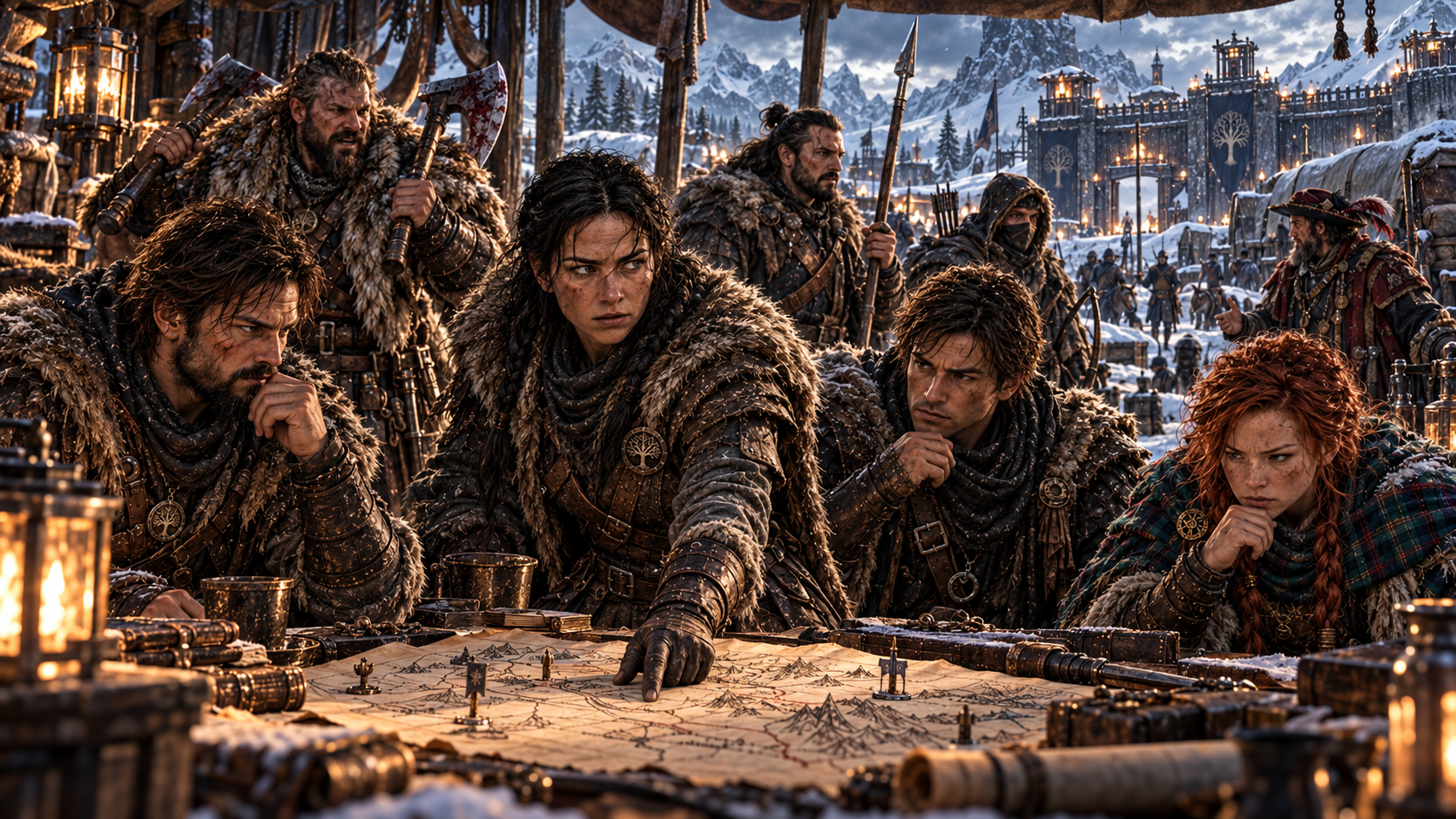
AFTER THE WHITE KING — V THE HOMECOMING OF KHARAD
The fifth and final part of the five-part story arc
I — THE ALLIES
GBR came first.
Angus rode at the head of its forces, a man of honor carrying two heavy axes. GBR brought soldiers, healers, food, metal, weapons, and horses.
“We read your plea for help,” Angus said.
Argento nodded. “Then you know why you're here.”
“Yes. And we'll stay until Phaeton's fate is decided.”
AIO arrived two days later.
Kristiano led its troops, a cunning strategist and dangerous spearman. His eyes went first to Argento's maps.
“You're the chronicler.”
“Among other things.”
“Good. I want to see everything you know about Vark.”
Angus distrusted Kristiano's taste for deception. Darth, on the other hand, liked him at once.
N3N came last.
No army.
Advisers.
And wagons.
Darth pulled back the cover of the first wagon.
Gravel.
“What is this?”
“N3N support.”
Darth took a handful.
“We're fighting a war against Phaeton.”
“Yes.”
“And you send us scenery.”
Even Ket had to turn away.
II — THE PLAN
Argento's maps showed Kharad, the mines, Phaeton's camp, watchtowers, supply routes, and the refugees' testimony.
The goal was to free Kharad.
But Vark's main force had to be drawn out first.
Darth suggested a false trade convoy.
“Vark knows me. If I'm sitting on a wagon supposedly full of priceless goods, he'll believe it.”
“No,” Ket said.
Kristiano nodded. “He's right.”
“You aren't helping.”
Angus folded his arms. “I don't like any strategy that uses an ally as bait.”
Kristiano leaned on his spear.
“We're merely ensuring that Phaeton does exactly what Phaeton wants to do anyway.”
Darth pointed at him.
“I like him.”
Ket replied, “That worries me.”
Argento warned that Vark would now expect deception.
So the trap needed a believable mistake.
And Nikki found one on an open, icy field southeast of Kharad.
Even before the plan was settled, responsibilities divided.
Chief Seef remained in the NFD. Not because he was too old for the field, but because someone had to defend the kingdom, coordinate reinforcements, and secure the army's supplies.
“You lead out there,” he told Ket. “I'll cover your back.”
Moidark took charge of the false convoy's logistics. Darth invented the story. Moidark made sure it sounded the same in freight lists, merchants' rumors, and three different taverns.
Deathhead was already on the move.
Two nights later she returned with numbers.
Patrols. Guard changes. Riders. A poorly guarded side route to the mine.
“Vark expects a trick,” she said.
Argento nodded. “Then we give him one he recognizes.”
Darth grinned. “And a second behind it.”
III — GRAVEL
Nikki studied the ice.
Then the N3N wagons.
“We need the gravel.”
Darth stared at her.
“Say that again.”
“No.”
Argento understood.
“Grippy corridors.”
Nikki nodded. Narrow, barely visible routes would be prepared with gravel—for their own infantry, horses, wounded transports, and a later counterattack. Much of the rest of the field would stay smooth.
Kristiano smiled.
Angus studied the ground.
“Deception.”
“Preparation,” Nikki said.
Darth laid a hand on a gravel wagon.
“I knew from the start this would decide the war.”
“No,” Ket, Nikki, and Argento said together.
“More or less.”
IV — THE MINE
While the battlefield was prepared, Nikki planned to free the mine.
No great wonder weapon.
Small tools, valve locks, clamps, and clear instructions.
The hoisting systems must not be destroyed. Prisoners were underground.
Mara Eisengrund helped with the safety devices.
“If something jams, don't force it,” Nikki said.
Her lesson from Story III still held:
No single person should know everything.
Many people should know enough to prevent a catastrophe.
V — VARK
Darth's false convoy was discovered.
Argento's observers soon reported movement.
Phaeton was coming.
More than expected.
Vark wanted more than the convoy.
He wanted the decision.
Phaeton banners, infantry, and riders appeared on the open field.
Ket studied the enemy ranks.
Angus drew both axes.
Kristiano took up his spear.
Argento holstered his pistol and checked his short sword.
Ket looked at him.
“You stay in the second line at first.”
“Of course.”
“That answer came too quickly.”
Darth rode past.
“Don't worry. Argento always obeys orders.”
Ket watched him go.
“That worries me even more.”
VI — THE FIRST BLOW
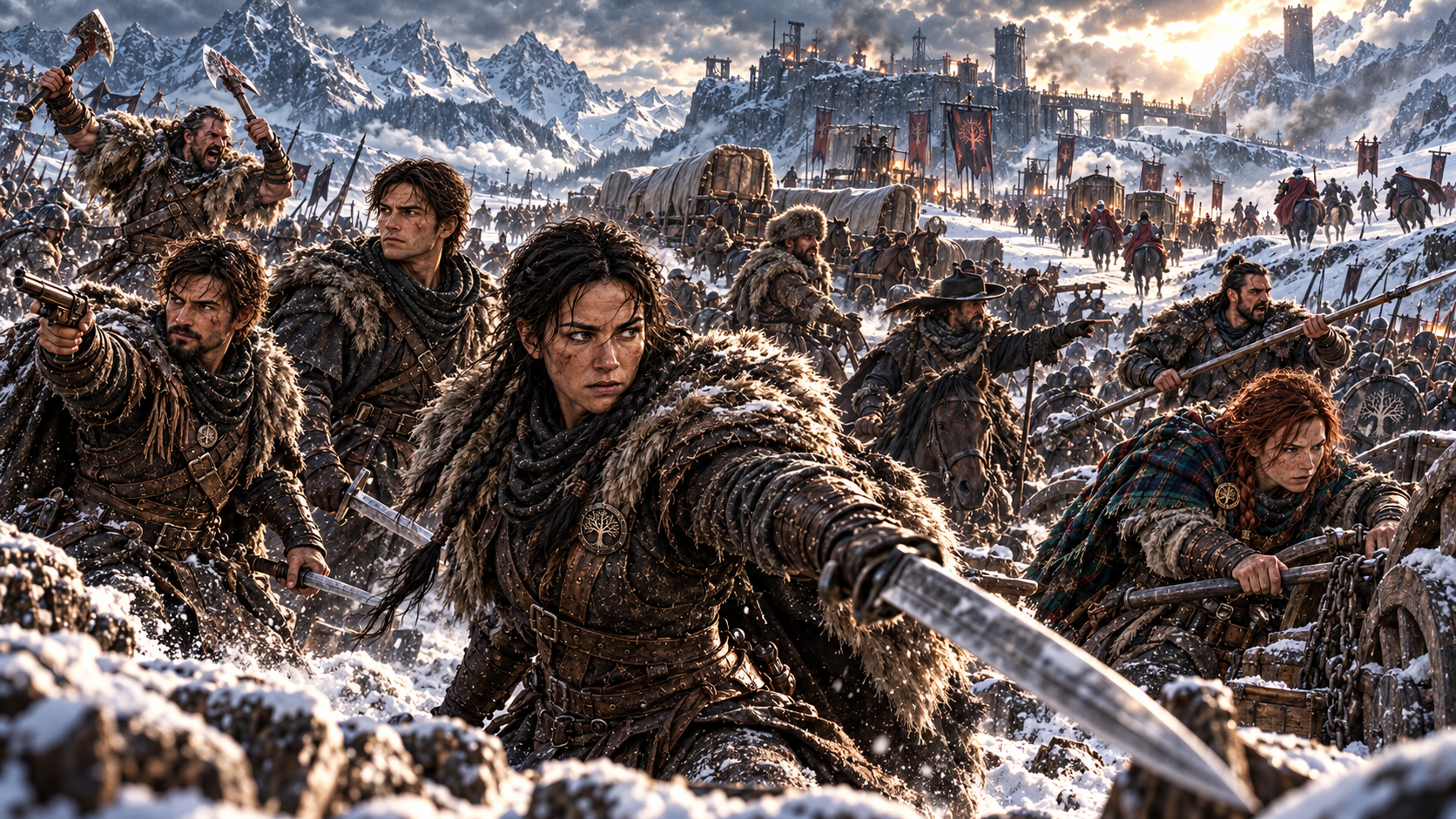
Phaeton attacked in the morning.
Arrows darkened the sky.
Then the lines met.
Angus held the left with GBR. His two axes worked with brutal force, but he wasted no step.
Kristiano led AIO on the right flank. His spear darted between shields while his troops withdrew, advanced, and repeatedly caused Phaeton's ranks to react the wrong way.
Ket led the center.
The NFD held.
Then Phaeton pressed harder.
People fell.
Horses screamed.
Blood stained the snow.
The battle was not beautiful.
It was brutal.
And Vark sent in still more troops.
VII — ARGENTO
At some point, there was no second line left.
A Phaeton unit moved through a hollow toward Angus's flank.
Argento could not reach Ket in time.
He had only six NFD people with him.
A damaged wagon.
Ropes.
Fallen shields.
Tools.
A bad situation.
So he needed a bad solution.
“Wagon sideways!”
They overturned the damaged wagon onto the ice.
Argento waited with his pistol.
Not for the first enemy.
For the officer.
One shot.
The officer fell.
Phaeton hesitated.
“NOW!”
The NFD fighters pulled the ropes. The wagon tipped fully over, crates and metal parts sliding across the ice and breaking up the charge for a few seconds.
Argento drew his short sword.
“Forward!”
“There are six of us!”
“Then we won't stay long!”
They attacked.
Not to win.
To buy time.
Argento's right hand hurt under the strain; the old burn scars pulled tight.
A spear came at him.
Argento dodged, yanked its shaft, and sent the opponent slipping on the ice.
Then an axe crashed down beside him.
Angus.
“Second line?”
“It changed.”
“I can see that.”
For a few moments they fought back to back.
Twin axes and short sword.
Then GBR soldiers reached the flank.
Angus looked at Argento.
“You should be writing maps.”
Argento raised his short sword.
“I will later.”
VIII — THE APPARENT COLLAPSE
At midday, the alliance began to retreat.
Deliberately at first.
Then almost for real.
“Back!” Ket ordered.
Phaeton believed the center was breaking.
Kristiano appeared beside her, blood on his sleeve.
“Vark is taking the bait.”
Angus hated the retreat but obeyed.
The alliance withdrew along the prepared gravel corridors.
Vark's troops followed.
Deeper and deeper.
Faster and faster.
Onto the open ice.
IX — THE COUNTERSTRIKE
Ket raised her arm.
“NOW!”
The NFD turned.
GBR turned.
AIO vanished on one flank and reappeared where Phaeton did not expect it.
Phaeton's riders reached bare ice.
Horses slipped.
Formations broke.
Not everywhere.
Not completely.
But enough.
Kristiano led AIO along a prepared corridor into Phaeton's side.
Angus saw the attack.
“Damned cheat.”
Darth rode past.
“He means that affectionately!”
An N3N adviser gazed reverently over the field.
“Our gravel.”
Darth pointed at him.
“Don't tell anyone you were right!”
An overturned wagon blocked one of their own corridors.
Nikki cursed.
Argento examined ropes, two horses, and a broken drawbar.
“Give me five minutes.”
Darth: “You have two.”
“Then it will be ugly.”
With Nikki's help they wedged the drawbar, reharnessed the horses, and pulled the wagon partly apart and partly off the path.
Nikki studied the result.
“That wasn't a repair.”
“It worked.”
“That doesn't make it a repair.”
X — THE TRICK BECOMES A BATTLE
Vark recognized the trap.
Too late.
But he was good.
Phaeton's heavy infantry reformed.
Now no trick alone would help.
Angus held the line.
Kristiano forced Phaeton to change direction constantly.
Darth led reserves and supplies along the safe routes.
Nikki's preparations kept the corridors open.
Argento's intelligence had predicted how Vark would move his forces.
And Ket had waited for the right moment.
“NFD!”
Her people looked at her.
“FORWARD!”
The counterattack began.
XI — THE FIELD
After that, there was no elegant plan.
Only fighting.
Ket fought through the center.
Angus's axes were red.
So was Kristiano's spear point.
Darth lost his horse, stood again, and kept fighting.
Argento reloaded his pistol.
One shot.
Then the short sword again.
A Phaeton fighter drove him to the ground.
A sword rose.
A spear shot past.
The attacker fell.
Kristiano drew back his weapon.
“You're the man with the maps.”
Argento got up.
“Among other things.”
Later, Argento saw a hook catch one of Angus's axes.
He shot the mechanism.
Metal splintered.
Angus's axe came free.
“That was either very good or very stupid.”
“Both.”
Then Phaeton's left line broke.
Banners fell.
Units retreated.
Vark ordered withdrawal.
XII — VARK LEAVES
Ket could see him.
General Vark gathered the remnants of his riders.
An officer called:
“We can pursue him!”
Ket looked at the wounded.
The fallen.
Her exhausted allies.
And Kharad.
“No.”
“But Vark—”
“Let him go.”
Vark rode away with what remained of Phaeton.
Defeated.
Driven from the region.
Not destroyed.
Argento stepped beside Ket.
“He'll come back.”
“Perhaps.”
“That wasn't a guess.”
Ket looked at him.
“Then write it down.”
Argento sheathed his short sword.
“Later.”
XIII — KHARAD
After Vark's defeat, the weakened garrison could no longer hold Kharad.
Some Phaeton soldiers fled.
Others surrendered.
Some fought.
Nikki went to the mining facilities with the first units.
“Pump two slowly!”
“Hold the valve!”
“Don't touch the main shaft!”
Mara worked beside her.
The hoists were shut down under control.
No tunnel was deliberately turned into a tomb.
Then they opened the barracks.
People came out.
Thin.
Exhausted.
Distrustful.
Jarek began to cry.
Argento opened his book.
Not to write.
To count.
“One hundred four.”
Ket looked at him.
“What?”
“We have one hundred four.”
He turned the pages.
“There should be one hundred eleven.”
Seven names were missing.
One was Tomas Verren.
XIV — SEVEN NAMES
A freed worker knew the place.
The old eastern shaft.
Partly collapsed.
Ket went.
Nikki went.
Argento too.
Angus insisted.
Kristiano came without asking.
And Darth complained that they had all left without him while he followed them.
They found the missing people.
One behind a blocked door.
One injured.
Three deeper in the shaft.
Then two more beneath a collapsed beam.
Argento and Angus lifted it together.
“Tomas Verren?”
The man blinked.
“Yes.”
Argento exhaled.
“Your mother is waiting.”
Tomas began to cry.
They brought all seven out.
A name had kept them from being left behind.
XV — HOME
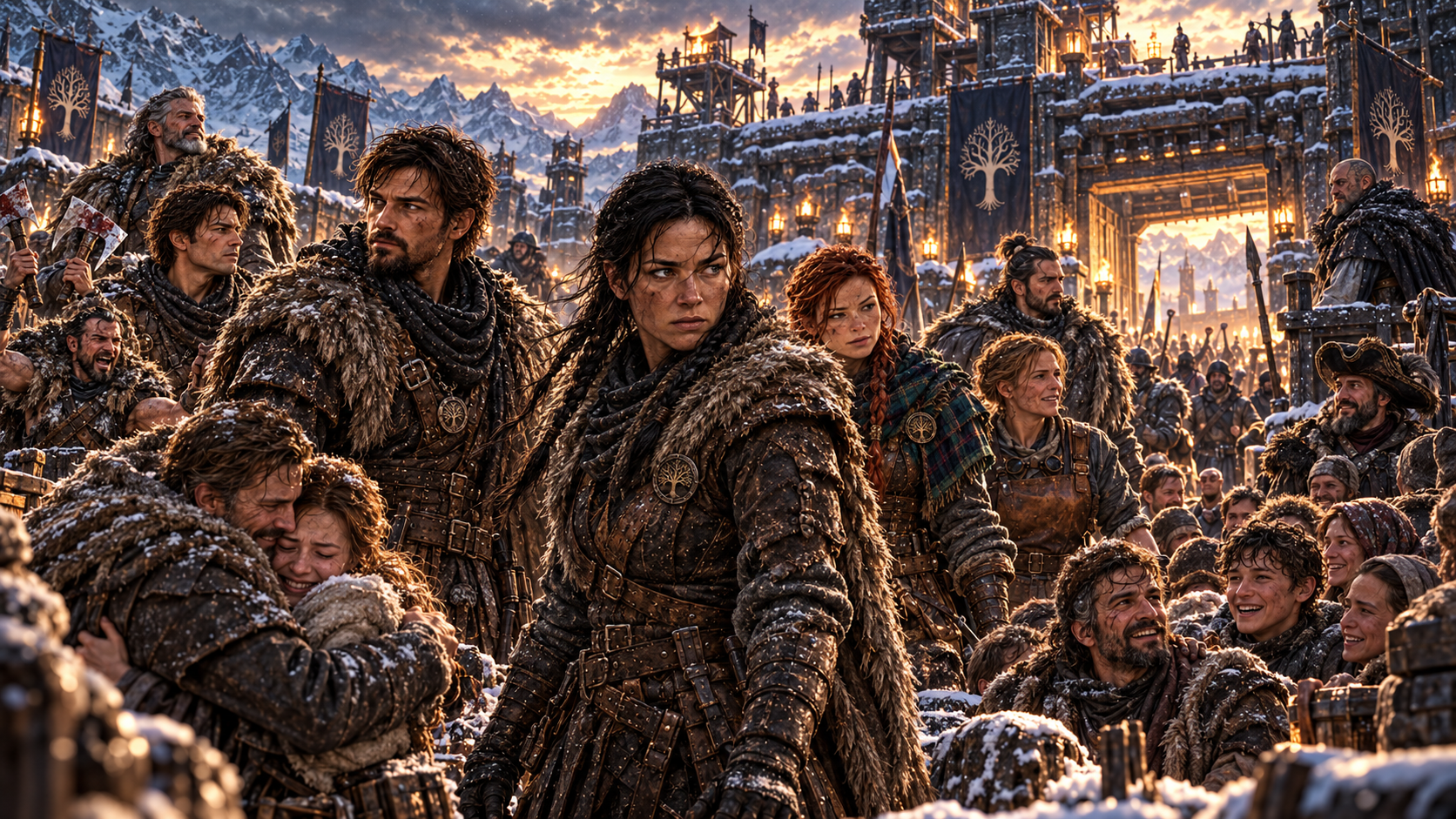
Elin waited at the NFD gate.
When Tomas climbed down from the wagon, she ran to him.
Argento only watched.
Later he opened the book.
Beside Tomas Verren he wrote:
RETURNED HOME.
Then beside the next name.
And the next.
This time Argento did not record the names because they had died.
He recorded them because they had come home.
XVI — RECOGNITION
When the envoys later assembled in the NFD, Chief Seef stood beside Ket.
For years, his title had been almost synonymous with the community. Chief Seef. NFD. To many, they had been the same word.
Now the envoys looked to him.
Seef took a single step back.
Not far.
Just far enough.
Ket looked at him.
He nodded.
Go.
She stepped forward.
Moidark stood with merchants and envoys, Deathhead at the edge of the hall, half in shadow. Argento held no sword. Only his book. Nikki still had oil on her hands. Darth looked as though he was already calculating how much money a coronation celebration might bring in.
Seef looked at them all.
The NFD no longer needed one Chief to endure.
To him, that was no loss.
It was proof they had survived.
Weeks later, delegations from AIO, GBR, and N3N stood in the NFD.
Angus with GBR.
Kristiano with AIO.
And the advisers with N3N.
Darth studied the newly reinforced square.
Gravel.
He said nothing.
That visibly cost him effort.
The representatives spoke about Kharad.
About Phaeton.
About the battle.
And finally about the NFD.
After the White King, it had been a wounded town.
Now it had walls, workshops, trade, administration, its own technology, soldiers, allies, and an information network.
It had protected other settlements.
It had not forgotten Kharad.
It had built an alliance.
And, together with its allies, it had defeated Phaeton on an open field.
AIO, GBR, and N3N declared together:
From that day on, the NFD was recognized as a full kingdom.
Not an outpost.
Not merely a settlement.
A kingdom.
Ket stood beside Nikki, Darth, and Argento.
Angus bowed his head.
Kristiano did too.
Darth whispered:
“Even the gravel was somehow useful.”
Nikki replied:
“Just don't tell them.”
XVII — WHAT REMAINS
The people of Kharad decided for themselves what should happen next.
Some returned to rebuild their home.
Others stayed in the NFD.
Darth was already planning trade routes.
Nikki wanted to help rebuild the mining facilities safely.
Ket spoke with Angus about future cooperation.
Kristiano studied the maps with Argento.
“Vark is alive.”
“Yes.”
“So is Phaeton.”
“Yes.”
“Then this isn't an ending.”
Argento looked out over the town.
“No. But perhaps it's a beginning that has earned an ending.”
XVIII — DARTH HAS AN IDEA
The next morning, the four sat together.
Ket was tired.
Nikki had oil on her hand.
Argento's right hand was bandaged after the battle.
Darth was eating.
For a while it was quiet.
Then Darth put down his bread.
“So.”
Ket did not look at him.
“No.”
“You don't even know what I was going to say.”
“No.”
“We're a kingdom now.”
“Yes.”
“Kingdoms need revenue.”
Nikki groaned.
“And diplomatic relations.”
Argento slowly set down his pen.
“And cultural events.”
Ket looked at Darth.
“Darth.”
“Regular fairs.”
Silence.
Ket thought.
“That is surprisingly sensible.”
Darth beamed.
“Thank you.”
Nikki grew suspicious.
“There's more.”
Darth spread his arms.
“Controlled bear exhibition fights.”
Silence.
Ket said:
“No.”
“You don't even know—”
“No.”
Argento asked:
“Define controlled.”
Darth thought.
“Still working on that.”
“No,” Nikki said.
“You're alarmingly hostile to innovation for a young kingdom.”
A deep bear roar sounded outside.
All four looked toward the window.
Darth smiled.
“See? Demand.”
Ket threw a piece of bread at him.
Darth ducked.
Argento laughed.
So did Nikki.
For a moment, they were not a leader, engineer, merchant, or chronicler.
They were the four again.
Outside, it was no longer merely a town that lived.
The Kingdom of NFD lived.
Workshop hammers struck.
Merchants called.
Soldiers changed the guard.
Messengers rode through the gate.
People from Kharad planned their return.
And somewhere, someone argued over who should clear away the remaining gravel.
Argento picked up his pen.
He opened the chronicle.
Then he wrote:
We had survived winter.
Afterward we had to learn to build a future.
Beneath it he wrote:
KINGDOM OF NFD.
Then he closed the book.
Not forever.
Only for today.
END — STORY V
END OF THE FIVE-PART STORY ARC
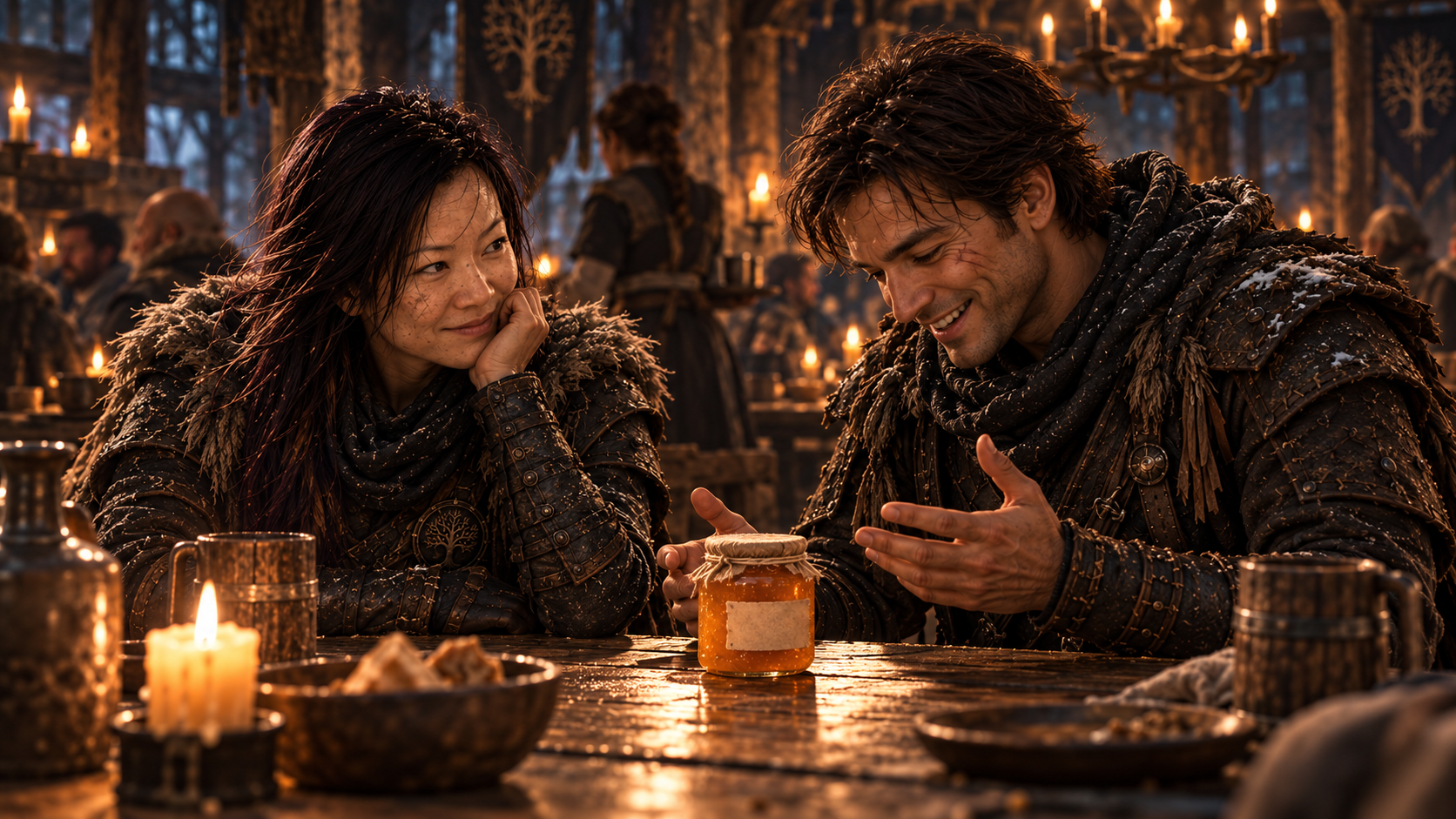
THE REASON
The tavern was called The Shivering Dungeon, a name Darth found both ridiculous and unnecessarily complicated.
He preferred names like The Axe.
Or The Pointy End.
Inside, however, it was warm. Pine resin burned in the hearth, mutton turned slowly above the fire, and spilled mead had soaked so deeply into the floorboards that Darth suspected the building itself would fail a sobriety test.
Ket sat across the scratched wooden table.
She raised her cup and studied him over its rim.
Darth had imagined this meeting for years.
Most versions had involved accusations.
Some, violence.
In one particularly unpleasant version, Ket had simply looked at him and walked away.
Instead, she said:
“You still drink too fast.”
Darth lowered his cup.
“You still talk too much.”
Ket smiled.
For a while they talked about nothing important.
Bad roads.
Worse weather.
People they had known.
Battles whose details had grown less reliable with every retelling.
At one point Ket reminded him of a fight in which Darth had charged an enemy before anyone else was ready.
“That was tactical,” Darth insisted.
“You shouted my name.”
“I was communicating.”
“You shouted, ‘Ket, now would be good!’”
“Clear battlefield communication.”
Ket laughed.
Darth grinned despite himself.
At least that part felt familiar.
They had once fought side by side. Survived things neither now cared to describe too precisely. Whatever titles they had held at different times, whatever troops they had served with—there had been a time when they trusted one another with the uncomplicated certainty of people who expected to die together.
And then Darth had left.
Ket's smile slowly faded.
“There's something I never asked you.”
Darth knew at once what she meant.
He looked into his cup.
Ket went on.
“You vanished. One note. If you can even call it that.”
Darth said nothing.
“For years I wondered why.”
The tavern noise seemed to recede around them.
“I thought perhaps there was someone else,” Ket said. “Or some reason you couldn't tell me. I wondered if I had done something.”
Darth ran his thumb along a crack in the table.
He had rehearsed answers to this question in more taverns than he could count.
None of those answers survived this moment.
At last he sighed.
“It was the marmalade, Ket.”
Silence.
Ket blinked.
“The what?”
“The marmalade.”
She stared at him.
Darth leaned forward.
“The winter stores. The orange marmalade.”
Ket's face remained completely still.
“You gave the last jars to the archers.”
A tiny movement appeared at the corner of her mouth.
Darth pointed at her.
“Don't laugh.”
“I'm not.”
“You are.”
“I'm listening.”
“We got pickled turnips.”
Ket pressed her lips together.
“Pickled,” Darth repeated darkly, “turnips.”
Her shoulders moved.
Darth slapped his palm on the table.
“You knew I hated them.”
That broke her resistance.
Ket burst out laughing.
Not politely.
Not quietly.
She bent forward with a hand over her face while Darth watched her with the wounded dignity of a man whose deepest grievance was being mocked by his oldest friend.
“All those years,” Ket managed. “All those years I thought it was something terrible.”
“It was terrible.”
“I thought maybe you'd fallen in love.”
“Worse.”
“Or that you'd found some great calling.”
“I had a calling. It called me toward food that wasn't preserved in vinegar.”
Ket laughed even harder.
Darth folded his arms.
“It was very good marmalade.”
Eventually Ket could breathe again.
She wiped her eyes.
“So that was the reason?”
Darth's grin vanished.
“No.”
Ket stopped laughing.
He looked into the fire.
“The marmalade annoyed me.”
“I got that.”
“Afterward it became the story I told myself. It was easier that way.”
Ket waited.
Darth continued quietly.
“There wasn't one reason. I was angry. Restless. Stupid. I thought leaving would be easier than staying long enough to find out what I really wanted.”
He shrugged.
“And then enough time passed that coming back became harder than leaving had ever been.”
Ket said nothing for several seconds.
“So the marmalade—”
“Was unforgivable.”
She smiled.
“But not the reason.”
Darth looked at her.
“It was a reason.”
“Of course.”
“An important one.”
“Naturally.”
“Possibly the most important.”
Ket reached down beside her chair and opened the leather bag at her feet.
She took out a small earthenware jar.
Darth stared at it.
She set it on the table and slowly turned the label toward him.
STOLEN RESERVE — FOR DARTH ONLY
He looked from the jar to Ket.
“You're joking.”
“I kept it.”
“How long?”
“Long enough.”
Darth picked up the jar as though it were a priceless relic.
“You've carried this around with you?”
“Not every day, you idiot.”
“Oh.”
“But I kept it.”
“Why?”
Ket leaned back.
“In case I found you.”
For the first time, Darth had no answer.
Ket raised her cup.
“Welcome back.”
Darth looked at the marmalade.
Then at his oldest friend.
Laughter came suddenly.
Ket joined him.
People at the neighboring tables turned to look.
Neither cared.
Some stories between old friends were about wars.
Some about betrayal.
Some about all the things left unspoken far too long.
And some, after enough years had passed, were easier to tell if you simply blamed the marmalade.
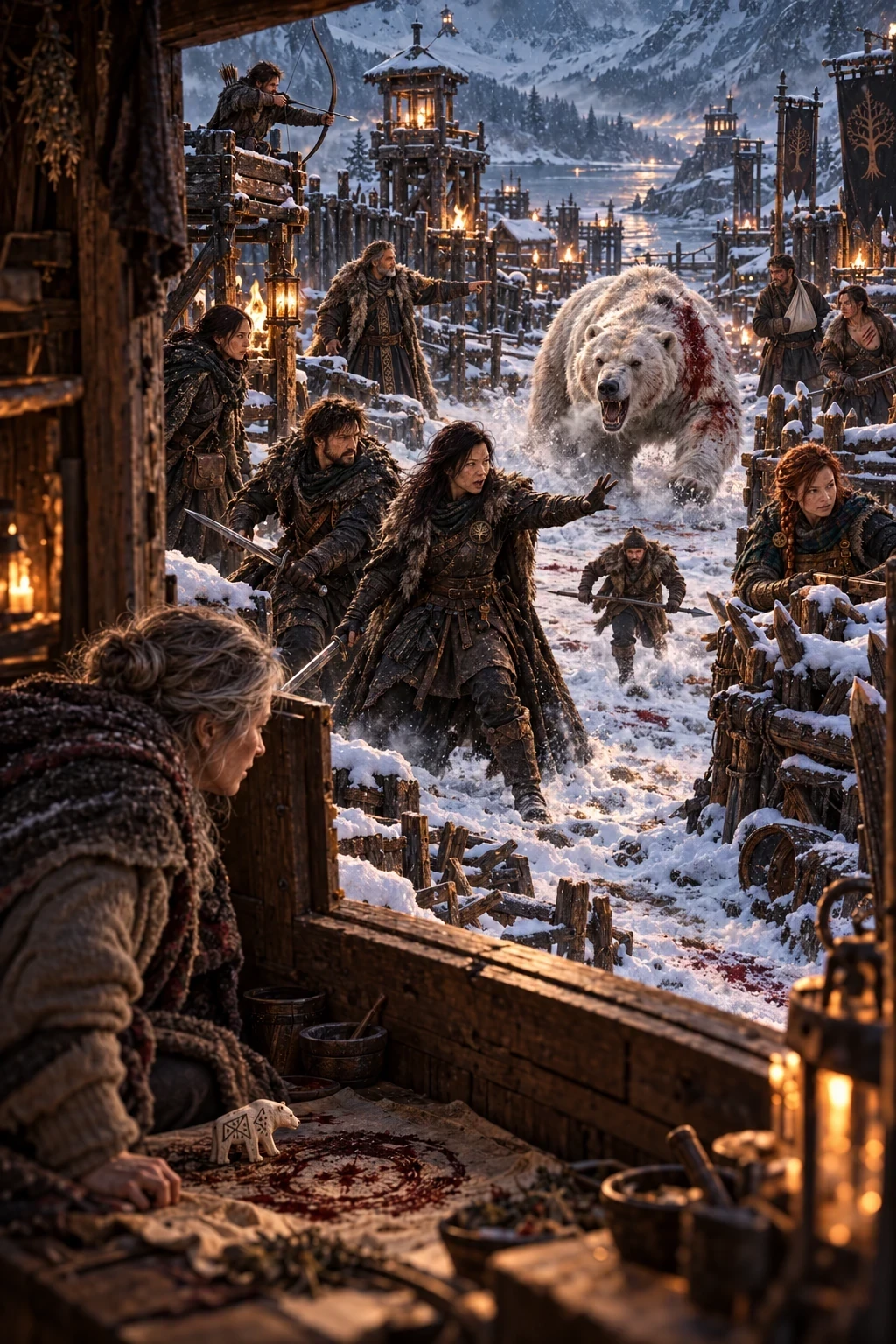
The Bear Witch
Years earlier, a huge white bear had attacked the settlement of Oakhaven. Among the dead was Elara, Margret's husband.
The hunters had not pursued it. Too many people were injured, too little ammunition remained, and a snowstorm had swallowed the tracks within hours.
For most residents it was a defeat they eventually stopped discussing. For Margret it was betrayal. She remembered who had voted to pursue the bear, and, even more clearly, who had voted against it.
When another great white bear appeared nearby years later, Oakhaven remembered at once.
The first dead man was Borin. They found him behind his barn. Two nights later a stable was torn open. Two nights after that a guard died on the settlement's edge.
Ket noticed the pattern first. “Every second night.”
Seef looked across the table. “Coincidence.”
“Three times?”
“Three times isn't a law.”
Ket laid the reports side by side. “Then let's wait two nights and see whether your coincidence eats someone.”
Flake Snow and Ball searched for tracks. They found prints. Large. Very large. But never where they expected them. In places, the trail ended in open ground.
Flake knelt in the snow for a long time. “Wind.”
Ball looked at the sky. “There isn't any.”
“Then old snow. Drifts. Ice. Something.”
Ball studied the last visible pawprint. “You don't believe yourself.”
Flake did not answer.
On the next attack night Nikki erected a barricade at the eastern entrance. When the bear came, she did not strike a ghost with an axe, as later stories claimed. She stood with the other defenders behind a heavy wooden barrier. The animal hit it hard enough to break two crossbeams. Nikki saw white fur, a shoulder, blood. Then the bear vanished into the driving snow.
In the morning they found blood on a post. Real blood. That was a comforting thought for about five minutes. Despite it, they found no trail that lasted more than a hundred paces.
Jota and Doma tried two nights later. They lay in wait outside the settlement, planning to drive the animal between two prepared positions. The plan failed. Jota returned with a broken arm. Doma had deep scratches across his chest.
“Did you hit it?” Seef asked.
Jota sat down. “Yes.”
“And?”
“It didn't seem impressed.”
Doma threw a broken knife onto the table. “If anyone says the blade went through a ghost, I'll hit him.”
Jota looked at the knife. “In twenty years they'll say exactly that.”
“Then I'll hit him in twenty years.”
Argento began searching old reports. Not because he believed a ghost had attacked them, but because someone in Oakhaven already did. A name was circulating: Blood Bear. An animal summoned by hatred, a bear that came only on certain nights, a curse.
Argento did find an old story about it. It described a so-called Blood Bear, bound to a nightly cycle and supposedly summoned by a “bitter heart.”
Ket read the page. “Do you believe it?”
“No.”
“You answered quickly.”
“Because I don't want you to ask whether I think it's impossible.”
Ket put down the page. “Do you think it's impossible?”
Argento sighed. “Of course you ask.”
Deathhead brought the first real lead. She had seen Margret several times at the edge of Blackwood, alone at night. Margret gathered plants and carried small bundles to her hut.
“What plants?” Argento asked.
Deathhead named them. Some were medicinal. Others poisonous. None proved witchcraft. But some could kill a person.
Seef wanted to question Margret immediately. Ket stopped him. “We have a woman collecting herbs.”
“And whose husband was killed by a white bear.”
“That makes her suspicious?”
“It makes her interesting.”
Deathhead stood at the door. “There's something else.” She put a small wood shaving on the table. Dark wood, freshly cut.
“What is it?” Seef asked.
“I don't know yet.”
Argento picked it up. One side held a tiny notch, like fur.
The morning after the next attack, they went to Margret's hut: Seef, Ket, Argento, Deathhead, Flake Snow and Ball. Jota insisted on coming despite his broken arm. Doma came because he would not let Jota go alone.
Margret's door was unlocked. Ket opened it. Inside it smelled of herbs and blood.
A circle had been drawn on the floor. It did not shine or glow. It was simply a circle of dried blood and dark plant paste. In its center stood a carved bear painted white.
Margret sat beside it. She looked tired, not surprised.
“Margret,” Seef said.
She looked up at him. “Finally.”
Ket did not draw her weapon. “What have you done?”
Margret looked at the little bear. “What you didn't do.”
“That answers nothing.”
“You left Elara there.”
Seef fell silent. “We couldn't pursue the bear then.”
“You were afraid.”
“Yes,” Seef said.
For a moment the answer seemed to unbalance her. Seef stepped closer. “We were afraid. People were dead. Others were bleeding out. A storm was coming. I decided not to let more people die.”
Margret's face hardened. “And Elara?”
“Was already dead.”
Margret sprang up. Ket was faster and caught her arm. A knife fell to the floor. Jota stepped forward.
“Don't,” Ket said.
Margret stared at her. “You want to know whether I sent your bear?”
No one answered. Margret began to laugh softly. “Maybe.”
Argento studied the circle of blood. “What does this mean?”
“Maybe nothing.”
“And the bear?”
“Maybe everything.”
Ket tightened her grip. “Enough.”
Margret met her eyes. “You wanted to be afraid.”
“No.”
“Yes. Now at least you know what it feels like.”
“Did you kill people?”
Margret's smile disappeared. “I didn't kill anyone with my hands.”
That was no answer, and everyone in the room knew it.
Then a scream came from outside. Flake turned toward the door. A second scream. “Bear!”
Ket looked at Margret, still held in her hand. Something roared outside. Ball ran out, followed by Deathhead. Ket hesitated for just one second. It was enough. Margret tore free, shoved the table into Seef and jumped through the back window.
“Damn it!”
Jota moved to follow. “With that arm?” Doma shouted.
“Shut up!”
Ket ran for the door. Outside was chaos. At the settlement's edge a large white body moved between the houses. Flake fired. The bear turned away. For an instant Ket saw it clearly: fur, blood on its shoulder, breath in the cold air. An animal. At least it looked like one. Then it disappeared into the storm.
Margret was not found that day, nor the next. In her hut they found herbs, animal blood, knives, old records about Elara and several carved bear figures. Argento also found copies of the same old Blood Bear story he had read in his archives.
That proved Margret knew the legend. It did not prove the legend was true.
Seef wanted to close the matter. Ket did not. “The bear attacked while Margret was with us.”
“That doesn't clear her.”
“No.”
“Then what?”
Ket looked at the carved figure. “It makes everything worse.”
Two nights later they waited. Jota and Doma on the western road. Flake Snow and Ball in elevated positions. Nikki behind a reinforced barrier. Deathhead outside the village. Ket in the middle of the street. Argento and Seef watched from the guardhouse.
Shortly after midnight snow began to fall. Then came the roar. The white bear appeared again, exactly as before. Margret was gone: perhaps far away, perhaps dead, perhaps somewhere in the forest. Nobody knew. Still the bear came.
Many versions of this story arose later. In one Margret was a powerful witch. In another she had summoned a spirit. People said Jota's blade passed through the animal and Nikki's axe struck only mist. Others claimed Ket had killed Margret and created a curse binding the bear to Oakhaven forever.
None of it could be substantiated. The records from the time offered a less satisfying account.
Margret had lost her husband Elara in an earlier bear attack. For years she accused the settlement of failing to avenge him. She knew the Blood Bear legend. She had used circles of blood, herbs and carved bears. She deliberately gave no clear answer when asked about her responsibility. She disappeared. And the white bear kept attacking.
Whether Margret had attracted it, trained it, exploited its attacks or truly done something beyond reasonable explanation remained unknown.
At the end of his report Argento wrote just one sentence: “A legend is not evidence.”
Ket later added underneath: “Neither is a bear.”
And below that, in a hand nobody could identify with certainty: “Ask Margret.”
Margret was never questioned. For Margret was never found.
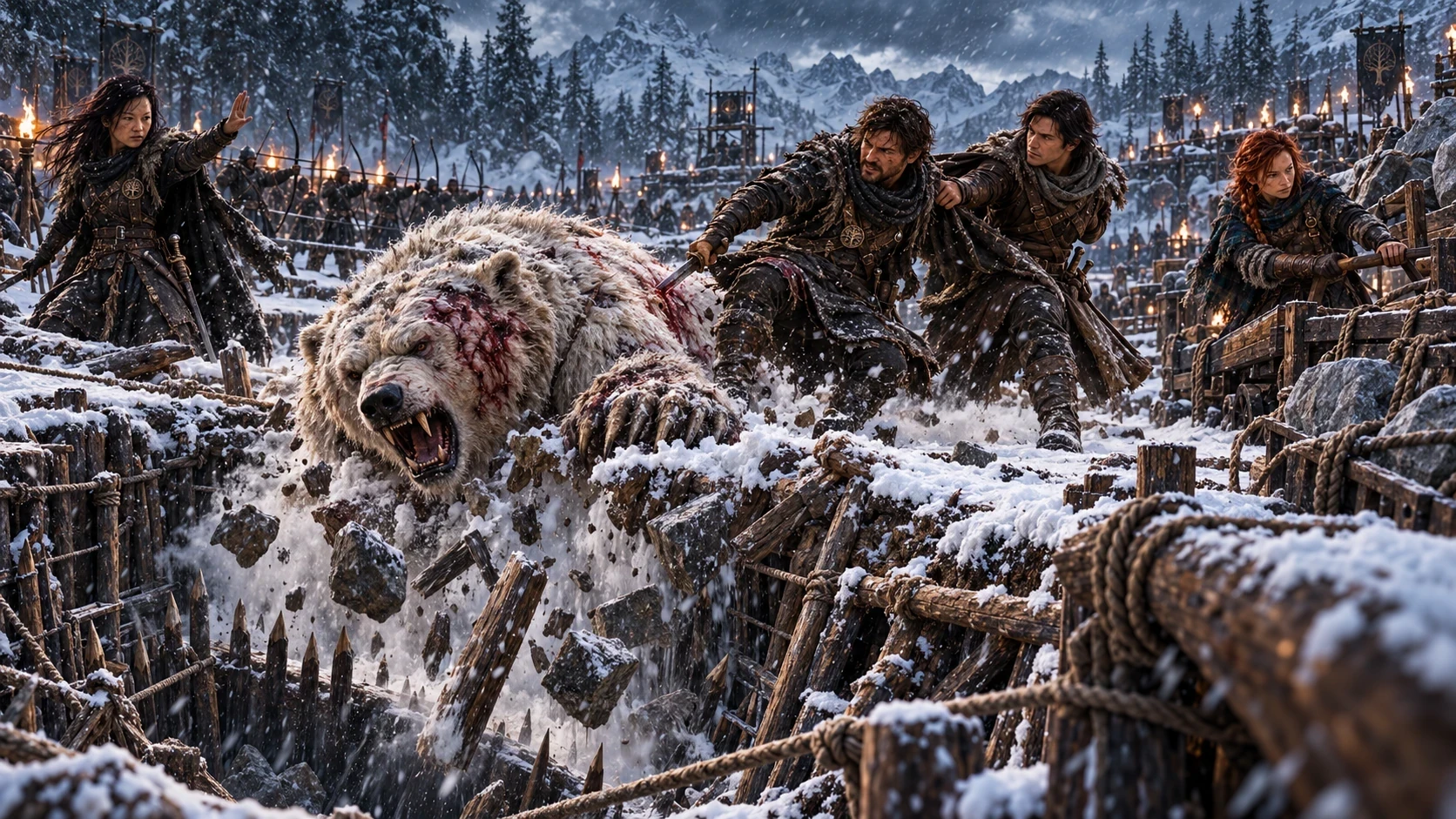
The Hunt for the Winter Monster
Years had passed since seven traveling gunslingers and the settlement's defenders had driven a gigantic white bear into a prepared pit. The story remained. More importantly, so did the records: dimensions, load limits, digging times, coverings, mistakes.
When another white bear appeared in Black Timber Wood, Darth brought out those old plans. The animal was larger than anything most hunters had seen. It had killed lumberjacks, broken up hunting parties and forced several outposts to be abandoned. Survivors said it kept moving even after severe wounds.
Before long it had a name: the Winter Monster.
Darth disliked the name. “Names make animals bigger,” he said.
Ket looked at the map. “This one doesn't need much help.” Nobody disagreed.
Darth prepared no ordinary hunt. Almost a thousand people were assembled for the operation, though they were not a thousand soldiers. There were hunters, archers, laborers, wagon drivers, lumberjacks, healers, scouts, and men and women whose most important job was hauling earth out of a hole.
Darth did not intend to kill the Winter Monster in open combat. He intended to bury it. The gunslingers' old pit supplied the model. Darth made it bigger. Much bigger.
For weeks they worked the frozen ground, installed support beams, prepared snow coverings and altered the approaches so an animal could be driven from several sides into one corridor.
Nikki supervised construction. She found roughly twenty things in Darth's original design that, in her opinion, would make the trap collapse too soon or not at all. Eventually Darth asked if there was anything good about his plan.
“The idea of a hole.” After that they argued less.
Argento and his fighters would secure the rim in case the animal detected the trap or tried to climb out. Ket commanded the ranged fighters. Her order was simple: do not kill it. Steer it. The Winter Monster had to run exactly where Darth wanted it.
It came shortly before sunset. First the forest grew quiet. Then they heard the scouts. “Contact!”
Ket raised her hand. Hundreds of bows were drawn. Something white appeared between the trees, moving slowly, almost calmly.
Argento stood at the edge of the hidden pit and saw the bear for the first time. “Shit.”
Darth nodded beside him. “That's about the professional assessment.”
The creature was enormous. Its fur was dirty, matted in places and crossed by old scars. One side of its head looked misshapen, as if something had broken there long ago and healed badly.
Ket dropped her hand. The first volley flew. Not every arrow struck. Many that did vanished into thick winter fur or hit at poor angles. The animal twitched, raised its head and charged.
“Second line!”
Another volley. This time the animal turned, exactly as planned. The flanking groups pressed it with torches, noise and more arrows, forcing it into the prepared corridor. For a few minutes everything worked.
Then the Winter Monster stopped behaving like a hunted animal. It broke sideways through the barrier. People screamed. Wood splintered. The front rank had no chance.
Darth watched his plan unravel. “Back! Back to the pit!”
The Winter Monster struck one man several meters through the air, then another. Panic spread. Ket shouted orders until her voice broke. “Not the body! Eyes! Snout! Under the jaw! Drive it right!”
The archers recovered, slowly. Too slowly. By the time the animal ran toward the trap again, dozens lay in the snow.
Argento drew Vengeance. “Now it's our part.”
Darth looked at him. “For once, try not to die heroically.”
“I'll do my best.”
The Winter Monster reached the pit. The snow covering broke. One front leg disappeared, then the other. But the structure did not give way completely. The bear hung halfway over the abyss and began pulling itself up again.
“No,” Darth said.
Argento ran. Later nobody knew whether it was courage, madness or simply the realization that there would be no second chance. Probably some of each.
The Winter Monster pulled itself higher. Argento leaped onto the rim. Its paw struck at him. He dodged, narrowly. Vengeance drove deep into its flank. He felt almost no resistance. That unsettled him more than anything. The flesh beneath the fur did not feel as it should: dry, soft, almost decayed.
He tore out the blade. The Winter Monster roared. The edge of the trap collapsed. Bear, timber and snow vanished together into the depths. Argento leaped back. Darth caught his coat and dragged him away from the crumbling rim.
Something struck below. Then a roar rose from the pit. It was still alive.
“Nikki!”
She was ready. Carts loaded with stone, timber and frozen earth stood around the pit. “All of it in!”
The workers released the restraints. Tons of material plunged down. Spears followed. Stones. Beams. More earth. The Winter Monster kept roaring. Once Ket saw a white paw strike out between the debris. Then it vanished.
Nikki ordered the side supports removed. The upper part of the pit collapsed. Snow and frozen ground slid down. The roar grew muffled and then stopped.
Nobody cheered. Too many people lay in the forest. Too many would never go home.
Later Argento sat in the snow looking at Vengeance. Something black clung to its blade: no ordinary stain, but a thick dark substance smelling of damp earth and something sharp that some later compared to sulfur.
Nikki knelt beside him. “Blood?”
Argento shook his head. “If it is, I've never seen anything like it.”
Nikki did not touch it. “Have it examined.”
“By whom?” She had no answer.
The blade was cleaned. The substance disappeared. Nobody found an explanation.
That night the temperature fell unusually fast. By morning the collapsed pit had disappeared under a thick layer of ice and hard snow. Some workers considered this perfectly normal. Others swore no ground could freeze so thoroughly in one night.
Nikki disagreed with both sides. “We filled in a hole. That's all we know.”
Darth had the area marked. Nobody was to dig there.
Ket asked why. “Because I don't want to find out whether we killed it.”
Argento looked at the sealed ground. “What if it's alive?”
Darth paused. “Then I hope it feels the same way about excavations that I do.”
The hunt became legend. The almost thousand participants became a thousand warriors. Some accounts turned the prepared collapse into one of Nikki's spells. People said the frost itself had sealed the pit. Others claimed a gate lay beneath Black Timber Wood and the Winter Monster had crawled out of it. No evidence was ever found for any of that.
The dead were real, however. So were the injured, the pit and the black substance on Argento's sword, even if nobody could explain what it was.
The Winter Monster was never dug up. Nobody knew whether it died down there. Darth made sure it stayed that way.
Many years later a scribe found two construction drawings in the archives. The older showed a large pit, with margin notes about seven gunslingers who had once fought a giant white bear alongside the settlement's defenders.
The second drawing was considerably larger. At its top, in Darth's handwriting, were the words:
“The same principle. Only this time the damned bear mustn't get out again.”
Underneath Nikki had written: “Then build the hole properly.”
Ursus Diabolus — Fireworks
Nobody knew exactly when a catastrophe had become a tradition. Perhaps after the fifth attack. Perhaps after the tenth. Perhaps the evening Seef stopped putting down his cup during a bear attack because he realized Ket had matters under control anyway.
One thing was certain: Ursus Diabolus returned. Again and again.
The name arose after a guard called the enormous white bear “that damned devil bear.” Argento later used the more scholarly sounding Ursus Diabolus in his report. To his annoyance, it stuck.
The bear was immense. Standing upright, it reached roughly four meters. Its white fur was often stained with dirt, blood and ice. It was aggressive, unusually persistent and evidently intelligent enough to try different entrances to the settlement.
It also developed a remarkable habit: it appeared about every two days. Not always at the same hour or from the same direction, but often enough that NFD began to prepare.
The first time there was panic. The second time Ket organized defensive lines. By the third, barricades were ready. By the fourth, Moidark had begun logging the attacks.
After a few weeks there were tables. Direction of attack. Time. Wind. Injuries. Bear's favored side. Response to spears, noise, fire and Ket. Beside the last entry someone had written in Moidark's papers: Negative. Ket added below: Mutual.
On a particularly cold evening Seef sat on a reinforced platform at the edge of the village square and looked at his pocket watch. Below, a heavy wagon broke apart. Ursus Diabolus roared. Ket roared louder.
“CLOSE THE LEFT SIDE!” Soldiers ran into position. “AND WHOEVER HOLDS A SPEAR LIKE THAT AGAIN GETS TWO EXTRA HOURS TOMORROW!”
Seef checked his watch. “Twenty-two minutes.”
Argento stood beside him with a notebook. “She's slower today.”
“The bear?”
“Ket.” Seef looked at him. Argento kept writing. “The bear too.”
The defenses were carefully prepared now. Heavy barriers guided the animal into an open part of the square. Soldiers worked in groups, retreating whenever it came too close.
Ket had turned the repeated attacks into a drill. It was dangerous: one mistake could still kill a person. But NFD had stopped treating every attack as the end of the world. The fighters learned distance, formations, retreat, cover and, above all, how not to panic when several hundred kilograms of bad temper charged at them.
Moidark watched from a protected position. “Right shoulder!” he called.
Ket dodged a paw. “What?”
“He's favoring the right shoulder again!”
“Then write it down!”
“I already have!”
“THEN STOP TELLING ME ABOUT IT!”
Moidark made another note: Ket reacts irritably to tactical advice during immediate mortal danger.
Ket found the line later. Beneath it, to this day: Moidark is sensitive to being hit with file folders.
Deathhead lay high in a prepared marksman's position, her heavy crossbow before her and a clear view of the square. Her task was simple: if the bear broke through or reached a fallen fighter, she would shoot. She did not need to that evening.
“He's about to charge,” she said.
Seef looked at her. “Sure?”
“No.” The bear lowered its head. Deathhead smiled thinly. “Now I am.”
Ursus Diabolus charged. Ket had the front line part. The bear raced between them. Then several prepared firecrackers detonated. No magic: powder, metal, paper and a great deal of work by people to whom Nikki had repeatedly explained why fuses should not be stored beside an open flame.
Startled, the bear turned. “Now!” Ket called.
Rockets rose from the rooftops. Gold, red, violet. They exploded above the settlement. Some were purely signal flares. Others were designed to crack as loudly as possible or produce a piercing whistle.
The idea came from a simple observation: Ursus Diabolus hated fireworks. The first accidental display had ended an attack. NFD tested whether it worked a second time. The third time Seef ordered more rockets. After that matters got out of hand.
Residents now came out onto their balconies. Of course guards stood ready to usher them inside if necessary. Of course there were safe areas. Of course Ket had repeatedly explained that an attacking giant bear was not a festival. The residents stopped calling it a festival. They called it Fireworks Night.
There was hot apple juice and food. Eventually somebody started taking bets. Not on whether anyone would die: Ket personally forbade that. Bets concerned harmless things: where the bear would come from, how long the attack would last, whether Moidark would shout “right shoulder” more than five times, and whether Ket would assign someone extra training afterward. Eventually the last wager was dropped. The odds were too poor.
Light burst across the sky again. Ursus Diabolus swatted at the sparks, roared and backed away. Ket stood in the middle of the square, soot on her face.
“Come on!” she shouted at the animal. “You're two minutes too slow today!”
Argento looked at Seef. “She probably shouldn't do that.”
“No.”
“Will you tell her?”
Seef took a sip. “No.”
One last rocket rose and burst high above the village in an enormous golden fireball. The bear had had enough. It turned and vanished among the trees. For a moment all was quiet. Then the people cheered.
Ket slowly turned to the balconies. “That's no reason to cheer!” More cheering. “And training tomorrow morning!” A few boos. “DOUBLE TRAINING!” Now it was quiet. Ket nodded in satisfaction. “That's better.”
Seef climbed down from the platform. “Decent evening.”
Argento closed his notebook. “The attacks are becoming predictable.”
“Complain to the bear.”
Argento considered it. “Perhaps I'll write to him.”
Seef stopped. “You want to write a letter to a four-meter bear?”
“A formal complaint.”
“Of course.”
“His attacks are losing dramatic quality.”
Seef kept walking. “Tell him to come earlier next time. The fireworks will get damp otherwise.”
Ursus Diabolus did return. Not always exactly two days later: sometimes sooner, sometimes later. Nobody knew why he kept attacking the settlement or why he returned despite numerous injuries. NFD tried several times to track him outside the settlement, without lasting success.
He remained a distinct bear in NFD history. There is no evidence that he was Barrabas, Gunnar, Loki, the Winter Monster or any other known great bear.
What endured was the tradition. A defensive measure became something characteristic of NFD: military exercise mixed with dark humor and a stubborn refusal to let a monster decide when they were allowed to feel afraid.
Years later someone found a statistical record of Ursus Diabolus's attacks among Moidark's papers. Beneath it lay a single sheet in Argento's handwriting:
Complaint to Ursus Diabolus
Dear Bear,
Your recent attacks show clear deficiencies in quality.
In particular, your right shoulder—
The letter ends there. Underneath Ket had written: NO.
The Honey Bear
Of a cup of tea, a stolen jar and an unexpected friendship
Leader Seef's thoughts were usually quiet and unhurried, like a lazy river in summer. They flowed around the rocks of administration: disputes over chicken ownership, the eternal damp in the grain store, and the alarming rate at which the settlement's communal sock supply seemed to vanish.
For the past three weeks, however, that river had become a torrent of pure panic, circling one enormous furry problem.
Honey. Again.
All of Mrs. Gable's winter supply. The good clover honey for her mead. Baker Bert's largest sugarloaf. And, most unforgivably, the expensive jar of orange marmalade from the trading post.
Every other day, almost like clockwork, a gigantic white bear emerged from the snow, raided the stores and disappeared.
It was as big as a small barn. Seef stood with some of NFD's most dependable people while snow gathered on their shoulders.
“The pattern is undeniable,” Argento said, adjusting his glasses, already crusting with ice. “A raid approximately every forty-eight hours. Either the animal has an extraordinary sense of time, or—”
“Or it likes sugar,” Ket interrupted. She rested a hand on her weapon and looked toward the storehouse. “We'll set a trap.”
Seef looked at her. “One big enough for that?”
“A very big trap.”
Moidark grunted softly. Pucca, his black wolf, sat beside him with his nose to the wind. “We could follow it,” Moidark said. “Find out where it sleeps.”
“And then?” Nikki asked, soot from the forge streaking her hands and apron. “Politely ask it to stop eating our winter supplies?” Nobody answered.
Just then the smell of burnt toast and lavender drifted through the gathering. Petunia came down from her cottage on the hill. NFD's people called her a witch, though whether that was a title, an accusation or simply the most convenient explanation for Petunia remained disputed. She encouraged none of the three interpretations and corrected no one.
She stopped before them and frowned. “You're all standing around staring at the forest,” she muttered. “You're making my newt nervous.”
“Petunia,” Seef said carefully, “we have a problem.”
“Yes. A bear. I have eyes.”
“A very big bear,” Ket added.
Petunia rolled her eyes. “You want to know why he keeps coming here?”
Argento immediately looked interested. “That would be extremely helpful.”
“Then ask him.” Silence.
Seef stared at her. “Ask the bear?”
“Yes.”
“How?”
Petunia sighed as though surrounded by particularly disappointing children. “Try listening properly for once.”
She raised a crooked finger and muttered several words whose exact wording nobody later agreed on. Argento insisted he had heard a recognizable structure. Ket claimed Petunia had merely insulted them all under her breath. Nikki was certain the final word had unmistakably been “turnip.”
A brief violet spark vanished toward the distant trees. Nobody could later prove whether Petunia had worked magic, performed some elaborate trick or simply known something about the bear the others did not.
“When he next comes,” she said, “perhaps you'll understand each other.” Then she turned and walked back to her cottage.
Two days later the bear returned. He stepped out of the snow with the ease of a creature that had never in its life needed to worry about being the largest living thing around. The settlement froze.
Ket stood ready. Moidark held his bow. Pucca watched at his side. Argento held a notebook. Leader Seef briefly wondered why Argento had brought a notebook to a confrontation with a bear.
Then the enormous animal reached the storehouse, rose on his hind legs and placed a paw against the door. Seef heard a voice. Or perhaps he understood a meaning that his frightened mind turned into words. Nobody was ever entirely sure afterward.
“Well then,” said a deep, surprisingly pleasant baritone. “I'll just get the usual. Hope you don't mind.”
Everyone in the square stared. Argento lowered his notebook. “You ... can speak?”
The bear turned his huge head. “Apparently you can finally understand me.”
Ket tightened her grip. “Why our honey?”
The bear looked embarrassed. “It's for my tea.” Silence.
Seef blinked. “Your tea?”
“Oh yes. My cave is terribly cold. A hot cup makes the evenings considerably more civilized. But tea without honey is miserable. Sugar helps too.” He glanced toward the storehouse. “And the marmalade was an experiment.”
Moidark slowly lowered his bow. “You've been raiding us for your afternoon tea?”
“Raiding is an unpleasant word.”
“What word would you use?”
The bear thought about it. “Borrowing with very little intention of returning anything?”
Nikki snorted, then laughed. Seconds later she was doubled over, the hammer loose in one hand. Seef tried not to laugh. He failed. The tension that had gripped the settlement for three weeks dissolved into helpless laughter. The bear waited patiently.
They learned his name was Barrabas. He had been alone for a very long time. The raids were not only about honey. Barrabas kept approaching the settlement because he was curious about its people. His attempts to attract attention had gone badly. A raised paw seemed much less friendly when it was big enough to crush someone. His calls sounded like threats. When he approached, guards reached for weapons.
Eventually he discovered that stealing food guaranteed attention. It was not a particularly sophisticated social strategy, but it worked.
From then on Barrabas became a familiar sight in NFD. Every other afternoon he wandered into the settlement, now as a visitor rather than a thief.
Nikki discovered he was excellent at carrying timber and working the forge bellows when she needed both hands free. Barrabas considered this enormously important work and demanded tea breaks at unreasonably short intervals.
The children discovered his broad back made an excellent snow slide. Moidark found that Barrabas knew fishing spots even he had never located. Pucca often became his shadow. Ket tried teaching him to roar in time with the settlement's songs. Barrabas was enthusiastic and almost entirely without talent.
Argento, meanwhile, discovered something stranger than a tea-drinking bear. Barrabas liked poetry. They spent long evenings arguing about old verses while Seef wondered how his life had reached a point where a gigantic white bear criticized metaphors by the fire.
Petunia never explained what she had done. Whenever anyone asked, she smiled in a way that made further questions seem unwise. Perhaps she had enchanted Barrabas. Perhaps she had enchanted the people of NFD. Perhaps she had done nothing at all.
Barrabas himself merely shrugged when Argento asked. “You humans spend far too much time worrying about how things happen,” he said once. “Sometimes it's enough that they have happened.”
One evening the northern lights stretched across the sky. Barrabas sat in the settlement square wearing an enormous knitted blanket the residents had made for him during the winter. Before him stood a small barrel of hot tea. He lifted it carefully between his paws.
“You know,” he said, “this is much nicer than stealing.”
Seef raised an eyebrow. “You took a while to realize that.”
“Well. I'm a bear. We aren't exactly famous for diplomacy.”
Nikki laughed. Barrabas took another sip and looked at the people gathered around him.
“The tea tastes sweeter when you don't have to run away afterward.”
Argento opened his mouth, presumably to explain that this was an unexpectedly elegant metaphor. Ket stopped him. “Don't ruin it.”
For once, Argento listened.
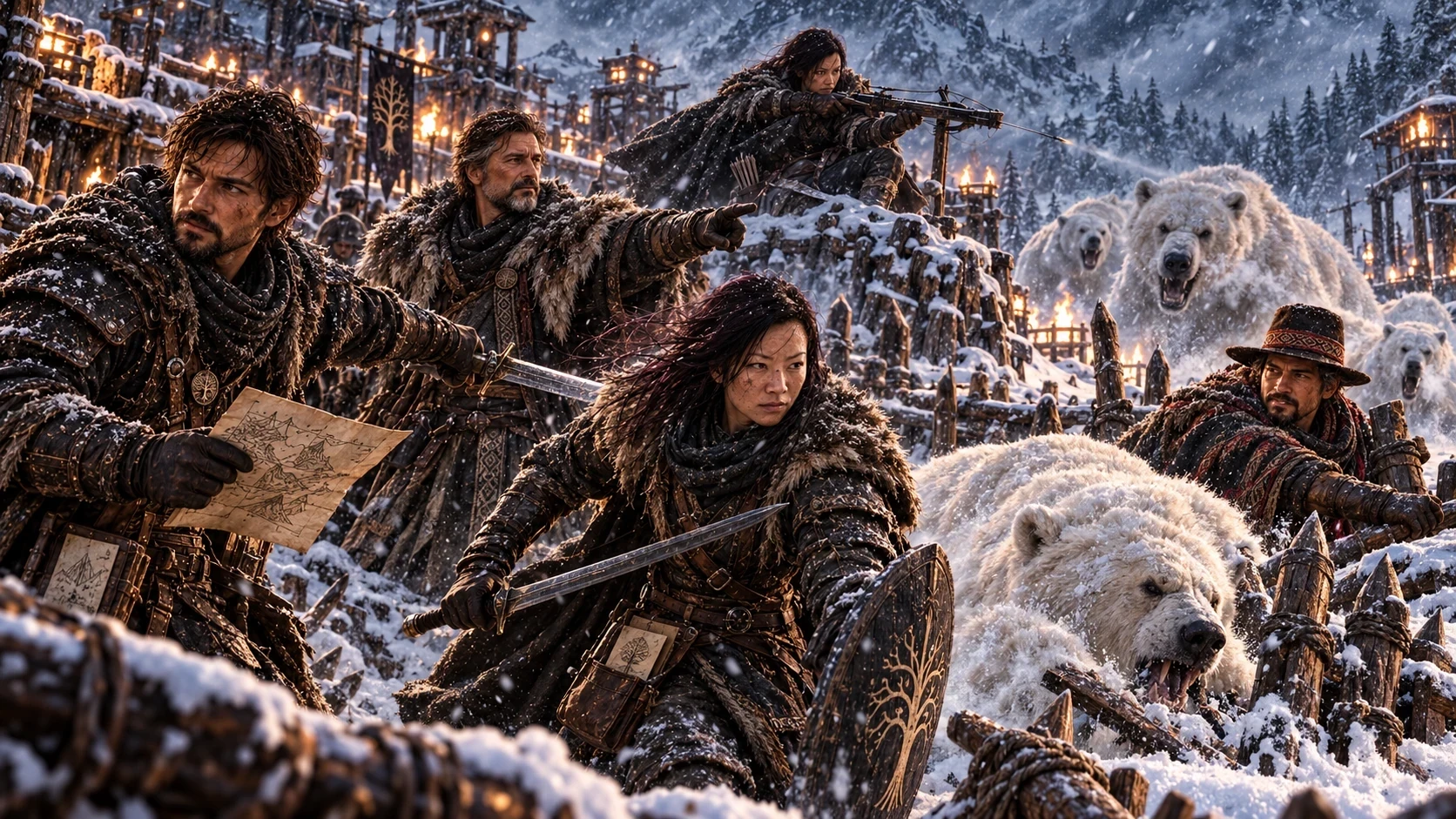
PERSONA
The winter that year was especially harsh. Icy winds howled through the forests, and snow reached the windows of some houses. For weeks the cold demanded everything of the people. Work, guard duties and constant concern for the settlement left little time to think of anything else.
Even those who bore responsibility sometimes needed a break. Leader Seef had his own way of taking one. Once the day's duties were done and nobody needed him for a few hours, Seef became Little Chief. Not literally, of course. Little Chief was his alter ego, a side of him that did not have to worry about orders, supplies or tomorrow's problems. He went out into the snowy woods, searched for new paths and enjoyed the rare hours when he could simply be an adventurer.
Ket knew that need too. As a military leader she was responsible for people who placed their lives in her hands. Decisions had to be made quickly; mistakes could be fatal. But sometimes Ket laid all that aside. Then she became Harley.
Harley did not lead soldiers into battle. She painted. Sometimes she wrote. She could spend hours over a canvas or sheet of paper, forgetting everything beyond that small moment. Her paintings were bold, sometimes wild, and her writing more personal than Ket would ever have allowed in everyday life. It was her way of catching her breath.
Argento had a refuge of his own. When Argento became MdaAgent, he usually disappeared into the kitchen. There he needed no plans or orders. Only a knife, a heavy pot, a hot stove and good ingredients. Argento loved cooking. And, as even his friends reluctantly admitted, he was damned good at it.
He tried spices, altered old recipes and could turn stores that left others staring helplessly into the pantry into a meal that let everyone forget the frozen world outside for a few hours. MdaAgent was perhaps the only persona whose appearance everyone else explicitly welcomed.
Moidark, in turn, became BadMoidark. It was his chance to spend a while free of constant thoughts about intelligence, secrets and possible dangers. What BadMoidark did during those hours was his own business. Nobody asked many questions.
That winter, switching off was harder than usual. A report about the southern trade routes lay on his desk. Unknown buyers were paying conspicuously high prices for copies of maps, lists of traveling craftspeople and names of people with access to warehouses and council chambers. The same place came up repeatedly: Sonnenfeuer Schloss.
It was no proof of a crime. Wealthy courts bought information, maps and services. Still, Moidark did not file the report among ordinary trade papers. Before becoming BadMoidark, he locked it in the bottom drawer.
For Deathhead, that other self was called Miss Deathhead. She sought no people. She sought quiet. Alone outdoors she could unwind. She knew animal tracks and could tell when the forest was truly quiet and when it only seemed so. Out there nobody demanded explanations of her.
Five people. Five alter egos. Five different ways to be somebody else for a few hours. But that winter gave them little rest.
It began with rumors. Hunters reported unusually large tracks. Travelers claimed to have seen white bears, not one but several. Then Deathhead returned. She needed only a few words. “They're coming.”
The tracks she found were enormous. The animals were moving toward the settlement. The time for personas was over. Or at least it should have been.
Seef organized the defenses. Ket assembled her people and prepared them for an attack. Argento gathered every available account of sightings, routes and animal movements. Moidark looked for ways to lure the bears away from populated areas and disrupt their paths. Deathhead went out again, this time not to relax.
When the first bears emerged from the white storm, the fight began. They were huge. White bodies burst from the snow faster than their size suggested. Men shouted warnings. Ket led her people against the animals while Seef kept the defense from breaking apart.
Deathhead fired. One bear fell, then another. Argento's information let the defenders anticipate the animals' movements. Moidark's prepared obstacles forced several bears into bad positions.
Yet something was wrong. The animals did not behave normally. They did not flee. They barely retreated. Even wounded bears kept pressing toward the settlement.
Some later claimed they had seen something in their eyes. Others told of a darkness behind the snowstorm, of something driving the animals. Perhaps it was true. Perhaps people were seeking an explanation for what they did not understand.
That night it did not matter. Seef, Ket, Argento, Moidark and Deathhead fought together. Truly together. Every movement complemented the next. A warning from Argento became an order from Seef. An order from Seef became a movement by Ket's people. Moidark's preparations forced a bear exactly where Deathhead already waited.
Eventually no one could say who was responding to whom. It seemed as if they no longer needed to speak, as if five people thought the same thought, as if five bodies moved with a single will.
Later storytellers made something greater of it. They said Little Chief, Harley, MdaAgent, BadMoidark and Miss Deathhead had merged into one being that night: a figure of strength and determination facing the darkness.
Of course they never literally became one being. But anyone who saw them fight that night could understand how the story arose.
By morning the bears had been defeated. What drove them to attack remained unclear. Perhaps hunger, perhaps the unusually hard winter, perhaps something else. The settlement still stood. The five were exhausted.
Once the wounded had been treated, damage assessed and the most pressing work done, everyday life slowly returned. Seef vanished among the trees again as Little Chief. Ket took up brushes and paper as Harley. Deathhead sought the forest's quiet as Miss Deathhead. Moidark became BadMoidark and let the world's secrets remain secrets for a few hours. The next morning he opened the bottom drawer again.
And somewhere Argento, as MdaAgent, was already setting a large pot on the stove. After that winter, he thought, they deserved a proper meal.
Perhaps their personas had never been meant to make them stronger. Perhaps they were simply what allowed them to stay strong.
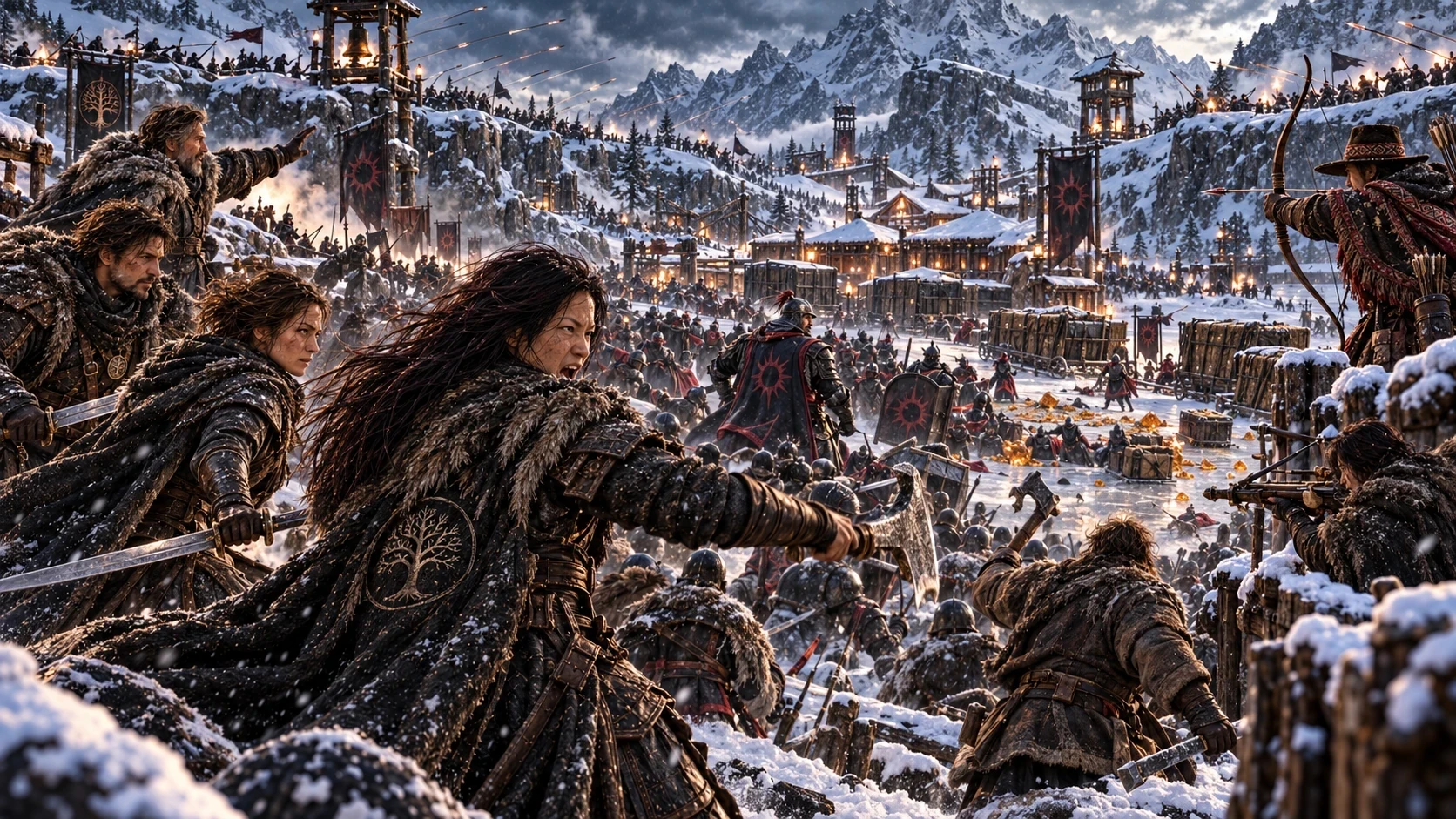
THE CONVOY
The Ambush at the Trading Station
The snow fell so thickly that the far bank of the frozen river vanished from time to time.
Ronne stood on the landing and studied the six sleds.
Furs.
Blankets.
Tools.
Dried meat.
And amber.
Amber above all.
It was small enough to disappear inside one hand and valuable enough for people to kill over a single crate.
Ronne knew that.
That was why she checked the lashings on the lead sled for the third time.
“Pull on it once more and you'll snap the rope yourself,” Ket said behind her.
Ronne straightened.
The scar running from her left cheek to her jaw tightened as she grinned.
“Then at least I'll know whose fault it was.”
Ket looked over the sleds.
“Six?”
“Three carrying the valuable goods. Three decoys.”
“Which are which?”
“If I tell you, everyone will know soon enough.”
Ket raised an eyebrow.
“I'm supposed to defend the convoy.”
“Then defend all six.”
Ket laughed.
Only briefly.
Then she grew serious again.
“Phaeton patrols on the north ridge.”
Ronne nodded.
She had already heard.
Seef crossed the landing toward them.
“Not just patrols.”
He held out a folded report to Ronne.
“Moidark's people saw a larger unit yesterday. It's moving east.”
“How large?”
“Large enough that I doubt they're hunting rabbits.”
Ronne took the report.
“Vark?”
Seef nodded.
General Vark.
By now, the name had surfaced along several trade routes.
A Phaeton officer who understood that he did not necessarily have to conquer a settlement to defeat it.
He could simply take away its food.
Its iron.
Its leather.
Its money.
And its friends.
Argento joined them with several rolled maps beneath one arm.
“If the convoy doesn't get through, we'll lose more than amber.”
Ronne looked at him.
“Please don't say anything about some ancient book.”
Argento stopped.
“I was going to talk about trade agreements.”
“Almost as bad.”
He ignored that.
AIO, GBR, NFD and N3N used the same northern trade routes. Not always peacefully and certainly not out of friendship. But goods changed hands, news was exchanged and agreements were made.
If Phaeton controlled those roads, the balance of power would shift.
Moidark emerged from the blowing snow.
Deathhead was with him.
“Vark is here,” Moidark said.
Ronne looked toward the north ridge.
“Certain?”
Deathhead answered.
“I saw him.”
That was enough.
They changed the plan.
The convoy would go ahead regardless.
Three sleds would lead.
Three would follow at a distance.
Ket commanded the escort.
Moidark's scouts moved away from the road.
Deathhead vanished before sunrise.
No one asked where.
Holger led a group of additional helpers: lumberjacks, hunters, drivers and several young defenders whom he had spent weeks teaching that a spear was useful only if they did not trip over their own feet first.
Seef remained behind.
At least, that was what Phaeton was meant to believe.
“We'll meet at the trading station,” he told Ronne.
“If I make it.”
“You'll make it.”
Ronne climbed onto the lead sled.
“That almost sounded friendly.”
“Don't get used to it.”
The first few hours passed quietly.
Too quietly.
Ronne did not like quiet trade roads.
Quiet usually meant that every sensible animal had already fled.
Moidark appeared on a hill to the left of the route.
He raised two fingers.
Ket saw the signal.
“Two groups.”
Ronne tightened the reins.
“How far?”
“Close.”
The answer came from the forest.
One blast of a horn.
Then a second.
Phaeton soldiers burst from the curtain of snow.
Heavy armor.
Spears.
Shields.
The black sun symbols on their banners were visible even through the storm.
“Sleds together!” Ket roared.
The drivers reacted at once.
Three sleds were turned sideways.
The escort took position behind them.
Phaeton struck seconds later.
The first collision was brutal.
Spears crashed against wood.
One man was dragged from a sled.
Ket smashed her axe into a shield, kicked the soldier behind it off his feet and pulled the next defender into the gap.
“Hold the line!”
Ronne dropped the reins and drew her sword.
A Phaeton soldier reached for a crate of amber.
Ronne struck him in the face with the pommel.
“Hands off.”
He staggered.
She kicked him from the sled.
On the far side of the road, Deathhead appeared between two soldiers.
One fell.
The other turned.
Deathhead had already vanished.
From a high rocky ridge, Moidark signaled to his archers.
No arrows of ice.
No magic.
Only steel, wood and people who knew where to shoot.
The volley struck Phaeton's right flank.
“Fall back!” Ronne called.
Ket looked at her.
“We can hold them.”
“Not long enough.”
Ket understood.
The trading station.
They had to draw Vark there.
The retreat began in good order.
Then it became chaotic.
Phaeton pressed forward.
One of the lead sleds was hit and swung across the road.
“Ronne!”
Ket saw several soldiers seize the draft animals.
Ronne jumped.
The sled overturned.
A crate shattered.
Amber scattered across the ice.
Several Phaeton soldiers rushed toward it at once.
Ronne lay in the snow.
Argento reached her first.
“Injured?”
“Only angry.”
“That doesn't count with you.”
He pulled her up.
Together, they did not gather the amber.
They left it where it lay.
Argento gave her a questioning look.
Ronne grinned.
“Decoy sled.”
For the first time that day, Argento looked pleased.
Phaeton's soldiers were already fighting over worthless rubble and a few small pieces of amber.
“I take back everything I've ever said about merchants.”
“No, you don't.”
“No.”
They ran on.
Then Vark appeared.
He did not ride.
He walked among his soldiers as though the snow belonged to him.
A scar crossed his face.
“Ronne!”
She turned.
“You know me?”
“I know everyone who stands in my way.”
“Then you'll need a better memory.”
Vark smiled.
“You think this is about a few crates?”
His men continued their advance.
“Trade is power. Whoever controls the roads decides who starves and who receives weapons. AIO. GBR. NFD. N3N. Sooner or later, they will all pay.”
Ket stepped beside Ronne.
Her axe was bloody.
“You talk too much.”
Vark looked at her.
“And you are Ket.”
Ket's mocking expression vanished.
Vark knew her name.
“Phaeton knows its enemies,” he said.
Ket raised her axe.
“Then remember the rest.”
They continued to fall back.
The trading station emerged through the snow.
A low building.
A storage yard.
An iron bell tower.
Ronne heard Phaeton's footsteps behind her.
Too many.
Holger led the last civilians between the trees.
“Keep moving! Don't stop!”
Moidark reappeared.
“They took the bait.”
Ronne looked at him.
“Reinforcements?”
“Waiting.”
“How many?”
Moidark grinned.
“Enough.”
Ronne reached the bell tower.
She seized the rope.
She pulled once.
The iron bell rang.
Its voice rolled across the plain.
Vark stopped.
Too late.
The snow around the trading station moved.
White camouflage sheets were thrown aside.
Seef's people rose from prepared positions.
Archers on the roofs of the warehouses.
Spearmen behind low walls of snow.
More fighters in the forest.
Seef stood in the middle of the road.
“Now.”
The first volley struck Phaeton from the side.
The second came from the front.
Moidark's people closed the road behind them.
Vark had chased the convoy.
And arrived exactly where Seef wanted him.
“Forward!” Ket roared.
This time, no one fled.
Ronne tightened her grip on her sword and advanced beside her.
The battle at the trading station did not last long.
It felt like hours all the same.
Phaeton was disciplined.
Vark's men did not break at once.
But they were trapped between Seef's defenders, Ket's escort and Moidark's people.
Deathhead appeared wherever a line seemed about to hold.
Once the sleds were safe, Holger led the workers and drivers back into the fight.
Argento fought near the station and at one point shouted:
“Ronne!”
She turned.
He threw something to her.
A small bead of amber.
She caught it.
“What am I supposed to do with this?”
“You were so determined that it should arrive.”
Ronne slipped it into a pocket.
“Idiot.”
“You're welcome.”
Then Phaeton's line broke.
Vark escaped.
Ket saw him disappear among the fleeing soldiers.
She wanted to pursue him.
Seef held her back.
“No.”
“We have him.”
“We have the convoy.”
Ket looked toward the road.
Wounded.
Dead.
Broken sleds.
But the three vehicles carrying the true trade goods stood safely inside the station.
Ronne joined them.
“He'll come back.”
Moidark nodded.
“Yes.”
Deathhead cleaned her blade.
“At least we know what he looks like.”
Seef looked at her.
“You are not going after him alone.”
Deathhead said nothing.
That made Seef visibly unhappy.
That evening, the trading station's bell rang once more.
This time, not as a signal.
The merchants had arrived.
The goods were delivered.
The amber was weighed.
The agreements were confirmed.
And word of the attack traveled on with the merchants to AIO, GBR and N3N.
Phaeton had tried to break a trade route.
Instead, Vark had shown them all why they needed it together.
Argento later wrote that the ambush at the trading station had not been won by any special weapon.
Nor by an ancient artifact.
It had been information.
Preparation.
Deception.
And a convoy that survived long enough to lead the enemy to the wrong place.
Years later, Ronne read the account.
Beneath the final sentence she wrote only:
“And six damned good sleds.”
Ket added beneath it:
“Five.”
Ronne crossed it out.
“Six. The broken one counts.”
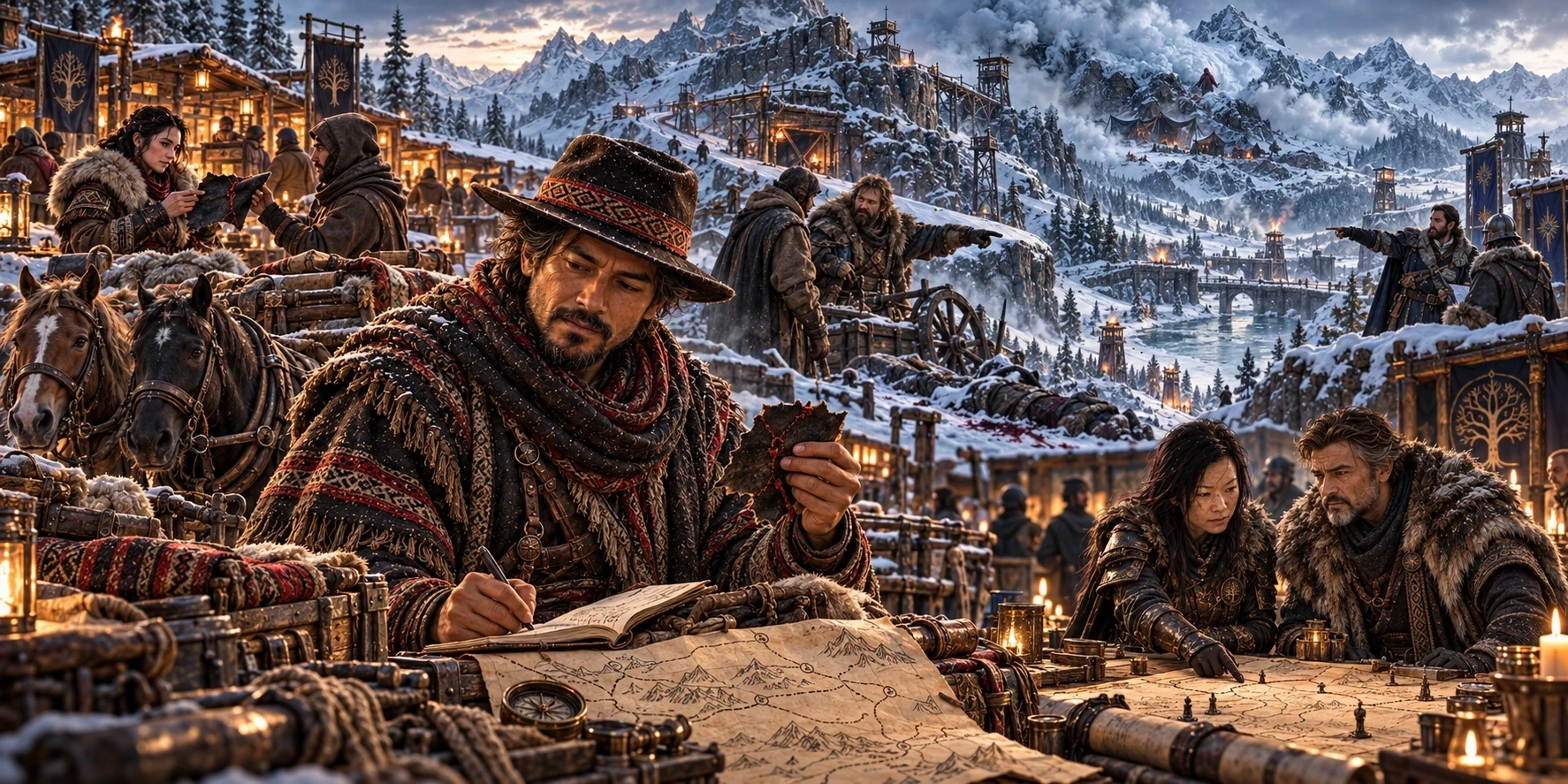
MOIDARK
The Merchant of Frost and Fire
Before Moidark became known in NFD for maps, reports and secrets, he was one thing above all: a merchant.
His sled traveled between N3N, GBR, AIO and NFD. It carried cloth, iron, furs, tools and anything else for which a buyer could be found during a long winter. His two powerful draft animals, Hark and Thane, knew some trade roads better than the men who guarded them.
But Moidark's most valuable wares never lay on his sled.
They were information.
He listened to miners. Guards. Innkeepers. Merchants who, after two cups too many, suddenly spoke of things they would rather have kept quiet the following morning.
That was how Moidark became one of the first to notice that something was wrong on the trade routes.
Three of his caravans vanished near Glacial Pass.
They were no ordinary raids. Goods had been left behind, while provisions, tools and certain metal parts were missing.
At an abandoned wagon, Moidark found a piece of black leather stitched with red thread.
A symbol he did not know.
In N3N, he showed it to Makka.
She recognized it.
“Phaeton.”
Moidark looked down at the strip of leather.
“I thought they were gone.”
“Many did.”
That was not enough for him.
He traveled on to GBR.
There he met Angus, who told him of two murdered sentries and suspicious movements near the mines. Supplies had vanished there as well. Not at random. Food, metal, fuel and equipment.
Someone was preparing something.
“Vex,” Angus said at last.
Moidark knew the name only from rumors.
“You saw him?”
“No. A man in a red coat. Perhaps Vex. Perhaps someone who wanted us to believe it was him.”
Moidark wrote that sentence down exactly in his notebook.
Perhaps.
That word would save his life many times in the years to come.
In AIO, the picture grew clearer.
Kristiano had also lost scouts. Reports suggested that Phaeton's people were watching trade routes and gathering information about troop movements.
More troubling still was their objective.
Within a few weeks, representatives of N3N, GBR, AIO and NFD were due to meet for negotiations.
If an attack took place during that meeting and the blame fell on NFD, distrust could become war.
Moidark left for NFD at once.
Seef listened to his report in silence.
Ket stood beside the table, studying the marked trade routes.
“Evidence?” Seef asked.
Moidark laid pieces of leather, coins, copies of guard reports and his own notes on the table.
“No single piece proves everything,” he said. “Together, they form a pattern.”
Ket looked at Seef.
“Enough to investigate.”
Seef nodded.
“Then we investigate.”
NFD sent out scouts.
Moidark insisted on going with them.
He was no frontline fighter. He knew that better than anyone.
But he knew trade roads, old smuggling paths and the places where one man could supply fifty people without a single wagon ever appearing on an official road.
That reasoning led them to Black Hollow.
There they found a hidden Phaeton camp.
Weapons.
Supplies.
Pieces of uniforms from different regions.
Forged insignia.
And enough material to plant evidence after an attack that would have pointed to NFD.
Ket whispered:
“You were right.”
Moidark shook his head.
“I was afraid I was right.”
Then they were discovered.
The fighting began faster than anyone had planned.
Phaeton fighters poured from the shelters. Ket and the scouts held them back while Moidark searched for a route of retreat.
At the far edge of the camp he glimpsed a man in a red coat for a few seconds.
“Vex!” someone shouted.
Moidark could never say with certainty whether it truly was Vex.
The man vanished behind the rocks.
Moidark noticed something else.
A heavy shelf of snow hung above the camp on a steep slope.
He knew the country.
He knew snow.
And, above all, he knew loads.
“Ket! Fall back!”
She did not understand at once.
Moidark seized a signal flare and threw it to one of the scouts.
“At the marked spot!”
The man fired.
The impact alone would not have been enough. But the snowpack was already unstable, and Moidark had noticed a weak point on their way in.
Part of the slope gave way.
Snow, ice and rock crashed into the camp.
Ket pulled her people back.
Several Phaeton fighters were buried. Others fled through side exits.
The man in the red coat had vanished.
Later, they searched for him.
They found bodies.
They found equipment.
They found a torn strip of red cloth.
But no body that could be identified beyond doubt as Vex.
One scout declared him dead all the same.
Moidark struck the statement from his report.
Beside it he wrote:
Vex — death unconfirmed.
Seef later read the sentence twice.
“You think he's alive?”
“I don't think anything,” Moidark replied. “I only know we have no body.”
Seef nodded.
“Keep that habit.”
The planned attack never took place.
Negotiations between the regions continued. The evidence recovered at Black Hollow was shared, and several Phaeton connections along the trade routes were exposed.
Afterward, Moidark did not simply return to his old life.
He continued to trade.
But his journeys now had a second purpose.
Every market was a source.
Every caravan might have seen something.
Every missing sack of grain might mean nothing.
Or it might be the beginning of a pattern.
In time there were maps.
Lists.
Contacts.
Reports.
The merchant who had gathered information on the side became a man to whom information was brought.
Years later, others would know Moidark as NFD's planner, scoutmaster or intelligence officer.
He still preferred a simpler title.
“Merchant.”
Ket once asked him:
“What do you even trade now?”
Moidark thought for a moment.
“Truths.”
Ket grimaced.
“That sounds terrible.”
“Furs, then.”
“Better.”
In his oldest surviving report on Phaeton, the same note still appears beneath Vex's name:
No body. No confirmation.
At some point, someone added below it in a different hand:
You really are no fun at funerals.
Moidark added:
Only when there's a body.
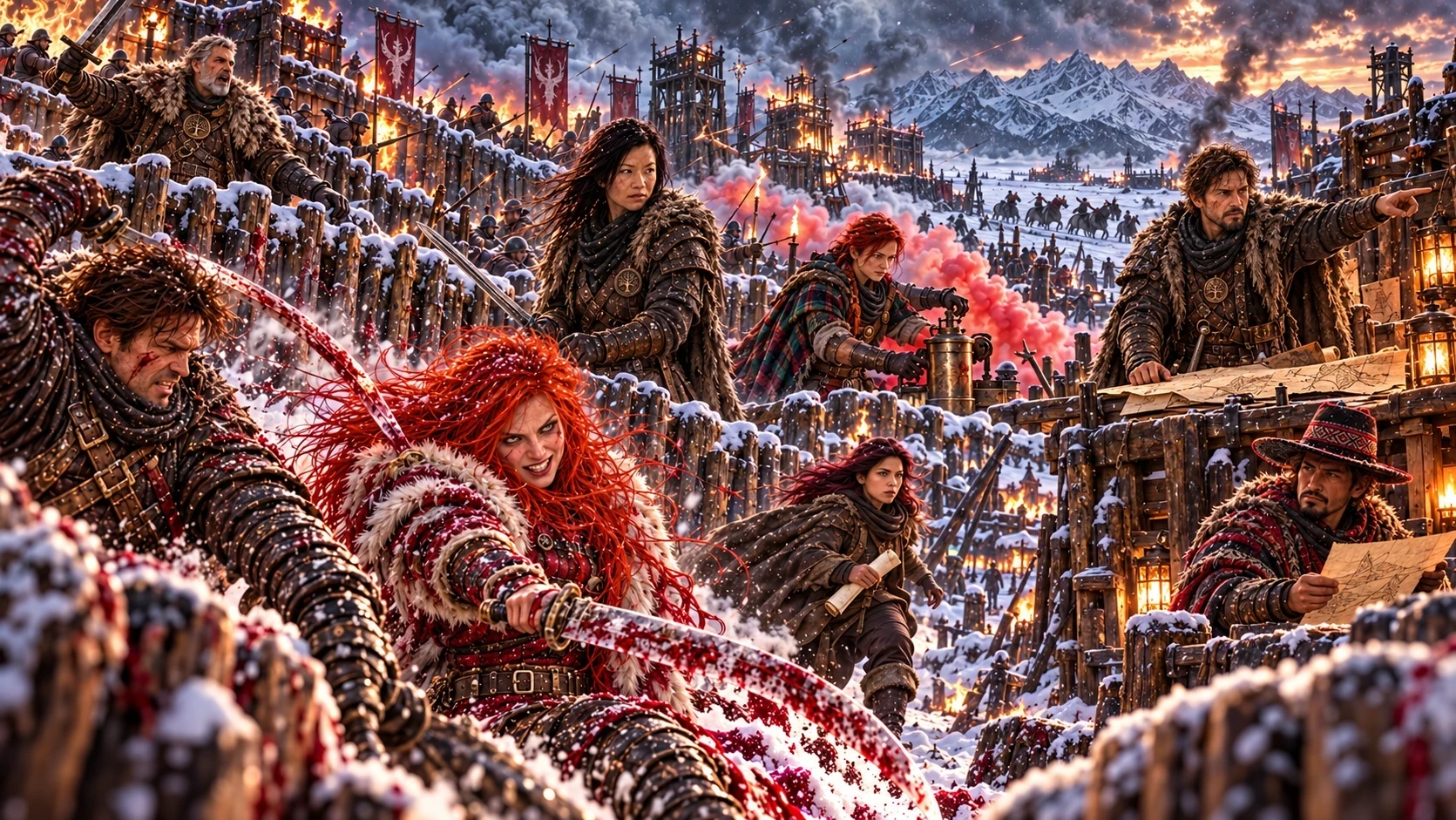
THE SIEGE OF THE TUNDRA TRADING STATION
Darthsiege — Final Edition
By the Ink of Winter, I write this tale—of cold steel, colder hearts,
and people who refused to kneel.
I. KET – THE WEIGHT OF COMMAND
The Tundra Trade Station mattered because NFD had changed. After Kharad, the northern roads were no longer merely survival routes. They connected a recognized kingdom to allies, markets, letters, food and metal. Darth’s evolution from fighter to merchant had become part of that system, and Argento’s maps were no longer the hobby of a librarian.
An attack on the station was therefore an attack on NFD’s reach.
Ket understood that.
So did Seef.
And so did Crazy Joe.
The northern wind hammered against the walls of the Tundra Trade
Station. What had once been little more than a remote platform for
merchants had grown into one of the important knots of the northern
routes. Furs, tools, food, metal, letters and agreements passed through
it. So did rumors.
That was why Crazy Joe had come.
Ket stood on the watchtower and watched torches move through the forest.
A hundred marauders, perhaps more, advanced through the snow. Some rode
lean tundra beasts, others marched behind crude shields made from
scavenged iron and timber.
At their head rode Crazy Joe.
Her copper-and-ash hair whipped in the wind. In one hand she carried a
heavy chain flail whose head burned with an unnatural blue flame. Nobody
on the wall knew how the weapon worked.
Ket did not care.
“They’re not here for bodies,” she said. “They want the stores.
Granaries. Trade seals. Gold.”
Seef looked down toward the station yard. “And if they take them?”
“Then they don’t just rob us. They cripple the routes.”
Ket turned from the wall.
“Archers to the eastern ridge. Infantry behind the inner barricade.
Nobody chases unless I give the order.”
Deathhead waited below, already armed.
Darth stood beside her, shuffling a battered deck of tarot cards with
gloved fingers.
Ket pointed toward Crazy Joe’s western flank.
“You two go around them. Break their command. Standard-bearers first.
Officers if you can reach them.”
Darth drew a card and glanced at it.
The Hanged Man.
He smiled.
Deathhead looked at him. “Bad sign?”
“Depends who’s hanging.”
Ket gave them both a hard stare.
“Try surviving long enough to argue about it later.”
Then the war horns sounded.
II. ARGENTO – THE MAPS OF THE DEAD
Argento was already in the library.
Not because he intended to hide there.
The shelves held generations of maps, trade reports, weather notes,
survey sketches and half-forgotten accounts from merchants who had
crossed the tundra before the station had walls.
Zee rushed through the door.
“South gate breached. Two wounded.”
Argento did not look up.
“Where are Joe’s reserves?”
“Western tree line.”
“That makes no sense.”
He spread three old maps across the table.
One showed the station before the northern warehouse had been built.
Another marked an abandoned drainage trench. The third was a survey of
the eastern slope made years before the trade road had been widened.
Argento traced a finger across the paper. The scarred skin of his right hand tightened as he flattened the oldest map, and the lamplight caught the burn scars along the left side of his face.
“They think this is open ground.”
Zee leaned closer.
“It isn’t?”
“Not underneath.”
The old drainage trench had been covered by snow and years of repairs,
but much of it still existed beneath the eastern approach. Heavy riders
crossing it in numbers could break through the crust and collapse the
route.
Argento grabbed a sheet of paper.
“Take this to Ket. Tell her to give them the east.”
“The east?”
“Make it look weak.”
Zee stared at him.
Argento tapped the map.
“Crazy Joe came for our trade station. Let the trade station fight
back.”
III. NIKKI – THE WORKSHOP
Nikki hated plans that depended on perfect timing.
So she had built hers to work even if everyone else got the timing
wrong.
Inside the workshop stood squat metal canisters assembled from scrap
pipe, furnace fittings and pressure caps. Tubes ran from them toward
vents hidden near the eastern barricade.
Ket entered.
“What does it do?”
Nikki tightened a fitting.
“Nothing pleasant.”
“That isn’t an answer.”
“It’s the only answer you’re getting while I’m working.”
The mixture inside was crude: smoke compounds, pepper, powdered
irritants and several ingredients Nikki refused to let anyone else
handle. It was not magic. It did not need to be.
If the wind held, the canisters would flood the eastern approach with
choking, blinding smoke.
If the wind changed, everyone behind the wall would have a terrible
evening.
Ket looked at the pressure gauges.
“Safe?”
Nikki looked offended.
“Define safe.”
“Nikki.”
“Safer than letting Crazy Joe into the granary.”
Ket accepted that.
“Good enough.”
Nikki smiled.
“It usually is.”
IV. DARTH – THE GAMBLER WITH A LOADED DECK
Darth and Deathhead moved through the snow behind Crazy Joe’s line.
Deathhead barely made a sound.
Darth made several.
“You’re doing that deliberately,” she whispered.
“Doing what?”
“Being irritating.”
“Natural talent.”
He turned over another tarot card while they crouched behind an
overturned sled.
The Tower.
Darth studied it.
Deathhead rolled her eyes.
“If you tell me that means something—”
“It means I’m missing one card from a perfectly good deck if I lose it.”
She disappeared into the darkness before he finished.
A moment later one of Crazy Joe’s standard-bearers dropped without a
cry.
Darth moved toward the second.
A guard turned.
Darth threw the card.
The man flinched instinctively.
The dagger in Darth’s other hand did the real work.
“See?” Darth whispered. “Cards are useful.”
Deathhead reappeared.
“You threw paper at him.”
“And yet I’m alive.”
They continued toward Crazy Joe.
V. THE EASTERN APPROACH
Ket deliberately weakened the eastern line.
Crazy Joe saw it.
Exactly as Argento had expected.
Her riders turned toward the gap.
“Hold,” Ket ordered.
The first wave crossed the snow-covered trench.
Nothing happened.
The second followed.
Still nothing.
Crazy Joe laughed from behind them.
Then the third wave hit the weakened ground.
The crust broke.
A horse and rider vanished first. Then another. Snow, timber and frozen
earth collapsed into the old drainage trench. The following ranks
crashed into those ahead of them.
Ket raised her sword.
“Now.”
Nikki pulled the release.
The first canister coughed.
The second screamed.
Thick smoke rolled across the eastern approach.
Men began coughing. Riders clawed at their eyes. Orders dissolved into
shouting.
The smoke did not kill the army.
It did something more useful.
It broke its shape.
Ket’s archers fired.
The infantry advanced.
Crazy Joe’s assault became a hundred separate fights instead of one
coordinated attack.
VI. BLOOD ON SNOW
Crazy Joe forced her way through the confusion.
The blue flame around her flail hissed against the falling snow.
Deathhead came for her from behind.
Crazy Joe turned at the last possible instant.
The chain snapped around Deathhead’s first dagger and tore it aside.
Crazy Joe spun and struck her with brutal force.
Deathhead hit the snow.
Crazy Joe raised the burning flail.
A hand erupted from beneath the edge of an abandoned canvas cover.
Darth.
He caught the chain with one arm, dragged it sideways and drove a
poisoned stiletto deep into Crazy Joe’s thigh.
Crazy Joe screamed.
She kicked him hard enough to throw him backward.
Deathhead was already standing again.
Blood ran from her nose.
“Your reign ends here.”
Crazy Joe grinned through clenched teeth.
“Come and take it.”
Darth rose beside Deathhead.
“Hearts or blades?”
“Shut up.”
They attacked together.
Darth feinted high.
Deathhead went low.
Crazy Joe blocked her, turned, and nearly caught Darth across the skull
with the flail.
He ducked.
Deathhead struck again.
One dagger punched through Crazy Joe’s armor beneath the collarbone.
The second hit a hidden plate and glanced away.
Crazy Joe staggered.
The poison in her leg was slowing her now. Her movements remained
violent, but no longer precise.
Darth kicked the wounded knee.
Crazy Joe collapsed into the red snow.
Deathhead stepped forward.
Then a horn screamed from the western ridge.
Three of Crazy Joe’s surviving riders crashed into the melee.
One struck Darth aside. Another threw himself between Deathhead and the
fallen pirate queen. The third dragged Crazy Joe onto a waiting sled.
Deathhead lunged.
Too late.
Darth hurled a blade after them.
It disappeared into the snowstorm.
Crazy Joe lifted her bloodied head once as the sled vanished into the
white.
“This isn’t over!”
Then she was gone.
VII. WINTER’S TOLL
Dawn came pale and indifferent.
Seef walked across the battlefield while the wounded were carried
inside.
Ket stood near the broken eastern barricade.
“We held,” she said.
“At a price,” Seef answered.
The granaries were intact.
The trade seals had not been taken.
The station still belonged to NFD.
Argento emerged from the library with Zee beside him and an armful of
maps under one arm.
Ket looked at him.
“You could have mentioned the trench earlier.”
Argento looked toward the collapsed eastern approach.
“I did.”
“Years earlier.”
“I wrote it down.”
“That is not the same thing.”
“To a librarian, it is.”
Ket decided not to argue.
In the workshop, Nikki was already inspecting the damaged canisters and
complaining about soldiers who had kicked one of her pressure lines
loose during the fighting.
Darth sat on a broken sled cleaning his blades.
He looked at the tarot deck in his hand.
One card was missing.
The Tower.
“Won the hand,” he muttered. “Lost a card.”
Deathhead stood apart from the others, staring north.
“She’ll come back,” she said.
Nobody disagreed.
EPILOGUE – THE WHITE HORIZON
Deathhead disappeared before noon.
For two days she followed the traces of Crazy Joe’s retreat north.
Blood appeared on the snow in several places. A broken harness. A
discarded strip of armor. Tracks from the sled.
Then the weather swallowed everything.
Deathhead returned alone.
“No body?” Darth asked.
“No.”
“Shame.”
“You wanted her dead?”
Darth slid a card back into his deck.
“I wanted my knife back.”
Deathhead almost smiled.
Almost.
Ket remained in command while the station repaired its walls and buried
its dead. Nikki returned to the workshop. Argento added new notes to the
old maps, including one very large warning beside the drainage trench.
The granaries were safe.
The trade seals remained intact.
And the northern routes stayed open.
But beyond the ridges, Crazy Joe was still alive.
Badly wounded.
Defeated.
Not finished.
The Tundra Trade Station remembered that.
So did Darth.
So did Deathhead.
And somewhere in the white beyond the horizon, Crazy Joe remembered them
too.
THE END
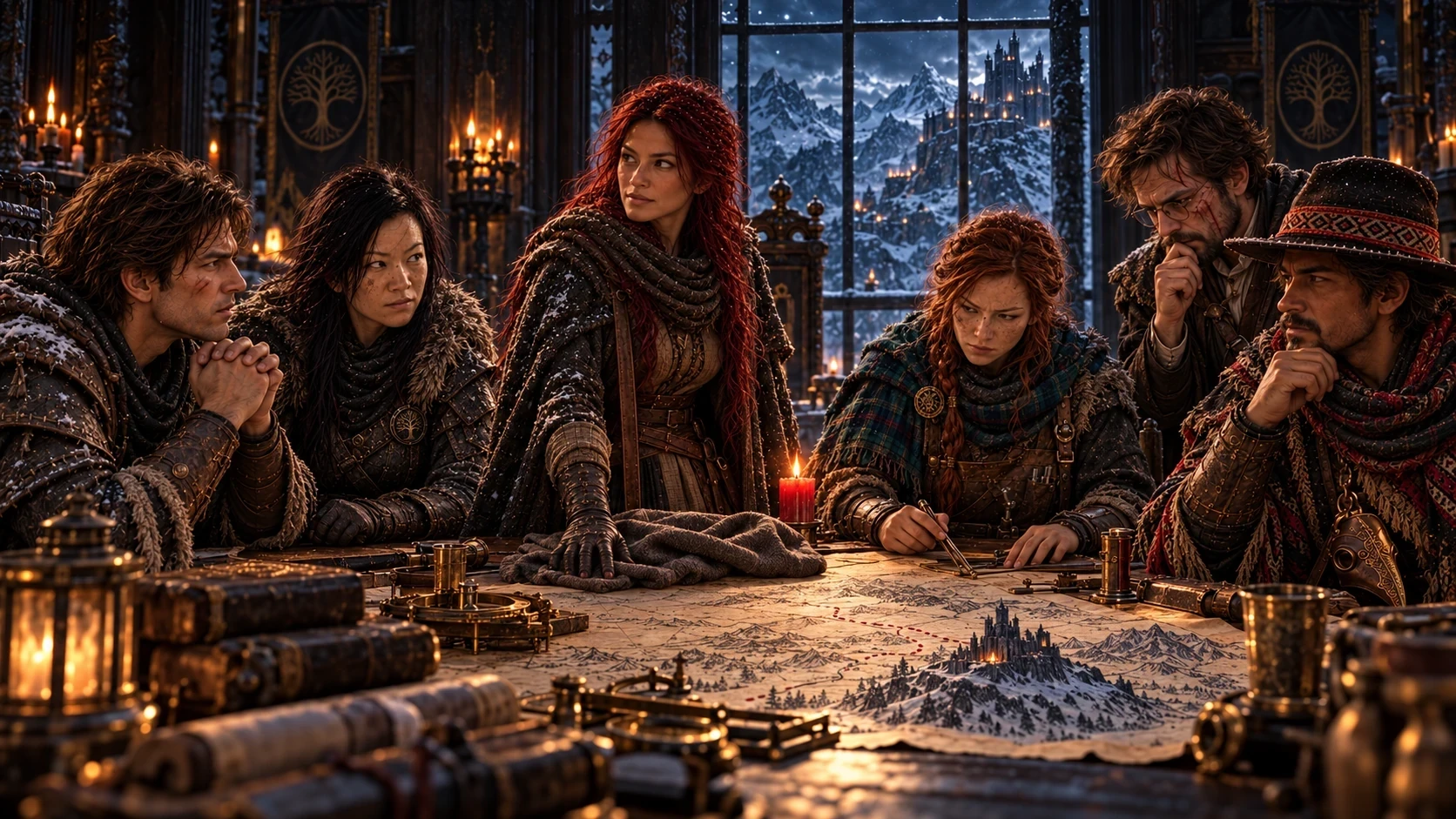
THE WOMAN WHO WAS MEANT TO DISAPPEAR
A Chronicle from the Argento Universe
STATUS: FINAL CANON
Chronicle position: 44
Trade was still functioning.
That was perhaps the most unsettling thing about it.
Caravans came to NFD.
Salt from the south.
Metal from the mountains.
Furs.
Grain.
Tools.
Sometimes books.
Sometimes news.
In the evenings the merchants sat in the taverns, drinking, cursing the snow and complaining about tariffs.
On the surface, everything was as it had always been.
And yet something had changed.
The guards at the borders asked more questions.
Letters of passage were inspected more often.
Tariffs rose without explanation.
Envoys smiled less.
And men who had once drunk together suddenly began paying attention to where their swords lay.
NFD noticed.
Argento noticed first.
Moidark soon after.
Eventually, everyone did.
I. THE SMALL COUNCIL
The group had no official name.
No charter.
No seal.
No assigned seats.
Yet whenever an important decision had to be made, the same people found themselves gathered around the same table with increasing frequency.
Ket.
Nikki.
Darth.
Argento.
Moidark.
Sometimes they argued.
Often, in fact.
But at some point, someone had begun calling them the Small Council.
No one remembered who.
Moidark claimed it had been his idea.
Ket claimed that was precisely why it could not have been.
No one laughed about it that evening.
Deathhead stood at the window.
Outside, snow fell over NFD.
Maps lay on the table behind her.
Not only maps of NFD.
Maps of Winterland.
Trade routes.
Borders.
Castles.
Roads.
And kingdoms that had once seemed very far away.
Argento leaned over them.
“These are not isolated incidents.”
Ket folded her arms.
“No one says they are.”
“We do.”
Argento looked up.
“We have been treating them as isolated incidents.”
He pointed to several marks.
“A new tariff.”
His finger moved.
“A closed road.”
Again.
“A searched caravan.”
Again.
“An envoy who suddenly travels with twenty soldiers when four used to be enough.”
Moidark leaned against the edge of the table.
“Prices change.”
Argento looked at him.
“So do people.”
Moidark nodded slowly.
“Exactly.”
II. THE KINGS
Nikki pulled up a chair.
“What do you think is happening?”
Argento did not answer at once.
He rarely did when he did not know.
Deathhead had once believed silence meant uncertainty.
By now, she knew better.
With Argento, silence usually meant he was trying not to make a supposition sound like a fact.
“I don't know.”
He indicated the realms.
“But we have reports about several rulers.”
Moidark added:
“And their predecessors.”
Argento nodded.
“Not all of them.”
“But enough.”
Deathhead turned from the window.
“What kind of reports?”
Argento lifted several sheets from the table.
“At first, mostly the same thing.”
He did not read from them.
He knew them by heart.
“A new ruler takes power. The army grows. Government becomes stricter. The borders are fortified.”
Ket shrugged.
“That's called ruling.”
“Yes.”
Argento set the first sheet aside.
“Then something changes.”
The second.
“More soldiers.”
The third.
“More demands.”
The fourth.
“Harsher punishments.”
Another.
“Distrust of allies.”
Moidark said:
“And eventually each of them begins to believe his realm is not large enough.”
Silence.
Darth sat at the far end of the table.
Unusually quiet.
Deathhead noticed.
Darth was rarely quiet.
When he said nothing, it usually meant something was serious.
Argento gathered the reports.
“They become more powerful.”
Ket looked at the maps.
“That isn't unusual.”
“No.”
Argento looked at her.
“But they also become more aggressive.”
Deathhead watched him.
Argento hesitated.
Then he said the word he had clearly been trying to avoid.
“Evil.”
No one disagreed.
III. SONNENFEUER CASTLE
Moidark picked up a small black figurine from the edge of the table.
He placed it far to the east on the map.
“There is one place that keeps appearing.”
Deathhead looked at the figurine.
Argento spoke the name.
“Sonnenfeuer Castle.”
Deathhead had heard of it.
Everyone had.
A black fortress in the ice.
Ancient.
Rich.
Feared.
A place merchants discussed only when there was enough alcohol on the table.
“What does the castle have to do with this?” Nikki asked.
“Perhaps nothing,” Argento said.
Darth raised his head for the first time.
“And perhaps everything.”
Argento nodded.
“Almost every ruler whose behavior changed markedly had contact with that place at some point.”
Ket stepped closer.
“A visit?”
“For some.”
Moidark answered this time.
“Others sent envoys.”
He pointed to several trade lines.
“Some traded with Sonnenfeuer Castle.”
His finger stopped on one route.
“And some publicly claimed never to have had anything to do with it.”
Deathhead looked at him.
“Which usually means they did.”
Moidark did not smile.
“You're learning.”
“From the best.”
“That almost insults me.”
No one laughed.
Deathhead noticed.
Again.
She looked at those around the table.
Ket.
Nikki.
Darth.
Moidark.
Argento.
They all already knew why she was there.
No one had said it yet.
IV. THE REQUEST
Argento removed his glasses.
He did not clean them.
He simply held them in his hand.
Deathhead had known him long enough to understand that this meant something too.
“We need someone inside.”
Now it had been said.
Deathhead remained by the window.
“For how long?”
Moidark answered.
“We don't know.”
“Weeks?”
No answer.
“Months?”
Moidark looked at Argento.
Argento said:
“Possibly longer.”
Deathhead nodded slowly.
“And what am I looking for?”
Argento put his glasses back on.
Then he looked directly at her.
“Everything.”
Deathhead raised an eyebrow.
“Unusually precise.”
Ordinarily, Darth would have laughed.
This time, he did not.
Argento approached the table.
“I want to know who goes in and out.”
He pointed to Sonnenfeuer Castle.
“Which merchants.”
Another point.
“Which envoys.”
Another.
“Which officers.”
His voice grew quieter.
“Which priests.”
Deathhead said nothing.
“I want to know what they buy.”
Argento looked at the trade routes.
“What they sell.”
Then at the castle.
“What they hide.”
Moidark added:
“Who can be bribed.”
Ket:
“How many soldiers they have.”
Nikki:
“What workshops they operate.”
Argento:
“What ties they have to the other kingdoms.”
Deathhead looked from one to another.
“Anything else?”
Darth answered.
“Come back.”
Everyone looked at him.
Darth did not shrug.
Did not joke.
Did not grin.
“That's part of the mission.”
Deathhead studied him for a moment.
Then she looked back at Argento.
“So you want me to enter one of the most dangerous fortresses in Winterland without knowing what I'm actually looking for.”
“Yes.”
“And stay there until I find something.”
“Yes.”
“Perhaps for months.”
Argento was silent.
Deathhead understood.
“Perhaps for years.”
This time, Argento answered.
“Yes.”
V. DEATHHEAD
No one spoke.
Not even Moidark.
Deathhead walked slowly to the table.
She studied the black figurine.
Sonnenfeuer Castle.
A name.
For the moment, that was all it was.
A name on a map.
Perhaps she would find nothing there.
Perhaps she would discover that NFD was chasing ghosts.
Perhaps the rulers were simply men who had possessed power for too long.
Perhaps no castle was needed.
No secret cause.
No conspiracy.
Perhaps power could turn people into monsters all by itself.
Deathhead did not know.
Argento did not know.
And that was precisely why they were sitting here.
“If I go,” she said, “there will be no messages.”
Moidark nodded.
“Too dangerous.”
“No regular meetings.”
“No.”
Moidark raised one finger.
“Only a sign.”
Deathhead looked at him.
“I know a merchant named Thorsen. I have for a long time. He was one of the few I could rely on before my business became more than a wagon and a good memory.”
“From your Moidarkmerch days?” Darth asked.
Moidark pursed his lips.
“I never used that name.”
“But everyone else did.”
Moidark ignored him.
“Thorsen's route passes Sonnenfeuer Castle every few months. He will carry no messages. He will not speak to you. He will not even know what you are looking for.”
Deathhead waited.
“Every night, leave a red candle burning in the window of your little room,” Moidark said. “Only there. Only that one sign.”
“And if Thorsen doesn't see it?”
Moidark looked at her.
“Then I will assume Deathhead did not survive.”
For a moment, only the wind at the window could be heard.
Deathhead nodded.
“One candle.”
“Nothing more.”
“If I am exposed, you don't know me.”
Moidark looked at her.
“Deathhead—”
“If I am exposed.”
Moidark fell silent.
Then he nodded.
“If you are exposed.”
Deathhead looked at Ket.
Ket said nothing.
At Nikki.
She too was silent.
Then Darth.
He simply looked at Deathhead.
No grin.
No stupid remark.
That made it worse.
At last, her gaze settled on Argento.
“And if I find nothing?”
Argento answered at once.
“Then that is information too.”
Deathhead looked again at the black figurine.
For a long time.
Then she took it from the table.
Turned it between two fingers.
“I need a story.”
Moidark understood first.
“A false identity.”
“A good one.”
“Origin?”
“Far enough away that no one can ask questions.”
Nikki said:
“Occupation?”
Deathhead considered.
Then she looked at her hands.
Hands that had held swords.
Knives.
Bows.
Hands that had killed.
“Something invisible.”
Argento understood.
“A servant.”
Deathhead nodded.
Moidark was already thinking.
“Name?”
This answer took longer.
Outside, the wind drove snow against the window.
Deathhead set the black figurine back on the map.
Directly on Sonnenfeuer Castle.
“Mara.”
VI. WHAT WE DO NOT KNOW
Later, they went their separate ways.
Ket first.
Then Nikki.
Moidark remained with the maps a while longer.
Darth stood in the doorway.
Deathhead tried to pass him.
He did not move aside.
“What?”
Darth looked at her.
“You don't have to do this.”
Deathhead waited.
“I know.”
“Good.”
He stepped aside.
Deathhead took two steps.
Then stopped.
“Darth.”
“Yes?”
“If I'm gone for two years and you do anything completely idiotic while I'm away, I'll kill you.”
Darth finally grinned.
Only a little.
“Then you'll have to come back.”
Deathhead left.
Argento remained alone.
Almost.
Moidark was still standing in the shadows across the room.
“You really believe there is something there,” he said.
Argento looked at the black figurine.
“I don't believe anything.”
Moidark snorted.
“Of course.”
Argento picked up one of the sheets.
One king.
One name.
One report of violence.
Then a second.
Another king.
More soldiers.
More fear.
“I only see a pattern.”
Moidark stepped beside him.
“And if Deathhead discovers there is no pattern?”
Argento laid the reports down again.
“Then we can stop looking for one.”
“And if she discovers there is?”
Argento looked toward Sonnenfeuer Castle.
For a long time.
“Then I hope we are ready to learn what waits at the end of it.”
Outside, Deathhead disappeared between the houses of NFD.
For now, she was still Deathhead.
Soon, she would be Mara.
And no one at the table knew that two winters would pass before she came home again.
They did not yet know of the Heart.
They did not yet know of Cthuga.
Sonnenfeuer Castle was still only a black fortress on a map.
But for the first time, NFD had decided not to wait for danger to come to them.
This time, they would look first.
THE END
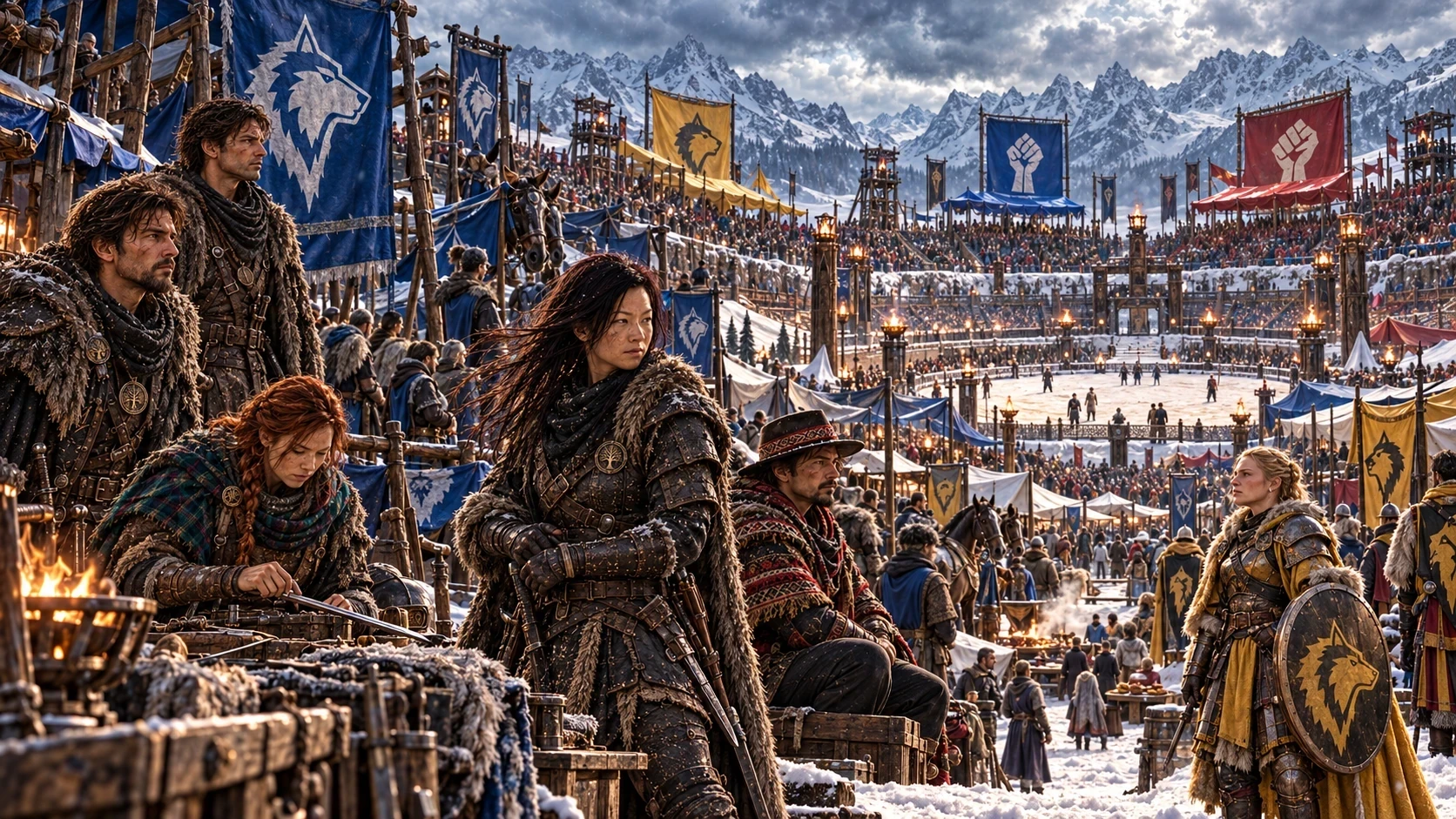
TOURNAMENT — KET
STATUS: FINAL CANON
Chronicle position: 45
The morning of the tournament did not begin with cheering.
It began with leather straps, cold metal, and Ket loosening the same bracer for the third time.
“Too tight,” Nikki said.
Ket pulled the strap tight again.
“Just right.”
“Your hand is turning blue.”
“Then it matches the banner.”
Nikki looked at her.
Ket did not grin.
So Nikki loosened the strap herself.
NFD's tent stood at the edge of the great tournament field on the Frost-Flats. Outside, the wind whipped the canvas, while horns, shouts and the dull beat of hammers carried from afar.
Thousands of people were already moving about.
Merchants raised their stalls.
Cooks pushed iron pots over charcoal braziers.
Guards checked the passages between the camps.
Above it all flew the four great banners.
N3N's yellow wolf.
AIO's blue fist.
GBR's red fist.
And NFD's blue wolf.
Little of that could yet be felt inside the tent.
Ket sat on a wooden crate and inspected her sword.
Argento stood at the table studying the list of events, as though staring long enough might make them less dangerous.
Darth leaned against the center pole, eating something that was presumably meant to be breakfast.
Nikki checked Ket's armor for the second time.
And Moidark stood at the entrance.
He had arrived only moments before.
Snow still lay on his shoulders.
Ket looked at him.
“News?”
Moidark slowly shook his head.
“Nothing I should tell you before a fight.”
Darth kept chewing.
“Then it's bad.”
“Not necessarily.”
Argento put the list down.
“Deathhead?”
For a moment, the tent grew quieter.
Not truly quiet.
Outside, a merchant was roaring that his sausages were the finest between AIO and the north ridge.
But no one inside listened.
Moidark removed his gloves.
“Her operation continues.”
“For months now,” Nikki said.
“Yes.”
Ket studied her sword.
Deathhead had left some time ago.
Not for a hunt.
Not for a brief reconnaissance.
She had disappeared beneath another name.
Mara.
An identity that had to survive long enough to become believable.
Sonnenfeuer Castle.
A place even Moidark discussed only when necessary.
“Contact?” Ket asked.
“Not directly.”
Moidark looked at her.
“Thorsen was there three weeks ago.”
Darth stopped chewing.
“The merchant?”
Moidark nodded.
He had known Thorsen since the years when a wagon, a few goods and the right acquaintances had been enough to open doors closed to others.
Every few months, Thorsen's route passed Sonnenfeuer Castle.
He did not speak to Deathhead.
He carried no message.
At night, he merely looked up at a small window.
At her even smaller room.
“The red candle?” Argento asked.
“It burns,” Moidark said.
No one in the tent moved.
It was not a report.
Not proof that her cover remained secure.
Only the agreed sign that Deathhead was still alive.
“And that is good,” Moidark said.
Darth raised an eyebrow.
“It doesn't sound good.”
“During an infiltration, boredom is usually better than a message.”
Argento nodded.
“If she writes, there is a reason.”
“Exactly.”
Ket sheathed her sword.
“So we know nothing.”
Moidark answered immediately.
“We know the candle has been burning at every one of his visits.”
Ket looked at him for a moment.
Then nodded.
That was typical Moidark.
Never claim more than the evidence supported.
Darth pushed away from the pole.
“She'll come back.”
No one answered.
Not because anyone wished to disagree.
But because no one wished to turn hope into fact.
Ket stood.
“Good.”
She took her helmet.
“Then she'll have something interesting to tell us after I've won this nonsense.”
Nikki folded her arms.
“You could simply come back in one piece.”
Ket put on her helmet.
“That sounds boring.”
Darth grinned.
“Now she's ready.”
Argento opened the tent flap.
The noise struck them like a wall.
*
The tournament had long since become far more than a few fights on frozen ground.
Between the four alliances' camps stood merchant wagons, cookshops, smithies, betting booths and makeshift taverns.
Children carried small cloth banners.
Veterans compared old scars.
Drivers bet on fighters whose names they had never heard the day before.
One stall sold wooden N3N wolf figures.
Two rows farther on, someone sold the same figures painted blue as NFD wolves.
The merchant insisted that this made them entirely different.
Argento bought none.
Darth bought two.
Nikki said nothing.
The Frost-Flats had become a small city of canvas, timber, smoke and voices.
People from N3N stood beside people from GBR.
AIO merchants bargained with NFD drivers.
Guards who might have met with drawn weapons years before now argued over which competitor had cheated at the javelin throw.
It was rivalry.
But it was rivalry governed by rules.
That fact alone said more about the world than many treaties.
Even before Ket reached the field itself, familiar faces appeared everywhere.
Seef sat in the main stand among the official delegations.
Ronne argued with an amber merchant over a price despite insisting she had no intention of buying anything. Holger stood beside her looking as though he had seen the mistake coming.
Bahiti debated sled construction with an AIO craftsman.
Yuki had found a place near the barrier with several young people.
Hera stood a little farther back, almost more interested in the horses than in the fighters.
John had found a place from which he could watch both the tournament and a large tree at the edge of the Frost-Flats.
Makka moved among the N3N contingent and was greeted with considerably more respect than most visitors.
Edda Halden had come with other young people from NFD.
Eirik Frostmark sat on a wooden stand, examined a crossbeam and muttered:
“Too thin.”
No one had asked.
Ket looked across the grounds.
Familiar faces.
Strange faces.
People from four communities who might once have met with drawn weapons.
Today they argued over seats, prices, bets and fighters.
She liked that more than she would ever admit.
But soon Ket noticed little of it.
For her, the tournament began.
*
Mimi represented N3N.
Broad.
Massive.
A man who looked as though winter itself had decided to wear armor.
His yellow surcoat was soiled from earlier bouts.
The wolf on his chest still seemed to howl.
He was the favorite.
Not loved.
But respected.
Kristiano represented AIO.
Narrower.
Faster.
Precise.
He fought like a man who had completed every movement before his opponent understood it had begun.
Angus wore GBR's red.
A mountain of a man.
His war hammer was less a weapon than an argument.
And then there was Ket.
NFD's only fighter.
Not the tallest.
Not the heaviest.
Not the strongest.
But after the first event, almost everyone was already talking about her.
During the mounted melee, she was hurled from the saddle.
Darth leapt to his feet in the crowd.
“That was deliberate!”
Nikki pulled him down again.
Ket rolled across the frozen ground, came to her feet, dodged the next horse and struck the passing rider's rear leg armor with her blade.
The man fell.
The crowd erupted.
Argento stood on the opposite side of the field among merchants and scribes.
He did not take notes.
At least, not immediately.
He only watched.
Moidark had taken a place higher up among the cheap seats.
Not with the officials.
Not with the delegations.
Where drivers, hunters, miners and merchants sat.
One heard more there.
Nikki stood near the fighters' entrance.
She watched more than Ket.
She watched her breathing.
Her stance.
Her left foot.
Darth roamed among the stalls throughout the day and appeared wherever the mood was loudest.
No one knew how many bets he had placed.
Probably not even Darth.
The others were scattered through the stands.
From the main tribune, Seef watched not only Ket but the delegations' reactions.
Ronne and Holger stood near a row of merchants.
Bahiti had joined several people from AIO.
Yuki and Edda pressed close to the front.
Hera remained near the horse pens.
John stood a little apart.
Makka sat on the N3N side.
Eirik Frostmark remained on his suspiciously creaking bench and now watched Ket and the structure beneath him with almost equal attention.
*
In the weapons-master contest, Ket faced a man almost twice her weight.
He grinned.
Ket did not.
The first blow nearly broke her shoulder.
The second missed.
By the third she began to understand how he moved.
On the fourth, she let him come.
She dodged only at the final instant.
His own weight carried him onward.
Ket planted her foot behind his.
A shove.
A curse.
Then he lay in the frozen mud.
The cheering was louder than it had been for any favorite's victory.
Ronne pointed at Ket.
“I bet on her.”
Holger looked at her.
“An hour ago you said betting was for idiots.”
“I've grown.”
Yuki cheered so loudly that two people in front of her turned around.
Edda tried to be louder still.
Eirik merely said:
“Don't jump on the bench.”
Edda jumped anyway.
When Ket returned to the edge, Nikki handed her water.
“You're limping.”
“No.”
“You're limping.”
“Then I'm limping quickly.”
Nikki looked at her.
Ket drank.
“Deathhead would have found that funny,” Nikki said.
Ket answered only after a moment.
“She would have said my stance was wrong.”
Moidark, appearing behind them, said:
“Probably.”
Ket looked at him.
“You've been a great help today.”
“It's what I'm known for.”
Then the semifinals began.
*
Angus faced Kristiano.
Strength against precision.
Kristiano's blade found openings.
Shoulder.
Side.
Thigh.
Small hits.
Clean.
Controlled.
But Angus kept coming.
The hammer struck Kristiano's shield.
Again.
Again.
The AIO fighter slowed.
His breaths grew shorter.
Then Angus struck his shoulder.
Kristiano went down.
GBR roared.
AIO fell silent.
And somewhere in the crowd Darth shouted:
“I bet on the other one!”
Nikki briefly closed her eyes.
*
Then came Ket.
By the time she entered her semifinal, almost everyone was standing.
Seef.
Argento.
Nikki.
Darth.
Moidark.
Ronne and Holger.
Bahiti.
Yuki and Edda.
Hera.
John.
Makka on the far side.
Eirik Frostmark rose last after checking the bench one more time.
Her opponent was a scar-faced GBR veteran whose smile disappeared as soon as the crowd began to call her name.
“KET!”
He attacked.
Hard.
Direct.
Ket gave ground.
His broadsword struck hers so hard that her hands went numb.
Again.
Again.
She yielded ground.
Not much.
Just enough.
Argento was the first to understand.
“She's making him work.”
Beside him, an older N3N soldier nodded.
“If she stays upright long enough.”
Across the field, Nikki saw the limp.
It had worsened.
Darth saw only the opponent.
Moidark watched the spectators.
More and more people were standing.
The man from GBR slowed.
His blows grew wider.
More impatient.
Ket waited.
Then came the mistake.
She slipped past his strike.
Her blade hit his wrist.
The sword fell.
Ket's pommel struck his temple.
The man sank to one knee.
“HALT!”
The referee raised his hand.
Everything else vanished beneath the cheering.
NFD was in the final.
*
Between the semifinal and the last fight, the grounds grew louder still.
Smoke hung above the cooking stalls.
Someone played an out-of-tune fiddle.
People from GBR argued with AIO merchants over Kristiano's defeat.
N3N soldiers stood in groups and spoke quietly about Mimi.
NFD's camp was suddenly crowded.
People who had barely known Ket before wanted to wish her luck.
Nikki threw them all out.
“She needs rest.”
Darth stayed.
“I'm not people.”
“Out.”
Argento was allowed to stay because he brought water.
Moidark was allowed to stay because he was already inside.
Ket sat on the same wooden crate as that morning.
Now her lip was split.
Her left side was turning dark.
No one could overlook the limp any longer.
Nikki knelt in front of her.
“You can stop.”
Ket looked at her.
Nikki held her gaze.
“This is not a war.”
“I know.”
“No one dies if you don't go back out.”
“I know.”
“Then don't pretend you have to.”
Ket was silent.
Outside, the crowd had already begun to call.
Not loudly.
Not yet.
Isolated voices.
Ket.
Ket.
Ket looked toward the entrance.
“I don't have to.”
She picked up her helmet.
“I want to.”
Nikki closed her eyes.
Then she tightened Ket's straps.
Not too tightly this time.
*
Mimi already waited inside the ring.
His visor was lowered.
No showmanship.
No grin.
No threat.
He simply stood there.
Ket faced him.
Moidark again sat among the ordinary spectators.
Argento had found a place near the delegations.
Nikki stood at the entrance to the field, her hands clasped so tightly that her fingers turned white.
Darth had vanished between two groups from NFD and suddenly led an entire block of spectators in their chants.
This time, every familiar face was scattered around the ring.
Seef stood in the main tribune.
Ronne and Holger at the barrier.
Bahiti among the people from AIO.
Yuki and Edda far forward.
Hera and John a little apart.
Makka on the N3N side.
Eirik Frostmark on his bench.
All watched the same fight.
Only through different colors.
“KET!”
The gong sounded.
Mimi did not move.
Ket circled.
One step left.
A feint.
Right.
Mimi's shield followed by only a few inches.
Ket attacked.
Her blade scraped across his greave.
No effect.
Mimi's counterthrust forced her back.
She tried again.
Helmet.
Forearm.
Shoulder.
Small hits.
Metal on metal.
Nothing decisive.
Mimi understood what every other opponent that day had failed to understand.
He did not have to defeat Ket.
He only had to wait.
She had already fought.
She was injured.
She limped.
Every movement cost more than the one before.
Ket grew faster.
Then slower.
Then faster again because she realized she was slowing.
Argento was standing now.
Nikki no longer spoke.
Neither did Darth.
Moidark watched Mimi.
The N3N fighter did not grow impatient.
That was the problem.
Ket feinted left.
Mimi barely reacted.
She attacked right.
His shield was there.
Again.
Again.
The crowd fell silent.
Everyone understood.
Ket would not break through that wall.
And Mimi knew it.
Ket began another attack.
Mimi took half a step.
His shield struck her sword arm.
A dry crack.
Ket cried out.
The sword fell.
She staggered back and pressed her arm against her body.
Nikki had already taken one step onto the field before the referee even reacted.
Argento raised a hand.
Not yet.
Mimi stood before Ket.
His sword was still raised.
The referee prepared to make the call.
But Mimi lowered his blade.
He did not strike again.
No humiliation.
No final blow.
Only a brief look.
Respect.
Then he stepped back.
“The victor and champion of the tournament — Mimi of N3N!”
The yellow banners dipped.
N3N cheered.
Polite applause came from the other camps.
Mimi had won.
Fairly.
Ket remained in the snow.
Then a sound came from the rear stands.
Quietly.
A single call.
“Ket!”
A second.
“Ket!”
Then ten.
A hundred.
Thousands.
“KET! KET! KET!”
Moidark stood among them.
He said nothing.
He did not need to.
Darth roared her name until his voice broke.
Nikki stood at the edge of the ring with sudden tears in her eyes, tears she would never discuss with anyone afterward.
Argento looked across the field.
N3N.
GBR.
AIO.
NFD.
It was not only blue banners that moved.
People from every camp stood.
Ronne shouted her name.
Holger shouted with her.
Yuki jumped up and down.
Edda stood on the bench again.
This time, Eirik gave up.
Bahiti applauded.
Hera smiled.
John raised his fist.
Makka stood in the N3N section, applauding slowly.
Seef rose in the main tribune.
Ket lifted her head.
Slowly, she pushed herself up with one arm.
One knee.
Then both feet.
She swayed.
But she stood.
Mimi, officially the tournament's champion, remained at the center of the ring.
He looked at her.
Then struck his fist once against his chest.
No mockery.
No challenge.
Recognition.
Ket nodded.
The cheering grew louder still.
N3N had won the tournament.
But that day, many people carried something else home.
The story of the small knight beneath the blue wolf who had lost to a wall of steel and risen all the same.
*
Later, they sat inside the NFD tent.
Ket's arm was splinted.
Seef entered later as well.
Ronne and Holger behind him.
Bahiti soon after.
Yuki pushed her head through the canvas flap.
Hera followed.
John remained by the entrance.
Edda squeezed between them.
Even Eirik came by, first explaining that the stands would have to be reinforced next year.
The tent grew too crowded.
Nikki complained.
No one left.
Nikki had forbidden Ket to move her arm.
Ket did not move it.
Most of the time.
Darth placed two small wooden wolves on the table.
One yellow.
One blue.
“I won.”
Moidark looked at him.
“You bet on Mimi.”
“Of course.”
Ket shot him a look.
Darth held up the blue wolf.
“But on you too.”
“That makes no sense.”
“That's why it worked.”
Argento sat at the table writing.
Ket noticed.
“If you write that I won a moral victory, I'll break your arm.”
Argento paused.
“You lost.”
Ket nodded in satisfaction.
“Good.”
“Mimi was better.”
“Even better.”
Argento continued writing.
After a moment, Moidark said:
“Deathhead would have bet on you.”
Darth shook his head.
“Deathhead wouldn't have bet at all.”
Nikki looked at him.
“Deathhead would have watched Mimi beforehand, known Ket would lose and bet on Ket anyway.”
For several seconds, no one spoke.
Then Ket smiled.
Only briefly.
“Then I hope she returns in time to pay her losses.”
Moidark did not answer at once.
He looked toward the tent flap, beyond which the four alliances' banners snapped in the wind.
“She'll come back,” Darth said again.
This time, no one corrected him.
Outside, someone began calling Ket's name again.
A few voices joined in.
Ket groaned.
“Please don't.”
Nikki grinned.
“Too late.”
And above the Frost-Flats, four banners stood in the same wind.
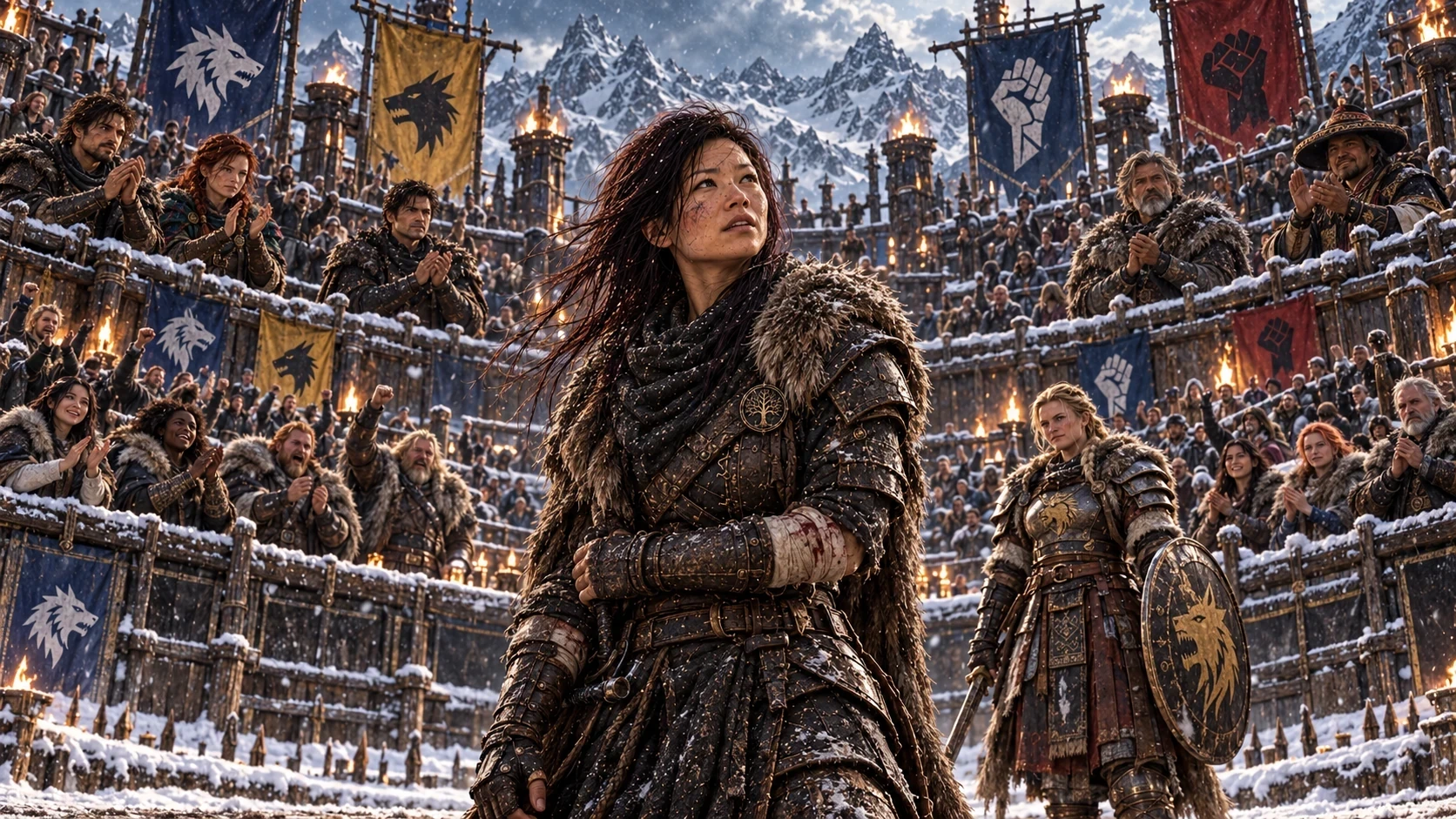
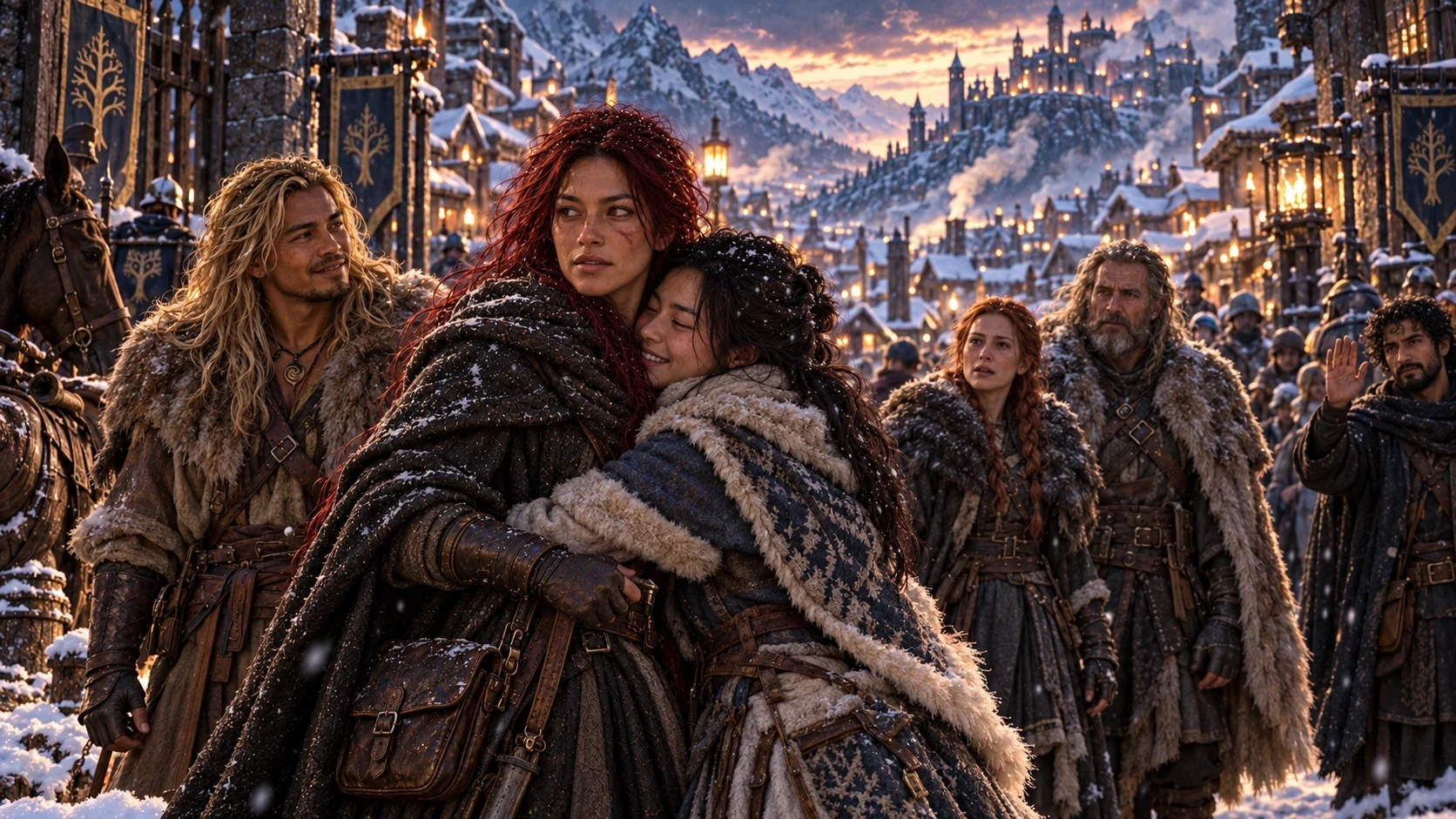
THE TWO LOST WINTERS
A Chronicle from the Argento Universe
STATUS: FINAL CANON
Chronicle position: 46
Kharad had taught Deathhead something she never forgot: an army could fail because of information long before it failed because of swords. She had watched Argento and Moidark build a picture from names, routes, prices and small observations.
When she later went to Sonnenfeuer Castle, she carried that lesson with her.
She did not merely want to get inside.
For two winters, she wanted to understand how the castle thought.
The first man Deathhead killed in Sonnenfeuer Castle was named Oren.
She did not know his name.
She learned it only three days later, when two kitchen maids argued over who would have to take his night shifts.
Oren had had a wife. Two children. Debts to the butcher. He had played cards and sung badly. Every morning he had slipped one of the maids a piece of candied apple.
Deathhead sat on a stool during that conversation, plucking a dead chicken.
She said nothing.
She had strangled Oren with a bowstring.
I. THE CHAMBERMAID
Sonnenfeuer Castle was beautiful from the outside.
That was the first thing Deathhead hated about it.
Its towers rose from the snow like fingers of black stone. Golden fires burned behind tall windows. Even in the deepest winter night, the paths within its walls never froze completely.
Here, warmth was wealth.
In NFD, warmth was survival.
It had taken Deathhead twelve days to reach the castle. Another six to get inside.
Now her name was Mara.
Mara was quiet, could sew, scrub floors, and supposedly could not read. She came from a burned village in the south. Her parents were dead. So was her betrothed.
The best lie, Argento had once told her, was one no one wanted to hear in greater detail.
No one wanted to ask Mara for details.
By day she emptied chamber pots, changed bed linen and learned.
At night she counted steps.
Forty-three from the kitchen to the western stairs.
Sixty-eight from there to the courtyard.
Twenty-two steps to the upper corridor.
Four guards before the royal chapel.
Six before the door beneath the north tower.
And no one spoke of what lay behind it.
So that door mattered most of all.
Deathhead did not yet know that it would take her two years to open it.
II. OREN
The guard caught her on the seventh night.
Deathhead had just hidden behind a statue when his lantern lit the corridor.
“You.”
She stopped.
“What are you doing here?”
“Bed linen, sir.”
Oren looked at her empty hands.
Shit.
“What bed linen?”
Deathhead smiled uncertainly.
He reached for her arm.
Reflex moved faster than thought.
She drove her elbow into his throat, dragged him into the alcove and looped the thin cord from her sleeve around his neck.
Oren was stronger than expected.
His fingernails tore her skin. His boots struck the stone. For one moment, they looked directly into each other's eyes.
Deathhead saw no malice in his.
Only fear.
That made it worse.
She pulled tighter.
Eventually, he stopped moving.
Deathhead sat behind him for a long time.
Then she whispered:
“I'm sorry.”
She hid the body in an old supply shaft.
The next morning, Mara scrubbed the floor before a nobleman's chamber and listened to two guards speak about their missing friend.
On the third day, she learned his name.
Oren.
From that moment on, Deathhead began writing down the names.
Not the names of enemies.
The names of the people she destroyed on the way to her objective.
III. THE FIRST WINTER
Sonnenfeuer Castle devoured people.
Deathhead understood that during the first winter.
Servants disappeared.
Prisoners disappeared.
Sometimes even guards disappeared.
No one asked about them.
Beneath the castle were passages older than the fortress itself. Walls of black stone bore symbols Deathhead did not understand.
She copied every one.
Tiny drawings on scraps of cloth.
Messages to no one.
Argento would have known what they meant.
The thought hurt.
She often thought of NFD.
Of Seef's endless meetings.
Of Ket, probably beating some poor recruit senseless in training again.
Of Argento among his books.
Of snow.
Of the damned bears.
She would never have believed she might one day miss a bear.
But Sonnenfeuer Castle possessed something Winterland did not.
Silence without peace.
Then Deathhead heard the Heart for the first time.
Thump.
She woke in the middle of the night.
Thump.
The sound did not enter through her ears.
It was inside her bones.
Thump.
She rose.
Barefoot, she followed the pulse through the servants' sleeping chamber.
Down a stairway.
Along an abandoned corridor.
To that door beneath the north tower.
Six guards stood before it.
Deathhead remained in the shadows.
Something beat behind the door.
Slowly.
Powerfully.
Alive.
And for a single moment, Deathhead thought she heard a voice.
You are far from home.
She backed away.
The voice was gone.
But now Deathhead knew what she was looking for.
IV. THE HEART OF CTHUGA
It took another four months to learn its name.
A drunken scholar spoke it.
The Heart of Cthuga.
He spoke of it as a relic.
The nobles treated it as a weapon.
The priests as a god.
The guards as a curse.
Deathhead treated it as a task.
She began documenting the changing of the guard.
She stole keys.
Bribed a stable hand.
Slept with an officer who believed Mara loved him and copied his access seals at night.
Afterward, she sat in the washroom and scrubbed his smell from her skin.
Not from shame.
From anger that he believed he owned her.
He told her everything all the same.
The northern chamber opened only at the turning of the moon.
The Heart must never be touched directly.
It had burned men before.
Others had gone mad.
One had screamed for three days, although his tongue had long since turned to ash.
Deathhead listened carefully.
“Why keep such a thing?” she asked.
The officer laughed.
“Because every king needs something even his friends fear.”
Two weeks later, he was found dead in his bed.
Deathhead had not killed him.
That troubled her more than if she had.
V. THE SECOND WINTER
In NFD, they had probably declared Deathhead dead long ago.
She did not know.
There was no news.
No letters.
No familiar voices.
Only every few months, the same old merchant arrived at Sonnenfeuer Castle with his caravan.
Thorsen.
Moidark knew him from his earlier trading years.
Thorsen never spoke to Mara.
He did not even look directly at her.
But on the nights his wagons stood before the walls, he raised his eyes toward a small window above the service rooms.
Toward Deathhead's even smaller room.
A red candle burned there.
The only sign Moidark and Deathhead had agreed upon.
No message.
No report.
Only life.
When Thorsen returned to NFD months later, he always told Moidark the same sentence:
“The candle burns.”
And so far, it had burned every night.
Only Mara.
Mara grew older.
Mara acquired a scar beneath her left eye.
Mara learned to pour wine without listening.
Mara learned that men especially liked to reveal secrets when they believed a woman was insignificant.
And Deathhead learned to kill people without trembling afterward.
That frightened her.
Oren had haunted her for weeks.
The fifth dead man for only three nights.
By the ninth, she no longer even remembered the face.
So she forced herself to keep writing down the names.
Oren. Tal. Meris. Jorek. Vanna.
Some had deserved it.
Others had merely stood in her way.
Deathhead made no distinction on the list.
By the second winter, she finally had a complete plan of the lower castle.
She knew when the guards ate.
When they drank.
Which of them gambled.
Which slept.
Which could be bribed.
And which had to die.
Above all, she now knew what the Heart truly meant.
Not everything.
But enough.
Sonnenfeuer Castle had not created it.
It had found it.
Deep beneath the ice.
Long before the present rulers.
And every attempt to control its power completely had failed.
Still they kept trying.
Of course they did.
People saw an abyss and did not ask how deep it was.
They asked to whom it belonged.
VI. THE DOOR
On the final night of the second winter, Deathhead again stood before the northern chamber.
This time she wore no servant's clothes.
Black leather.
A short bow.
Two knives.
And in a small pouch at her hip lay the names.
Six guards.
Deathhead knew every one of them.
She knew which had a daughter.
Which cheated on his wife.
Which secretly sent money to his mother.
Which beat prisoners for sport.
That was the worst part of two years spent spying.
Enemies did not remain faceless.
They became people.
Deathhead drew her first arrow.
The man fell before the others understood what had happened.
The second arrow struck the lantern.
Darkness.
Shouts.
Steel.
Deathhead moved.
When light entered the corridor again, only one remained alive.
He lay against the wall with both hands pressed to his stomach.
He recognized her.
“Mara?”
Deathhead looked at him.
“No.”
She went to the door.
Behind her, the man asked:
“Who are you?”
Deathhead put the stolen key into the lock.
For the first time in two years, she spoke her true name.
“Deathhead.”
The lock opened.
Heat struck her.
Not the pleasant warmth of a fire.
It was the heat of a burning house. A battlefield. A pyre.
Deathhead stepped inside.
The chamber was enormous.
And at its center, something hovered above a black altar.
Red.
Pulsing.
Impossible.
Thump.
Deathhead stopped.
Thump.
The Heart of Cthuga had no mouth.
Yet she heard its voice.
At last.
Deathhead's hand moved to her knife.
For the first time in months, she had to laugh.
Softly.
Exhausted.
Almost mad.
“Two damned winters,” she whispered.
The fire within the Heart flickered.
You did not come to find me.
Deathhead stepped closer.
Her skin began to burn.
“No.”
Then why?
She thought of Seef.
Of Ket.
Of Argento.
Of Winterland.
Of a kingdom that had probably dug her grave long ago.
And of the six new names she would have to add to her list that night.
Deathhead looked into the fire.
“I came to learn how to steal you.”
The Heart beat once.
THUMP.
And somewhere deep beneath Sonnenfeuer Castle, something began to laugh.
VII. HOMECOMING
Three weeks later, Deathhead saw the walls of NFD again.
She stopped on the final hill.
Two winters.
For that long, she had imagined what this moment would be like.
In her imagination, everything had remained the same.
Of course, nothing had.
New roofs rose between the old houses. Smoke climbed from workshops that had not existed when she left. Guards in cloaks bearing the kingdom's emblem stood upon the walls.
Deathhead pulled back her hood.
The first guard raised a crossbow.
The second stared at her.
Then lowered the weapon.
“Deathhead?”
Deathhead smiled wearily.
“Most of the time.”
The news traveled faster than she did.
Before she reached the inner gate, people came out of the houses.
Yuki stopped in the middle of the street.
For a moment she said nothing at all.
Then she ran forward and embraced Deathhead so suddenly that Deathhead almost reached for a knife.
Almost.
Deathhead slowly raised her arms.
“You've grown.”
Yuki pulled away and stared at her.
“You've grown old.”
Deathhead blinked.
Then laughed.
Bahiti stood a few steps behind her, shaking his head in disbelief.
“I bet on your death.”
“Then you owe someone money.”
“That's the worst part.”
Ronne and Holger came from the crowd. Both looked as though they had seen a ghost.
Holger opened his mouth.
Closed it again.
Ronne hit him on the arm.
“Say something.”
Holger looked at Deathhead.
“You're alive.”
Deathhead nodded.
“Apparently.”
Jota stood behind them.
He said nothing.
He only raised one hand briefly.
Deathhead returned the gesture.
It was enough.
Then the crowd parted.
Moidark came first.
Argento directly behind him.
Deathhead stopped.
For two winters, she had remembered faces so that Mara would not become all that remained of her.
Now two of them stood before her.
Moidark examined her from head to foot.
The scar beneath her left eye.
The worn coat.
The way her right hand still stayed near her knife.
“You look like shit,” he said.
Deathhead smiled.
“So do you.”
Moidark nodded with satisfaction.
“Then everything is normal.”
Argento said nothing.
That surprised her.
Of everyone in NFD, she had expected Argento to be the first to ask a question.
How many guards?
Which entrances?
Which names?
Which roads?
Instead, he simply stepped forward.
Deathhead saw the scars on his face, the books beneath his arm and the same searching gaze she had remembered for two winters.
“You're back,” Argento said at last.
Deathhead did not answer immediately.
Mara would have lied.
Deathhead did not.
“I think so.”
Argento understood.
He only nodded.
Moidark looked between them.
“Before you two start meaningfully staring at each other in silence: did you bring anything?”
Deathhead looked at him.
There he was again.
The merchant.
The gatherer of information.
The man who could read a military movement from a false price in a market.
Deathhead reached beneath her coat.
Moidark's hand moved immediately to his weapon.
Argento noticed.
So did Deathhead.
She drew no weapon.
She drew out a bundle of folded pieces of cloth.
Maps.
Names.
Guard changes.
Supply routes.
Seals.
Symbols from the ancient passages beneath Sonnenfeuer Castle.
Two winters, folded in her hand.
Moidark's expression changed.
The mockery vanished.
Argento did not take the bundle at once.
“What is this?”
“Sonnenfeuer Castle.”
Deathhead placed it in his hands.
“As much of it as I could carry away.”
Argento looked at the records.
Moidark stepped beside him.
Within seconds, their eyes were working.
Argento searched for connections.
Moidark searched for movements, prices, routes and people.
Deathhead watched them.
That was precisely what she had learned at Kharad.
An army could fail because of information long before it failed because of swords.
“There's something else,” she said.
Both looked up.
Deathhead was silent for a moment.
Then she said:
“Something lies beneath Sonnenfeuer Castle.”
Argento became completely still.
Moidark asked:
“A weapon?”
“Perhaps.”
“A fire crystal?” Argento asked.
Deathhead shook her head.
“No.”
She thought of the heat.
Of the black altar.
Of the slow beat that had not entered through her ears.
Thump.
“They call it the Heart of Cthuga.”
Argento and Moidark looked at one another.
Neither knew the name.
Deathhead did not like that at all.
“I saw it,” she said.
At last, Argento asked the question for which she had waited two years.
“What did you see?”
Deathhead looked back toward the gate.
Yuki stood there.
Bahiti.
Ronne and Holger.
Jota.
People from a life she had nearly lost.
Then she turned back to Argento and Moidark.
“That,” she said, “will take all night.”
Moidark sighed.
“Good.”
Deathhead raised an eyebrow.
“Good?”
“After two years, you owe us a story anyway.”
Deathhead looked at Argento.
The chronicler already held her records firmly in both hands.
For the first time since Sonnenfeuer Castle, she did not feel like Mara.
Not entirely.
But enough.
She was home again.
END OF PART ONE
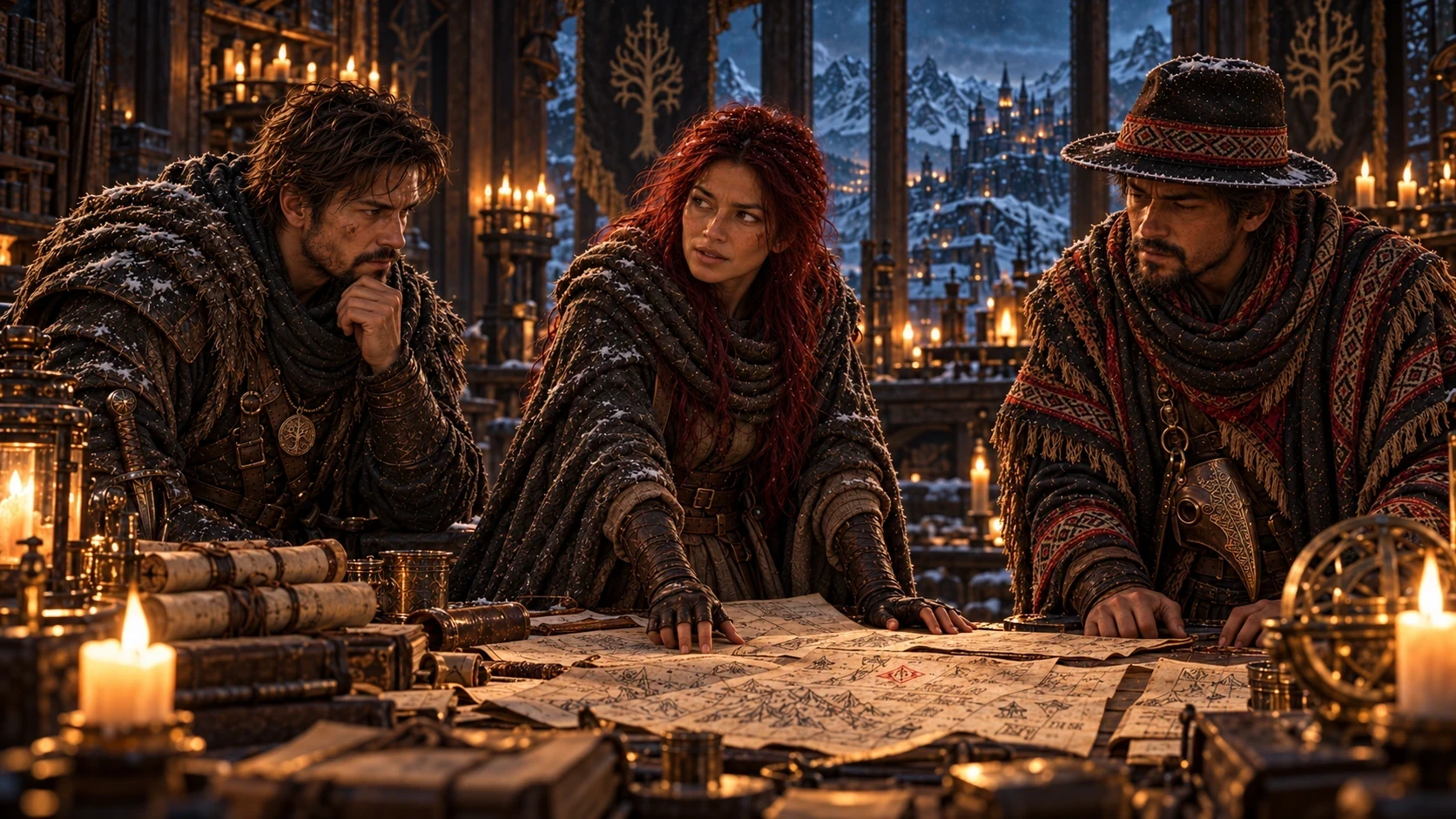
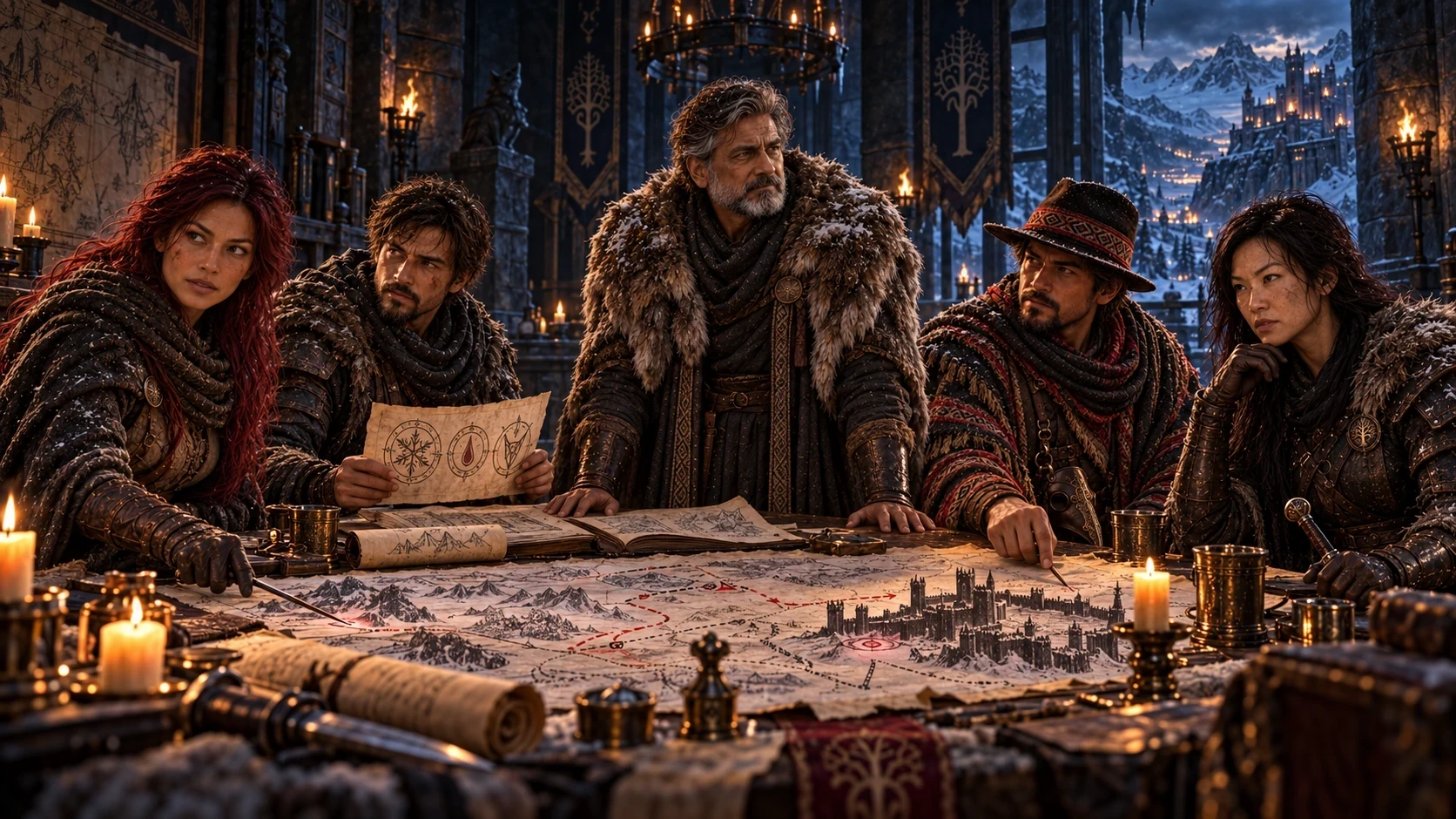
THE THEFT OF CTHUGA'S HEART
A Myth of the Frozen Realms
STATUS: FINAL CANON
Chronicle position: 47
There were many crowns in Winterland.
Most were made of gold.
Some of iron.
And some consisted merely of people's belief that the person wearing them was powerful.
But there was one crown no one could wear.
Sonnenfeuer Castle.
The black fortress rose from the eternal ice like a charred bone. Its walls were basalt, its towers vanished into clouds filled with distant thunder even in deepest winter.
Something beat beneath the castle.
Slowly.
Hot.
Ancient.
The Heart of Cthuga.
A crystal of living fire, older than the realms of N3N, GBR and AIO. Kings had begun wars over it. Dynasties had broken upon it. Some claimed that whoever controlled the Heart controlled Sonnenfeuer Castle.
Others went further.
They claimed that whoever controlled Sonnenfeuer Castle could control Winterland.
NFD had never ranked among the great realms.
They were too small.
Too poor.
Too far north.
And for that very reason, they had been underestimated.
I. THE WOMAN WHO VANISHED FOR TWO WINTERS
For two winters, no one in NFD had known whether Deathhead still lived.
Then she returned through the gate.
Three evenings later, she stood in the council chamber.
Ket was already waiting at the table.
“You still look as though you're dead.”
Deathhead pulled back her hood.
“The rumor was useful.”
She had grown thinner. Paler. Her eyes looked older than before.
Leader Seef rose slowly.
“Where were you?”
Deathhead looked at him.
“Sonnenfeuer Castle.”
Silence.
Moidark stopped stroking the black wolf beside him.
Argento removed his glasses.
Ket said nothing.
Deathhead laid a bundle of parchments on the table.
Guard plans.
Shift changes.
Floor plans.
Names.
Priests.
Officers.
Guards.
Secret passages.
For two years, she had lived as an inconspicuous servant in Sonnenfeuer Castle's lower halls. She had scrubbed floors, carried wine, hauled firewood and learned to become invisible.
People told their greatest secrets in front of servants.
Because servants were not people.
Not to them.
Deathhead had listened.
“The Heart truly is there,” she said.
Argento stepped closer.
“You saw it?”
Deathhead was silent for a moment.
“Yes.”
The room grew still.
“Once. On the final night.”
She pointed to an area deep beneath the drawn foundations.
“And since then, I have known we cannot simply walk out with it.”
“But I saw the priests who go down there.”
Her finger traveled over the map.
“And I saw how few of them return.”
II. THE LIBRARIAN'S KNOWLEDGE
For three days and three nights, Argento did not leave the library.
He compared Deathhead's records with chronicles no one had opened in centuries.
On the fourth morning, Ket found him asleep over a book.
“Argento.”
No response.
She nudged him.
The old librarian started awake.
“I was awake.”
Ket studied the patch of drool on the parchment.
“Of course.”
Argento put on his glasses.
“I know how to reach the Heart.”
Now Ket was awake.
Soon afterward, the council assembled again.
Argento laid three ancient parchments side by side.
“Sonnenfeuer Castle protects the Heart with more than soldiers.”
He pointed to three symbols.
“There are three veils.”
Moidark leaned forward.
“Which?”
“Ice.”
Argento's finger moved on.
“Blood.”
Then to the final sign.
“Sacrifice.”
Seef looked at him for a long time.
“What does sacrifice mean?”
Argento was silent.
“I don't know.”
Deathhead leaned against the wall.
“Then we'll find out.”
Ket snorted.
“That's your plan?”
Deathhead looked at her.
“It's worked so far.”
III. MOIDARK'S WAR
Moidark did not plan an attack.
He planned a lie.
NFD could not conquer Sonnenfeuer Castle.
So the castle would be made to believe that was exactly what they were attempting.
Ket would attack the western gate with a large part of the available force.
Loudly.
Brutally.
Unmistakably.
GBR would move its reserves there.
Meanwhile, Deathhead would enter the lower levels through an old supply tunnel.
Argento would guide her with his translations.
Moidark would coordinate every movement.
Seef listened to the plan.
“And if GBR realizes the attack is only a diversion?”
Ket answered:
“Then we make sure it stops being one.”
Moidark smiled thinly.
That was the answer he wanted to hear.
IV. THE WESTERN GATE
The attack began before sunrise.
Horns roared across the plain.
NFD soldiers charged through the snow.
Ket rode at their head.
Arrows rained from the walls.
People fell.
Others ran across their bodies.
Ket raised her sword.
“FORWARD!”
The first ram reached the gate.
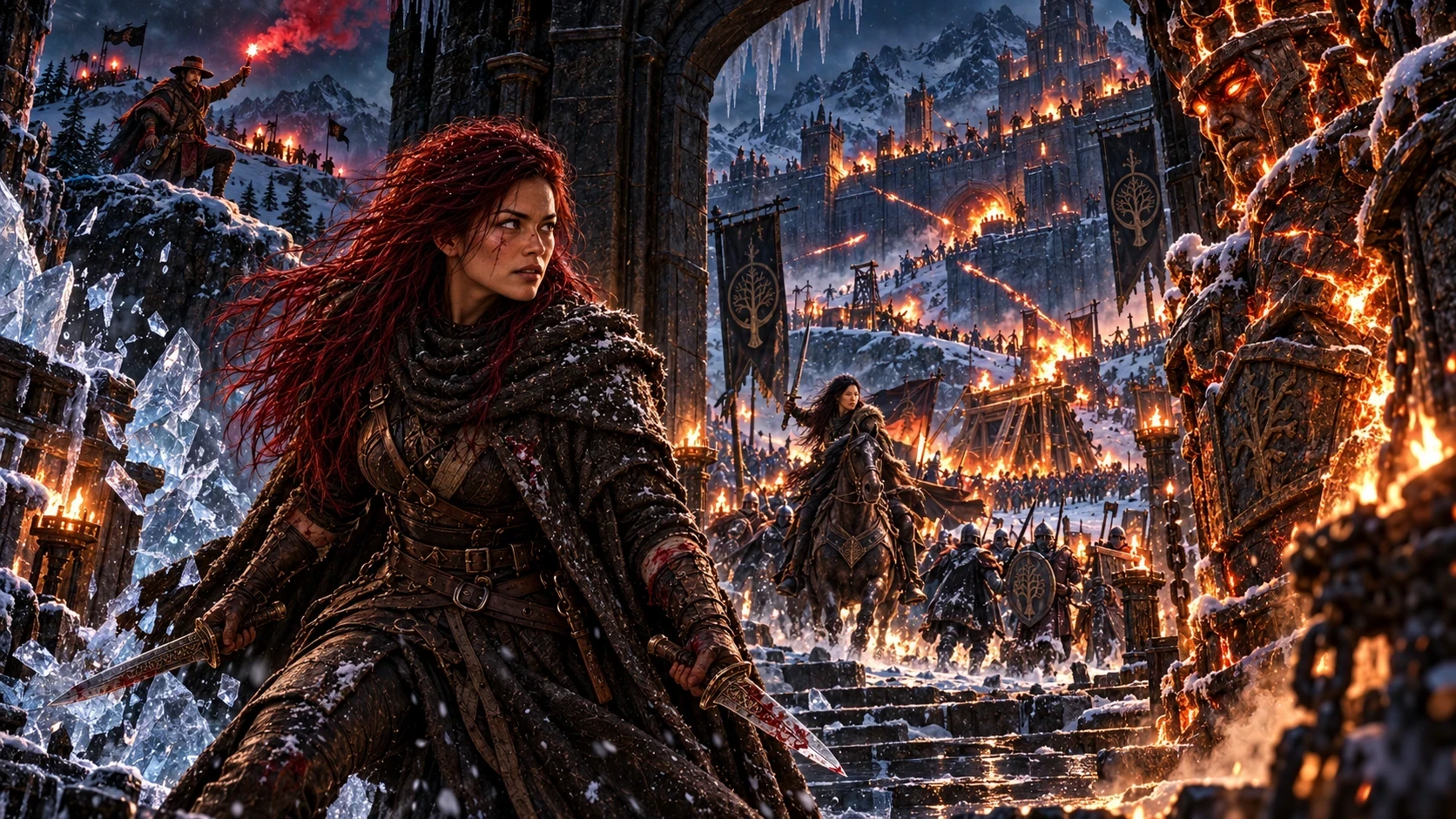
Oil poured from the walls.
Fire followed.
Men screamed.
The ram burned.
Ket ordered a second forward.
Then a third.
Alarm bells sounded from the towers.
That was exactly what Moidark had been waiting for.
GBR units left the castle's lower levels.
One company.
Then two.
Then more.
From a safe distance, Moidark watched the signal fires.
“Now.”
V. BENEATH SONNENFEUER CASTLE
Deathhead crawled through a tunnel no general would have found on a map.
She knew it from her time in the castle.
The kitchen boys called it the swine passage.
It smelled accordingly.
Deathhead pushed through mud, sewage and frozen filth.
When she finally reached the iron grate, she drew two slender tools.
Three seconds.
Click.
She was inside Sonnenfeuer Castle again.
For one moment, she was Mara again.
She knew the smell of lye, cold stone and stale smoke. For two winters she had walked these corridors with lowered eyes and a bucket in her hand while people spoke secrets beside her because they believed she was not listening.
This time, she wore no servant's clothes.
Two daggers hung at her hips.
She descended.
Deeper and deeper.
Until even the sounds of battle faded.
Then she reached the first veil.
Ice.
The corridor before her was perfectly smooth.
Deathhead set one foot inside.
The ice cracked.
Frozen spikes shot from the walls at once.
She leapt back.
Silence.
Then she remembered Argento's words.
The first veil does not test speed.
It tests stillness.
Deathhead breathed out.
Then entered again.
Slowly.
Very slowly.
One step.
Wait.
Another.
Minutes passed.
Sweat ran across her brow although the air burned her skin with cold.
At last, she reached the far side.
The first veil lay behind her.
VI. BLOOD
The chamber beyond was warm.
Too warm.
At its center stood what at first appeared to be a statue.
Then it opened its eyes.
Fire.
The creature rose.
Stone cracked.
Flames ran across its arms.
Deathhead drew her daggers.
Then Moidark's voice sounded from the small hollow bone at her throat.
“Don't fight.”
“Excellent time to mention that.”
A second voice.
Argento.
He spoke the words he had translated from the ancient texts.
Deathhead repeated them.
“I am the shadow that devours the light.”
The creature drew closer.
“The silence between two heartbeats.”
It stopped.
Deathhead felt the heat upon her face.
Then the guardian disintegrated.
Not into ash.
Into glowing sparks.
The second veil had fallen.
VII. THE HEART
Deathhead had seen much.
Battles.
Torture chambers.
People who had killed for less than a meal.
But nothing had prepared her for what waited beneath Sonnenfeuer Castle.
She knew the chamber.
On her final night as Mara, she had stood upon this very threshold and seen the red pulse above the black altar. Then, she had only been able to watch.
This time, she had come to take it.
The Heart of Cthuga hovered above a black altar.
It was not large.
Perhaps the size of two fists.
But the whole chamber pulsed with its light.
Red.
Gold.
Black.
As though a star were dying inside it.
Deathhead stepped closer.
Then she saw the chain.
Silver links encircled the crystal.
The face of a person was engraved into every one.
Argento's voice sounded.
Quieter this time.
“The third veil.”
Deathhead studied the chain.
“Sacrifice.”
No one answered.
Then Seef's voice came.
“Deathhead.”
She paused.
“Leader?”
“The ancient texts do not say someone has to die.”
Argento interrupted him.
“Seef—”
“They only say the Heart will take something.”
Deathhead looked at the crystal.
The fire within it moved.
Almost as though it were watching her.
She drew a dagger.
Cut open her palm.
And placed her bleeding hand upon the chain.
The world exploded.
She saw cities burn.
Armies in the snow.
Sonnenfeuer Castle without banners.
People kneeling before a throne of black stone.
Then she saw NFD.
Larger.
More powerful.
Feared.
And for one moment, Deathhead saw herself.
Alone.
Surrounded by fire.
Then the vision ended.
The chain lay on the floor.
The Heart of Cthuga floated free.
Deathhead reached for it.
VIII. THE PRICE
All of Sonnenfeuer Castle trembled.
Ket watched a crack tear through the western tower.
“That wasn't us,” one of her officers said.
Ket smiled.
“Then she did it.”
The gates opened.
GBR soldiers poured out.
Too many.
Ket raised her sword.
“Retreat!”
NFD disengaged from the western gate.
Not chaotically.
In good order.
Exactly as planned.
Deep below them, Deathhead ran.
The Heart of Cthuga was wrapped in black cloth.
Its heat still burned through her clothes.
Guards followed behind her.
She knew the corridors.
They did not.
Left.
Stairs.
The washroom lay at the next junction.
For a fraction of a second, Deathhead saw Mara sitting there again, her hands raw from scrubbing while two stolen access seals dried beneath her clothes.
She kept running.
Kitchen.
Storeroom.
Swine passage.
One soldier reached her.
Deathhead turned.
One dagger.
One brief scream.
Onward.
Then she saw daylight.
A hand reached into the tunnel.
Ket.
“You look like shit.”
Deathhead seized her hand.
“You smell better.”
Ket pulled her out.
Then she saw the bundle.
For the first time, her grin vanished.
“Is that…”
Deathhead nodded.
“Ride.”
IX. NFD
They rode for two days.
No one spoke of the bundle.
No one had to.
When they reached NFD, Seef, Argento and Moidark were already waiting.
Deathhead placed the black cloth on the council table.
Argento instinctively stepped back.
Moidark did not.
Seef studied it for a long time.
“Open it.”
Deathhead pulled the cloth aside.
Fire filled the room.
No one spoke.
NFD had done the impossible.
They had not conquered Sonnenfeuer Castle.
They had done something worse.
They had torn out its heart.
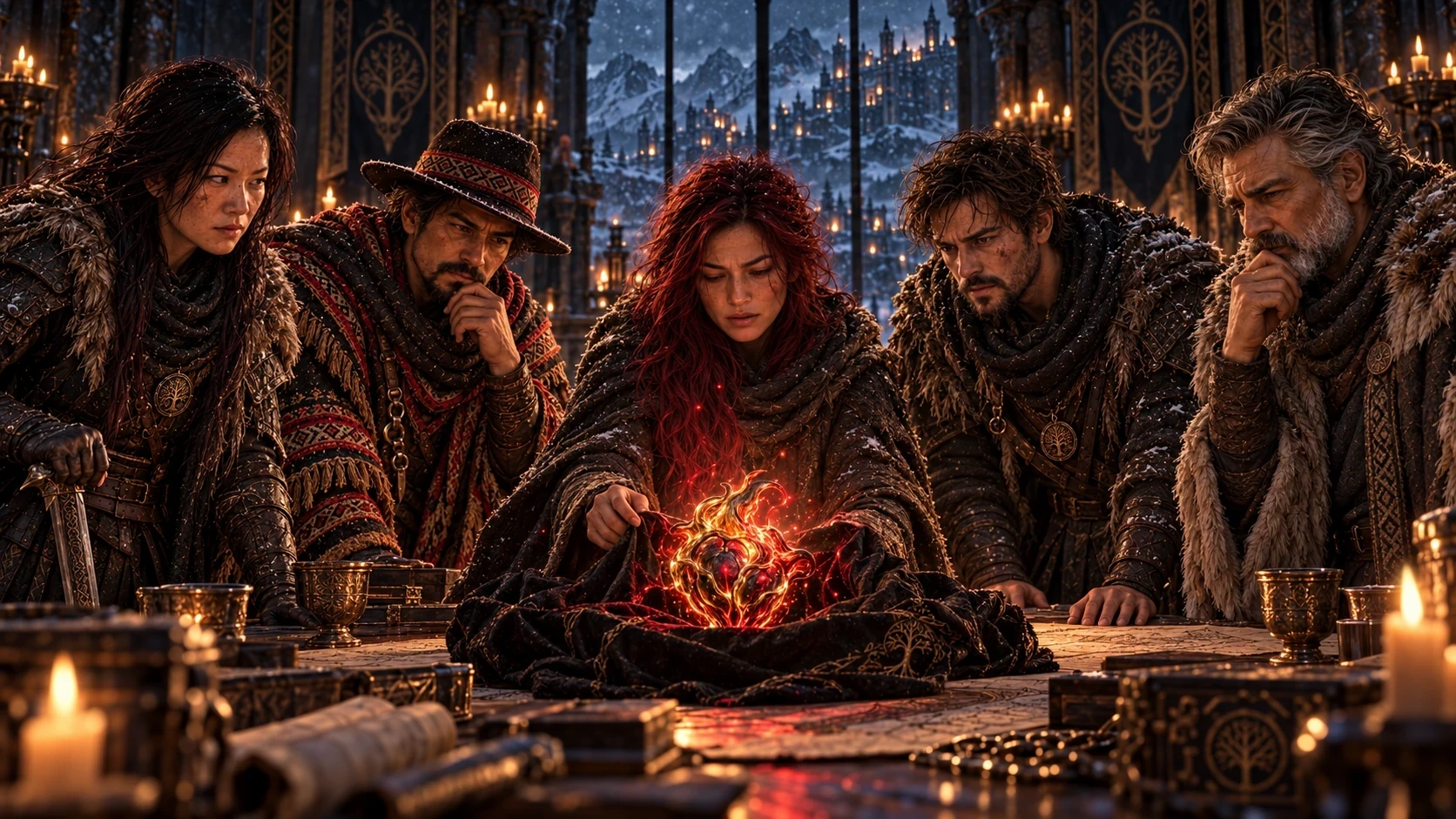
Ket looked at Seef.
“And now?”
Moidark was already studying the map of Winterland.
He knew exactly what would come next.
N3N would learn of it.
AIO would learn of it.
GBR already knew.
Armies would march.
Spies would come.
Friends would suddenly offer friendship.
Enemies would suddenly want peace.
Argento, however, looked only at the crystal.
His face was pale.
“We should not ask what we can do with it.”
Seef turned to him.
“What, then?”
Argento watched the fire inside.
For a moment, he thought he saw something within it.
Something looking back.
“Why it allowed itself to be stolen.”
No one answered.
The Heart of Cthuga pulsed.
Once.
Twice.
Like a heartbeat.
And far away, deep beneath the black foundations of Sonnenfeuer Castle, something answered.
THUMP.
Deathhead slowly raised her head.
The floor beneath her feet trembled.
Only slightly.
Then it was over.
Ket put a hand to her sword.
Moidark looked at Argento.
“What was that?”
The old librarian stared into the fire.
“I don't know.”
And for the first time that evening, he sounded truly troubled.
For NFD had believed the Heart of Cthuga was Sonnenfeuer Castle's treasure.
Perhaps they had been wrong.
Perhaps it had never been a treasure.
Perhaps it was a lock.
And perhaps they had just stolen the key.
DEATHHEAD — THE NIGHT OF FALSE FRIENDS
Deathhead knew something was wrong when the man claimed for the third time that he was her friend.
Friends normally did not need to mention it quite so often.
She sat opposite him with her boots on the table and studied him through the smoke of her cigarette. The room was small, cold and smelled of stale sweat. Somewhere beyond the wall, water dripped at steady intervals.
The man's name was Rask.
At least, that was what he had claimed.
Deathhead did not believe a word of it.
“So,” she said. “You're my friend.”
“Yes.”
“Argento's friend.”
“Of course.”
“And presumably Darth's friend as well.”
Rask hesitated.
Only for a moment.
But Deathhead noticed.
“Naturally.”
She smiled.
“Then you're a remarkably friendly fellow.”
Rask did not return the smile.
A pity.
Deathhead liked men who could still laugh before they died.
Not that she intended to kill him.
Not yet.
“Where is Argento?” Rask asked.
“Why?”
“I have to speak to him.”
“Then find him.”
“I thought you could—”
“I can.”
She took her feet from the table.
“I simply don't want to.”
Rask slowly breathed out.
Now came the part Deathhead had been waiting for.
His right hand moved.
Not far.
Only a few inches.
Toward his coat.
Deathhead placed her cigarette in the ashtray.
“Move that hand another three inches and you'll have one fewer afterward.”
The hand stopped.
“You misunderstand me.”
“That happens all the time.”
Deathhead stood.
“Usually just before someone bleeds.”
His smile had vanished now.
Good.
At last they were being honest with one another.
“Who sent you?”
“No one.”
Deathhead sighed.
“Rask.”
“What?”
“I always give people one opportunity not to lie to me.”
She walked slowly around the table.
“You just had yours.”
Rask drew the weapon.
He was fast.
Deathhead was faster.
She seized his wrist, slammed it against the edge of the table and heard the dry crack of bone.
Rask screamed.
The pistol fell to the floor.
Deathhead trapped it with her foot and kicked it beneath a cabinet.
“See?”
She pushed him back into the chair.
“Now our conversation has already turned unpleasant.”
“You damned—”
Deathhead struck him in the face.
Not especially hard.
Just hard enough.
“No insults. My mother raised me properly.”
Rask spat blood onto the floor.
“You have no idea what's happening here.”
Deathhead paused.
There it was.
The sentence she had been waiting for.
Not You will regret this.
Not I will kill you.
But:
You have no idea.
That usually meant someone believed he knew more than she did.
And people like that were useful.
“Then explain it to me.”
Rask was silent.
Deathhead pulled up a second chair and sat directly in front of him.
“We have time.”
“No.”
His expression changed.
Deathhead noticed at once.
Not fear.
Expectation.
She looked toward the door.
Then the window.
Then back at Rask.
“You're waiting for someone.”
He grinned.
Shit.
Deathhead sprang up.
At that same instant, the window exploded.
Glass flew across the room.
Deathhead threw herself to the floor.
Shots hammered through the wall.
Rask was torn from the chair.
One hit.
Two.
Three.
Then silence.
Deathhead remained where she was.
Five seconds.
Ten.
No further shots.
She crawled to Rask.
His chest was a single bloody wound.
“Rask.”
His eyes moved.
Still alive.
Barely.
Deathhead seized his collar.
“Who?”
His lips moved.
She leaned closer.
“What?”
“Not…”
Blood ran from his mouth.
“Not Argento…”
Deathhead froze.
“What about Argento?”
Rask tried to speak.
A sound came from his throat.
Then nothing.
Deathhead let him go.
“Wonderful.”
She sat on the floor.
Shattered glass everywhere.
Blood.
Gun smoke.
Her cigarette was still glowing in the ashtray.
Deathhead reached for it.
She took a drag.
Thought.
Someone had sent Rask.
Rask had been looking for Argento.
And someone else had shot Rask before he could explain why.
It could mean many things.
None of them good.
Deathhead stood and searched his pockets.
Knife.
Ammunition.
A few coins.
A piece of paper.
She unfolded it.
No message.
Only a drawing.
A circle.
Three roughly drawn figures inside it.
One of them crossed out.
Beneath the second was a name.
Darth.
Beneath the third:
Argento.
Deathhead studied the paper.
Then looked at the dead man.
“You really should have started with the truth.”
She put the note away.
Outside, she heard an engine.
The shooters were leaving.
Deathhead went to the shattered window and looked out.
Too late.
Only tail-lights in the darkness.
She could have followed them.
Perhaps she would have caught one.
Perhaps not.
But that did not matter now.
She had to find Argento.
And Darth.
At once.
Deathhead picked up Rask's pistol.
She checked the magazine.
Full.
“At least you brought something useful.”
Then she left the room.
An hour later, Deathhead stood before a heavy door.
She knocked.
Nothing.
Again.
Nothing.
Deathhead rolled her eyes and kicked it.
“ARGENTO!”
Something moved inside.
Then a voice.
“Who's there?”
Deathhead briefly closed her eyes.
“The damned Father Christmas.”
Silence.
“Deathhead?”
“No. The other Father Christmas.”
The door opened a crack.
Argento peered out. In the room's light, the old burn scars on the left side of his face were clearly visible. His right hand, scarred as well, gripped the door firmly.
Deathhead held the bloodstained piece of paper out to him.
“Get dressed.”
Argento studied the note.
Then her.
“Why?”
Deathhead did not smile.
“Because someone has started putting our names on death lists.”
Argento opened the door fully.
“That sounds bad.”
“Yes.”
Deathhead walked past him.
“And yours is on it.”
Argento looked at the paper again.
“That sounds considerably worse.”
Deathhead sat down.
“Wait until you hear who else is on it.”
Outside, somewhere in the night, the sound of an engine faded away.
Neither of them noticed.
And across the street, someone slowly lowered a pair of field glasses.
The hunt had begun.